
A process team needs to recover solvent from a product stream, reduce wastewater volume, and meet a purity specification that leaves little room for error. Distillation is familiar and robust, but the steam demand looks painful. A membrane system appears compact and lower-temperature, but concentration polarization, fouling, and limited selectivity raise new questions.
This is not an academic choice made from a single property table. Separation technology affects utility systems, plot space, maintenance routines, product quality, emissions, operator workload, and the ability to expand later.
Distillation and membrane separations are often presented as rivals. In practice, they solve different parts of the separation landscape exceptionally well, and many of the best flowsheets deliberately use both.
The right question is not simply “Which technology is better?” It is: which separation mechanism, operating window, and process arrangement best delivers the required product at acceptable lifecycle cost and risk? ⚙️
🧭 1. Start with the Separation Objective
Every selection begins by defining what must be separated, what must be recovered, and what each outlet stream must become. “Remove water” is not enough; the required residual water level, water destination, and product losses all matter.
Write the objective in measurable process terms: feed composition and flow range, required product purity, recovery, contaminants, throughput, and allowed variability. This prevents selecting equipment before defining the duty.
- Purification: create a high-purity product.
- Recovery: reclaim a valuable solvent or solute.
- Concentration: reduce liquid volume or increase solids content.
- Fractionation: split a multicomponent mixture into useful cuts.
🧪 2. Know the Fundamental Difference
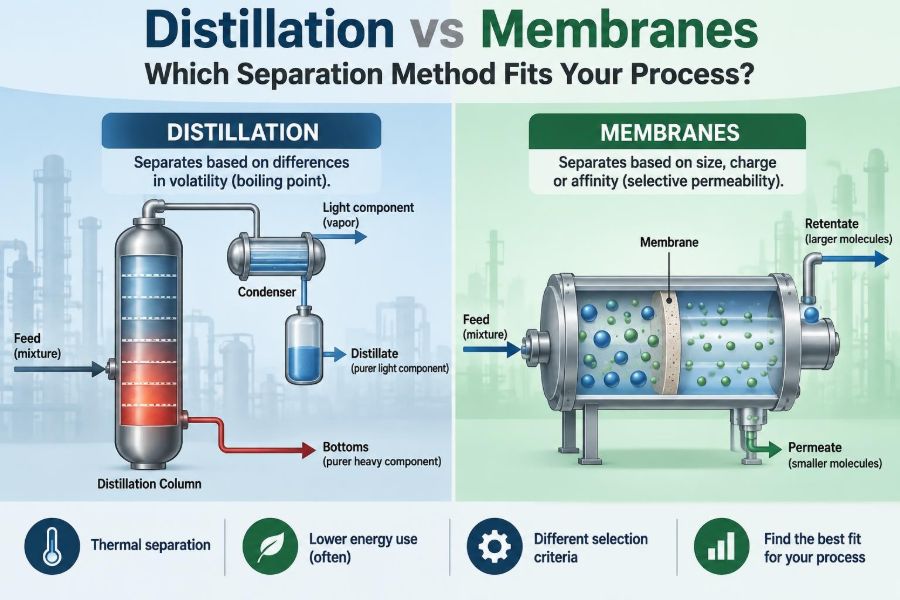
Distillation separates components because they distribute differently between vapor and liquid phases. Heat creates vapor, repeated vapor–liquid contacting enriches the more volatile components, and condensation returns liquid reflux to sharpen the split.
Membrane separation uses a selective barrier. A driving force, often pressure but sometimes concentration, electrical potential, or partial-pressure difference, moves certain species through the membrane faster than others.
One method relies mainly on phase equilibrium and heat; the other relies on selective transport through a material. That difference shapes nearly every design trade-off.
🔥 3. What Distillation Does Best
Distillation is particularly strong when components have sufficiently different volatilities and when large, continuous production rates justify columns, condensers, reboilers, and utility integration.
It can produce sharp separations and, with enough stages and appropriate reflux, high purities. Industrial experience is extensive for hydrocarbon fractionation, solvent recovery, alcohol purification, and many other liquid mixtures.
Its major strength is flexibility in handling complex multicomponent feeds. A properly designed column can create several product cuts rather than merely a retentate and permeate.
🧫 4. What Membranes Do Best
Membranes are attractive when separation can occur without boiling the bulk feed. This can protect heat-sensitive materials, reduce thermal exposure, and simplify treatment of dilute streams.
They are often valuable for clarification, desalting, dewatering, gas upgrading, solvent nanofiltration, and selective recovery where the membrane has adequate chemical resistance and selectivity.
A membrane skid is modular by nature. Capacity can often be expanded by adding modules, although pumps, pretreatment, headers, and downstream equipment must also be checked.
📊 5. Compare the Technologies at a Glance
| Decision factor | Distillation | Membranes |
|---|---|---|
| Primary driving force | Temperature and vapor–liquid equilibrium | Pressure, concentration, electrical potential, or partial pressure |
| Best-established duties | Volatile liquid fractionation and solvent purification | Selective filtration, desalting, dewatering, and some gas separations |
| Energy form | Usually substantial thermal energy plus pumping | Usually electrical pumping or compression; may need downstream energy |
| Key limitation | Close-boiling systems, azeotropes, thermal sensitivity | Fouling, limited selectivity, chemical compatibility, concentration limits |
| Typical product streams | Distillate, bottoms, and possible side draws | Permeate and retentate |
| Scale-up style | Larger vessels and internals | Additional modules and supporting equipment |
This table is only a screening aid. Real selection depends on the actual feed, specifications, utilities, and the whole flowsheet.
🌡️ 6. Volatility Determines Distillation Feasibility
For a binary mixture, relative volatility expresses how differently two components partition between vapor and liquid. A larger relative volatility generally means fewer theoretical stages and less reflux are needed for a given split.
When relative volatility approaches one, conventional distillation becomes difficult and energy intensive. Large columns can still be built, but practical limits and economics become decisive.
Relative volatility can also change strongly with composition, pressure, and temperature. Reliable vapor–liquid equilibrium data are therefore central to design.
🧱 7. Selectivity Determines Membrane Feasibility
Membrane performance is often described by permeability or flux and selectivity. High flux means more material passes per unit membrane area; high selectivity means the membrane better distinguishes the desired species.
A useful membrane must balance both. Very selective transport with extremely low flux can require excessive area, while high flux with weak selectivity may fail to meet the product specification.
Performance measured on a clean laboratory solution is not necessarily performance on a real process feed. Mixture effects, temperature, aging, and foulants can change it substantially.
💧 8. Recognize the Main Membrane Families
The word “membrane” covers several distinct technologies. Selecting the wrong family can make an otherwise sensible project fail.
Common liquid-phase examples
- Microfiltration: removes suspended solids and many microorganisms.
- Ultrafiltration: retains macromolecules, colloids, and some fine particles.
- Nanofiltration: separates based on size and charge effects, often with partial salt rejection.
- Reverse osmosis: rejects many dissolved salts and small solutes while water permeates.
- Pervaporation: uses a dense membrane and downstream vapor removal, often for difficult liquid separations.
Gas separation membranes and electrodialysis add further options, each with a different transport mechanism and design logic.
🧯 9. Identify Heat-Sensitive Materials Early
Distillation exposes at least part of the inventory to elevated temperatures, even when vacuum reduces boiling points. Some products degrade, polymerize, discolor, lose activity, or form deposits during this exposure.
Membranes can offer a gentler route because many systems operate near ambient or moderately elevated temperatures. However, chemical cleaning, pressure, shear, and long residence in recirculation loops can still damage sensitive materials.
If product stability is a concern, test actual feed under realistic operating and cleaning conditions rather than assuming “low temperature” automatically means “low risk.”
🌀 10. Understand Azeotropes and Close Boilers
An azeotrope is a composition at which vapor and liquid have the same composition at a given pressure. Ordinary distillation cannot cross that limit through repeated equilibrium stages alone.
Close-boiling mixtures may not form azeotropes but can still demand high reflux ratios and many stages. Their separation may be technically feasible while economically unattractive.
Possible alternatives include pressure-swing operation, extractive or azeotropic distillation, adsorption, liquid–liquid extraction, and membrane processes such as pervaporation. The best choice depends on the complete recovery and purity target.
⚡ 11. Compare Energy in the Full Process
Distillation commonly consumes thermal energy in the reboiler and rejects heat in the condenser. Where steam is available and heat integration is strong, this burden may be manageable; where fuel or steam is constrained, it can dominate operating cost and emissions.
Membranes often replace boiling duty with pumping or compression. That does not make them energy-free: pressure losses, recirculation, feed conditioning, cleaning, vacuum generation, and downstream concentration can all matter.
Compare total energy for the required final products, not only the energy inside one piece of equipment. A membrane that creates a dilute permeate may shift the thermal duty to a later step.
🔄 12. Think in Terms of Driving-Force Decay
In a distillation column, composition and temperature profiles create local driving forces from tray to tray or through packing. Reflux and boilup help maintain the internal separation.
In a membrane module, the useful driving force often declines along the flow path as the feed becomes depleted or concentrated. Increasing recovery can therefore lower flux and worsen the separation.
Staging, recycle, interstage compression, or multiple membrane passes may restore performance. These additions should be included during early process comparison.
🧼 13. Treat Fouling as a Design Variable
Membrane fouling occurs when particles, organic matter, scale, biofilms, or precipitated species accumulate on or within the membrane. The result may be lower flux, altered selectivity, higher pressure drop, and more frequent cleaning.
Fouling is not a minor maintenance footnote. It influences pretreatment, operating recovery, membrane area, cleaning chemicals, wastewater generation, availability, and replacement planning.
- Characterize suspended solids and colloids.
- Check scaling ions and concentration factors.
- Assess oils, surfactants, polymers, and biological growth potential.
- Validate cleaning effectiveness without damaging membrane materials.
🛠️ 14. Do Not Ignore Distillation Fouling Either
Distillation equipment also fouls. Reboiler scaling reduces heat transfer, polymeric deposits can obstruct internals, corrosion products can contaminate streams, and foaming can cause entrainment and off-spec overhead product.
Feeds containing solids, salts, high-boiling residues, or unstable compounds may need pretreatment, a special reboiler configuration, reduced residence time, or a different technology altogether.
The fair comparison is not “fouling membrane versus clean distillation.” It is a comparison of realistic maintenance burdens for both options.
🏗️ 15. Consider Footprint and Physical Layout
Membrane skids can be compact, especially at moderate capacities. Their modular geometry is useful in constrained sites, packaged systems, and retrofit projects.
Distillation columns require vertical clearance, structural support, maintenance access, overhead systems, and often significant utility piping. Yet a large column can process enormous flowrates efficiently, so footprint alone should not decide the issue.
Also consider where ancillary equipment goes: feed tanks, filters, clean-in-place systems, compressors, cooling equipment, vacuum systems, and waste handling can occupy more space than expected.
📈 16. Match the Technology to Throughput
At large continuous throughput, distillation often benefits from mature large-scale equipment and integrated utility networks. A single column may manage a duty that would require many membrane elements and large pumping systems.
At smaller scale, variable production, or staged expansion, membrane modularity can lower the barrier to deployment. The economics of each option change with scale, so extrapolation from a pilot plant needs care.
Capacity turndown matters too. Evaluate stable operation during low-rate production, startup, shutdown, and feed interruptions—not only at nameplate conditions.
🎯 17. Define Product Quality Beyond One Number
A specification may include purity, moisture, color, odor, dissolved gas, particle count, microbial limits, acidity, trace contaminants, or allowable solvent residue. A technology that meets one headline purity number may still miss another critical attribute.
Distillation can leave nonvolatile contaminants behind, but entrainment or volatile impurities can challenge overhead quality. Membranes may remove one solute class effectively while allowing small neutral molecules through.
Build a component-by-component fate map. It should show where each important species goes under normal operation and during expected feed variation.
🧩 18. Examine Feed Pretreatment Requirements
Membrane systems commonly require pretreatment to protect modules and control fouling. This may include screening, cartridge filtration, coagulation, activated carbon, pH adjustment, antiscalant dosing, or removal of oxidants that attack the membrane.
Distillation feeds may need filtration, degassing, neutralization, water removal, or removal of reactive contaminants. Pretreatment can be simpler or more demanding depending on the feed.
Never price or compare a separator in isolation. Include all equipment needed to deliver a feed that the separator can reliably accept.
🧪 19. Check Materials Compatibility
Membrane polymers, adhesives, seals, and housings may swell, embrittle, dissolve, or lose selectivity in certain solvents and at certain temperatures. Oxidants and extreme pH can also be critical limitations.
Distillation requires compatibility of shell materials, trays or packing, gaskets, heat exchanger surfaces, and instrumentation with liquid and vapor phases. Corrosion can accelerate where acids, chlorides, water, and high temperatures combine.
Ask suppliers for compatibility guidance, but validate the actual mixture. Trace compounds and cleaning formulations can be as important as the main feed components.
🧑🏭 20. Compare Operability, Not Just Design Performance
Columns demand control of pressure, reflux, boilup, levels, differential pressure, and heat balance. Their response can be slow because of liquid holdup and thermal inertia, but operators often know the behavior well.
Membranes require attention to transmembrane pressure, crossflow velocity, permeate quality, feed conductivity or composition, pressure drop, and cleaning triggers. They can respond quickly, but performance drift may be gradual and difficult to diagnose.
A good design gives operators clear operating limits, meaningful alarms, sample points, bypass arrangements, and safe recovery procedures.
🧮 21. Use the Right Design Models
Distillation design depends on credible phase-equilibrium and enthalpy models. Binary data alone may not capture multicomponent behavior, nonideality, dissolved gases, or the impact of trace species.
Membrane design needs transport correlations or validated supplier data, realistic concentration polarization assumptions, pressure losses, temperature effects, and a model for flux decline over time.
Models guide decisions, but they are not substitutes for representative testing. The more difficult the separation, the more valuable a pilot or targeted laboratory study becomes.
🔬 22. Pilot the Real Feed When Risk Is High
A pilot should answer specific scale-up questions rather than merely demonstrate that some separation occurs. Test feed variability, product quality, recovery, fouling rate, cleaning recovery, solvent compatibility, and response to upset conditions.
For distillation, pilot work may clarify equilibrium behavior, foaming, thermal stability, residence-time effects, and impurity distribution. For membranes, it often reveals the gap between clean-water performance and real-feed operation.
Record mass balances carefully. A trial that cannot account for material losses, retained inventory, and sampling uncertainty provides weak design evidence.
🔗 23. Explore Hybrid Flowsheets
Distillation and membranes frequently work better together than separately. A membrane can remove water or a troublesome impurity before a column, reducing reboiler duty or avoiding an azeotropic limitation.
Conversely, distillation can preconcentrate a stream before membrane polishing, or recover solvent from a membrane retentate. Hybrid designs can divide a hard separation into steps that each technology handles well.
Useful hybrid patterns
- Distillation followed by pervaporation for deep dehydration.
- Membrane concentration followed by evaporation or distillation.
- Membrane pretreatment upstream of solvent recovery.
- Gas membrane bulk separation followed by cryogenic or adsorption polishing.
🌍 24. Assess Environmental Impacts Carefully
Lower thermal demand can reduce fuel use where distillation heat comes from combustion, but the result depends on the site energy system. Electrically driven membranes also have an upstream energy footprint.
Consider cooling-water demand, cleaning chemicals, spent membranes, wastewater, solvent emissions, vent treatment, and the destination of concentrate or bottoms. A separation that reduces one impact may increase another.
Material recovery can be environmentally valuable when it prevents disposal and reduces fresh solvent demand. That benefit must be balanced against the energy and consumables required to achieve it.
💰 25. Evaluate Lifecycle Economics
Capital cost includes more than the column shell or membrane modules. Add pumps, heat exchangers, compressors, controls, utility connections, buildings or steelwork, pretreatment, cleaning systems, storage, installation, and contingency appropriate to project maturity.
Operating cost includes energy, labor, maintenance, cleaning chemicals, membrane replacement, corrosion management, waste disposal, and lost production during outages. Product losses and off-spec material can be especially significant.
Use consistent assumptions for uptime, utility prices, feed composition, and future capacity. A low initial purchase cost is not automatically the lowest-cost process over its operating life.
🛡️ 26. Address Safety and Process Hazards
Distillation may involve hot surfaces, pressurized vapor, vacuum collapse risk, flammable overheads, reboiler leaks, and large inventories of hazardous liquid. Relief design and containment must reflect credible upset scenarios.
Membrane systems can involve high pressure, compressed gases, chemical cleaning, leaks through seals, and accumulation of hazardous species in retentate or permeate. A compact skid still needs robust isolation and pressure protection.
Perform hazard identification early, especially when feeds are flammable, toxic, reactive, or prone to decomposition. Safety requirements can materially change the preferred process configuration.
✅ 27. Build a Practical Selection Workflow
A disciplined workflow avoids premature commitment to a familiar technology.
- Define feed ranges, products, recoveries, contaminants, and quality limits.
- Screen physical properties: volatility, equilibrium behavior, molecular size, charge, and stability.
- Identify constraints on heat, electricity, space, materials, and discharge.
- Create feasible stand-alone and hybrid flowsheets.
- Estimate complete mass and energy balances for each option.
- Test high-risk assumptions with representative feed.
- Compare lifecycle cost, operability, safety, and environmental impacts.
- Select a design with adequate margin for variation and degradation.
⚖️ 28. The Core Principle: Fit the Mechanism to the Process
Distillation is usually the natural choice when vapor–liquid equilibrium provides a practical separation, thermal exposure is acceptable, and the process benefits from robust large-scale fractionation. Membranes are often the better fit when selective transport can achieve the duty at moderate conditions, especially for sensitive feeds, dilute streams, or targeted polishing.
Neither technology wins by default. The strongest decision comes from understanding the feed, defining the true product requirement, accounting for pretreatment and downstream consequences, and evaluating hybrid options before locking in the flowsheet.
Choose distillation or membranes by matching the separation mechanism to the complete process—not by comparing equipment in isolation. ⚖️🔬🌱