
A glass of drinking water, a tank of gasoline, a dose of medicine, and a carton of milk all have something in common: each depends on separating one substance from another. The raw materials rarely arrive in the neat, pure form that people use.
At a refinery, crude oil must become carefully defined fuel fractions. In a water plant, contaminants and salts must be removed without wasting excessive energy. In pharmaceutical production, the desired compound may be present alongside solvents, by-products, and trace impurities.
These jobs are often less about creating new molecules than about deciding which existing molecules should go where. That is why separation processes occupy such a large part of industrial chemical engineering.
Industrial separation has moved far beyond simply boiling a liquid and collecting its vapor. Distillation remains indispensable, but membranes, adsorption beds, extraction systems, crystallizers, and hybrid processes now give engineers more ways to match a separation method to a particular mixture.
⚗️ Separation Is the Hidden Work of Process Industries
A separation process divides a mixture into streams with different compositions. One stream may be the valuable product, another may be recycled solvent, and another may require treatment before disposal.
Reaction engineering gets much attention because it changes chemicals into new chemicals. Yet many commercial processes spend substantial equipment, energy, and operating effort on purification. A reaction that produces the correct molecule is not enough if the molecule cannot be recovered at the required purity.
The central engineering question is simple: what physical difference can be exploited to distinguish the components? That difference may be volatility, molecular size, solubility, electrical charge, affinity for a surface, or freezing behavior.
🧩 Mixtures Determine the Separation Challenge
Before selecting equipment, engineers identify the mixture type. A dissolved salt in water behaves very differently from suspended clay in water, and a blend of two fully miscible liquids behaves differently again.
- Heterogeneous mixtures contain distinct phases, such as oil droplets in water or solids in a liquid.
- Homogeneous mixtures appear as one phase, such as ethanol dissolved in water.
- Multiphase systems may contain gas, liquid, and solids simultaneously, as in slurry reactors or natural-gas processing.
Phase behavior and component properties set the limits of what is possible. They also indicate whether a simple mechanical separator may work or whether molecular-level separation is needed.
🕰️ Early Industry Relied on Direct Physical Differences
Many of the earliest industrial operations used obvious differences in particle size, density, or boiling behavior. Settling tanks allowed heavy particles to fall; screens retained coarse solids; evaporators concentrated solutions by removing water.
These methods were practical because they used readily observable phenomena and relatively simple equipment. They remain essential today. A modern plant may use a screen or gravity settler upstream of sophisticated equipment because removing bulk contaminants early protects downstream units.
The historical progression is not a story of old methods becoming useless. It is a story of engineers adding more selective tools as product specifications, energy constraints, and feed complexity increased.
🌡️ Distillation Became Industry’s Defining Separation Tool
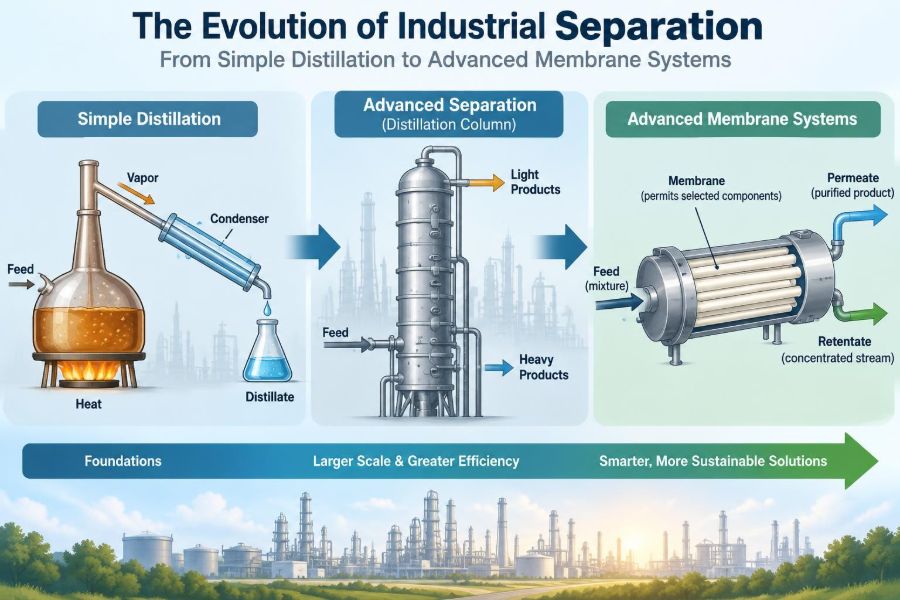
Distillation separates components according to volatility: their tendency to enter the vapor phase. When a liquid mixture is heated, the vapor is generally richer in the more volatile component than the liquid left behind.
Repeated vaporization and condensation sharpen that difference. A distillation column creates many opportunities for vapor and liquid to contact each other, so the rising vapor becomes richer in light components while descending liquid becomes richer in heavy components.
This straightforward principle made distillation a foundation of petroleum refining, bulk chemicals, solvent recovery, and air separation. It is versatile, familiar to operators, and capable of producing high-purity streams when the mixture permits it.
🏭 Anatomy of a Distillation Column
A typical continuous column has a feed point, an upper rectifying section, and a lower stripping section. Vapor rising from the bottom meets liquid flowing downward from the top, transferring mass and heat at each contact stage.
At the top, a condenser cools overhead vapor. Part of the condensed liquid is returned as reflux, which improves separation by washing less-volatile material downward. The remaining liquid leaves as distillate.
At the bottom, a reboiler supplies vapor and produces a liquid bottoms product. Trayed columns use discrete contacting devices; packed columns use structured or random packing to create a large contact area with a pressure drop suited to the service.
📈 Why Reflux Improves Purity—and Raises Cost
Higher reflux usually improves top-product purity because more liquid circulates inside the column. That extra liquid gives vapor more contact opportunities and strengthens the internal composition gradient.
However, reflux is not free. More reflux commonly means greater condenser duty, reboiler duty, and internal liquid and vapor traffic. At high rates, flooding can occur: liquid holdup rises, vapor flow is restricted, and column performance deteriorates.
Column design therefore involves compromise. Engineers balance product specifications, number of stages, column diameter, heat-exchanger size, utility cost, and controllability rather than pursuing maximum purity without limit.
🔍 Relative Volatility Explains Distillation Difficulty
The usefulness of distillation depends largely on relative volatility, a measure of how differently two components distribute between vapor and liquid at equilibrium. When the difference is large, separation is comparatively easy.
When components have similar volatilities, many stages and substantial energy may be required. A close-boiling mixture can make a conventionally designed column tall, expensive, and sensitive to operating disturbances.
Engineers use vapor–liquid equilibrium data rather than boiling points alone. Boiling point is helpful intuition, but mixture interactions can substantially change the composition of both liquid and vapor phases.
🔁 Azeotropes Set a Thermodynamic Boundary
An azeotrope is a mixture whose vapor has the same composition as its liquid at a particular pressure and composition. At that condition, ordinary distillation no longer enriches one component relative to the other.
The ethanol–water system is a familiar teaching example: conventional atmospheric distillation can concentrate ethanol only up to its azeotropic limit. Reaching drier ethanol requires another strategy.
Possible approaches include pressure-swing distillation, adding an entrainer in azeotropic or extractive distillation, adsorption, and membrane dehydration. The appropriate choice depends on capacity, solvent handling, utility availability, and the required product dryness.
🔥 Distillation’s Energy Burden Drives Innovation
Heating a reboiler and cooling a condenser can require large utility loads, especially for high-throughput columns or difficult splits. The issue is not that distillation is inefficient in every case; it is that phase change carries a significant energy requirement.
Low relative volatility, high reflux, and feeds containing large amounts of water can increase that burden. Separations that require very deep cooling or vacuum operation bring additional compression, refrigeration, and equipment considerations.
This energy demand has encouraged alternatives and improvements: better heat integration, mechanical vapor recompression, dividing-wall columns, heat pumps, and non-thermal methods such as membranes or adsorption.
🧱 Absorption Separates Gas by Dissolving It
Gas absorption transfers a soluble gas component into a liquid solvent. In a packed absorber, gas commonly rises while solvent flows downward over packing, creating interfacial area for mass transfer.
For example, acid gases may be removed from gas streams using reactive or physical solvents, depending on the conditions and target species. The cleaned gas exits one end, while the solvent carrying absorbed material leaves the other.
If the solvent can be regenerated, a stripper or regenerator releases the absorbed component and returns solvent to service. Absorption is especially useful when the target is dilute in a gas stream or when chemical reaction increases solvent selectivity.
🌬️ Stripping Moves Volatile Components Out
Stripping is conceptually the reverse of absorption. A gas, steam, or vapor stream contacts a liquid and removes a volatile dissolved component from it.
Steam stripping can recover volatile organics from aqueous streams, although the resulting vapor mixture must then be condensed, treated, or processed further. Air stripping may be appropriate in some services but can transfer contaminants to another phase, creating an off-gas treatment obligation.
A useful design habit is to follow every component after it leaves a unit. A separator does not eliminate material; it redistributes it. The destination of the concentrated stream matters as much as the quality of the cleaned stream.
🧪 Liquid–Liquid Extraction Uses Selective Solubility
In liquid–liquid extraction, a feed liquid contacts a second, largely immiscible liquid called a solvent. A desired solute preferentially dissolves in the solvent, creating an extract phase and a raffinate phase.
Think of washing a colored compound from one liquid into another that has a stronger attraction for it. The method is useful when distillation would require excessive heat, when components are heat-sensitive, or when boiling points are inconveniently close.
Solvent selection is crucial. It should have good selectivity and capacity, separate readily from the raffinate, be reasonably stable and safe to handle, and be recoverable without turning the process into a larger separation problem.
🧲 Adsorption Captures Molecules on Solid Surfaces
Adsorption occurs when molecules accumulate on the surface or within pores of a solid. Activated carbon, silica gel, zeolites, and specialized resins can preferentially retain certain molecules from gases or liquids.
Unlike absorption, which moves a component into the bulk of a liquid, adsorption uses a solid’s internal surface and pore structure. Molecular size, polarity, and surface chemistry all influence which species are retained.
Because adsorbent capacity is finite, beds eventually require regeneration or replacement. Plants may use multiple beds so one operates while another is regenerated by heating, pressure reduction, purge gas, or another suitable method.
🛏️ Pressure-Swing Adsorption Enables Cyclic Purification
Pressure-swing adsorption, often abbreviated PSA, uses the fact that many gases adsorb more strongly at higher pressure. A bed loads selected components under pressure, then regenerates when pressure is lowered.
The operation is cyclic rather than steady in a single vessel. Several vessels are coordinated so that feed treatment remains continuous while individual beds pass through adsorption, depressurization, purge, and repressurization steps.
PSA can be effective for gas drying, hydrogen purification, and other gas separations, but product recovery, cycle timing, impurities, and adsorbent aging need careful attention. It is not simply a filter that can run indefinitely without regeneration.
🧂 Ion Exchange Targets Charged Species
Ion-exchange resins contain fixed charged groups that exchange counterions with ions in a liquid. They are widely used where dissolved ionic contaminants must be reduced, such as water softening and demineralization.
A cation resin may exchange hydrogen or sodium ions for positively charged dissolved species, while an anion resin exchanges negatively charged species. The chemistry depends on resin type and operating objective.
Regeneration restores capacity but produces a concentrated regenerant waste stream. Good system design considers not only treated-water quality but also chemical storage, safety, resin fouling, and management of regeneration effluent.
🧊 Crystallization Purifies by Building a Solid Phase
Crystallization separates a solute by forming ordered solid crystals from a solution, melt, or vapor. It is common where the desired product is a solid chemical, salt, food ingredient, or pharmaceutical compound.
Supersaturation provides the driving force. It can be created by cooling, evaporating solvent, changing composition, or reacting components. Crystal nucleation begins the process, while subsequent growth determines much of the final particle-size distribution.
Crystallization can provide high purity, but it is sensitive to impurities, cooling profiles, mixing, seeding, and residence time. The crystals must also be separated from mother liquor and dried, so the crystallizer is part of a larger solids-handling system.
🧺 Filtration and Centrifugation Finish Many Separations
Once solids exist as particles or crystals, mechanical methods become practical. Filtration retains solids on a porous medium while liquid passes through. A filter cake may itself become a resistance that slows later flow.
Centrifugation accelerates phase separation by applying centrifugal force. It can separate fine solids from liquids, remove liquid from crystals, or assist liquid–liquid separation when gravity settling is too slow.
Choosing between them depends on particle size, concentration, density difference, viscosity, required dryness, throughput, and whether continuous operation is needed. A beautifully designed crystallization step can still underperform if its downstream solid–liquid separation is neglected.
🧫 Membranes Introduced a Different Separation Logic
Membranes separate by allowing some species to pass through a selective barrier more readily than others. Rather than repeatedly creating vapor and liquid phases, many membrane systems use pressure, concentration, electrical potential, or temperature differences as driving forces.
The stream that passes through is the permeate; the retained stream is the retentate, sometimes called concentrate. Membrane systems are compact and modular, which can make capacity expansion straightforward in suitable applications.
They are not universal replacements for columns. Their success depends on membrane selectivity, flux, feed pretreatment, fouling tendency, pressure requirements, cleaning strategy, and the value of both product streams.
🚰 Microfiltration and Ultrafiltration Remove Larger Species
Microfiltration generally retains suspended particles, cells, and relatively large droplets. Ultrafiltration uses smaller pores or tighter structures to retain macromolecules, colloids, and many proteins while allowing water and smaller solutes through.
These processes are used in water treatment, biotechnology, food processing, and wastewater polishing. They often replace or supplement clarification and conventional filtration where more reliable removal of fine material is needed.
They do not usually remove dissolved salts effectively. Confusing particle removal with dissolved-ion removal is a common design mistake. A clear-looking liquid can still contain a substantial dissolved-solids concentration.
💧 Nanofiltration and Reverse Osmosis Reject Dissolved Salts
Nanofiltration lies between ultrafiltration and reverse osmosis in separation tightness. It can preferentially reject many multivalent ions and larger dissolved organics while allowing more passage of some smaller ions.
Reverse osmosis uses pressure to overcome osmotic pressure and force water through a dense membrane while rejecting most dissolved salts. It is central to desalination and high-purity water production.
Higher salt concentration raises osmotic pressure, so greater pressure is needed as recovery increases. This is one reason concentrate management, energy use, scaling control, and staged design are integral to reverse-osmosis engineering.
🔌 Electrodialysis Moves Ions with Electricity
Electrodialysis uses ion-selective membranes and an electric field. Cation-exchange membranes allow positive ions through, while anion-exchange membranes allow negative ions through, producing dilute and concentrated streams.
Because it moves ions rather than water, electrodialysis can be attractive for brackish-water desalination and selected ionic separations. Its suitability depends strongly on feed salinity, ion composition, pretreatment quality, and electricity economics.
It is less appropriate for removing uncharged dissolved compounds, and membranes can still foul or scale. The electrical driving force changes the equipment configuration, but it does not remove the need for chemical and hydraulic understanding.
🌫️ Gas Separation Membranes Exploit Fast and Slow Permeation
Gas membranes often separate components because they dissolve into and diffuse through the membrane material at different rates. A fast-permeating gas enriches in the permeate, while a slower one enriches in the retentate.
Applications can include gas drying, carbon dioxide removal, hydrogen recovery, and nitrogen generation. Compression or vacuum commonly supplies the pressure difference that drives transport.
A recurring trade-off is permeability versus selectivity. A highly permeable membrane can reduce area requirements, but insufficient selectivity may demand multiple stages, recycle streams, or another polishing technology to meet specification.
🧼 Fouling Is the Practical Limit Behind Membrane Performance
Fouling occurs when particles, organic matter, microbes, precipitated salts, or other materials accumulate on or within a membrane. It can reduce flux, increase pressure drop, alter selectivity, and raise cleaning frequency.
Prevention starts upstream. Screens, cartridge filters, coagulation, softening, antiscalants, pH adjustment, and careful flow design may be used depending on the feed and membrane type.
Cleaning can recover part of lost performance, but aggressive chemicals or temperatures may damage the membrane. A membrane design that ignores feed variability and cleaning access may work briefly in a pilot test yet struggle in sustained industrial service.
🔗 Hybrid Systems Combine Strengths Instead of Choosing Sides
Many effective separation trains combine methods. Distillation may recover bulk solvent, followed by adsorption or a membrane unit to reach a low moisture specification. A membrane may preconcentrate a stream before thermal finishing.
Hybridization works because each method handles the portion of the task that suits its driving force. For example, a high-volume, relatively easy split may favor distillation, while a difficult final polishing step may favor adsorption.
Integration must account for how one unit changes the feed to the next. Temperature, pressure, contaminants, concentration polarization, solvent traces, and flow variability can determine whether a theoretically promising sequence is operationally robust.
♻️ Heat Integration Changes the Economics of Thermal Separation
Thermal separation systems often contain hot streams that must be cooled and cold streams that must be heated. Heat integration seeks useful heat exchange between them, reducing the demand for external steam and cooling utilities.
In distillation, condenser heat is sometimes too low in temperature to directly supply reboiler duty, but process arrangement, pressure changes, heat pumps, or vapor recompression can create useful matches in certain cases.
The objective is not merely to minimize an energy number on paper. Networks must remain controllable, operable during startup and turndown, and safe under changing feed conditions. Excessive coupling can make a plant difficult to run.
📊 Comparing Major Separation Families
| Method | Main driving force | Best suited to | Typical limitation |
|---|---|---|---|
| Distillation | Heat and volatility difference | Miscible liquids and condensable vapors | Energy demand; azeotropes |
| Extraction | Selective solubility | Heat-sensitive or close-boiling systems | Solvent recovery requirement |
| Adsorption | Surface affinity | Trace removal and gas purification | Finite capacity and regeneration |
| Membranes | Pressure, concentration, or electrical potential | Water, gas, and selective polishing duties | Fouling and selectivity–flux trade-offs |
| Crystallization | Supersaturation | Purified solid products | Particle control and mother-liquor losses |
The table is a starting point, not a selection rule. Real choices require process simulation, laboratory data, pilot work where appropriate, and consideration of the entire process rather than one standalone unit.
🧭 Selecting a Process Starts with the Specification
Engineers should define what “separated” means before comparing technologies. Is the goal high recovery of a valuable component, low impurity in a product, reduced pollutant loading, a dry gas, or a reusable solvent?
Key questions include:
- What are the feed composition, flow rate, temperature, pressure, and expected variability?
- Which components are valuable, hazardous, corrosive, or difficult to dispose of?
- What purity, recovery, and throughput are actually required?
- Which utilities, solvents, space, maintenance skills, and waste-treatment options are available?
A technically elegant separator may be a poor plant choice if its concentrated by-product has no viable handling route or if its maintenance needs exceed site capability.
⚠️ Common Mistakes in Separation Design
One mistake is selecting equipment from a familiar flowsheet without checking equilibrium, transport, and fouling behavior for the actual mixture. Another is designing for an average feed while ignoring startup, contamination events, or seasonal variation.
Engineers also sometimes focus on purity alone. High purity can come at a disproportionate energy or recovery penalty, and the economically sensible specification may be lower if downstream use allows it.
Finally, treating waste streams as an afterthought can create expensive surprises. Concentrates, spent regenerants, off-gases, purge streams, and cleaning solutions need defined destinations from the beginning.
🛡️ Safety and Materials Compatibility Remain Fundamental
Separation equipment may handle flammable vapors, toxic gases, corrosive solvents, high pressures, vacuum, hot oils, or reactive chemicals. The chosen technology changes the hazard profile but never removes the need for process safety discipline.
Vacuum distillation can lower boiling temperatures but introduces air-leak concerns. Solvent extraction may avoid high heat but introduces solvent flammability and exposure risks. Membrane systems can operate at modest temperature yet require high-pressure containment.
Materials selection must address corrosion, swelling, embrittlement, gasket compatibility, cleaning chemicals, and product contamination. Safe operation depends on detailed engineering, safeguards, operating procedures, and site-specific review.
🧠 Digital Tools Improve Understanding but Do Not Replace Data
Process simulators help engineers estimate phase equilibria, energy use, equipment sizing trends, and recycle behavior. Advanced monitoring can detect pressure-drop changes, declining membrane flux, or composition drift before specifications are missed.
However, models are only as good as their thermodynamic methods, assumptions, and input data. Complex mixtures, trace contaminants, fouling, and scale-up behavior can differ from idealized predictions.
Laboratory equilibrium measurements, representative feed testing, and pilot-scale trials remain valuable when uncertainty is high. Digital tools are strongest when used to organize engineering judgment, not to substitute for it.
🌱 The Future Is More Selective, Integrated, and Resource-Aware
Separation development increasingly aims to use less energy, recover more valuable material, reduce solvent losses, and create smaller environmental burdens. Better membranes, more selective adsorbents, intensified contactors, and smarter control systems all contribute.
Yet the future is unlikely to belong to one “winning” technology. Large-scale fractionation will continue to need distillation, solids production will continue to need crystallization and filtration, and difficult streams will often need combinations of methods.
The most useful innovation is often a better match between material properties and separation strategy: applying the right driving force at the right stage rather than forcing every problem through the same equipment.
🎯 The Core Principle: Exploit Difference with Minimum Waste
From a simple still to a reverse-osmosis train, every separation process relies on a difference between components and a driving force that turns that difference into useful movement. Volatility sends material toward vapor; affinity draws it to a solvent or surface; pressure moves selected species through a membrane.
Good chemical engineering recognizes both the opportunity and the cost of that movement. It considers thermodynamics, mass transfer, energy, equipment reliability, safety, product quality, and what happens to every outlet stream.
The evolution of industrial separation is therefore not a replacement of old technology by new technology. It is an expanding toolkit that lets engineers solve increasingly precise problems with greater awareness of energy, resources, and operational reality.
The best separation is not the most advanced-looking unit; it is the process that achieves the required split reliably, safely, and with the most sensible use of energy and materials. 🧪⚙️💧