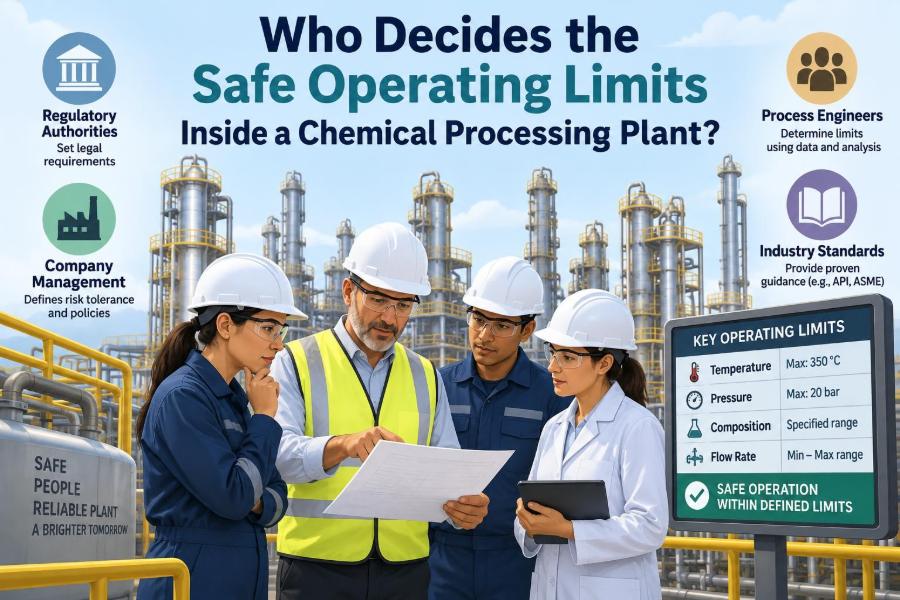

A reactor temperature begins to rise during an ordinary afternoon shift. The operator sees an alarm, reduces a feed flow, and watches the trend settle. Was the alarm limit chosen by the operator, the control engineer, the equipment vendor, or someone reviewing the process years earlier?
In a chemical plant, limits appear everywhere: maximum vessel pressure, minimum tank level, high furnace temperature, allowable pump vibration, and the composition range of a flammable mixture. They can look like simple numbers on a screen, but each one represents a decision about what the equipment, process, and people can safely tolerate.
No single person “decides safety” alone. Safe operating limits are built from design information, chemical behavior, operating experience, formal hazard reviews, engineering calculations, and legal requirements. They are then maintained by an organization that must recognize when a number no longer matches the plant it is operating.
Understanding where these limits come from helps operators use them wisely, helps engineers design better safeguards, and helps managers see why production pressure must never quietly redefine what is acceptable.
🏭 What a Safe Operating Limit Actually Means
A safe operating limit is a defined boundary for a process variable beyond which the risk becomes unacceptable or equipment performance can no longer be assured. The variable may be pressure, temperature, flow, level, composition, pH, speed, electrical current, or another measurable condition.
The limit is not always the point at which something fails immediately. It is often set earlier to provide time for detection and corrective action. A reactor might physically tolerate a higher temperature than its high-temperature operating limit, but reaching that limit could mean cooling capacity is becoming inadequate or a runaway reaction is becoming more likely.
🧭 The Difference Between Operating, Alarm, and Design Limits
Several limits can apply to the same item, and confusing them is a common source of poor decisions. An ordinary operating target is not a safety boundary, while a design pressure is not a normal operating instruction.
| Limit type | Purpose | Typical response |
|---|---|---|
| Normal operating range | Maintains quality, efficiency, and stable control | Adjust process controls |
| Alarm setpoint | Warns that attention or action is needed | Investigate and correct deviation |
| Trip or interlock setpoint | Automatically moves the process to a safer state | Confirm shutdown response and diagnose cause |
| Mechanical design limit | Defines equipment capability under specified conditions | Must not be treated as a routine operating target |
A pressure vessel designed for a stated maximum allowable working pressure still needs normal operating pressure, alarm settings, relief protection, and defined actions below that rating. Safety is created by the margin and the response system, not by operating close to a nameplate value.
👥 Why the Answer Is a Team, Not a Job Title
The question “who decides?” has a distributed answer. Process engineers establish process conditions; mechanical engineers assess equipment limits; instrumentation engineers develop alarms and protective functions; operators contribute practical knowledge; and safety specialists challenge assumptions through structured reviews.
Plant leadership has a separate responsibility: providing authority, time, and resources to follow the limits. A technically sound limit is weak if workers are encouraged to bypass it to recover production.
Responsibilities should be visible in procedures and management systems. Everyone may influence a limit, but someone must be accountable for approving it, documenting its basis, and controlling changes.
🧪 Process Chemistry Sets the First Boundaries
Chemical reactions often establish the most consequential constraints. Reaction rate commonly changes with temperature, and an exothermic reaction releases heat as it proceeds. If heat generation rises faster than heat removal, temperature and pressure can accelerate rapidly.
Limits may therefore be based on reaction calorimetry, kinetic models, pilot testing, historical data, or conservative process knowledge. For reactive systems, engineers ask what happens if cooling is lost, feed is mischarged, agitation fails, or contamination enters the vessel.
These questions define conditions that must be avoided, not merely conditions that reduce product yield.
🌡️ Temperature Limits Are Rarely Just About Heat
A high-temperature limit can protect much more than the vessel wall. Elevated temperature may increase vapor pressure, degrade a catalyst, damage a polymer product, generate non-condensable gas, weaken gaskets, or initiate unwanted decomposition.
Low-temperature limits matter too. Freezing, crystallization, excessive viscosity, thermal shock, and loss of instrument reliability can all occur at low temperatures. In a line carrying a material that solidifies, a low-temperature alarm may prevent an operational blockage that later creates an overpressure risk.
💨 Pressure Limits Combine Equipment and Process Knowledge
Pressure limits begin with the mechanical design of vessels, piping, heat exchangers, and connected equipment. But the safe process limit also depends on weak points: a downstream low-pressure vessel, a hose, a sight glass, a pump seal system, or a blocked-in section exposed to heat.
Engineers evaluate credible overpressure scenarios, such as blocked outlet, control valve failure, external fire, thermal expansion of trapped liquid, gas blowby, or runaway reaction. Relief devices are then sized and set as part of a wider pressure-protection strategy.
A relief valve is essential protection, but it should not be treated as permission to routinely run near its set pressure.
🧱 Materials of Construction Put Limits on the Process
Steel is not a universal answer. Corrosion, hydrogen damage, chloride stress corrosion cracking, erosion, caustic attack, and high-temperature creep can reduce the margin between normal service and failure.
Materials engineers and inspection teams use process conditions to identify credible degradation mechanisms. A change in concentration, water content, temperature, or contaminant level can change the corrosion environment even if pressure remains unchanged.
That is why material limits often include composition and impurity restrictions, not only temperature and pressure.
⚙️ Equipment Vendors Supply Critical, but Limited, Information
Manufacturers provide operating envelopes for pumps, compressors, mixers, furnaces, seals, and control valves. A pump, for example, has a preferred flow range, a maximum pressure capability, and a minimum flow requirement to prevent overheating or internal recirculation damage.
Vendor data must be interpreted in the plant context. A compressor surge limit is meaningful only when connected to the actual gas composition, suction conditions, control system, and piping arrangement. The plant engineer integrates vendor constraints with process hazards.
📐 Process Design Defines the Intended Envelope
During design, engineers develop heat and material balances, process flow diagrams, piping and instrumentation diagrams, utility requirements, and control philosophies. These documents describe the intended operating envelope: the conditions under which the unit should meet its purpose safely.
Design work also identifies what happens when variables deviate. If a distillation column loses reflux, for instance, overhead composition, pressure, condenser duty, and downstream emissions may all change. Limits must account for the system response rather than treating each instrument in isolation.
🔍 Hazard Reviews Test the Assumptions
Formal hazard identification methods test whether the design has overlooked a pathway to harm. A hazard and operability study, often called a HAZOP, examines deviations such as “more flow,” “less pressure,” “reverse flow,” or “high temperature” and asks for causes, consequences, safeguards, and recommendations.
Other methods may include what-if reviews, failure mode and effects analysis, layers of protection analysis, and quantitative risk assessment. The appropriate method depends on the complexity and hazard of the process.
These reviews do not create physics. They make assumptions visible, challenge whether safeguards are independent, and identify where a limit needs stronger protection.
🛡️ Layers of Protection Shape the Final Number
A limit is often selected with multiple protective layers in mind. Basic control keeps the process near target; an alarm prompts an operator response; an independent trip acts if the deviation continues; and relief or containment protects against remaining scenarios.
A useful safeguard must be capable, reliable enough for its role, and independent where independence is claimed. An alarm that depends on the same failed transmitter as the control loop may not provide the protection assumed in a hazard review.
Good design avoids relying on one alert person to prevent every serious event.
🚨 Alarms Need a Defined Meaning and Response
An alarm should answer a practical question: what abnormal condition needs attention, and what should the operator do? Alarm setpoints need enough time between warning and consequence for a realistic response.
Too many alarms create alarm flooding, where urgent signals are lost among routine messages. An alarm that sounds constantly during normal operation is likely to be ignored, suppressed, or treated as background noise.
Alarm management assigns priorities, rationalizes setpoints, documents response instructions, and periodically checks whether the alarm remains useful.
🔒 Interlocks and Trips Are Not Simply “Stronger Alarms”
An interlock or trip automatically performs an action when a defined condition is reached: closing feed valves, stopping a pump, opening a quench valve, isolating fuel, or shutting down a compressor. It is used when the required response must be prompt, reliable, or independent of human action.
Trip setpoints require careful coordination. If set too close to a normal fluctuation, nuisance trips can erode confidence and tempt bypassing. If set too close to the hazardous condition, the protective action may arrive too late.
Testing, proof checks, and strict bypass control are necessary because a protective function that cannot operate when demanded is only an assumption.
👷 Operators Turn Written Limits into Real Control
Operators understand how the unit behaves during startups, grade changes, upsets, and weather changes. Their observations can reveal that a procedure is unclear, a level transmitter is sluggish, or a nominally safe operating range produces unstable control.
They do not normally have authority to casually revise formal safety limits, but they are essential contributors to improving them. A healthy reporting culture makes it easy to report near misses and difficult-to-operate conditions before someone normalizes them.
Clear operating procedures should state the limit, why it matters, the signs of approach, immediate actions, escalation path, and conditions for restarting.
🧠 Human Factors Affect Whether Limits Work
People work under time pressure, fatigue, competing alarms, incomplete information, and handovers between shifts. A safe limit that is hard to find, poorly displayed, or explained only in technical language may fail in practice.
Human-centered design uses readable displays, consistent units, sensible alarm priorities, checklists for infrequent tasks, and unambiguous procedures. The goal is not to blame people for errors; it is to make the safe action easier to recognize and carry out.
📋 Operating Procedures Translate Analysis into Action
Process safety analysis can be sophisticated, but it must eventually become usable instructions. A startup procedure may require confirming cooling water flow before charging reactants because the underlying analysis assumes cooling is available before heat generation begins.
Procedures should distinguish between a target, an alert threshold, and a stop-work boundary. Vague wording such as “maintain pressure at a reasonable value” leaves dangerous room for interpretation.
When procedures disagree with control-room displays or current equipment configuration, the discrepancy must be treated as a management-of-change issue, not solved informally during a shift.
🔄 Management of Change Prevents Quiet Limit Drift
Management of change, commonly abbreviated MOC, is the formal process used to evaluate modifications before implementation. Changes can include new raw materials, a different catalyst, revised control logic, altered pipe routing, replacement equipment, increased throughput, or a revised operating procedure.
Even a seemingly small change can invalidate an old limit. Raising production rate may reduce residence time, change heat-transfer behavior, increase pressure drop, or bring a relief scenario outside the original design basis.
Temporary changes deserve the same discipline. They need approval, a defined duration, documented safeguards, and explicit removal or review.
📈 Production Pressure Can Distort Safety Decisions
Plants must meet customer commitments, control costs, and recover from downtime. Those realities can create pressure to operate nearer a boundary or to treat repeated excursions as normal.
The danger is gradual normalization: a deviation happens without immediate harm, then happens again, and eventually feels acceptable. Yet the original limit may have been protecting against a low-frequency condition that has not occurred yet.
Production goals and safety boundaries are not equal tradeoffs. If the plant cannot meet a target within its approved operating envelope, the solution is engineering review, scheduling, capacity investment, or revised product planning—not unauthorized limit expansion.
🧮 Safety Margins Are Deliberate, Not Wasteful
A margin accounts for uncertainty: sensor error, process variability, changing ambient conditions, modeling limitations, response delay, and imperfect equipment performance. It gives operators and safeguards room to act before a physical or chemical boundary is reached.
Margins should be technically justified rather than arbitrary. Excessively narrow margins make operation fragile; excessively conservative limits can cause needless trips or make a process impractical. The objective is a defensible balance based on credible scenarios and available protection.
📊 Data Historians Help Detect Approaching Boundaries
Modern plants record trends from thousands of instruments. Reviewing this history can show whether a process is creeping toward a limit, cycling unusually, or requiring frequent manual intervention to stay stable.
For example, steadily increasing heat-exchanger outlet temperature at the same production rate may suggest fouling. Identifying this trend early can prevent an operator from compensating by raising a reactor temperature toward a limit that was never intended as a routine control lever.
Data supports judgment; it does not replace field verification. A trend can be misleading if an instrument is poorly calibrated or a process connection is plugged.
🧰 Inspection and Maintenance Protect the Assumed Boundaries
Operating limits depend on equipment condition. A corroded vessel, fouled relief line, sticking control valve, degraded insulation, or unreliable transmitter can reduce the protection assumed when the limit was established.
Mechanical integrity programs inspect, test, repair, and document safety-critical equipment. Their scope commonly includes pressure equipment, piping, relief devices, emergency shutdown systems, instruments, and other components whose failure could defeat a safeguard.
Deferring maintenance may be manageable for cosmetic issues; it is far more serious when it erodes a barrier that allows safe operation near a process limit.
🧯 Relief Systems Are the Last Line, Not the Operating Plan
Pressure relief devices protect equipment when pressure exceeds a set condition, directing material to a safer location such as a flare, scrubber, or containment system. Their design requires consideration of fluid behavior, disposal capacity, backpressure, two-phase flow, and the initiating scenario.
They cannot solve every hazard. A relief path may release flammable or toxic material into a downstream system that has its own capacity limits. In some scenarios, preventing escalation through control, isolation, or emergency cooling is more effective than relying on relief alone.
🧩 A Hypothetical Reactor Example
Consider a batch reactor performing an exothermic reaction. The normal temperature target is below the high-temperature alarm. Above that alarm, the operator stops feed and verifies cooling. At a higher temperature, an independent trip closes feed automatically and opens emergency cooling.
The vessel’s pressure relief device is set based on mechanical design and relief analysis, not as the temperature-control target. A maximum recipe charge may also be limited because a larger charge could generate heat faster than the cooling system can remove it.
This hypothetical example shows why no single number tells the whole safety story. Recipe controls, temperature alarms, trips, cooling reliability, pressure relief, and operator actions work together.
🧷 Process Safety Information Is the Evidence File
Plants need accessible, current information supporting their limits. This may include chemical hazard data, reaction hazards, equipment design details, piping diagrams, relief calculations, instrument setpoint records, control narratives, and operating procedures.
Documentation is not bureaucracy for its own sake. It lets a new engineer understand why an alarm exists, allows reviewers to assess a proposed change, and prevents critical knowledge from leaving when experienced employees retire or transfer.
⚖️ Regulations and Standards Set Expectations, Not Every Setpoint
Regulatory frameworks and recognized engineering practices require organizations to manage hazardous processes, maintain equipment, train personnel, investigate incidents, and control changes. Exact obligations vary by country, industry, material, and facility type.
They generally do not provide a universal safe temperature for every reactor or a universal pressure limit for every vessel. Site-specific limits must come from the process, the equipment, and the documented hazard analysis.
Compliance is therefore a baseline discipline, not a substitute for engineering understanding.
🕵️ Incident and Near-Miss Reviews Can Reveal Weak Limits
After an incident or near miss, a useful investigation asks more than who acted last. It examines whether the limit was appropriate, whether warning came early enough, whether procedures were workable, and whether organizational pressure influenced decisions.
A near miss may reveal that an alarm was set too late, an interlock was bypassed without adequate control, or a startup sequence relied on knowledge absent from the written procedure. Learning should result in specific corrective actions and verification that they were completed.
🚧 Common Mistakes When Setting or Using Limits
- Using a design rating as a normal target: this consumes margin intended for abnormal conditions.
- Copying a limit from another unit: similar equipment may have different chemistry, utilities, or relief paths.
- Changing a setpoint without reviewing consequences: a small adjustment can undermine alarm-to-trip spacing or invalidate assumptions.
- Relying on one safeguard: sensor failures, human delays, and common-cause failures must be considered.
- Treating frequent alarms as normal: repeated alarms usually indicate a control, equipment, or operating problem worth resolving.
🗣️ Escalation Is a Core Operating Skill
When a variable approaches a defined limit and the cause is uncertain, the right action is often to stabilize, reduce the hazard, and seek support early. Escalation is not evidence of incompetence; it is how a plant uses the full expertise available to it.
Clear escalation criteria reduce hesitation. They should specify when an operator calls a supervisor, when engineering is required, when feed must be reduced or stopped, and when emergency procedures take over.
🎓 What Students and New Engineers Should Learn First
Do not memorize setpoints without asking what they protect. For each important limit, try to identify the hazardous consequence, initiating causes, available safeguards, time available for response, and the action expected from the operator.
A productive question in training is: “What changed in the physical process if this number rises?” That question connects a screen value to heat release, vapor formation, material strength, flow restriction, composition, or another real mechanism.
🤝 Building a Culture That Respects Boundaries
A strong safety culture does not mean people are afraid to report problems. It means they can question a limit, report that it is repeatedly challenged, and request technical review without being dismissed as obstructive.
It also means a formal limit is respected until that review occurs. Curiosity improves limits; informal workarounds weaken the system designed to protect people, equipment, and the surrounding community.
🧭 The Core Principle: Limits Are Managed Knowledge
Safe operating limits are not merely numbers programmed into a control system. They are the practical expression of what an organization knows about chemistry, equipment capability, human response, failure modes, and uncertainty.
The people who establish them include designers, specialists, operators, reviewers, inspectors, and leaders. The organization decides whether that knowledge remains current, whether safeguards are maintained, and whether the limits are allowed to mean what they were designed to mean.
The safest plant is not the one with the most limits; it is the one where every critical limit has a sound basis, a clear response, reliable protection, and disciplined change control.
When a number on a control-room display is treated as the visible edge of a carefully engineered safety envelope—not an obstacle to production—better decisions follow at every level of the plant. 🧪⚙️🛡️