
A plant operator notices that product purity has begun to drift, even though the feed recipe, reactor temperature, and catalyst test results all look normal. A process engineer then asks a deceptively simple question: how long is the material actually staying in the reactor?
That question can uncover problems ranging from an incorrect feed rate to gas bypassing through a vessel, liquid stagnant in a dead zone, or a control valve responding too aggressively. In a chemical plant, minutes or seconds can separate an on-spec product from unreacted feed, unwanted by-products, or an unstable operating condition.
Residence time connects reactor size, flow rate, chemistry, mixing, heat removal, and product quality. It is one of the most useful ideas in reactor engineering because it turns a physical vessel into a time-based process: material enters, experiences reaction conditions for a while, and leaves.
The catch is that the number calculated from a vessel volume and a flow rate is often only the beginning. Real molecules do not all follow the same path. Understanding that difference is essential for designing reactors and diagnosing the ones already running.
⏱️ Residence Time in Plain Language
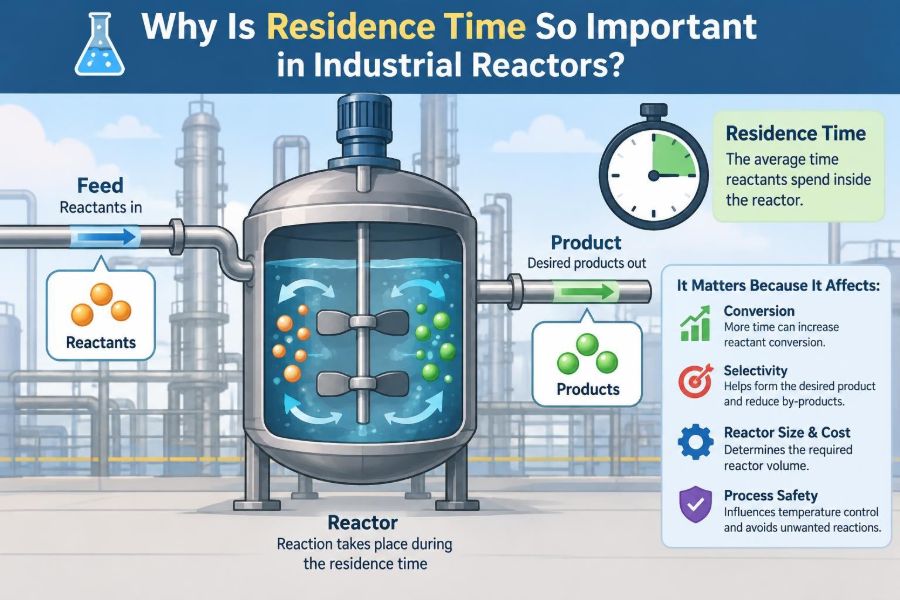
Residence time is the time a portion of process material spends inside a defined piece of equipment. In a reactor, it represents the available time for reactants to mix, react, transfer heat, and perhaps form intermediate or unwanted products.
For a simple continuous system at steady state, the nominal or average residence time is often written as τ = V/Q, where V is the active reactor volume and Q is the volumetric flow rate.
If a liquid reactor has 10 m³ of working liquid volume and receives 2 m³/h of feed, its nominal residence time is 5 h. That does not mean every molecule remains for exactly 5 h; it means the reactor holds roughly five hours of incoming flow under those assumptions.
📦 Why Volume Alone Does Not Describe a Reactor
A large vessel may look as though it provides a long reaction time, but only the active volume counts. Liquid below an outlet nozzle, vapor space above a liquid level, internals occupied by catalyst, or regions that barely exchange with the bulk fluid may not contribute in the same way.
In a slurry reactor, for example, the liquid volume, solid catalyst holdup, and gas volume each require separate thought. A residence time based on total shell volume can be misleading if much of that shell is not occupied by the phase being considered.
Engineers therefore define a control volume carefully before calculating anything. “Residence time of what phase, in what region, at what operating level?” is a better starting question than simply “What is the vessel volume?”
🧮 The Link Between Flow Rate and Time
At fixed active volume, increasing throughput reduces nominal residence time. Doubling a liquid feed rate approximately halves V/Q, provided density and vessel level do not change substantially.
This is why production-rate changes can alter conversion even when temperature and composition targets remain unchanged. The chemistry has less time to proceed, and mixing or heat-transfer limitations may become more visible.
For compressible gases, the issue needs extra care. Gas volumetric flow varies strongly with pressure and temperature, so engineers usually convert flow rates to the actual reactor conditions before using them in a gas-phase residence-time calculation.
⚗️ Reaction Kinetics Give Time Its Value
Reaction kinetics describe how quickly a chemical transformation occurs under particular conditions. Residence time matters because it sets how long material is exposed to that intrinsic reaction rate.
For a slow reaction, a short residence time may yield low conversion because reactants leave before much transformation occurs. For a fast reaction, additional time may offer little benefit once the limiting reactant has mostly been consumed.
The relationship is not always simple. Reaction rates can change as concentration, temperature, catalyst activity, and composition change along the reactor. Residence time must therefore be evaluated alongside the rate law rather than treated as an isolated design variable.
🎯 Conversion Is Not the Same as Residence Time
Conversion is the fraction of a reactant consumed. Residence time is the time available for that consumption. They are related, but one does not automatically determine the other.
A long residence time can still give poor conversion if a catalyst is inactive, reactants are poorly mixed, temperature is too low, or mass transfer is limiting. Conversely, a highly reactive feed may reach high conversion in a very short reactor.
This distinction is practical during troubleshooting. If conversion falls, increasing residence time may help, but it may only mask a deeper cause such as catalyst fouling or a change in feed impurities.
🧪 Selectivity Can Improve—or Deteriorate—with Time
Many industrial reactions have competing pathways. A desired product may form first and then react further into an undesired by-product if it remains under reaction conditions too long.
Consider a hypothetical sequence in which A becomes desired B, while B slowly becomes undesired C. More residence time can raise the conversion of A but reduce the selectivity to B after a certain point. The best operating point is a compromise, not necessarily the longest possible time.
This is especially important in fine chemicals, polymer production, oxidation reactions, and catalytic systems where small changes in impurity profile have commercial consequences. Maximum conversion and maximum product value are not always the same objective.
🔄 Batch Residence Time Means Hold Time
In a batch reactor, all material is charged, processed, and discharged as a batch. The relevant timing is usually called reaction time, batch time, or hold time rather than residence time.
The underlying principle remains the same: chemistry needs a controlled exposure period. However, batch timing also includes charging, heating, cooling, sampling, and discharge steps, so the total vessel occupancy time can be much longer than the time at the reaction setpoint.
For batch operations, a longer hold can increase conversion but can also cause degradation, crystal-size changes, color formation, or loss of productivity. Good batch recipes specify time together with temperature, agitation, and feed-addition conditions.
🌊 The Ideal Plug-Flow Reactor
In an ideal plug-flow reactor, often called a PFR, fluid moves through the reactor as sequential elements with little axial mixing. Material entering later does not thoroughly mix with material already farther downstream.
Each element spends nearly the same time in the reactor, so the residence-time distribution is narrow. Concentration and temperature can change along the flow direction, which is useful for reactions that benefit from staged conditions.
Tubular reactors commonly approximate plug flow, although bends, fittings, radial gradients, and nonuniform velocity profiles prevent perfect behavior. The ideal model is still valuable because it provides a clear benchmark for design calculations.
🌀 The Ideal Continuous Stirred-Tank Reactor
An ideal continuous stirred-tank reactor, or CSTR, is perfectly mixed. The exiting material has the same composition and temperature as the contents inside the tank.
Unlike plug flow, some material can leave soon after entering because it mixes into the bulk and has a chance of reaching the outlet. Some other material remains much longer than the nominal average.
A CSTR is often easy to control and highly useful where good mixing and heat removal are needed. Yet its broad spread of actual residence times can make it less efficient than plug flow for many positive-order reactions at the same volume.
🧭 Residence-Time Distribution Explains Real Flow
Residence-time distribution, or RTD, describes the range of times that different portions of material spend in a system. It moves the discussion beyond a single average value.
RTD is often represented by a curve showing how much tracer leaves the outlet at different times after a pulse or step change is introduced at the inlet. A narrow curve suggests more uniform passage; a wide curve indicates substantial spreading in residence times.
RTD analysis helps reveal whether a reactor behaves more like plug flow, a mixed tank, several tanks in series, or something less ideal. It is a bridge between fluid mechanics and reaction performance.
📉 Short-Circuiting Reduces Useful Contact Time
Short-circuiting occurs when part of the feed travels from inlet to outlet through an unusually direct path. It may leave far sooner than the nominal residence time calculated from total volume and flow rate.
This can happen when an inlet points toward an outlet, a distributor performs poorly, an impeller creates a strong circulation path, or an internal baffle is missing or damaged. The vessel may be physically large, yet some feed receives very little processing.
Short-circuiting can lower conversion, worsen separation, and cause outlet-quality fluctuations. Simply increasing vessel size may not solve it if the flow pattern remains defective.
🧱 Dead Zones Consume Volume Without Processing Well
A dead zone is a region with weak circulation or slow exchange with the main flow. Material there may remain for a very long time, while the rest of the stream moves through more quickly.
Dead zones can form behind internals, near vessel walls, in poorly designed cones, around supports, or where viscosity is high and agitation is insufficient. In multiphase reactors, solids settling or gas holdup can create further complexity.
They matter because they reduce effective volume and can allow degradation, solids buildup, polymer deposition, or temperature differences. A nominal residence time calculated using the whole vessel can overstate reactor performance.
🌡️ Heat Release Makes Time a Safety Variable
For exothermic reactions, residence time affects not only conversion but also how much heat is released inside the reactor and where that heat appears. Longer exposure can permit more reaction, while poor heat removal can raise temperature and accelerate temperature-sensitive kinetics.
In some systems, a temperature increase makes the reaction faster, which releases heat more rapidly. This feedback can become hazardous if cooling capacity, mixing, emergency quench capability, or control response is inadequate.
Residence time alone does not predict thermal safety. Engineers evaluate reaction calorimetry, heat-transfer area, cooling utility reliability, inventory, mixing, and credible upset scenarios. Still, changing throughput changes timing and can alter the safety margin.
❄️ Endothermic Reactions Need Enough Thermal Exposure
Endothermic reactions absorb heat. Their performance may decline when residence time falls because the feed has less opportunity to receive the required heat and approach the intended temperature profile.
In fired heaters, tubular cracking systems, or electrically heated reactors, flow changes can alter both the time available for reaction and the heat absorbed per unit mass. These effects should be assessed together rather than by conversion alone.
Longer time is not automatically favorable here either. High-temperature exposure may cause coking, thermal degradation, material stress, or undesirable side reactions.
🧲 Catalysts Experience Contact Time Differently
In catalytic reactors, engineers often discuss space time, weight hourly space velocity, or liquid hourly space velocity. These measures relate feed rate to catalyst volume or catalyst mass.
They are closely connected to residence-time thinking, but they are not interchangeable in every system. Porous catalyst pellets introduce diffusion paths, and the reacting fluid may move through void spaces rather than through the total catalyst-bed volume.
At high flow rates, external film resistance or internal diffusion can limit the observed rate. Increasing residence time may improve performance, but restoring catalyst activity, adjusting temperature, or changing pellet geometry may be more effective.
🫧 Multiphase Reactors Have More Than One Clock
Gas-liquid, gas-solid, and liquid-solid reactors do not have a single universal residence time. Gas bubbles, liquid, suspended solids, and catalyst particles can each have different hold-up and movement through the equipment.
In a gas-liquid hydrogenation, for instance, gas residence time affects gas holdup and mass transfer, while liquid residence time affects reactant conversion. A catalyst particle may remain in the reactor far longer if it is retained by a filter or settling zone.
This is why multiphase design requires phase-specific balances and mass-transfer analysis. A reported “residence time” is useful only when its basis is stated clearly.
📏 Working Volume Must Be Measured at Operating Conditions
Design drawings provide geometry, but operating volume depends on liquid level, foaming, gas holdup, internals, and normal control range. A level transmitter may measure one region of a vessel while the actual process volume includes complicated shapes.
For reactors with changing density, swelling polymers, or boiling fluids, volume can shift during operation. The calculated residence time should use representative operating data, not only nameplate capacity.
Periodic reconciliation of level, flow, density, and inventory data can catch errors. It also helps distinguish a true residence-time issue from a faulty instrument or an incorrectly scaled flow signal.
📊 A Comparison of Common Reactor Flow Models
The models below are simplifications, but they help organize expectations before detailed simulation or plant testing.
| Reactor model | Mixing behavior | Residence-time spread | Typical practical implication |
|---|---|---|---|
| Ideal plug flow | Minimal axial mixing | Narrow | Good use of concentration gradients for many reactions |
| Ideal CSTR | Complete mixing | Broad | Uniform tank conditions and straightforward control |
| CSTRs in series | Partial mixing between stages | Intermediate | Often approaches plug-flow behavior as stages increase |
| Real vessel with bypass or dead zones | Nonideal and uneven | May have early and late tails | Performance can differ sharply from nominal calculations |
No table can replace an RTD test or validated model when product quality or safety depends strongly on flow behavior. It does, however, show why two reactors with identical V/Q can perform very differently.
🧫 Tracer Tests Reveal What the Average Hides
A tracer test introduces a detectable, nonreactive material at the inlet and measures its concentration at the outlet over time. Depending on the process, the tracer may be a dye, salt, inert gas, conductivity change, or another compatible signal.
A pulse test creates a response curve that can show early breakthrough, long tails, or multiple peaks. A step test can also identify how rapidly the outlet approaches a new inlet composition.
Tracer selection and interpretation require care. The tracer should follow the phase of interest, not react or adsorb strongly, and be measured accurately. In hazardous or regulated systems, test planning must also address compatibility, waste handling, and operating constraints.
🧩 Tanks in Series Offer a Useful Middle Ground
Many real reactors behave neither like one perfectly mixed tank nor like ideal plug flow. A common engineering approximation represents the system as several stirred tanks in series.
As the number of ideal tanks increases, the predicted RTD becomes narrower and more plug-flow-like. This model can be useful for staged reactors, baffled compartments, and systems where moderate axial mixing is expected.
It is still a model, not a diagnosis. A series-of-tanks fit may reproduce outlet tracer data while concealing the physical cause, such as recirculation, bypassing, or poorly placed feed nozzles.
🏭 Scale-Up Changes Flow Patterns
A pilot reactor and a commercial vessel can have the same nominal residence time but very different mixing behavior. Diameter increases, impeller-to-tank proportions, nozzle arrangements, heat-transfer surfaces, and fluid velocities do not all scale in the same way.
Viscous systems are especially challenging because large vessels may develop poorly mixed regions that were absent in small equipment. Gas dispersion and solid suspension can also change as scale increases.
Successful scale-up therefore considers dimensionless groups, mixing time, power input, heat transfer, and RTD—not only the ratio of volume to flow. A residence-time target must be supported by a credible hydrodynamic design.
🔧 Agitation Can Change Effective Residence Time
An agitator does not alter the nominal V/Q by itself, but it can dramatically change how effectively the vessel volume is used. Better circulation reduces stagnant pockets and improves contact among reactants, catalyst, and heat-transfer surfaces.
Impeller type, diameter, speed, number of impellers, baffle arrangement, and fluid viscosity all influence the resulting flow pattern. More power is not always the correct answer; excessive shear can damage crystals, emulsions, biological material, or fragile catalyst particles.
The practical goal is suitable mixing for the process duty. That may mean uniform temperature, suspension of solids, dispersion of gas, controlled shear, or prevention of phase separation.
🚦 Process Control Depends on Dynamic Residence Time
Residence time creates delay between an inlet disturbance and its full effect at the outlet. A feed-composition change may be detected immediately upstream but appear in product quality only after material has travelled and mixed through the reactor system.
Control loops must account for this dynamic behavior. Aggressive controller tuning can overcorrect before the process response is visible, while overly slow control can allow quality drift to persist.
In reactors with recycle streams, the dynamics become more complex because material can pass through equipment multiple times. Process models, online analyzers, and well-designed sampling plans help operators separate a genuine trend from a delayed response.
🧾 Residence Time Affects Sampling and Quality Decisions
A sample taken immediately after a process adjustment may not represent the new steady condition. The nominal residence time provides an initial estimate of when to expect a response, but RTD determines how gradual that response may be.
For example, after changing reactant ratio in a mixed vessel, early outlet samples can contain a blend of old and new material. Releasing product based on that transition period can create inconsistent quality decisions.
Operating procedures should define sampling intervals and stabilization criteria appropriate to the equipment. Where quality risk is high, facilities may use validated dynamic models or tracer-based knowledge rather than relying on a simple waiting rule.
💰 Productivity Is a Residence-Time Trade-Off
Shorter residence time can increase throughput from a given reactor volume, which may improve asset utilization. But if conversion falls, downstream separation loads rise and valuable reactants may need to be recycled.
Longer residence time can raise conversion or smooth variability, yet it requires more reactor volume for the same production rate and can increase inventory tied up in the process. It may also promote by-products or degradation.
The economic optimum depends on the whole flowsheet: raw-material cost, energy use, recycle capacity, separation difficulty, waste treatment, product specification, and capital constraints. Reactor residence time should never be optimized in isolation.
⚠️ Common Mistakes in Residence-Time Calculations
Several shortcuts produce values that look precise but do not represent the operating reactor.
- Using total vessel capacity instead of active process volume.
- Combining standard gas flow with reactor volume at actual pressure and temperature.
- Ignoring recirculation flow when it changes mixing or local velocities.
- Assuming a nominal average proves that every material element receives adequate treatment.
- Using steady-state formulas during major startup, shutdown, or level-change transients.
- Failing to state whether the basis is liquid, gas, slurry, catalyst bed, or total vessel volume.
A clear calculation records its assumptions, flow basis, measurement sources, and operating conditions. That transparency is often more valuable than carrying extra decimal places.
🛠️ Practical Ways to Improve Reactor Performance
When residence-time behavior is causing a problem, the best fix depends on the physical cause. Increasing volume or reducing throughput may help, but neither corrects every type of nonideal flow.
- Reposition or redesign inlet and outlet nozzles to reduce direct bypassing.
- Add or repair baffles, distributors, draft tubes, or internal compartments.
- Adjust agitation after evaluating mixing, shear, power, and mechanical limits.
- Use staged feed addition when concentration peaks drive side reactions.
- Inspect for fouling, settled solids, damaged internals, and unexpected level changes.
- Run a properly planned tracer study when the flow pattern is uncertain.
Changes should be assessed through management-of-change practices and appropriate process-safety review. A modification that improves conversion can also alter pressure drop, heat removal, vibration, or controllability.
🧠 A Better Workflow for Design and Troubleshooting
A disciplined workflow prevents residence time from becoming a single number disconnected from the process. Start with mass balance: define the active volume, phases, inlet and outlet flows, density basis, and expected operating range.
Next, connect that estimate to kinetics, selectivity, heat transfer, and mixing requirements. Ask whether ideal plug flow, complete mixing, or an intermediate model is plausible—and what evidence supports that choice.
Finally, compare model predictions with plant data: conversion, temperature profile, product impurities, response to feed changes, and tracer behavior where feasible. Differences between prediction and observation are clues, not inconveniences.
🔍 Questions to Ask Before Changing Throughput
Before increasing or decreasing feed rate, teams should examine more than the new nominal residence time. A useful review asks:
- Will conversion and selectivity move in the desired direction?
- Can heat-transfer equipment handle the new reaction-duty profile?
- Will pressure drop, gas distribution, or solids suspension change?
- Does catalyst performance remain acceptable at the new space velocity?
- How long will it take for the outlet and downstream units to stabilize?
- Are safeguards and operating procedures valid for the proposed range?
This systems view is particularly important when a reactor is near a constraint. The limiting equipment may be a compressor, separator, heat exchanger, control valve, or wastewater system rather than the reactor itself.
🏁 The Core Principle: Time Must Match the Physics
Residence time is important because industrial reactors are not just containers. They are environments in which flow, reaction, mixing, mass transfer, and heat transfer occur simultaneously for a limited period.
The nominal value V/Q is an essential first estimate, but real performance depends on the distribution of actual times and on whether every phase experiences the intended conditions. Short-circuiting, dead zones, catalyst limitations, and temperature gradients can all make a reactor behave differently from its simple calculation.
The right residence time is the one that gives the required reaction outcome safely, selectively, and economically under real flow conditions—not merely the largest or smallest number on a design sheet.
When engineers treat time as a process variable rather than a static calculation, they can make better decisions about reactor size, throughput, control, troubleshooting, and product quality. That perspective turns a basic ratio into one of the most practical tools in chemical engineering. 🧪⏱️🏭