
A process engineer is asked to increase production of a specialty chemical. The first instinct may be to propose a continuous plant: material flows in, product flows out, and the equipment runs around the clock. That can be an excellent answer—but not always.
The product may be made in small campaigns, sold in variable grades, or based on a reaction that needs careful staging. A continuous line designed for one steady operating point can become an expensive constraint when the business, chemistry, or regulations demand flexibility.
Batch processing is often treated as the old-fashioned alternative to continuous operation. In reality, it is a deliberate engineering choice that can reduce development risk, protect product quality, and fit uncertain markets remarkably well.
The important question is not which mode is universally better. It is which mode best matches the required scale, chemistry, operating strategy, and lifetime economics of a specific process. ⚙️
🧭 1. Start with the actual decision
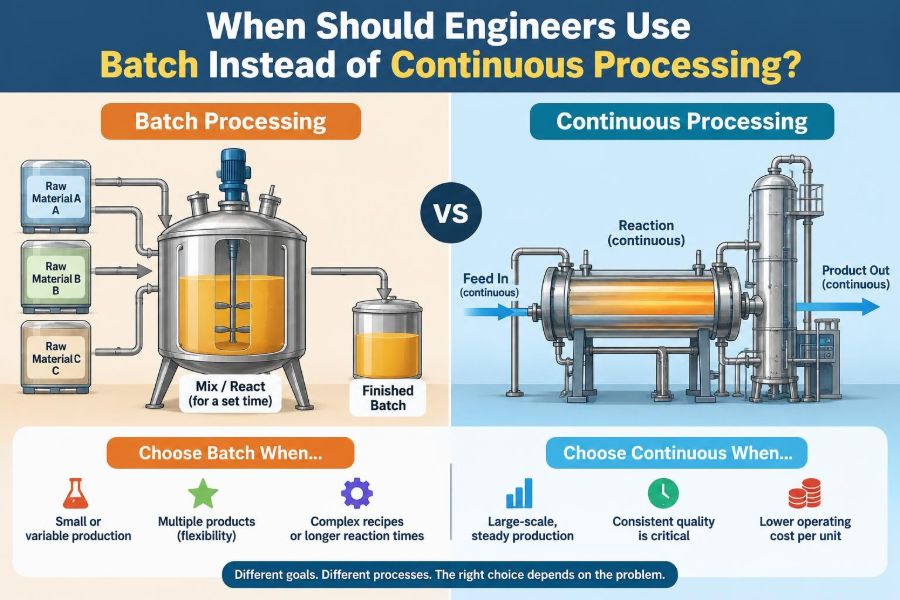
Batch processing handles a defined quantity of material through one or more steps, then empties, cleans, and prepares equipment for the next batch. Continuous processing feeds material and removes product continuously, ideally near a stable operating condition.
Engineers should not choose between them based on familiarity alone. The decision affects reactor sizing, storage, control systems, staffing, validation, maintenance planning, and the ability to change products later.
🏭 2. Understand what “batch” includes
A batch plant is not necessarily a single stirred tank. It may include charging vessels, reactors, filters, dryers, blenders, holding tanks, and packaging equipment operated in a coordinated sequence.
Some steps can be batch while others are continuous. For example, a plant may perform a reaction in batches, filter each batch, then use a continuous utility system or continuous wastewater treatment unit.
🌊 3. Understand the continuous alternative
In continuous processing, feed rates, temperatures, pressures, compositions, and flows are maintained around targets while the plant is operating. Reactors may be tubular, loop, fluidized-bed, or continuously stirred systems.
Continuous operation can offer high throughput from compact equipment, consistent conditions, and lower handling per unit of product. Those strengths matter most when demand and process conditions are stable.
📦 4. Use batch for low or uncertain production volumes
Batch plants are often appropriate when annual demand is too low to justify a dedicated continuous line. A multipurpose reactor train can make several products over a year, using campaign scheduling to share expensive assets.
They also suit products with uncertain early demand. Building a flexible batch facility can allow a company to serve the market before committing capital to a high-capacity, dedicated installation.
- New specialty products
- Low-volume intermediates
- Custom-manufactured chemicals
- Products with seasonal or volatile demand
🔄 5. Choose batch when product variety matters
Many specialty and formulated products are sold in many grades, concentrations, colors, or additive packages. Batch equipment can switch recipes more readily than a continuous plant optimized for one formulation.
Changeovers still require time, cleaning, line clearance, and quality checks. But a shared batch asset generally provides more practical product flexibility than a dedicated continuous train.
🧪 6. Favor batch for multistep synthesis
Complex syntheses commonly require charging reagents in sequence, holding at a condition, adjusting pH, separating phases, crystallizing, washing, and redissolving. These discrete operations often fit naturally into batch recipes.
A batch record can specify each addition, agitation period, sampling point, and acceptance criterion. That structure is especially useful when the material changes significantly from step to step.
⏱️ 7. Consider reaction time and residence-time needs
Long reaction times do not automatically require batch processing, but they can make continuous equipment large or operationally awkward. A batch reactor can hold material for hours or longer without requiring a very long tubular reactor or a large continuous cascade.
Conversely, a rapid, well-behaved reaction may strongly favor continuous operation. Engineers should compare the required reaction volume in each mode rather than relying on reaction time alone.
🧫 8. Use batch when chemistry needs staged additions
Some reactions are controlled by the rate and order of reagent addition. Slow feeding can manage heat release, suppress by-products, keep a reactant concentration low, or guide particle formation.
Batch reactors make these staged actions straightforward: charge, heat, feed, hold, sample, and quench. Continuous systems can perform similar control, but their design and startup strategy may be substantially more demanding.
🔥 9. Examine thermal behavior before deciding
Exothermic reactions require careful heat removal in either mode. Batch operation can be attractive when a reaction needs a programmed temperature profile, controlled feed rate, or a deliberate pause before the next step.
However, “batch is safer” is not a universal rule. Large batches can store significant energy, and loss of cooling or agitation can be serious. Continuous reactors may reduce hazardous inventory by keeping reacting volume small.
🛡️ 10. Compare safety using inventory, not slogans
A sound safety comparison asks how much hazardous material is present, how quickly heat or gas can be generated, what deviations are credible, and whether the system can be isolated or quenched.
Batch systems may allow operators to stop a feed and hold a batch at a defined stage. Continuous systems may limit the volume under reaction at any instant. Both require hazard analysis, relief design, interlocks, and workable procedures.
🎛️ 11. Select batch for recipe-driven control
Batch control is organized around a sequence of phases and transitions. The control system may execute instructions such as “add solvent,” “agitate,” “heat to target,” “hold,” “sample,” and “transfer if approved.”
This approach is valuable when every lot follows a formal recipe and conditions vary intentionally over time. It also makes it easier to associate operating data with a particular lot or campaign.
📏 12. Prefer continuous when steady state is genuinely achievable
Continuous processing works best when feeds are reliable, product specifications are stable, and the process can settle near a consistent operating condition. Under those circumstances, automation can maintain narrow operating windows for long periods.
If feed composition changes frequently or production is interrupted by many grade changes, reaching and maintaining steady state may consume much of the theoretical advantage.
🔬 13. Match the mode to analytical feedback
Batch manufacturing permits sampling at meaningful milestones: after reaction completion, after phase separation, or before crystallization. Laboratory or at-line testing can determine whether the batch proceeds, is adjusted, or is rejected.
Continuous plants benefit greatly from reliable online or at-line measurements because a disturbance can affect product until it is detected and corrected. The availability, speed, and trustworthiness of analytics should influence the selection.
✅ 14. Consider lot traceability and release strategy
A batch creates a natural material boundary. Raw-material records, processing conditions, samples, yields, deviations, and final test results can all be tied to a defined lot.
This is useful in regulated or high-assurance industries, including pharmaceuticals, food ingredients, and performance materials. Continuous production can also be traceable, but engineers must define material segmentation and response rules carefully.
🧹 15. Account for cleaning and cross-contamination
Multiproduct batch facilities require cleaning between campaigns. The time, solvent, water, labor, verification effort, and waste associated with cleaning can dominate schedules for some products.
Batch is most attractive when equipment can be cleaned effectively and economically, or when compatible products are grouped into campaigns. If cleaning is extremely difficult, a dedicated continuous line may ultimately be simpler.
🧩 16. Evaluate downstream operations separately
The reactor does not determine the entire plant mode. Filtration, centrifugation, extraction, evaporation, distillation, drying, blending, and packaging may each favor different operating patterns.
A practical design is frequently hybrid. For instance, a batch crystallization may feed a continuous dryer, or a continuous reaction may discharge into batch finishing vessels for formulation and quality adjustment.
💧 17. Use batch when solids handling is variable
Slurries, crystals, viscous materials, and sticky solids can be difficult to move continuously, especially when particle size, moisture, or rheology changes through the campaign. Batch equipment gives operators time to establish the right mixing, washing, or discharge conditions.
Continuous solids processing can be highly effective when well characterized, but it often requires careful feeder design, robust conveying, and stable material properties.
📊 18. Compare capacity with the whole cycle time
Batch capacity is governed by more than reactor volume. Engineers must include charging, heating, reaction, cooling, sampling, transfers, cleaning, setup, and downtime between campaigns.
A useful early calculation estimates batches per period from the total cycle time, then applies realistic yield and availability assumptions. Ignoring turnaround time is a common way to overstate batch capacity.
💰 19. Compare capital and operating costs honestly
Continuous plants may have lower unit operating costs at large, stable throughput, but they can require specialized equipment, sophisticated controls, and dedicated feed and product handling. Batch plants often reuse general-purpose vessels and utilities.
The economic comparison should include more than purchased equipment. Include development work, installation, automation, cleaning, labor, waste, inventory, quality testing, downtime, and the cost of lost flexibility.
| Decision factor | Batch often fits when | Continuous often fits when |
|---|---|---|
| Demand | Low, variable, or uncertain | High and predictable |
| Product portfolio | Many products or grades | One dedicated, stable product |
| Operation | Recipes and staged steps | Stable steady-state conditions |
| Development | Process is evolving | Process is well understood |
| Changeovers | Acceptable with cleaning and scheduling | Rare or minimal |
🏗️ 20. Think about scale-up and modular expansion
Batch scale-up often means increasing vessel size, adding parallel equipment, or adding another train. This can be a practical route when demand grows in increments rather than all at once.
But larger batch vessels do not behave exactly like smaller ones. Heat transfer area per unit volume, mixing time, gas dispersion, and addition rates can change substantially, so scale-up must be engineered rather than assumed.
🧠 21. Use batch while the process is still learning
Early commercial processes may continue to evolve as engineers learn about impurities, raw-material variability, catalyst life, isolation behavior, and customer specifications. Flexible batch equipment creates room for recipe changes.
That does not excuse poor process understanding. It recognizes that locking an immature process into a fixed continuous design can make future improvements slower and more expensive.
👷 22. Plan for operators and human factors
Batch plants involve more manual decisions, connections, transfers, inspections, and interventions than highly automated continuous plants. Skilled operators are therefore central to safe and consistent performance.
Good design reduces avoidable dependence on memory: use clear procedures, engineered transfer paths, appropriate alarms, status indication, and automation for repetitive or hazardous actions. Human factors are part of process design, not an afterthought.
🔧 23. Include maintenance and reliability in the choice
A continuous plant can lose substantial production when one critical item fails because the whole line may depend on uninterrupted operation. Redundancy and maintainability become important design features.
Batch plants can sometimes schedule maintenance between campaigns, though failure of a shared reactor or filter can also affect multiple products. Evaluate single points of failure in both configurations.
🌱 24. Assess waste, energy, and material efficiency
Batch operation may use additional cleaning materials and generate more changeover waste. It can also require repeated heating and cooling of vessels, piping, and contents.
Continuous operation may reduce some of these losses, but it can create off-spec material during startup, shutdown, or disturbances. The better environmental choice depends on yields, solvent recovery, utility integration, cleaning demand, and operating stability.
⚖️ 25. Avoid the most common selection mistakes
One mistake is assuming continuous is automatically modern and batch is automatically inefficient. Another is assuming batch automatically handles any complicated chemistry without capacity or safety consequences.
- Choosing from a generic rule instead of process data
- Ignoring cleaning, turnaround, and campaign scheduling
- Comparing only reactor costs rather than total installed and operating costs
- Forgetting startup, shutdown, and off-spec management
- Designing a fully dedicated plant before demand is established
- Failing to consider a hybrid flowsheet
🗺️ 26. Build a structured selection workflow
Start by defining product demand, grades, quality limits, feed variability, reaction kinetics, hazards, and downstream requirements. Then develop credible batch, continuous, and hybrid concepts at a comparable design basis.
For each option, estimate capacity, equipment count, inventories, control needs, cleaning burden, staffing, capital, operating cost, and risks. Pilot work and modeling should target the uncertainties that could change the decision.
Bring operations, maintenance, quality, safety, supply chain, and commercial teams into the review early. The best process mode is rarely determined by reaction engineering alone.
🎯 27. The core principle: fit the process to its context
Engineers should use batch processing when flexibility, product variety, staged chemistry, defined lot control, uncertain demand, or evolving process knowledge outweigh the benefits of uninterrupted flow. It is particularly powerful for specialty products and complex, recipe-based manufacturing.
Engineers should favor continuous processing when demand is large and stable, the process is thoroughly understood, feeds and specifications are consistent, and long steady runs can capture meaningful gains in throughput, control, and unit cost.
The right choice is the mode that manages technical risk and business risk while delivering safe, reliable product at the required scale. ⚙️📈🧪