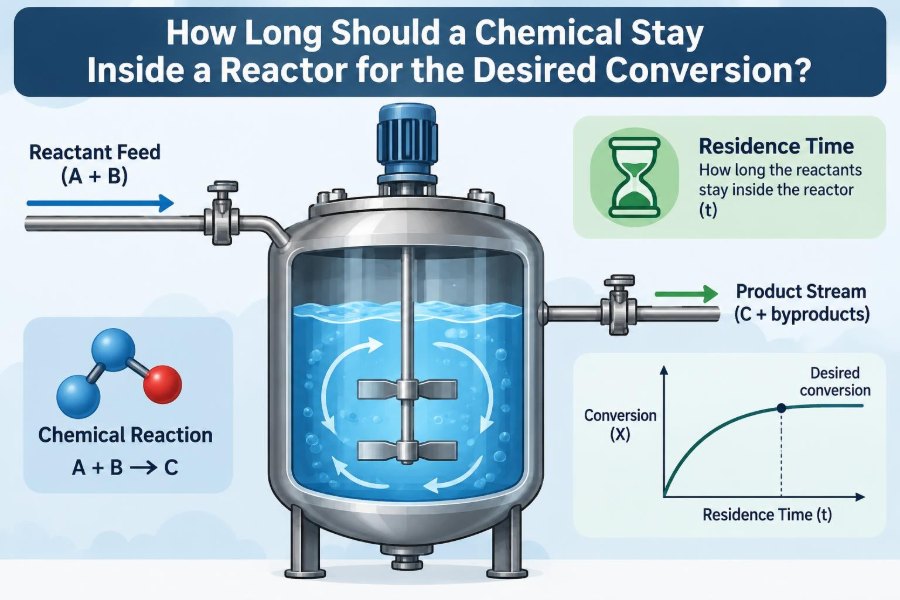

A production team notices that the outlet concentration from a reactor has drifted upward. The feed rate has increased, the reactor volume has not changed, and suddenly more unreacted material is leaving the unit. Is the chemistry failing, or is the material simply not staying long enough?
This question appears in settings ranging from wastewater treatment tanks to pharmaceutical plants, polymer lines, refineries, and laboratory flow reactors. It is usually described as a question of residence time: the time a fluid element spends inside a reactor.
Residence time seems easy to calculate, but choosing the right value is not just a volume-divided-by-flow exercise. Reaction kinetics, mixing, temperature control, pressure drop, side reactions, catalyst condition, and the real flow pattern all influence whether a chosen residence time actually delivers the desired conversion.
The practical goal is not to keep a chemical inside a reactor for the longest possible time. It is to provide enough effective reaction time, under the right conditions, to meet conversion and product-quality targets safely and economically.
🧭 Start With the Question Behind the Question
“How long should it stay?” can mean several different things. A process engineer may be asking for the average time in the vessel, while a kineticist may mean the time required for a batch reaction to reach a specified conversion.
These are related but not interchangeable. A reactor can have a suitable average residence time while some material bypasses quickly and some remains much longer than average.
🔄 Define Conversion Before Designing for It
Conversion measures how much of a reactant has been consumed. For reactant A, the conversion is commonly written as X = (moles of A fed − moles of A leaving) / moles of A fed.
A conversion of 0.80 means 80% of A has reacted. It does not automatically mean 80% became the desired product; competing reactions may form by-products.
⏱️ Residence Time Is a Flow-Based Average
The nominal or hydraulic residence time is usually estimated by τ = V/Q, where V is the working reactor volume and Q is the volumetric flow rate.
If 10 m³ of liquid is held in a vessel and flows through at 2 m³/h, the nominal residence time is 5 h. This calculation is a valuable first estimate, but it assumes the whole volume is active and the flow rate is properly defined at reactor conditions.
🧪 Batch Time and Residence Time Are Different
In a batch reactor, material is charged, reacted for a planned duration, and then discharged. The relevant variable is reaction time, often supplemented by heating, cooling, charging, and cleaning time.
In a continuous reactor, feed enters and product leaves at the same time. Individual molecules have a distribution of ages, so residence time describes flow behavior rather than a single clock time for every molecule.
📈 Reaction Rate Sets the Fundamental Time Scale
The chemical rate law connects concentration to time. For a simple irreversible reaction, a faster intrinsic reaction needs less reactor time to reach a given conversion, while a slower reaction needs more.
Rate laws are obtained from experiments, mechanistic knowledge, or validated plant data. They may depend on reactant concentration, catalyst loading, temperature, pressure, solvent composition, and mass-transfer conditions.
➗ First-Order Kinetics Give a Useful Starting Model
For a hypothetical first-order reaction, -rA = kCA. In a plug-flow reactor with constant density, the required residence time is τ = -ln(1 − X)/k.
This relationship shows why high conversion can be expensive in time. Moving from 50% to 90% conversion requires substantially more time than moving from 0% to 50%, because less reactant remains available to react.
🧮 Other Reaction Orders Change the Design Picture
A zero-order reaction proceeds at an approximately constant rate over its valid range. A second-order reaction can slow sharply as reactant concentrations fall. Real systems may switch apparent order across different concentration ranges.
That is why a universal rule such as “double the residence time for double the conversion” is unreliable. The design must follow the applicable kinetics, not intuition alone.
🚰 Plug Flow Uses Reactor Volume Efficiently for Many Reactions
An ideal plug-flow reactor, or PFR, moves fluid through a tube or packed bed with minimal axial mixing. Each fluid element progresses along the reactor and experiences a changing concentration as reaction proceeds.
For many positive-order reactions, a PFR reaches a given conversion with less volume than a perfectly mixed continuous stirred-tank reactor. Tubular reactors and many fixed-bed catalytic reactors are designed to approximate this behavior.
🌀 Perfect Mixing Creates a Different Concentration Environment
In an ideal continuous stirred-tank reactor, or CSTR, contents are uniformly mixed. The outlet concentration is therefore the same as the concentration throughout the tank.
For a positive-order reaction, the reaction occurs everywhere at the relatively low outlet reactant concentration. A single CSTR often needs more volume, and thus more nominal residence time, than a PFR for the same conversion.
🧱 Reactors in Series Can Improve the Trade-Off
Several CSTRs in series create concentration stages. The first vessel sees the highest reactant concentration, and later vessels complete more of the conversion.
As the number of equal-volume tanks increases, their overall behavior can approach plug flow. This arrangement can be practical when one long tubular reactor is difficult to control, clean, or construct.
📊 Compare Ideal Reactor Behaviors Carefully
| Reactor model | Mixing assumption | Typical consequence for positive-order reactions |
|---|---|---|
| Batch reactor | Usually well mixed over time | Time is selected from concentration-versus-time behavior |
| CSTR | Complete mixing at steady state | Often requires greater volume for high conversion |
| PFR | Minimal axial mixing | Often uses volume more efficiently |
| CSTRs in series | Stagewise mixing | Offers a controllable middle ground |
These are idealized models, not guarantees. Their value is that they make assumptions visible and provide useful design limits.
🌡️ Temperature Can Change Required Time Dramatically
Reaction-rate constants commonly increase with temperature, often described by the Arrhenius relationship. A modest temperature change can therefore reduce the residence time needed for a target conversion.
But higher temperature is not a free shortcut. It can promote decomposition, unwanted reactions, vapor formation, catalyst deactivation, corrosion, or thermal runaway in exothermic systems.
🔥 Exothermic Reactors Need a Heat-Removal Plan
When a reaction releases heat, faster reaction raises temperature, and higher temperature may further accelerate the reaction. This feedback can make conversion highly sensitive to flow rate and cooling performance.
Residence-time selection must be paired with heat-transfer design, temperature measurement, emergency relief analysis, and operating limits. A long hold-up time may increase the energy released during an upset.
❄️ Endothermic Reactions Can Slow as They Proceed
Endothermic reactions absorb heat. Without sufficient heat input, the reacting mixture can cool, lowering the reaction rate and making the actual conversion less than a design based on constant temperature.
Heating jackets, furnaces, interstage heating, or heat-exchanger reactors may be needed. The kinetic calculation should use the temperature profile that the equipment can realistically sustain.
⚖️ Equilibrium May Limit Conversion Regardless of Time
Some reversible reactions approach chemical equilibrium. Once the forward and reverse rates balance, additional time alone cannot increase equilibrium conversion under unchanged conditions.
Possible strategies include changing temperature or pressure, using excess reactant, removing a product as it forms, or separating and recycling unreacted feed. These choices require process-wide evaluation, not simply a larger reactor.
🧫 Selectivity May Matter More Than Maximum Conversion
Suppose desired product B forms from A, but B slowly converts to unwanted C. Extending residence time may consume more A while also destroying more B.
The best operating point may therefore be below maximum A conversion. Engineers commonly optimize for yield and selectivity, not conversion in isolation.
🧲 Catalysts Add Their Own Clock
A catalyst can increase reaction rate and reduce required reactor volume, but activity changes with age. Poisoning, fouling, sintering, attrition, and coking can all lengthen the effective residence time needed to hold conversion.
Design should account for expected activity decline between regenerations or replacement. A freshly loaded catalyst bed may meet target easily, while an aged bed may become the limiting condition.
🫧 Mass Transfer Can Masquerade as Slow Kinetics
Not every slow reaction is chemically slow. In gas-liquid, liquid-solid, and porous-catalyst systems, reactants must first move across phase boundaries or diffuse into pores.
If mass transfer limits the overall rate, increasing nominal residence time may help but may not be the best solution. Smaller bubbles, improved agitation, different packing, higher interfacial area, or altered particle size can be more effective.
🌪️ Mixing Determines Whether the Chemistry Sees the Intended Conditions
Fast reactions can occur in the small period before feed streams fully mix. Local zones of high concentration or temperature may create by-products even when average reactor conditions appear acceptable.
Agitator design, feed-point location, impeller speed, injection velocity, and viscosity all matter. Residence time cannot correct poor micromixing when selectivity is decided in milliseconds or seconds.
🕳️ Dead Zones Make the Useful Volume Smaller
Dead zones are poorly circulated regions where fluid exchanges slowly with the main flow. They reduce effective volume and can expose material to much longer-than-planned residence times.
Common causes include poor vessel geometry, low agitation, internal obstructions, settled solids, and stagnant branches. In sensitive products, stagnant zones can cause degradation, contamination, or difficult cleaning.
➡️ Channeling Lets Some Material Leave Too Soon
Channeling occurs when flow finds preferential paths through a vessel, packed bed, or treatment tank. Some material exits rapidly while other regions are underused.
The average residence time may still look acceptable, yet early-exiting material may be underconverted. Distributor design, bed loading quality, internals, and hydraulic operating range are central to prevention.
📉 Residence-Time Distribution Reveals Real Flow Behavior
A residence-time distribution, or RTD, describes how long different portions of fluid spend in a system. It is commonly evaluated with a tracer test: a detectable, nonreactive tracer is introduced and measured at the outlet over time.
An RTD can reveal bypassing, dead volume, recirculation, or unexpected dispersion. It does not replace kinetic testing, but it shows whether an ideal reactor model is credible.
🧪 Use Tracer Tests With Thoughtful Interpretation
A tracer should be detectable, compatible with the process, and unlikely to adsorb, react, or separate into another phase. Pulse and step tests provide different views of the system response.
Results must also be interpreted at representative flow rates and fluid properties. Water-based tests may not fully represent a viscous, multiphase, or non-Newtonian production fluid.
📏 Define the Correct Reactor Volume
Nameplate vessel volume is rarely the right number. Working volume excludes vapor space and may exclude regions unavailable during normal operation, while packed-bed void volume differs from total shell volume.
For gas-phase systems, volumetric flow can change strongly with temperature, pressure, and mole-number changes. Use flow and volume on a consistent basis, and state that basis clearly.
🔁 Recycle Changes the Meaning of Single-Pass Conversion
Many processes separate unreacted feed from products and return it to the reactor. In such systems, single-pass conversion can be modest while overall conversion of fresh feed is high.
Recycle reduces losses but raises circulation flow, separation duty, and control complexity. The reactor residence time must be evaluated alongside the recycle ratio and the capacity of downstream equipment.
🏭 Throughput and Residence Time Pull in Opposite Directions
For a fixed effective volume, increasing throughput increases volumetric flow and decreases nominal residence time. If kinetics and conditions remain unchanged, conversion generally falls.
Plants often face this constraint during debottlenecking. Capacity can sometimes increase through better temperature control, catalyst upgrades, staging, or improved mixing, but each option needs validation rather than assumption.
🛠️ A Practical Design Workflow
- Define the target conversion, yield, purity, and production rate.
- Develop or obtain a rate model over the relevant composition and temperature range.
- Select plausible reactor models and account for phases, mixing, and heat transfer.
- Calculate required volume or time under normal and limiting operating conditions.
- Check equilibrium, selectivity, pressure drop, utilities, safety, and downstream separation.
- Validate with pilot data, plant tests, or conservative scale-up methods.
This workflow avoids a common error: sizing a reactor from kinetics alone and discovering later that heat removal or hydraulics controls the design.
⚠️ Common Shortcuts That Produce Bad Answers
- Using vessel volume instead of effective volume: ignores vapor space, packing, and stagnant regions.
- Assuming ideal plug flow or perfect mixing without evidence: hides distribution and bypassing risks.
- Designing at one temperature: misses start-up, seasonal utility changes, and hot spots.
- Chasing conversion alone: can sacrifice selectivity, yield, or product stability.
- Ignoring catalyst age: creates a design that works only at the beginning of a run.
🧯 Safety and Operability Set Real Boundaries
A technically sufficient residence time may still be unacceptable if it creates excessive inventory of hazardous material, difficult emergency isolation, polymer buildup, or severe consequences during loss of cooling.
Conversely, an extremely short residence time can make control loops too sensitive to feed disturbances. Good design balances reaction performance with stable, maintainable operation.
🔍 Monitor Indicators That Show Time Is No Longer Enough
Outlet composition is the most direct indicator, but it should be interpreted with flow rate, temperature profile, pressure drop, agitator power, catalyst age, and feed composition.
A drop in conversion may result from shorter residence time, but it may also indicate fouling, poor mixing, a cooling limitation, changed feed quality, or an analyzer problem. Troubleshooting should test these competing explanations.
🧠 Use Models as Decision Tools, Not Oracles
Steady-state reactor equations are essential, but plant behavior can be dynamic. Start-up, grade transitions, catalyst wetting, and changes in feed composition may create temporary conditions that a simple steady-state model misses.
Models become most valuable when their assumptions are compared with measurements. Update them as kinetic, hydraulic, and operating data improve.
✅ The Core Principle: Time Must Match Chemistry and Flow
There is no universal residence time for a desired conversion. The required value arises from reaction kinetics, reactor type, temperature, mixing, transport limitations, equilibrium, selectivity, and the difference between nominal and actual flow behavior.
The best answer is usually a range with a justified operating target, not a single isolated number. That range should include credible disturbances and the condition—such as aged catalyst or maximum feed rate—that truly limits performance.
A chemical should remain in a reactor only as long as the real reaction system needs to meet conversion, yield, safety, and operability targets—not as long as an ideal equation suggests in isolation. 🧪⏱️🏭