
A refinery turns crude oil into useful fuels. A pharmaceutical plant recovers solvents for reuse. A beverage producer concentrates alcohol. Although the products and equipment look very different from the outside, many of these operations depend on the same idea: repeatedly contacting vapor and liquid so that each becomes a little more selective.
That repeated contact happens inside a distillation column. It is a tall vessel often fitted with trays or packed with structured material, and it may appear deceptively simple on a process-flow diagram. In operation, however, it is a carefully balanced system of heat input, cooling, fluid flow, pressure, and composition.
Distillation matters because many industrial mixtures cannot be separated well by a single evaporation or condensation step. The goal is not merely to boil something; it is to create many opportunities for the more volatile components to move upward and the less volatile components to move downward.
Following the column stage by stage makes the equipment far less mysterious. It also reveals why a small change in reflux, feed condition, pressure, or steam can affect product quality throughout an entire plant.
🏭 What a Distillation Column Actually Does
A distillation column separates a liquid mixture according to differences in volatility, meaning how readily each component enters the vapor phase at a given temperature and pressure. Components that vaporize more readily tend to become concentrated toward the top. Less volatile components tend to collect toward the bottom.
This is not a molecular sorting machine. Both vapor and liquid usually contain several components at every point in the column. Separation occurs because their compositions change progressively as the two phases contact one another.
🧪 Start with Vapor–Liquid Equilibrium
When liquid and vapor contact long enough at a specified temperature and pressure, they approach vapor–liquid equilibrium, often shortened to VLE. At equilibrium, neither phase is necessarily pure, but the vapor is normally richer in the more volatile component than the liquid.
Consider a hypothetical mixture of ethanol and water. Under suitable conditions, vapor formed from the mixture contains more ethanol than the liquid from which it came. Condensing that vapor gives a liquid enriched in ethanol. A column repeats this enrichment many times.
🌡️ Volatility, Not Simply Boiling Point
Boiling-point comparisons are useful for an initial intuition, but industrial design relies more directly on relative volatility. Relative volatility describes how much more strongly one component favors the vapor phase than another under particular conditions.
It can vary with temperature, pressure, and mixture composition. A pair of compounds with comfortably separated normal boiling points may still be difficult to separate in a real mixture, while another pair may separate efficiently under the chosen operating pressure.
⬆️ The Essential Countercurrent Flow
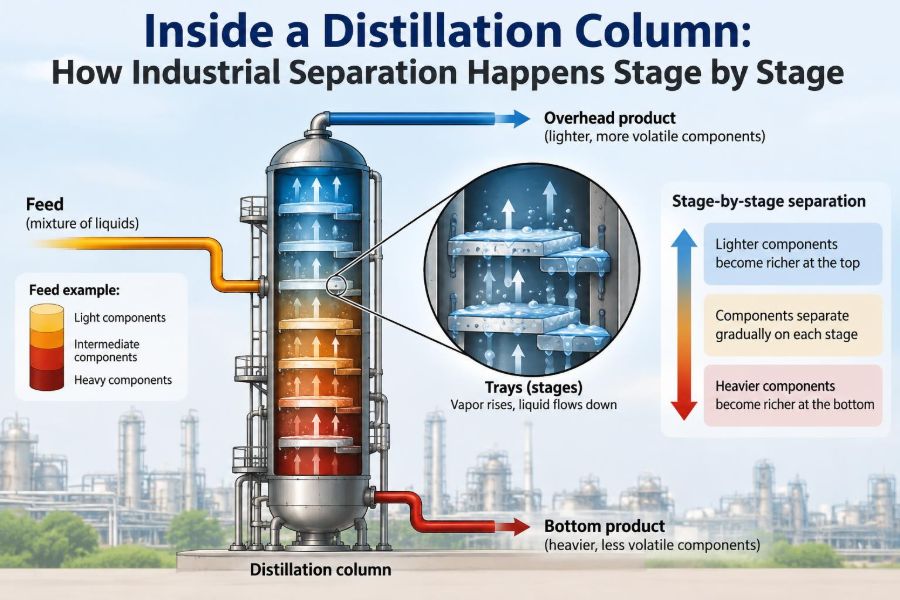
Inside most columns, vapor flows upward while liquid flows downward. Their countercurrent movement is crucial. Rising vapor encounters liquid that has already been partly stripped of its light component, while descending liquid encounters vapor increasingly rich in that light component.
At each contact point, light material transfers preferentially from liquid to vapor, and heavy material transfers preferentially from vapor to liquid. The cumulative result is a top stream rich in light components and a bottom stream rich in heavy components.
🧱 Why One Flash Vessel Is Not Enough
A flash drum performs one equilibrium separation: a feed partially vaporizes, then vapor and liquid disengage. It is useful, but its separation is limited to one contact opportunity.
A column is better understood as a sequence of flashes linked together. Vapor leaving one stage contacts liquid from the stage above; liquid leaving one stage contacts vapor from the stage below. This repeated redistribution is why columns can achieve demanding product specifications.
🪜 The Meaning of a Theoretical Stage
A theoretical stage is an idealized contact where leaving vapor and liquid are at equilibrium. It is a calculation tool, not necessarily a physical tray.
Real trays may not reach perfect equilibrium because contact time, mixing, froth behavior, and mass-transfer resistance are finite. Designers therefore use tray efficiency or packing performance data to translate required theoretical stages into practical equipment height or tray count.
🔩 Tray Columns: Stages Made Visible
In a tray column, horizontal decks hold a layer of liquid. Vapor rises through openings, bubbling through that liquid and creating a frothy, turbulent contacting zone. The liquid then flows across the tray and down to the tray below.
Common tray arrangements include sieve trays, valve trays, and bubble-cap trays. They differ in how vapor passes through the deck and how they handle changes in vapor rate, fouling, cost, and operating flexibility.
⚙️ Key tray features
- Downcomers carry liquid from one tray to the next lower tray.
- Weirs retain a controlled liquid depth on the tray.
- Active area is where vapor and liquid contact through holes or valves.
🧩 Packed Columns: Continuous Contacting
Packed columns replace discrete trays with a bed of material that spreads liquid over a large surface area while vapor rises through open passages. Random packing may consist of individual shapes dumped into the vessel; structured packing is arranged in ordered corrugated layers.
Packing can offer low pressure drop, making it attractive for vacuum distillation. It can also be valuable for heat-sensitive materials, though good liquid distribution is essential. A poorly distributed liquid stream can leave large parts of the packing underused.
📍 The Feed Tray Divides the Column
The feed enters at a selected point between the column top and bottom. This location divides the column into two functional regions: the rectifying section above the feed and the stripping section below it.
Above the feed, rising vapor is enriched in the light component. Below it, descending liquid is stripped of light material. Feed location is not arbitrary: placing a feed too high or too low can force unnecessary internal traffic and increase energy demand.
💧 Feed Condition Changes Internal Flows
The feed may enter as a cold liquid, saturated liquid, partially vaporized mixture, saturated vapor, or superheated vapor. Its thermal condition changes how much vapor and liquid are present immediately around the feed stage.
A cold liquid must absorb heat before it can vaporize, tending to condense some upward vapor. A vapor-rich feed contributes more upward vapor. Engineers represent this behavior in design methods using a feed-quality parameter, often called q, but the practical lesson is simpler: feed temperature influences the entire column’s internal balance.
🔥 The Reboiler Supplies the Upward Push
At the bottom, liquid from the column enters a reboiler, where heat creates vapor. Most of that vapor returns upward into the column; a liquid bottoms product is withdrawn separately.
The reboiler is more than a heater. Its boil-up rate determines the vapor traffic through the stripping section. Too little boil-up can leave excessive light material in the bottoms. Too much raises utility use and may push internal hydraulics toward unstable operation.
❄️ The Condenser Creates Reflux
Overhead vapor leaves the column and enters a condenser. A total condenser turns essentially all of that vapor into liquid; a partial condenser leaves a vapor and liquid phase and can itself provide an equilibrium separation.
Part of condensed liquid becomes overhead product. The rest returns to the column as reflux. This cool liquid flows downward from the top and is central to obtaining a high-purity distillate.
🔁 Reflux Is Recycled Separation Power
Reflux may look wasteful because material that has reached the top is sent back down. In reality, it supplies liquid for repeated contact in the rectifying section. More reflux generally makes the top product richer in the light component.
The reflux ratio compares returned reflux with withdrawn distillate. Higher reflux often reduces the number of stages needed for a target separation, but it increases internal flow and condenser and reboiler duties. Plants therefore seek an economic operating range rather than the highest possible reflux.
📉 The Temperature Profile Tells a Story
Temperature usually decreases from the hot bottom toward the cooler top, but it should not be interpreted as a direct composition analyzer. Pressure changes and multicomponent behavior affect boiling temperature, and a single temperature cannot uniquely specify composition in every system.
Still, a stable temperature profile is a powerful operating indicator. A sudden movement in one section can point to changes in feed composition, pressure, reflux, reboiler duty, or an approaching hydraulic problem.
🧭 Pressure Shapes the Entire Separation
Changing pressure changes equilibrium, temperatures, vapor density, and utility choices. Lowering pressure often lowers boiling temperatures, which can protect thermally sensitive materials. It also increases vapor volume, potentially requiring a larger column diameter.
Higher pressure can allow condensation using warmer cooling utilities, but it may make a difficult split even harder. Pressure selection is therefore a compromise involving separability, heat integration, equipment size, safety, and product stability.
📊 Reading Composition from Top to Bottom
A binary-column picture is useful: the light component rises in concentration toward the top, while the heavy component rises toward the bottom. Real industrial feeds often contain many components, so the pattern is more layered.
In a multicomponent column, intermediate-boiling materials may concentrate near particular regions and may be removed through side draws. Designers must track every significant component, not just a conveniently named “light key” and “heavy key.”
🧮 The Material Balance Comes First
Before sizing equipment, engineers account for matter. At steady state, feed entering must equal the total products leaving, provided no accumulation occurs. Component balances extend the same logic to each species.
These balances identify whether stated product flow rates and compositions are even possible. They also provide the basis for selecting recovery targets: for example, how much of a valuable light component should be recovered overhead versus allowed into the bottoms.
⚡ Energy Balance Connects Heat and Purity
A column consumes heat in the reboiler and rejects heat in the condenser. Feed enthalpy, product enthalpies, heat losses, and phase changes all matter in an energy balance.
Purity has an energy cost because more demanding separation commonly requires stronger internal recycling through reflux and boil-up. Heat integration—such as using one hot process stream to preheat another—can reduce external utility demand, but it must not make control or maintenance impractical.
📐 From Stage Count to Column Height
Separation design asks how many equilibrium contacts are needed, then how those contacts will be provided. For relatively simple systems, graphical approaches can illustrate the relationship among stages, reflux, and feed condition. Industrial design commonly uses rigorous thermodynamic models and process simulation.
For tray columns, theoretical stages are converted using expected efficiency and tray spacing. For packed columns, designers use concepts such as height equivalent to a theoretical plate. Neither shortcut removes the need for reliable physical-property data.
📏 Diameter Is Set by Hydraulic Capacity
Column height mainly relates to required contacting, while diameter mainly relates to how much vapor and liquid can pass without trouble. As vapor rate rises, entrainment and pressure drop increase. As liquid rate rises, downcomers or packing passages can become overloaded.
A column must accommodate normal operation as well as expected changes in feed rate, product demand, and utility conditions. Designing only for one ideal point can produce an efficient-looking but inflexible installation.
🌊 Flooding: When Internal Traffic Becomes Too High
Flooding occurs when upward vapor impedes the downward movement of liquid so severely that liquid accumulates. In tray columns, it may overwhelm downcomers or carry liquid upward. In packed columns, rising vapor can hold up liquid and sharply increase pressure drop.
Flooding reduces separation and can cause unstable levels, off-spec products, and operational upset. It is a major reason why vapor and liquid loads are checked carefully during design and monitored during operation.
💨 Weeping and Dumping at Low Vapor Rates
The opposite problem occurs when vapor flow is too low to support liquid on a tray. Liquid can leak through vapor openings rather than flowing across the tray to its downcomer. This is called weeping; severe loss of liquid retention is often called dumping.
Contacting then deteriorates because vapor does not bubble effectively through a liquid layer. The column may have many installed trays yet behave as though it has far fewer useful stages.
🫧 Entrainment and Foaming Blur the Split
Entrainment is liquid carried upward by vapor. If heavy-component-rich droplets reach higher trays or the overhead system, they contaminate material intended to be light-rich. Demisters and adequate vapor disengagement can help at the column top.
Foaming creates an unusually stable gas-liquid dispersion that occupies excessive volume and disrupts flow. Surface-active contaminants can promote it. The response depends on the cause: reducing rates may help, but changing feed treatment or equipment internals may be necessary.
🧱 Maldistribution Can Quietly Waste Packing
In a packed bed, liquid should spread broadly and repeatedly across the packing. If it channels along the wall or through only part of the cross-section, vapor contacts less liquid than intended.
Distributors, redistributors, proper leveling, and sound installation matter because packing performance is strongly tied to flow distribution. A pressure-drop reading alone may not reveal this issue; composition profiles and performance tests are often more informative.
🎛️ The Core Control Loops
Columns are coupled systems, so no single controller “controls separation.” Pressure is commonly controlled through condenser duty or a vent arrangement. Reflux flow, distillate flow, bottoms flow, and reboiler heat input are then coordinated with inventories and product-quality objectives.
Temperature at selected sensitive locations is often used as a practical inferential signal for composition. Online analyzers can provide more direct quality measurement, but they require maintenance and may respond more slowly than temperature measurements.
🔍 What Operators Watch During a Shift
Useful observations combine instruments with process context. A change in overhead pressure affects temperature readings; a lower reflux flow can explain a top-temperature shift; a rising differential pressure may indicate increasing hydraulic resistance.
- Column pressure and pressure drop
- Reflux, distillate, bottoms, and feed flow rates
- Reboiler duty and condenser performance
- Tray or bed temperatures at meaningful locations
- Drum and bottom levels, plus laboratory or analyzer results
One measurement rarely tells the full story. Trends and relationships are usually more valuable than a single isolated number.
⚠️ Startups and Shutdowns Need Patience
During startup, the column and its internals must warm gradually enough to avoid severe thermal stress and unstable vapor surges. Operators establish pressure control, circulation, heat input, and reflux in a planned sequence while watching levels and differential pressure.
Shutdown can be equally demanding. Heat input may be reduced while maintaining enough reflux or circulation to avoid undesirable composition shifts, overheating, vacuum problems, or accumulation in connected equipment. Exact procedures depend on the process and site safeguards.
🛡️ Distillation Has Real Process Hazards
Many columns handle flammable, toxic, corrosive, hot, or pressurized fluids. A loss of cooling can raise pressure; a blocked outlet can overfill equipment; incorrect line-up can send material to the wrong destination. Relief systems and operating procedures address credible scenarios, but they do not replace disciplined operation.
Thermal decomposition is another concern for sensitive products. Lower pressure, shorter residence time, and alternative separation methods may be considered when heat exposure threatens product quality or creates hazardous byproducts.
🧷 Azeotropes Set a Fundamental Limit
Some mixtures form an azeotrope, a composition at which vapor and liquid have the same composition under specified conditions. Ordinary distillation cannot pass beyond that composition at that pressure because the usual vapor enrichment disappears.
Options may include pressure-swing distillation, adding an entrainer in azeotropic or extractive distillation, adsorption, membranes, or another separation sequence. The right choice depends on the mixture, purity target, available utilities, and whether an added solvent can be recovered safely.
🔄 When Distillation Is Not the Best Tool
Distillation is robust and widely understood, but it is often energy-intensive when relative volatility is low or feed concentration is very dilute. Evaporation, liquid–liquid extraction, crystallization, adsorption, membranes, or hybrid systems may perform part of the job more effectively.
The practical question is not whether distillation is familiar. It is whether repeated vapor–liquid contact offers the best combination of purity, recovery, energy use, controllability, and lifecycle cost for the specific mixture.
🧠 A Stage-by-Stage Mental Model
Imagine standing on any tray. Vapor arriving from below is relatively rich in light material. Liquid arriving from above is relatively rich in heavy material. They contact, exchange components, and depart in opposite directions: the vapor leaves lighter, while the liquid leaves heavier.
Move upward and repeat the same logic. Move downward and repeat it in reverse. The reboiler continuously creates vapor at the bottom, and reflux continuously supplies liquid at the top. That circulation is the engine of fractional distillation.
✅ The Core Principle to Remember
A distillation column succeeds through controlled repetition. Equilibrium favors a different composition in vapor than in liquid; countercurrent contact captures that difference many times; reboiler heat and condenser reflux sustain the internal flows.
Its performance depends on more than the number of trays or the height of packing. Thermodynamics establishes what separation is possible, hydraulics limits how much material can move, and control keeps the operating point where product specifications can be met reliably.
Industrial distillation works stage by stage because every well-managed vapor–liquid contact makes a small separation, and the column turns those small changes into a useful product split. 🧪🏭⚙️