
A bottle of detergent, a pain-relief tablet, a sheet of plastic packaging, and the clean fuel that moves a delivery truck can look like unrelated products. Behind each one is often a chain of carefully controlled chemical processing steps.
To someone outside the industry, a chemical plant may appear to be a maze of towers, pipes, tanks, and steam. To an engineer or operator, it is a connected system that transforms raw materials into products while managing energy, quality, emissions, and risk at every point.
Understanding how a modern processing plant is built helps make sense of chemical engineering as a practical discipline. It shows why a seemingly simple reaction requires much more than a reactor, and why layout, instrumentation, maintenance, and human decisions matter as much as chemistry.
The exact equipment differs between a refinery, pharmaceutical site, water-treatment facility, and specialty chemicals plant. Yet the underlying design logic is remarkably consistent: define the product, control the transformation, separate what is valuable, recycle what can be reused, and protect people and the environment.
🏭 The Plant as a Connected Production System
A chemical processing plant is not a collection of independent machines. It is an integrated production system in which material, energy, information, and utilities move continuously or in planned batches.
Feedstocks enter, undergo physical or chemical change, are purified, checked against specifications, and leave as products or managed by-products. A disruption in one unit can affect every unit downstream, much like a blocked lane can slow an entire road network.
This systems view is central to chemical engineering. The goal is not merely to make a reaction occur; it is to make the full process safe, stable, economical, controllable, and compliant over long operating periods.
🧭 Starting with the Product Specification
Plant design begins with what the customer needs, not with a preferred piece of equipment. Product specifications may include composition, purity, viscosity, particle size, moisture content, color, packaging form, and allowable trace impurities.
For example, producing industrial-grade ethanol and producing solvent-grade ethanol can require different purification targets. A small amount of water or another organic compound may be acceptable in one application but unacceptable in another.
Specifications also establish the process window. Engineers must determine which properties must be tightly controlled, which can vary within a range, and how the plant will verify the result before shipment.
🧪 Choosing and Preparing Feedstocks
Feedstocks are the starting materials supplied to the plant. They may be gases, liquids, solids, biomass-derived materials, mineral ores, recycled streams, or intermediates made at another facility.
Incoming materials rarely arrive in perfect condition. A liquid may contain water, a gas may carry particulates, or a solid may have an inconsistent size distribution. Pretreatment protects downstream equipment and prevents contaminants from undermining reaction performance or product quality.
- Filtration removes suspended solids from liquids or gases.
- Drying reduces water where moisture would interfere with processing.
- Blending smooths natural or supplier-to-supplier variation.
- Heating or cooling brings a feed to a suitable processing temperature.
Feed variability is a real design condition, not an inconvenience to ignore. A plant that only works with ideal feedstock is unlikely to operate reliably in practice.
🚚 Receiving, Storage, and Material Handling
Before material reaches the process, it must be unloaded, identified, stored, and transferred without contamination or loss. Tank farms, silos, warehouses, rail connections, truck bays, pumps, and conveyor systems are therefore part of the process—not just logistics.
Storage design considers chemical compatibility, vapor generation, temperature sensitivity, inventory needs, and emergency containment. A volatile liquid may require a closed transfer system, while a moisture-sensitive powder may need dry handling and sealed packaging.
Segregation is equally important. Incompatible chemicals must not share transfer paths or containment areas if an accidental release could create a hazardous reaction. Clear labeling and verified line-up procedures help prevent a material from being routed to the wrong destination.
⚗️ Where Chemical Change Happens: The Reactor
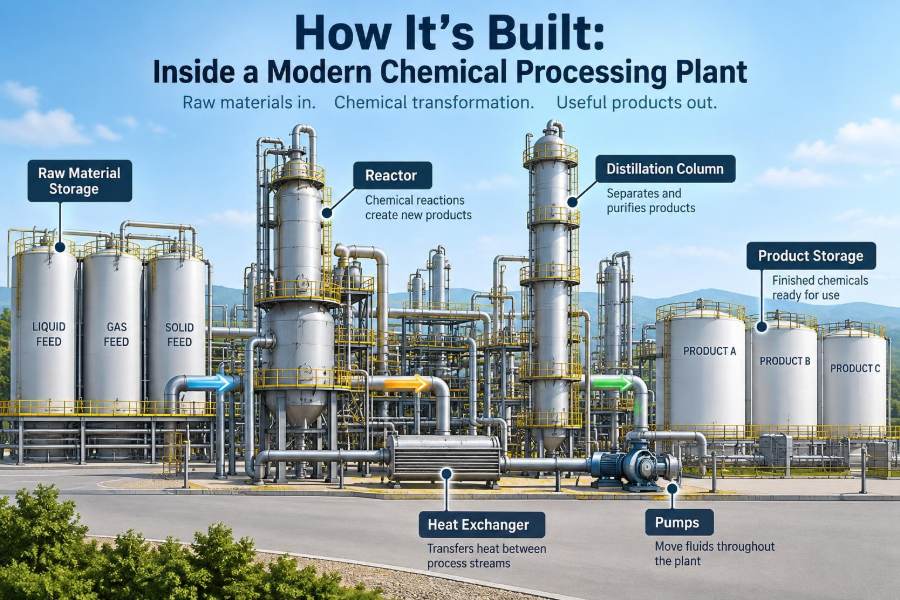
The reactor is the unit where reactants are intentionally converted into desired products. It may be a stirred vessel, a tubular pipe reactor, a packed catalyst bed, a fermenter, or another configuration chosen for the chemistry.
Reactor selection depends on reaction rate, heat release or absorption, phase behavior, mixing needs, pressure, catalyst use, and desired throughput. A fast gas-phase reaction may suit a continuous tubular system, while a formulation with many ingredients may be made in a batch vessel.
Conversion alone does not define success. The plant also cares about selectivity: how much of the feed becomes the desired product rather than unwanted side products. Conditions that raise conversion can sometimes reduce selectivity, creating a design trade-off.
🌡️ Managing Heat During Reaction
Many reactions release heat, while others need heat supplied continuously. If this energy is not managed, temperature can drift, reaction rates can change sharply, and materials may degrade or form unwanted products.
Jackets, internal coils, external heat exchangers, and recirculation loops remove or provide heat. In a large reactor, mixing must be strong enough that one zone does not become much hotter or richer in reactant than another.
For strongly exothermic systems, temperature control is also a safety function. Engineers assess credible upset conditions, such as loss of cooling or incorrect feed addition, and design layers of protection rather than relying on routine control alone.
🔄 Batch and Continuous Processing
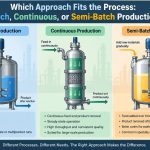
In batch processing, a defined quantity of material is charged, processed, discharged, and the cycle repeats. Batch plants are common where product grades change frequently, volumes are moderate, or traceability of individual lots is essential.
Continuous plants operate with material flowing in and product flowing out for extended periods. They can provide steady quality and efficient use of equipment at high production rates, but they demand robust controls and careful management of transitions.
| Feature | Batch processing | Continuous processing |
|---|---|---|
| Typical strength | Flexibility between products | Stable high-volume operation |
| Operating pattern | Repeated campaigns or lots | Ongoing material flow |
| Common challenge | Cleaning and changeovers | Managing disturbances without interruption |
| Quality focus | Lot-by-lot consistency | Control of steady-state conditions |
Neither mode is inherently superior. The product portfolio, market demand, reaction behavior, and cleaning requirements usually decide the better fit.
🧱 Catalysts and Their Practical Limits
A catalyst increases reaction rate or directs a reaction toward a preferred product without being consumed in the same stoichiometric way as a reactant. Catalysts can make a process feasible at lower temperature or pressure, reducing energy use and unwanted reactions.
In real plants, catalysts age. They may be fouled by impurities, poisoned by trace contaminants, sintered by excess heat, or physically damaged. Performance monitoring is needed because declining catalyst activity can show up as poorer conversion, higher energy demand, or off-spec product.
Some catalyst systems can be regenerated; others must be replaced. That decision affects maintenance planning, waste handling, and the economics of the entire process.
🌀 Separating the Product from the Mixture
Reaction mixtures usually contain more than the target product: unreacted feed, solvents, catalysts, by-products, water, and dissolved gases may all be present. Separation often consumes a major share of a plant’s equipment and energy.
The separation method uses a physical difference between components. That difference might be volatility, density, solubility, particle size, electrical charge, or affinity for a surface.
- Distillation separates liquids using volatility differences.
- Filtration retains particles while fluid passes through a medium.
- Extraction transfers a component between immiscible liquid phases.
- Adsorption captures selected molecules on a solid surface.
- Membranes allow certain species to pass preferentially.
A separation that looks simple on a flowsheet can be difficult when properties are similar or when heat-sensitive materials cannot tolerate high temperatures.
🏗️ Distillation Columns: Tall Equipment with a Precise Job
Distillation columns are among the most recognizable pieces of process equipment. Inside, rising vapor and descending liquid contact each other on trays or packing, allowing more volatile components to concentrate toward the top and less volatile components toward the bottom.
The overhead vapor is condensed, and part of the liquid is returned as reflux to sharpen the separation. Heat supplied near the bottom through a reboiler generates vapor that drives the internal contact.
Columns are powerful but energy intensive. Designers examine pressure, reflux, number of stages, feed location, heat integration, and control strategy. When a mixture forms an azeotrope or has close boiling points, conventional distillation may need assistance from another technique.
💧 Pumps, Compressors, and the Machinery That Moves Matter
Fluids do not move through a plant on their own. Pumps add energy to liquids, while compressors raise the pressure of gases. Their selection must account for flow rate, pressure rise, temperature, chemical compatibility, and the consequences of failure.
A pump can be damaged if vapor forms at its suction and collapses inside the machine, a phenomenon known as cavitation. Good suction piping, adequate available pressure, and sensible operating conditions reduce this risk.
Rotating equipment also needs vibration monitoring, lubrication, alignment, and planned maintenance. A small seal leak or bearing problem can become a process interruption if it is not detected early.
🔥 Utilities: The Hidden Infrastructure
Utilities are shared services that let process units operate. Steam, cooling water, chilled water, electricity, instrument air, nitrogen, refrigeration, vacuum, and treated water are common examples.
Steam can heat reactors and reboilers; cooling water can condense vapor or remove reaction heat; nitrogen can blanket equipment to reduce contact with air. These systems may not appear in the finished product, but their reliability shapes production capacity.
Utility design also requires prioritization. During an upset, critical systems such as safety instrumentation, emergency shutdown capability, and essential cooling may need protected or backup supplies.
♻️ Recovering Heat Instead of Throwing It Away
Process streams often leave one unit hot and enter another unit needing heat. Heat exchangers transfer energy between those streams without normally mixing them, reducing the need for external heating or cooling.
For example, a hot product stream might preheat a cold feed before the feed enters a reactor. This is a simple illustration of heat integration, a major tool for reducing utility demand.
The best energy target on paper is not always the easiest design to operate. Closely integrated networks can be more sensitive to fouling, flow changes, and startup conditions, so practical control and maintenance must be considered alongside efficiency.
🧫 Quality Control Is Built into the Process
Quality is not created only by a final laboratory test. Modern plants use a combination of incoming-material checks, process measurements, samples, laboratory analysis, and release procedures to prevent defects from advancing unnoticed.
Online analyzers can measure variables such as composition, moisture, pH, density, or spectroscopic signals continuously or at intervals. Laboratory methods may provide more detailed confirmation but can take longer and require careful sampling.
A representative sample matters. If a sample is taken from a poorly mixed vessel or an unflushed sample line, an accurate laboratory instrument can still produce an unhelpful answer.
📈 Instrumentation Turns Equipment into a Controllable Plant
Temperature, pressure, flow, level, composition, and pH are common process variables. Sensors measure them, transmitters send signals, and control systems display trends and execute control actions.
A basic feedback loop compares a measured value with a target setpoint. If reactor temperature rises above its target, for instance, a controller may open a cooling-water valve. The loop does not “understand” chemistry; it follows configured logic based on measured signals.
Instrument reliability includes more than selecting a sensor. Installation location, calibration, impulse lines, response time, maintenance access, and protection from corrosion or plugging all affect whether the measurement can be trusted.
🖥️ Control Rooms and the Human Role
In a control room, operators oversee process displays, alarms, trends, procedures, and communications with field personnel. Automation can handle routine adjustments rapidly, but people still interpret unusual patterns, coordinate work, and make decisions during abnormal situations.
Good interfaces show what matters without burying operators in unnecessary alarms. An alarm should direct attention to a condition requiring action, not simply announce every minor deviation.
Field operators provide another essential perspective. They can observe leaks, unusual noise, vibration, odor, ice formation, valve position, or equipment behavior that may not be obvious from a screen.
🛡️ Designing Layers of Process Safety
Process safety focuses on preventing and mitigating major releases of hazardous energy or materials. It differs from, but complements, personal safety practices such as gloves, hard hats, and safe lifting.
Plants use multiple layers because no single device or procedure is perfect. Typical layers include inherently safer design choices, basic process controls, alarms with operator response, independent protective systems, relief devices, containment, and emergency response planning.
Relief valves and rupture disks help protect equipment from excessive pressure by providing a controlled discharge path. Their design must include where that discharge goes; moving material out of a vessel is not enough if it is released to an unsafe location.
⚠️ Hazard Reviews Before and During Operation
Structured hazard reviews ask what could deviate from intended operation and what the consequences could be. Teams may consider conditions such as no flow, high pressure, reverse flow, excessive temperature, contamination, or loss of utility supply.
Methods such as hazard and operability studies, often called HAZOPs, use guide words to prompt disciplined discussion. The value comes from a diverse team: process engineers, operators, maintenance personnel, controls specialists, and safety professionals can identify different failure paths.
A review is only useful when recommendations are resolved properly. Open actions, undocumented assumptions, or later modifications that bypass safeguards can quietly weaken the original design intent.
🌬️ Emissions, Wastewater, and Responsible End-of-Pipe Design
Every process must account for material that does not become saleable product. Gas vents, wastewater, spent catalysts, filter cakes, contaminated packaging, and off-spec material require planned handling routes.
Air-emission controls may include condensers, scrubbers, adsorption beds, thermal oxidation, or recovery systems, depending on the compounds and operating conditions. Wastewater may need neutralization, oil removal, biological treatment, or other treatment before discharge or reuse.
The preferred approach is often to reduce waste at its source through better yield, recovery, and segregation. End-of-pipe treatment remains necessary in many plants, but it should not substitute for understanding why waste is generated.
🧯 Containment and Emergency Preparedness
Secondary containment, drainage design, spill response equipment, fire protection, gas detection, and emergency isolation systems prepare a site for events that prevention measures do not fully stop.
Containment must fit the chemical hazard. A water-based response may be appropriate for one spill and dangerous or ineffective for another. Emergency plans therefore depend on site-specific inventories, physical properties, and credible release scenarios.
Training and drills test more than individual knowledge. They reveal whether communications work, access routes are usable, responsibilities are clear, and outside responders have the information they need.
🔧 Maintenance Is Part of Plant Design
A plant is designed to be maintained. Equipment needs clearance for lifting, safe access to instruments, isolation points for repair, drains, vents, and locations where technicians can work without creating unnecessary exposure.
Maintenance strategies range from scheduled inspection to condition-based approaches using vibration, temperature, oil condition, or performance trends. The right method depends on how equipment fails and how critical it is to safety or production.
Deferred maintenance can appear to save money until a leak, unplanned shutdown, or damaged asset creates a much larger cost. At the same time, unnecessary intrusive work can introduce errors, so maintenance should be risk-informed rather than automatic.
🔒 Isolation, Permits, and Safe Work Control
Plants routinely need line breaks, confined-space entry, hot work, electrical maintenance, and vessel cleaning. These tasks require formal work controls because process equipment can contain pressure, heat, hazardous chemicals, stored mechanical energy, or an oxygen-deficient atmosphere.
Lockout and tagout practices help ensure energy sources are isolated before work begins. A permit system clarifies the job scope, hazards, precautions, testing requirements, and authorization needed for the task.
Paperwork alone does not make work safe. The field condition must match the permit, isolation points must be verified, and changes in weather, process status, or job scope must trigger reassessment.
🧹 Cleaning, Changeovers, and Contamination Control
When a plant makes multiple products, residues from one campaign can affect the next. Cleaning may involve flushing, solvent washing, steaming, detergent circulation, mechanical removal, or validated cleaning sequences, depending on the product and equipment.
Dead legs—short sections of piping with little or no flow—can retain material and complicate cleaning. Good hygienic or contamination-sensitive design minimizes such hold-up areas and provides drainability.
Changeovers also affect scheduling. A product with difficult cleanup may occupy equipment longer than its reaction time suggests, reducing the apparent capacity of a multipurpose plant.
📦 Finishing, Packaging, and Dispatch
Many products leave the main process as a liquid, slurry, powder, pellet, gas, or concentrate that still needs finishing. Drying, granulation, blending, pelletizing, milling, crystallization, filling, and labeling can determine whether the material is usable by the customer.
Packaging protects product quality and communicates essential information. The correct container, closure, label, and shipment documentation depend on the product’s physical behavior, hazard classification, shelf-life needs, and customer requirements.
Traceability connects finished containers back to production records, raw-material lots, testing results, and operating conditions. If a quality concern emerges later, this record chain helps define the affected scope.
🧮 Material and Energy Balances Keep the Story Honest
Material balances account for what enters, leaves, accumulates, reacts, or is lost from a system. Energy balances do the same for heat and work. These simple conservation principles underpin process design, troubleshooting, and production accounting.
If a tank level rises unexpectedly, a material balance can help determine whether an inlet is too high, an outlet is restricted, an instrument is inaccurate, or a hidden recycle path is contributing flow. Balances turn vague suspicion into testable possibilities.
Real plant data are imperfect: instruments drift, inventories change, samples have uncertainty, and reactions may be incompletely characterized. Reconciliation and engineering judgment are needed before treating a calculated imbalance as proof of a fault.
📊 From Design Basis to Piping and Instrumentation Diagrams
Projects move from broad concepts to increasingly detailed documents. A process flow diagram shows major equipment and stream relationships. A piping and instrumentation diagram, commonly called a P&ID, adds valves, control loops, relief devices, line details, and many safeguards.
The design basis records assumptions such as feed properties, production rate, operating range, utilities, product requirements, and applicable constraints. It gives later decisions a reference point and helps teams recognize when a proposed change exceeds the original envelope.
Drawings are living technical records. If the installed plant differs from the drawing, maintenance and emergency decisions can be made using false information. Managing updates is therefore a safety and reliability issue, not clerical housekeeping.
🏗️ Constructing the Plant Without Losing Design Intent
Construction converts drawings into physical equipment, structures, pipework, electrical systems, and controls. Fabrication quality, weld inspection, material traceability, pressure testing, and correct installation all matter because small errors can become chronic operating problems.
Constructability should be considered early. A layout that is theoretically compact but impossible to access with lifting equipment, or difficult to inspect after installation, may create decades of avoidable maintenance difficulty.
Commissioning teams verify that systems are built, tested, and documented before introducing process chemicals. This staged approach catches missing connections, incorrect valve orientation, control-loop problems, and incomplete safeguards while consequences are lower.
🚀 Commissioning and Startup: The First Real Test
Startup is when design assumptions meet real equipment. Before production, systems may be cleaned, leak-tested, dried, flushed, function-tested, and operated with water, air, nitrogen, or other safe media where appropriate.
Introducing feed is usually gradual. Operators monitor temperatures, pressures, levels, compositions, and equipment behavior while confirming that controls and protective systems respond as intended.
Early operation often reveals practical issues: a control valve may be oversized, a sample point may plug, or a heat exchanger may foul faster than expected. These findings should feed back into operating procedures and design improvements rather than being treated as mere startup inconvenience.
🔁 Troubleshooting Through Process Thinking
Effective troubleshooting starts with defining the deviation clearly: what changed, when, where, and compared with which normal condition? Random adjustment of valves can hide evidence and introduce new problems.
A useful sequence is to verify measurements, inspect recent changes, compare material and energy balances, review trends, and test the most plausible causes safely. Consider both process causes and measurement causes; an unusual reading may be a real upset or a faulty instrument.
For instance, lower distillation purity could result from changed feed composition, insufficient reflux, excess reboiler duty, flooding, a pressure shift, damaged internals, or an analyzer issue. The process engineer’s job is to narrow that list using evidence.
🌱 Modernization, Digital Tools, and Decarbonization
Modern plants increasingly use advanced analytics, improved sensors, digital maintenance records, simulation, and model-based control to understand operating behavior. These tools can reveal patterns, but they depend on sound measurements and knowledgeable users.
Decarbonization efforts can include heat recovery, electrified heating where suitable, lower-carbon power, improved separation methods, process intensification, feedstock changes, and carbon-management systems. Their usefulness depends heavily on the local process, energy source, and full system boundary.
New technology should be evaluated for operability and lifecycle implications, not just its theoretical performance. A solution that saves energy but requires difficult maintenance or introduces a new safety concern needs careful engineering.
👷 Skills That Make a Plant Work
Chemical plants depend on collaboration among operators, process engineers, mechanical and electrical specialists, instrument technicians, laboratory staff, planners, safety professionals, and supply-chain teams. No single role sees the entire plant alone.
For students, the most transferable habits are learning to read flowsheets, asking where material and energy go, respecting operating experience, and documenting assumptions. For experienced professionals, staying curious about the work performed outside one’s specialty improves decisions.
Technical competence matters, but so do communication and disciplined handovers. A shift log that clearly captures an abnormal condition can prevent the next team from repeating a failed action or missing a developing issue.
🎯 The Core Principle: Build for Controlled Transformation
A modern chemical processing plant is built around controlled transformation. Raw materials become useful products only when chemistry, transport, separation, heat transfer, machinery, controls, people, and safeguards work together.
The most visible equipment—the reactor or tall distillation column—is only part of the story. Reliable production depends on the less glamorous details: clean feed lines, accurate sensors, workable maintenance access, clear procedures, realistic design assumptions, and well-managed changes.
That is why chemical engineering reaches beyond reaction equations. It is the discipline of turning scientific understanding into a process that can perform repeatedly under real-world constraints.
A chemical plant succeeds when every part of the system supports a safe, controllable, and repeatable conversion from feedstock to product. Seeing the plant as one connected system is the first step toward designing, operating, or improving it well. 🧪🏭♻️