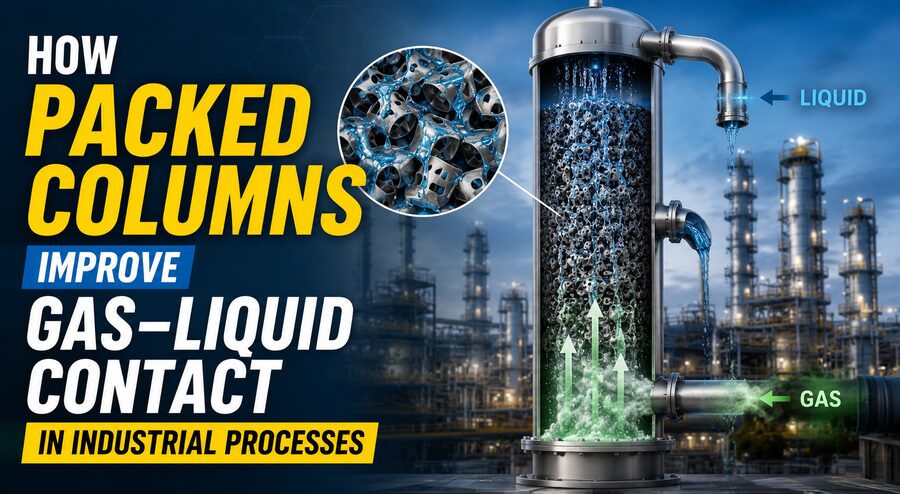

Many industrial processes depend on bringing a gas and a liquid into close contact so that material can transfer from one phase to the other. This principle is central to operations such as gas absorption, stripping, distillation, humidification, and pollution control. 🌫️💧
One of the most widely used pieces of equipment for achieving this contact is the packed column, also called a packed tower.
Unlike a vessel that simply allows gas to bubble through liquid, a packed column contains a bed of specially shaped solid materials known as packing. These materials create a large surface area over which liquid can spread while gas flows through the open spaces.
The result is intense gas–liquid interaction without requiring the phases to mix completely.
Packed columns are especially valuable because they can provide high mass-transfer efficiency, relatively low pressure drop, and flexible operation. For chemical plants, refineries, environmental systems, food-processing facilities, and pharmaceutical production, those advantages can translate into better separation performance and lower energy consumption. ⚙️🌱
🧪 What Is a Packed Column?
A packed column is usually a tall vertical vessel filled with packing material.
In a typical gas–liquid contacting operation:
💧 Liquid enters near the top of the column.
⬇️ The liquid flows downward over the packing.
🌫️ Gas enters near the bottom.
⬆️ The gas flows upward through the spaces between the packing.
🔄 The two phases contact each other as they move in opposite directions.
This arrangement is known as countercurrent flow.
Countercurrent operation is extremely useful because the freshest liquid can contact the gas that is already partly treated, while the incoming gas contacts liquid that has already absorbed some of the transferred material.
This creates a favorable driving force for mass transfer across much of the column.
🌐 Why Surface Area Matters
Gas–liquid mass transfer occurs at the interface between the gas and liquid phases.
If the contact area is small, only a limited amount of material can move from one phase into the other at a given time.
Packed columns solve this problem by creating an enormous wetted surface area inside the vessel. 🌊
As the liquid flows downward, it spreads across the surface of the packing in films, rivulets, and droplets.
Meanwhile, the gas flows around and through those wetted surfaces.
The greater the effective contact area, the more opportunities molecules have to cross the gas–liquid boundary.
This is one of the central reasons packed columns can be so efficient.
🧱 What Is Column Packing?
Packing consists of solid structures designed to maximize gas–liquid contact while still allowing fluids to move through the column.
There are two major categories:
🔹 Random Packing
Random packing consists of many small individual pieces poured into the column.
Examples include:
Raschig rings
Pall rings
Berl saddles
Intalox saddles
Modern high-performance ring designs
The pieces arrange themselves randomly, producing many pathways for gas and liquid.
Random packing is widely used because it can be economical and relatively easy to install.
🔹 Structured Packing
Structured packing is manufactured in carefully arranged layers, often using corrugated metal sheets, plastic, or wire mesh.
The channels are intentionally oriented to promote liquid spreading and gas flow.
Structured packing often provides:
Lower pressure drop
High mass-transfer efficiency
Better flow organization
Excellent performance in vacuum systems
Because of these benefits, structured packing is commonly used in demanding distillation and absorption applications. 🏭
💧 How the Liquid Spreads Across the Packing
When liquid enters the top of a packed column, simply pouring it onto the bed would not be enough.
The liquid must be distributed as evenly as possible.
For this reason, industrial columns often use a liquid distributor.
The distributor may contain:
Orifices
Troughs
Spray points
Drip tubes
These devices divide the liquid across the column cross-section.
Once the liquid reaches the packing, it spreads over the surfaces and creates a thin film.
Thin films are desirable because molecules inside the liquid have a shorter distance to travel before reaching the gas–liquid interface. 💧
Better liquid distribution generally means better use of the available packing area.
🌫️ How the Gas Moves Through the Column
Gas usually enters below the packing bed and moves upward.
The packing does not form a solid barrier. Instead, it contains interconnected channels and void spaces.
Gas flows through these spaces while interacting with the descending liquid.
Well-designed packing offers a useful balance:
Large surface area + high void fraction + manageable flow resistance
If the packing were extremely dense, it might provide plenty of surface area but create excessive resistance to gas flow.
If it were too open, pressure drop would be low but contact area could be inadequate.
Engineering the correct geometry is therefore essential. ⚙️
🔬 The Role of Mass Transfer
The purpose of a packed column is usually to transfer one or more chemical species between phases.
Suppose a gas contains a soluble contaminant.
When the gas contacts a suitable liquid, the contaminant can move:
Gas phase ➡️ Gas–liquid interface ➡️ Liquid phase
The rate of transfer depends on several factors, including:
Interfacial area
Concentration difference
Solubility
Temperature
Pressure
Fluid velocity
Physical properties
Packing characteristics
Chemical engineers often describe the driving force using differences in concentration or partial pressure.
The larger the driving force, the faster mass transfer tends to occur. 📈
🌿 Example: Removing a Pollutant From Gas
Imagine an industrial exhaust stream containing a soluble acidic gas.
The gas enters the bottom of a packed absorber.
A liquid absorbent enters from the top.
As the gas rises, the pollutant moves from the gas into the descending liquid.
By the time the gas reaches the top, much of the unwanted compound may have been removed.
The liquid leaving the bottom now contains the absorbed material and can be treated, regenerated, or disposed of appropriately.
Packed towers are therefore commonly used in gas-cleaning and emissions-control systems. 🌱
Depending on the chemistry, they may help remove substances such as acidic gases, ammonia, or volatile compounds.
🔄 Why Countercurrent Flow Is So Effective
Countercurrent flow is one of the packed column’s most important design features.
Imagine the gas becomes cleaner as it moves upward.
At the top of the column, it encounters the freshest incoming liquid, which has the greatest capacity to absorb the remaining contaminant.
Near the bottom, the incoming gas contains the highest pollutant concentration. It encounters liquid that has already absorbed material but can still remove additional contaminant because the gas concentration is high.
This arrangement maintains a useful mass-transfer driving force throughout the equipment.
Compared with simple co-current contact, where both fluids move in the same direction, countercurrent operation can often achieve more complete separation. 🔁
📏 Packing Height and Separation Performance
A packed column usually requires a certain bed height to achieve the desired separation.
More packing height means more contact opportunity.
However, making the tower indefinitely taller would increase:
Equipment cost
Pressure drop
Structural requirements
Pumping or compression needs
Engineers therefore design the packing height based on required performance.
Two common engineering concepts are:
Height of a Transfer Unit (HTU) and Number of Transfer Units (NTU).
In simplified form:
Required packed height ≈ HTU × NTU
The NTU represents how much separation is required, while the HTU reflects how efficiently the equipment transfers mass.
A more efficient packing generally provides a smaller HTU, meaning less column height may be needed for the same duty. 📐
⚡ Why Low Pressure Drop Is Valuable
Gas flowing upward through any column loses pressure because of friction and flow resistance.
This pressure loss is called pressure drop.
Packed columns, especially those containing structured packing, can achieve relatively low pressure drop compared with some other contacting devices.
Low pressure drop is important because moving gas requires energy.
Compressors, fans, or upstream process equipment may need to overcome the pressure loss.
A lower-pressure-drop column can therefore reduce operating energy. 🔋
This becomes especially important in:
Vacuum distillation
Large gas-treatment systems
Energy-sensitive processes
High-volume air pollution control
🧯 What Is Flooding?
Packed columns have operating limits.
If gas velocity becomes too high, the upward-moving gas begins to interfere strongly with the downward liquid flow.
Liquid may accumulate inside the bed instead of draining properly.
Eventually, the column can approach a condition known as flooding. 🌊
During flooding:
Pressure drop rises sharply.
Liquid holdup increases.
Gas flow becomes restricted.
Separation efficiency may become unstable.
Liquid can be carried upward.
Industrial columns are normally designed to operate below the flooding point.
Engineers determine appropriate gas and liquid loading using hydraulic correlations and packing performance data.
💦 What Is Loading?
Before full flooding occurs, another condition called loading may appear.
At low gas rates, liquid flows downward mainly under gravity.
As gas velocity increases, the upward gas begins to slow the liquid.
Liquid accumulation increases and pressure drop starts rising more rapidly.
Loading is therefore a warning that the column is moving closer to its hydraulic limit.
Maintaining proper flow rates is essential for safe and efficient operation.
🚿 Why Liquid Distribution Is Critical
Even the best packing will perform poorly if the liquid is distributed unevenly.
Suppose most of the liquid flows down one side of the tower.
Some regions become heavily wetted, while other regions remain relatively dry.
The gas passing through dry areas receives little useful contact with liquid.
This phenomenon is called maldistribution.
It reduces the effective mass-transfer area and can dramatically lower efficiency.
Large columns often include:
Liquid distributors
Redistribution trays
Collector systems
These devices help restore uniform liquid flow as it moves through long packed beds. 🎯
🧱 Packing Material Selection
Packing can be manufactured from several materials.
Common choices include:
🔩 Metal
Metal packing offers strength and good temperature resistance.
It is often used in:
Distillation
Hydrocarbon processing
High-temperature service
🧪 Plastic
Plastic packing is lightweight and resistant to many corrosive environments.
It is common in:
Acid gas scrubbing
Water treatment
Chemical absorption
🏺 Ceramic
Ceramic packing can provide excellent chemical and thermal resistance.
It may be used when highly corrosive chemicals or elevated temperatures would damage other materials.
The best material depends on process chemistry, temperature, pressure, mechanical requirements, and cost.
🏭 Packed Columns in Distillation
Packed columns are not limited to gas absorption.
They are also widely used in distillation.
Inside a packed distillation column:
Vapor rises.
Liquid flows downward.
More volatile components tend to move into the vapor.
Less volatile components tend to remain in or move into the liquid.
Repeated gas–liquid contact gradually enriches the vapor in the more volatile component while enriching the liquid in the less volatile one.
Structured packing is especially popular in vacuum distillation because its low pressure drop helps maintain low operating pressure. 🧪
🌬️ Packed Columns for Stripping
Stripping is essentially the reverse of absorption.
Instead of moving a component from gas into liquid, the goal is to remove a dissolved component from the liquid and transfer it into a gas.
For example, air or steam may be used to remove volatile compounds from water.
The liquid flows downward through the packing while the stripping gas rises.
The unwanted dissolved material transfers into the gas phase and exits with the gas stream. 💨
🌡️ Heat Transfer Can Occur Too
Although packed columns are mainly associated with mass transfer, heat transfer frequently occurs at the same time.
When gas and liquid contact each other:
Their temperatures may approach equilibrium.
Evaporation may cool the liquid.
Condensation may release heat.
Chemical absorption may generate heat.
For example, absorption of certain gases can be strongly exothermic.
Temperature changes can affect solubility and therefore influence mass-transfer performance.
Engineers may need to include cooling systems or intermediate cooling sections in large absorbers. 🌡️
⚖️ Packed Columns vs Tray Columns
Another common gas–liquid contacting device is the tray column.
Tray columns contain horizontal plates where vapor bubbles through liquid.
Each tray acts as a contacting stage.
Packed columns instead rely on continuous contact across packing surfaces.
Packed columns often offer advantages such as:
Lower pressure drop
Good performance at low liquid rates
Lower liquid holdup
Suitability for corrosive service
High efficiency with structured packing
Tray columns can be advantageous when:
Wide operating ranges are required
High liquid loads occur
Side draws are needed
Easy internal inspection is important
Neither design is universally better.
The choice depends on the specific industrial process. 🏗️
🧼 Fouling and Plugging Challenges
Packing contains many small passages.
If the process fluid contains:
Suspended solids
Sticky materials
Crystals
Biological growth
Polymer-forming compounds
those passages may become blocked.
This is called fouling or plugging.
Fouling increases pressure drop and reduces effective contact area.
For dirty services, engineers may choose larger, more open packing or alternative contacting equipment.
Regular cleaning and proper upstream filtration can also help maintain performance. 🧽
💡 Why Packing Geometry Matters
Modern packing is carefully engineered.
Its shape influences:
Liquid spreading
Gas turbulence
Pressure drop
Wetted area
Mechanical strength
Flooding capacity
An ideal packing encourages liquid to continuously redistribute instead of flowing straight downward in isolated channels.
At the same time, gas should be able to pass through with minimal unnecessary resistance.
This balance between mass-transfer efficiency and hydraulic performance is at the heart of packing design. ⚙️
📊 What Determines Packed Column Efficiency?
Several variables determine how well a packed column performs:
Packing type
Packing size
Liquid distribution quality
Gas velocity
Liquid flow rate
Surface tension
Viscosity
Density
Diffusivity
Temperature
Pressure
Chemical equilibrium
Because these factors interact, industrial packed-column design usually relies on experimental correlations, vendor performance data, and rigorous process simulation.
🌱 Environmental Applications
Packed columns play an important role in environmental engineering.
They may be used for:
Flue-gas cleaning
Odor control
Acid-gas removal
VOC absorption
Air stripping
Wastewater treatment
For example, a packed scrubber can expose contaminated gas to a reactive liquid.
The pollutant dissolves or reacts chemically with the liquid while cleaner gas exits the tower.
This makes packed columns useful tools for controlling industrial emissions. 🌍
🔧 Advantages of Packed Columns
Packed columns are widely used because they combine several useful characteristics:
🌐 Large gas–liquid contact area
⚡ High mass-transfer efficiency
📉 Relatively low pressure drop
💧 Low liquid holdup
🔄 Effective countercurrent contacting
🧪 Compatibility with many chemical systems
🏭 Scalability from laboratory to industrial size
🌱 Strong suitability for gas-cleaning applications
These advantages make packed columns especially attractive when efficient continuous contacting is required.
⚠️ Important Design Limitations
Packed columns also have limitations.
Engineers must consider:
Flooding
Liquid maldistribution
Fouling
Channeling
Packing damage
Corrosion
Limited turndown in some designs
Distributor performance
Maintenance access
A packed tower will only perform as well as its overall design.
Simply filling a vessel with packing does not guarantee efficient operation.
The fluid distributors, support plates, packing geometry, gas inlet design, and operating conditions must all work together.
🤖 The Future of Packed Column Operation
Modern plants increasingly use digital monitoring to improve packed-column performance.
Sensors can track:
Pressure drop
Temperature profiles
Flow rates
Composition
Liquid levels
Gas emissions
Advanced control systems can detect unusual changes before severe flooding or fouling occurs.
Machine-learning models may also help predict when packing needs cleaning or when operating conditions should be adjusted. 🤖📊
Improved structured packings continue to reduce pressure drop while increasing effective surface area.
These innovations are especially valuable in industries trying to lower energy consumption and carbon emissions.
🏭 Final Thoughts
Packed columns improve gas–liquid contact by creating a large wetted surface area inside a compact vessel.
Liquid spreads across the packing while gas passes through the open spaces, allowing molecules to transfer efficiently between the phases.
Countercurrent flow helps maintain a strong mass-transfer driving force, while carefully designed packing provides high contact efficiency without creating excessive pressure drop.
The effectiveness of a packed column depends on much more than simply the amount of packing present. Proper liquid distribution, gas velocity, packing geometry, operating conditions, and material selection are all essential. ⚙️
When correctly designed, packed columns can efficiently perform absorption, stripping, distillation, humidification, and environmental gas cleaning.
Their basic idea is simple:
Create as much useful gas–liquid contact as possible while allowing both fluids to flow efficiently.
That combination of high interfacial area, low pressure loss, and continuous countercurrent operation is why packed columns remain one of the most important pieces of mass-transfer equipment in modern chemical and process industries. 🌫️💧🏭