
Industrial processes often generate gas streams filled with dust, ash, powder, metal particles, sand, or other suspended solids. If these particles are released directly into equipment or the atmosphere, they can cause serious problems. They may damage machinery, contaminate products, reduce process efficiency, create health hazards, or contribute to air pollution. 🏭💨
One of the simplest and most widely used devices for removing solid particles from moving gas is the cyclone separator.
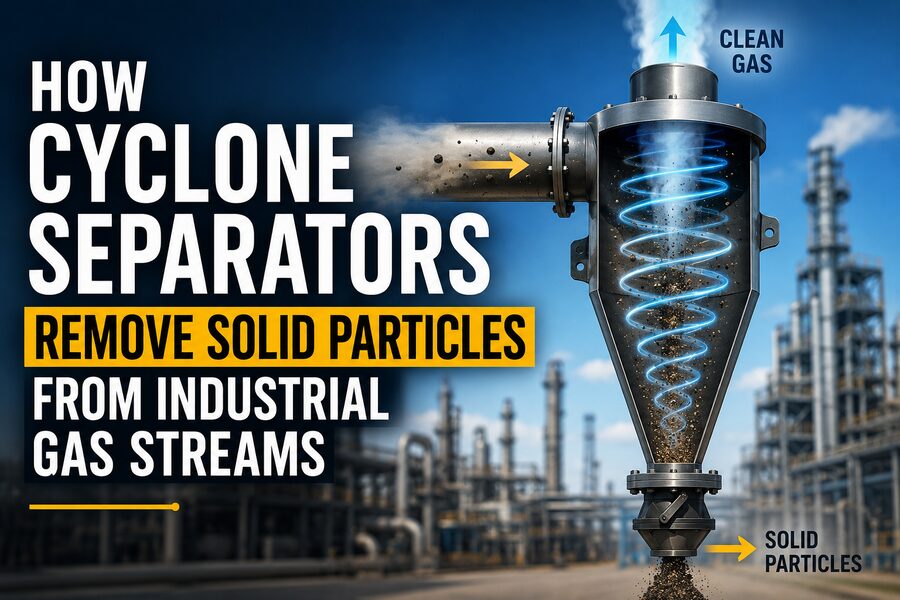
A cyclone separator does not normally rely on filters, screens, or complex moving components. Instead, it uses the motion of the gas itself to create a powerful swirling flow. This rotational movement generates centrifugal effects that push heavier particles toward the walls of the separator, allowing cleaner gas to escape through a central outlet.
Cyclone separators are found in industries ranging from cement manufacturing and woodworking to power generation, mining, chemical processing, food production, and metalworking. Their popularity comes from their durability, relatively low cost, and ability to handle high temperatures and large particle loads.
Understanding how cyclones work provides a fascinating example of how fluid dynamics can be used to separate materials efficiently. 🌪️⚙️
🏭 1. Why Industrial Gas Streams Contain Solid Particles
Many industrial operations involve crushing, grinding, combustion, drying, conveying, or mixing materials.
These activities can release fine particles into the surrounding gas stream.
Examples include:
- Fly ash from combustion systems
- Cement dust from kilns and mills
- Sawdust from woodworking equipment
- Metal particles from machining operations
- Mineral dust from crushing plants
- Powder from chemical manufacturing
- Grain dust from agricultural processing
If these particles remain suspended, they can travel through ducts and downstream equipment.
Some particles may erode fans, heat exchangers, valves, or pipelines. Others may contaminate products or interfere with later processing stages.
Cyclone separators provide a practical way to remove a substantial portion of these particles before the gas moves further through the system.
🌪️ 2. The Basic Shape of a Cyclone Separator
A typical cyclone separator has a distinctive vertical shape.
The upper section is usually cylindrical, while the lower portion tapers into a cone.
The main components generally include:
- A tangential gas inlet
- A cylindrical separation chamber
- A conical lower section
- A central gas outlet tube
- A dust collection hopper or discharge point
Dust-laden gas normally enters the cyclone from the side near the top.
The inlet is positioned tangentially rather than pointing directly toward the center.
This tangential entry is crucial because it forces the incoming gas to begin rotating around the inside wall. 🔄
The resulting swirling motion creates the cyclone’s characteristic vortex.
🌀 3. Creating a High-Speed Vortex
When the gas enters tangentially, it cannot travel directly across the cyclone.
Instead, the cylindrical wall guides the flow into a spiral path.
The gas begins rotating around the separator at relatively high speed while gradually moving downward.
This forms what is commonly called the outer vortex.
Particles suspended in the gas have mass and therefore possess inertia.
As the gas changes direction continuously while rotating, the particles do not follow the curved gas stream perfectly.
Instead, their inertia tends to carry them outward toward the cyclone wall.
This outward migration is the fundamental principle behind cyclone separation. ⚙️
🧲 4. Centrifugal Effects Push Particles Outward
Cyclone separators are often described as using centrifugal force.
From a rotating reference frame, particles appear to experience an outward force as they move through the curved flow.
In practical engineering terms, the important result is that denser solid particles tend to move toward the outer wall while the gas continues swirling around the cyclone.
The magnitude of the separating effect depends partly on:
- Gas velocity
- Cyclone diameter
- Particle size
- Particle density
- Gas density
- Gas viscosity
- Cyclone geometry
Larger and denser particles are generally easier to separate because they have greater inertia.
Very small particles follow the gas flow more closely and are therefore more difficult to remove.
🧱 5. What Happens When Particles Reach the Wall
Once solid particles migrate toward the cyclone’s outer wall, they lose some of their rotational momentum through interaction with the wall and surrounding flow.
Gravity and the downward-moving outer vortex then help carry them toward the conical section.
As particles travel downward, they eventually reach the bottom of the cyclone.
There, they fall into a collection hopper or discharge system.
The collected material may be:
- Recycled back into the process
- Stored for later use
- Sent for disposal
- Transferred to another processing stage
A properly designed discharge system is important because the cyclone must prevent collected dust from being re-entrained into the cleaned gas. 📦
⬇️ 6. Why the Cone Is Important
The conical lower section is not simply a container for dust.
It plays an important role in controlling the gas flow.
As the rotating gas moves downward through the narrowing cone, the geometry affects its velocity and pressure.
Eventually, the downward spiral cannot continue indefinitely.
Near the lower region, the gas flow reverses direction and begins traveling upward through the center of the cyclone.
This creates a second vortex known as the inner vortex.
The outer vortex generally moves downward near the walls.
The inner vortex moves upward near the center.
This two-vortex structure is a defining feature of cyclone operation. 🌪️
⬆️ 7. How Cleaned Gas Leaves the Cyclone
After the gas has traveled downward and reversed direction, it flows upward through the cyclone’s central region.
A vertical outlet tube, often called a vortex finder, extends into the top of the separator.
The upward-moving gas enters this tube and leaves the cyclone.
By this stage, many of the heavier particles have already been driven toward the wall and removed.
The gas leaving the cyclone therefore contains a much lower concentration of solids.
However, cyclone separators rarely remove every particle.
Very fine particles may remain suspended and leave with the gas.
For this reason, cyclones are often used as a pre-cleaning stage before equipment such as bag filters, scrubbers, or electrostatic precipitators.
📏 8. Particle Size Strongly Affects Separation
Particle size is one of the most important factors controlling cyclone performance.
Large particles possess greater mass and inertia.
They resist following the rapidly curved gas stream and are therefore more likely to move toward the wall.
Fine particles, by contrast, can closely follow turbulent gas motion.
As particles become smaller, separation becomes progressively more difficult.
Engineers often characterize cyclone performance using a parameter known as the cut size or cut diameter.
A common definition is the particle diameter at which the cyclone captures approximately 50% of particles of that size.
This is often written as d₅₀.
Particles larger than the cut size are generally collected with greater efficiency, while particles smaller than the cut size have a higher probability of escaping.
📊 9. Separation Efficiency Is Not the Same for Every Particle
Cyclone efficiency should not be thought of as one fixed percentage for all particles.
Instead, efficiency varies with particle diameter.
For example, a cyclone may remove nearly all relatively large dust particles but capture only a fraction of extremely fine particles.
Engineers sometimes describe this relationship using a grade efficiency curve.
The curve shows collection efficiency as a function of particle size.
This information helps determine whether a cyclone alone is sufficient or whether additional filtration equipment is required.
A process producing coarse sawdust may be well suited to cyclone separation.
A process generating submicron fumes may require a very different control technology. 🔬
💨 10. Gas Velocity Must Be Carefully Controlled
Gas velocity has a major influence on cyclone performance.
If the gas moves too slowly, the rotational motion may not generate enough separating effect.
Particles may remain suspended and escape through the outlet.
If the gas moves faster, separation can improve because the vortex becomes stronger.
However, higher velocity also creates disadvantages.
It increases pressure drop, energy consumption, turbulence, and equipment wear.
Extremely high velocities may even cause collected particles to become re-entrained.
Therefore, cyclone design requires a balance between strong separation and acceptable operating cost. ⚖️
📉 11. Pressure Drop Is an Important Design Consideration
A fan or blower is typically required to move gas through the cyclone.
As the gas enters, rotates, changes direction, and exits, it loses pressure.
This loss is called pressure drop.
Higher pressure drop means the fan must provide more energy.
Therefore, even a cyclone with excellent particle-removal efficiency may be undesirable if it consumes excessive power.
Engineers evaluate cyclone designs by considering both:
Collection efficiency and pressure drop.
The goal is to achieve the required separation while minimizing unnecessary energy use. ⚡
📐 12. Cyclone Diameter Affects Performance
Cyclone size has a strong influence on particle collection.
Smaller-diameter cyclones can create stronger centrifugal effects because the gas follows tighter circular paths.
This often improves the collection of smaller particles.
However, small cyclones can process less gas.
When a facility must handle a very large gas flow, engineers sometimes install multiple small cyclones in parallel.
This arrangement is called a multicyclone.
Each individual cyclone handles part of the total flow.
Multicyclone systems can combine high gas-handling capacity with relatively efficient particle separation.
🏗️ 13. Why Cyclones Are Popular in Harsh Industrial Environments
Cyclones have very few or no moving parts inside the separation chamber.
This simplicity provides major advantages.
They can often handle:
- High temperatures
- Abrasive particles
- Large dust concentrations
- High gas flow rates
- Rough industrial operating conditions
Unlike fabric filters, cyclones do not depend on filter media that may tear, clog, burn, or require frequent replacement.
This makes them attractive in demanding applications.
However, abrasive particles can still erode the cyclone walls over time, especially near high-velocity inlet regions.
Wear-resistant liners may therefore be installed in severe applications. 🛡️
🔥 14. Cyclones Can Operate at High Temperatures
Many industrial gas streams are extremely hot.
Examples include gases leaving furnaces, kilns, dryers, boilers, and combustion chambers.
Some filtration methods require gas cooling before treatment.
Cyclone separators can often be constructed from materials capable of tolerating elevated temperatures.
This allows them to remove solids directly from hot gas streams.
In certain applications, this can reduce process complexity and avoid the energy losses associated with cooling and reheating gas.
Material selection remains critical because cyclone walls, seals, and discharge systems must tolerate both heat and abrasion.
🪨 15. Abrasive Dust Can Cause Erosion
Although cyclones are mechanically simple, the particles inside them can be extremely aggressive.
Imagine sand, mineral dust, or ash moving around the separator at high speed.
Repeated impacts gradually wear away the walls.
The inlet region is often particularly vulnerable because incoming particles may strike surfaces at high velocity.
Industrial cyclones handling abrasive materials may use:
- Ceramic liners
- Hardened steel
- Replaceable wear plates
- Specialized coatings
These protective materials increase equipment life and reduce maintenance frequency.
🚪 16. Dust Discharge Must Remain Sealed
The bottom of a cyclone cannot simply remain open to the atmosphere in many systems.
If outside air enters through the dust outlet, it can disturb the internal vortex.
This unwanted airflow may reduce collection efficiency and carry collected material back into the gas.
Industrial systems therefore often use devices such as rotary airlock valves.
A rotary airlock allows solid material to leave the hopper while limiting gas leakage.
Other systems may use double-dump valves, screw conveyors, or sealed collection containers.
The dust-discharge system is therefore an important part of overall cyclone performance.
🔄 17. What Is Particle Re-Entrainment?
Capturing a particle at the wall does not guarantee that it will remain collected.
Strong turbulence may lift particles from the wall or hopper and return them to the gas stream.
This phenomenon is called re-entrainment.
Poor hopper design, excessive gas velocity, air leakage, or unstable flow can increase re-entrainment.
Good cyclone design attempts to guide separated solids downward smoothly while preventing them from returning to the upward-moving inner vortex.
This is one reason seemingly small geometric details can significantly affect performance.
🏭 18. Common Industrial Applications
Cyclone separators are used across a remarkable range of industries.
In cement plants, they remove raw material and clinker dust.
In woodworking facilities, they separate sawdust and wood chips from ventilation air.
In power plants, they may remove coarse fly ash from combustion gases.
In mining operations, they handle dust generated by crushing and material transfer.
In food processing, cyclones can recover powders from air streams.
In chemical plants, they can separate catalysts or product particles from process gas.
Cyclones are also widely used with pneumatic conveying systems, dryers, grinders, and fluidized-bed processes. 🏭
🧪 19. Cyclones Can Recover Valuable Product
Particle removal is not always performed simply for pollution control.
Sometimes the suspended solid is actually the valuable product.
For example, a drying process may produce a powder that becomes entrained in the exhaust gas.
A cyclone can recover much of this material before the gas leaves the system.
The collected powder can then be packaged, recycled, or returned to the process.
In such applications, better cyclone efficiency can directly improve production yield and reduce material loss. 📦💰
🧹 20. Cyclones Often Work as Pre-Cleaners
Cyclones are particularly useful as the first stage of a larger air-cleaning system.
Suppose a gas stream contains both large dust particles and very fine particles.
Sending the entire particle load directly into a fabric filter could cause rapid loading and increased maintenance.
A cyclone can first remove the larger and heavier particles.
The downstream filter then deals mainly with the finer fraction.
This combination can reduce wear, extend filter life, and lower the dust burden on more expensive pollution-control equipment.
Cyclones can therefore improve the performance of the entire gas-cleaning system.
🔬 21. Why Very Fine Particles Are Difficult to Capture
Very small particles have very little inertia.
Instead of being thrown strongly toward the wall, they tend to move with the gas.
Turbulence and molecular-scale effects can make their paths even more difficult to control.
As particle diameter decreases, cyclone collection efficiency usually declines.
For extremely fine particulate matter, technologies such as:
- Fabric baghouses
- Cartridge filters
- Wet scrubbers
- Electrostatic precipitators
may provide better performance.
Cyclones are therefore most effective when the particle-size distribution and process requirements match their strengths.
⚙️ 22. Cyclone Design Is a Fluid-Dynamics Problem
Although a cyclone looks mechanically simple, the flow inside it is highly complex.
The gas is simultaneously:
- Rotating
- Moving downward
- Reversing direction
- Moving upward
- Accelerating and decelerating
- Interacting with turbulent eddies
Particles of different sizes respond differently to these changing conditions.
Modern engineers may use Computational Fluid Dynamics, or CFD, to simulate cyclone behavior.
CFD models help visualize gas velocity, pressure, turbulence, and particle trajectories.
This allows designers to test geometric changes before building full-scale equipment. 💻🌪️
📐 23. Geometry Determines How Well the Cyclone Works
Small changes in cyclone geometry can strongly influence performance.
Important dimensions include:
- Inlet width and height
- Cyclone body diameter
- Cylindrical section height
- Cone angle
- Outlet tube diameter
- Outlet tube insertion depth
- Dust outlet diameter
Changing one dimension may improve particle collection but increase pressure drop.
Another modification may reduce energy consumption but allow more dust to escape.
Cyclone design therefore involves optimization rather than simply making the vortex as strong as possible.
✅ 24. Major Advantages of Cyclone Separators
Cyclones remain popular because they offer several practical benefits.
They have few internal moving parts.
They can handle large gas volumes.
They tolerate relatively high temperatures.
They can process heavy dust concentrations.
Maintenance requirements are often modest.
Construction can be comparatively simple.
They can recover useful solids.
They work well as pre-separators.
These characteristics make cyclones one of the most robust particle-separation technologies used in industry. 🛠️
⚠️ 25. Important Limitations
Cyclone separators also have limitations.
They are generally less effective on extremely fine particles.
High gas velocities may increase energy consumption.
Abrasive particles can erode internal surfaces.
Poor dust discharge can reduce efficiency.
Changes in gas flow rate may affect performance.
Cyclones may therefore need to be combined with additional pollution-control equipment when very low particulate emissions are required.
Understanding these limitations is essential when selecting the right separation technology.
🌪️ Conclusion
Cyclone separators remove solid particles from industrial gas streams by turning ordinary gas flow into a controlled vortex.
Dust-laden gas enters tangentially and begins spinning around the separator. The rotating flow causes particles with sufficient inertia to move toward the outer wall. These particles lose momentum, travel downward through the conical section, and fall into a collection hopper.
Meanwhile, the gas reverses direction near the bottom, forms an upward-moving inner vortex, and exits through the central outlet tube. 💨
The process requires no conventional filter media and usually no moving components inside the separation chamber.
Its effectiveness depends on a careful balance of gas velocity, particle properties, cyclone size, geometry, pressure drop, and discharge design.
Cyclones are not perfect for every particle size, particularly extremely fine dust. Yet for coarse and moderately sized particles, they offer an impressive combination of simplicity, durability, high-temperature capability, and low maintenance.
That is why the cyclone separator remains such an important piece of industrial equipment. By using nothing more than carefully controlled swirling motion, it can transform a dirty gas stream into a much cleaner one while recovering or removing large quantities of solid material. 🌪️🏭⚙️