
Many everyday products begin their industrial life as liquids but reach consumers as dry, free-flowing powders. Powdered milk, instant coffee, flavorings, pharmaceutical ingredients, detergents, protein powders, ceramic materials, and food additives can all be produced using a powerful industrial process known as spray drying. 🥛☕💊
Spray drying may sound simple: spray a liquid into hot air and collect the dry particles. In practice, however, it is a carefully controlled combination of fluid mechanics, heat transfer, evaporation, particle formation, and air handling.
The technology allows manufacturers to transform liquids, solutions, suspensions, or emulsions into powders within seconds. Because drying occurs extremely quickly, spray drying can often preserve product quality while creating particles with controlled size, density, moisture content, and flow characteristics.
So how does a large spray dryer turn thousands of tiny droplets into a uniform powder? The process begins with one critical step: atomization. 💨
🧪 What Is Spray Drying?
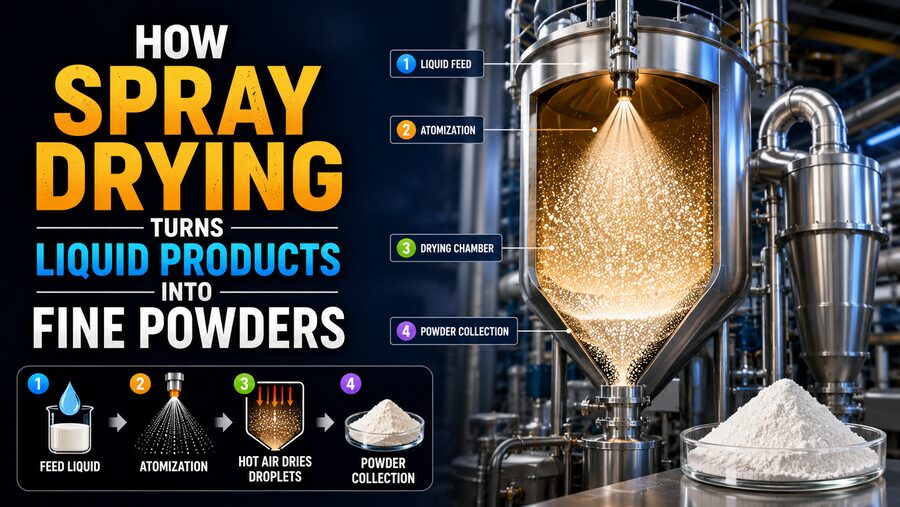
Spray drying is a process in which a liquid feed is converted into a dry powder by spraying it as extremely small droplets into a stream of heated gas, usually air.
The liquid can be:
- A solution, where material is completely dissolved
- A suspension containing fine solid particles
- An emulsion containing dispersed droplets, such as oil in water
- A slurry containing relatively high levels of solids
Once the liquid enters the dryer, it is broken into tiny droplets.
Because small droplets have an enormous surface area relative to their volume, water or another solvent can evaporate very rapidly.
Within a short time, each droplet becomes a dry or partially dry particle. 🌫️➡️⚪
The dried particles are then separated from the exhaust air and collected as powder.
🏭 The Main Parts of a Spray Drying System
A typical industrial spray dryer contains several important components.
These often include:
- Liquid feed system
- Atomizer or spray nozzle
- Heated-air supply
- Drying chamber
- Powder separation equipment
- Powder collection system
- Exhaust-air handling equipment
Each part must work together precisely.
If the droplets are too large, they may remain wet. If they are too small, they may become overly dry or difficult to collect. If the air temperature is too high, sensitive products may degrade. If the airflow is poorly controlled, powder may stick to chamber walls.
This is why industrial spray drying is much more sophisticated than simply spraying liquid into a hot container. ⚙️
💧 Step 1: Preparing the Liquid Feed
Before spray drying begins, manufacturers prepare the liquid feed.
In food processing, for example, milk may first be concentrated using an evaporator so that less water has to be removed inside the spray dryer.
A higher concentration of solids can improve energy efficiency because spray drying requires significant heat to evaporate water.
The feed may also be filtered, homogenized, mixed, heated, or adjusted to achieve the desired viscosity.
Important properties include:
- Solids concentration
- Viscosity
- Temperature
- Surface tension
- Density
- Chemical composition
These characteristics strongly influence how easily the liquid can be atomized.
A very thick liquid behaves differently from a thin liquid, and the atomization system must be designed accordingly.
🌪️ Step 2: Atomizing the Liquid Into Tiny Droplets
Atomization is one of the most important stages in spray drying.
Instead of introducing the liquid as a continuous stream, the dryer divides it into millions of tiny droplets.
Why?
Because evaporation becomes much faster when a liquid has a large surface area.
Imagine a glass of water sitting on a table. It may take days to evaporate completely.
Now imagine spreading that same amount of water into microscopic droplets suspended in hot air.
The total surface area becomes enormous, so water molecules can escape much more rapidly. 💨
This is the fundamental principle that makes spray drying so fast.
🔧 Different Types of Atomizers
Several technologies can produce the spray.
💦 Pressure Nozzles
A pressure nozzle forces liquid through a very small opening at high pressure.
As the liquid exits, it breaks apart into droplets.
Pressure nozzles are common because they can provide relatively controlled sprays and work well with many products.
🌬️ Two-Fluid Nozzles
A two-fluid nozzle uses compressed air or another gas to break the liquid into droplets.
The rapidly moving gas interacts with the liquid and creates a fine mist.
These systems can handle relatively low feed rates and are often useful in laboratory or specialty applications.
🌀 Rotary Atomizers
A rotary atomizer uses a rapidly spinning wheel or disc.
Liquid enters the rotating device and is thrown outward by centrifugal force.
At the edge, the liquid breaks into droplets.
Large industrial spray dryers frequently use rotary atomizers because they can process substantial quantities of liquid.
The selected atomizer helps determine the final particle size and distribution. 📏
🔥 Step 3: Introducing Hot Drying Air
At the same time that droplets enter the drying chamber, heated air is introduced.
The inlet air may be heated using:
- Steam heat exchangers
- Gas-fired heaters
- Electric heating
- Other industrial heat sources
The air temperature can be high, but an important point is often misunderstood.
The product particles do not necessarily reach the same temperature as the incoming hot air.
Why?
Because evaporation cools the droplets.
As water evaporates, it absorbs heat. This evaporative cooling helps keep the wet droplet at a significantly lower temperature during much of the drying process.
That is one reason spray drying can be used for certain heat-sensitive materials even when relatively hot inlet air is involved. 🌡️
However, temperature still requires careful control because sensitive ingredients can be damaged if exposed to excessive heat.
🌫️ Step 4: The Droplets Enter the Drying Chamber
Once atomized, droplets travel through a large drying chamber.
Industrial drying chambers are often tall, cylindrical vessels with conical lower sections.
Inside, hot air and droplets mix.
There are several possible airflow arrangements.
⬇️ Co-Current Flow
In co-current drying, hot air and droplets move in approximately the same direction.
The wettest droplets first encounter the hottest air.
Because evaporation strongly cools the droplets at this stage, co-current flow can be advantageous for heat-sensitive products.
⬆️ Counter-Current Flow
In counter-current systems, air and product move in opposite directions.
This arrangement can provide different heat-transfer characteristics but may expose relatively dry particles to hotter air.
The appropriate design depends on the product and required powder characteristics.
☀️ Step 5: Rapid Evaporation Begins
As soon as the liquid droplets contact hot air, heat transfers from the air into the droplets.
Water at or near the droplet surface begins evaporating.
Because each droplet is tiny, this can happen extremely quickly.
The surrounding air absorbs the evaporated moisture and becomes more humid.
Meanwhile, the droplet becomes progressively more concentrated.
Imagine a droplet containing dissolved milk solids.
Initially, much of the droplet consists of water.
As water evaporates:
- The droplet shrinks
- Solids become more concentrated
- Viscosity increases
- A particle structure begins developing
Eventually, the droplet transitions into a solid or semi-solid particle.
This entire transformation may occur within only a few seconds. ⚡
🫧 How a Droplet Becomes a Powder Particle
Particle formation is surprisingly complex.
As water evaporates from the droplet surface, dissolved or suspended material becomes concentrated near the outside.
Depending on the material and drying conditions, the droplet can form a solid outer shell.
Additional moisture inside then has to move through this shell before evaporating.
This can produce different particle shapes.
Some spray-dried particles are:
- Dense and solid
- Hollow
- Wrinkled
- Porous
- Spherical
- Agglomerated into larger clusters
The final shape affects how the powder behaves.
For example, highly porous particles may dissolve quickly, while denser particles may flow differently during packaging.
📏 Controlling Particle Size
Particle size is extremely important in commercial powders.
Manufacturers may want very fine particles for one application and larger particles for another.
Particle size can be influenced by factors such as:
- Atomizer speed
- Nozzle design
- Liquid pressure
- Feed viscosity
- Surface tension
- Solids concentration
- Drying-air conditions
Smaller droplets generally create smaller particles.
Larger droplets generally create larger particles.
But excessively large droplets may not dry completely before reaching the bottom of the chamber.
That can produce sticky powder or deposits on equipment. ⚠️
🧂 Why Powder Moisture Must Be Carefully Controlled
A spray-dried product is usually not dried to absolute zero moisture.
Instead, manufacturers target a specific residual moisture level.
Too much moisture can cause:
- Powder clumping
- Reduced shelf life
- Microbial concerns in certain products
- Poor flow
- Packaging problems
Too little moisture can also create problems.
Over-drying wastes energy and can sometimes damage the product or change its physical properties.
Therefore, operators carefully control variables such as:
- Inlet air temperature
- Outlet air temperature
- Feed rate
- Airflow
- Atomization settings
The outlet-air temperature is often particularly useful because it reflects the overall balance between heat input and evaporation.
🌀 Step 6: Separating Powder From the Air
At the bottom or outlet of the dryer, the air contains both dried powder particles and water vapor.
The powder must be separated from this exhaust stream.
One common device is the cyclone separator.
A cyclone forces the air to spin rapidly inside a chamber.
Centrifugal effects push heavier powder particles toward the outer wall.
The particles then fall downward into a collection container while cleaner air exits through another path.
Cyclones contain no complex internal filters and can efficiently collect many particle sizes. 🌪️
🧹 Fine Particle Collection
Very fine particles may escape the main cyclone.
Additional collection equipment may therefore be used.
Examples include:
- Bag filters
- Cartridge filters
- Secondary cyclones
- Wet scrubbers
These systems improve powder recovery and reduce particulate emissions.
High product recovery is especially important when manufacturing expensive pharmaceutical, nutritional, or specialty chemical powders. 💊
🔄 Powder Agglomeration
Extremely fine powders are not always desirable.
Fine particles can:
- Produce dust
- Flow poorly
- Be difficult to mix
- Dissolve unevenly
- Create handling problems
Manufacturers may therefore intentionally create agglomerates.
Agglomeration causes small particles to join into larger porous clusters.
This can improve:
- Flowability
- Wettability
- Dispersibility
- Instant dissolution
Instant milk powders and beverage powders often benefit from this approach.
Some modern spray dryers include integrated fluidized beds where partially dried particles can collide and agglomerate under controlled conditions.
☕ Why Instant Coffee Is Often Spray-Dried
Instant coffee provides an easy example.
Brewed coffee extract contains large amounts of water.
Manufacturers concentrate the coffee and then atomize the concentrated liquid into a spray dryer.
Hot air removes moisture rapidly, leaving behind dry coffee particles.
These particles can later dissolve again when consumers add hot water.
Spray drying offers high production capacity and relatively low manufacturing cost compared with some alternative drying techniques.
Freeze drying is another method used for instant coffee, but it operates using a very different process and often produces different product characteristics. ☕
🥛 Spray Drying in Dairy Processing
Milk powder is one of the best-known spray-dried products.
Fresh milk contains a large percentage of water, making it heavy and relatively difficult to store for long periods.
Removing most of the water creates milk powder that is:
- Lighter
- Easier to transport
- More shelf-stable
- Easier to package
- Convenient for food manufacturing
Before spray drying, milk is usually concentrated significantly through evaporation.
The concentrated milk is then atomized and dried rapidly.
The same general technology is used for products such as whey protein, infant formula, and dairy ingredients. 🥛
💊 Spray Drying in Pharmaceuticals
The pharmaceutical industry also uses spray drying.
Potential applications include producing:
- Drug powders
- Inhalable particles
- Amorphous solid dispersions
- Encapsulated active ingredients
- Controlled particle-size formulations
One important advantage is the ability to tailor particle properties.
By modifying formulation and drying conditions, researchers can influence particle size, morphology, solubility, and stability.
This makes spray drying valuable not only as a drying method but also as a particle-engineering technology. 🔬
🍊 Encapsulating Flavors and Oils
Some liquids contain volatile or sensitive ingredients that need protection.
For example, a flavor oil can be mixed into a solution containing a carrier material such as maltodextrin or another encapsulating ingredient.
The mixture is then spray-dried.
As the droplet dries, the carrier material can form a solid matrix around the flavor or oil.
The resulting powder can protect the ingredient from:
- Oxygen
- Moisture
- Light
- Handling damage
This process is called microencapsulation.
It is widely used in flavors, fragrances, nutrients, and specialty ingredients. 🍋
⚡ Why Spray Drying Is So Fast
The speed of spray drying comes mainly from the tiny size of the droplets.
Heat and mass transfer occur across the droplet surface.
When the liquid is divided into millions of droplets, the available surface area rises dramatically.
This allows heat to enter and moisture to leave extremely quickly.
Instead of requiring hours inside a conventional dryer, droplets may become powder within seconds.
This makes spray drying highly suitable for continuous industrial production. 🏭
💰 The Energy Challenge
Spray drying is extremely useful, but it can consume substantial energy.
Evaporating water requires a large amount of heat.
Manufacturers therefore often remove as much water as practical before the liquid reaches the spray dryer.
For example, an evaporator can concentrate a food product using energy-efficient heat-recovery systems before final drying.
Other energy-saving strategies can include:
- Heat recovery from exhaust air
- Multi-stage drying
- Improved insulation
- Optimized feed concentration
- Efficient air handling
- Fluid-bed finishing
Energy efficiency is especially important in large plants operating continuously.
🧼 Hygiene and Cleaning
Food and pharmaceutical spray dryers must also meet strict cleanliness requirements.
Powder can accumulate on chamber surfaces, pipelines, cyclones, and filters.
Equipment may therefore include Clean-in-Place, or CIP, systems.
CIP systems circulate cleaning liquids through equipment without requiring complete disassembly.
Sanitary dryer designs aim to minimize:
- Product buildup
- Contamination risks
- Difficult-to-clean surfaces
- Microbial growth
Careful cleaning is particularly important when switching between products. 🧽
💥 Powder Explosion Safety
Fine combustible powders can create a serious industrial hazard.
When some organic powders become suspended in air at suitable concentrations, they can burn extremely rapidly if an ignition source is present.
In enclosed equipment, this can potentially cause a dust explosion.
Spray drying facilities may therefore include safety measures such as:
- Explosion venting
- Pressure-relief systems
- Spark detection
- Fire suppression
- Grounding and bonding
- Controlled temperatures
- Inert-gas systems for certain products
The specific precautions depend on the powder being processed.
Safety engineering is therefore an essential part of spray dryer design. ⚠️🔥
🆚 Spray Drying vs. Other Drying Methods
Spray drying is not the only method for making powders.
Other technologies include:
- Freeze drying
- Drum drying
- Vacuum drying
- Fluidized-bed drying
- Tray drying
Each has advantages and disadvantages.
Spray drying is especially valuable when manufacturers need:
- Continuous high-volume production
- Rapid drying
- Controlled particle size
- Relatively uniform powder
- Direct liquid-to-powder conversion
Freeze drying, by comparison, can be useful for highly sensitive products but is generally slower and more expensive.
🌍 Where Spray-Dried Powders Are Used
Spray drying appears across many industries.
Common products include:
- Milk powder 🥛
- Whey protein
- Instant coffee ☕
- Egg powder
- Flavorings
- Food colors
- Vitamins
- Pharmaceutical ingredients 💊
- Detergents
- Pigments
- Ceramic powders
- Specialty chemicals
- Agricultural products
- Nutritional supplements
Although these products look completely different, many rely on the same basic engineering principle: transform tiny liquid droplets into dry particles using controlled hot-air contact.
🧠 The Science Behind the Process
Spray drying works because several scientific processes occur simultaneously.
These include:
- Atomization – breaking liquid into droplets
- Heat transfer – moving thermal energy from hot air into droplets
- Mass transfer – moving evaporated moisture from droplets into the air
- Particle formation – concentrating and solidifying dissolved or suspended material
- Separation – removing particles from the drying gas
The process may appear instantaneous, but engineers carefully model and control all of these interactions.
Even a small change in droplet size, air temperature, or feed concentration can significantly alter the finished powder.
✅ Conclusion
Spray drying is one of the most efficient and versatile ways to convert liquid products into dry powders.
The process begins by atomizing a liquid into millions of tiny droplets. These droplets enter a controlled stream of hot air, where their enormous combined surface area allows moisture to evaporate rapidly. As the liquid disappears, dissolved or suspended solids form individual powder particles. 🌫️➡️⚪
Cyclones, filters, and other separation equipment then recover the powder from the exhaust air.
By adjusting atomization, feed concentration, airflow, temperature, and drying time, manufacturers can control important powder characteristics such as particle size, moisture content, density, solubility, flowability, and structure.
This is why spray drying is used across industries ranging from food processing and pharmaceuticals to chemicals and advanced materials.
The technology transforms something as ordinary as a liquid into a precisely engineered powder in just seconds—a remarkable example of how heat transfer, airflow, and particle science work together in modern manufacturing. 🏭⚙️✨