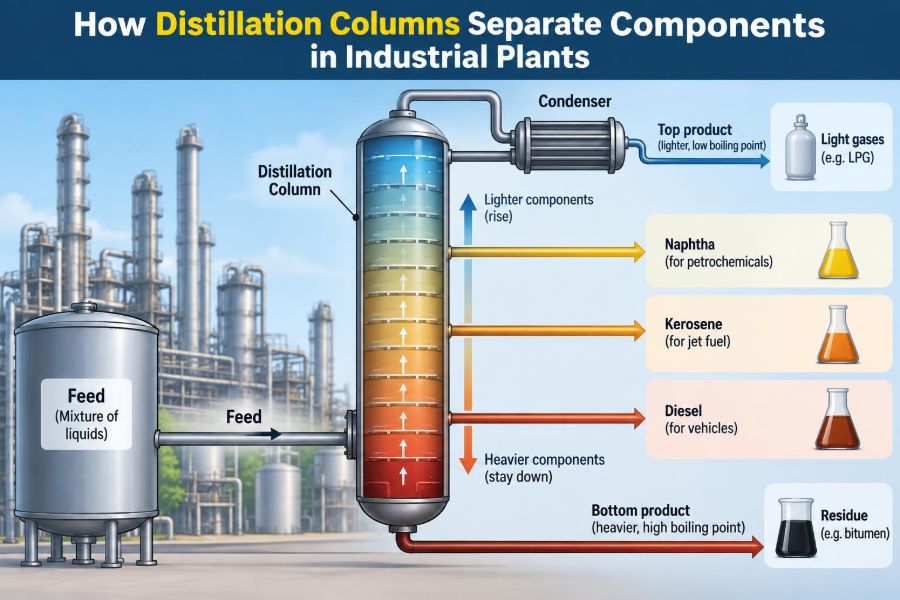

A refinery operator watches temperatures at several points along a tall steel tower. At the top, a cool vapor is condensed into a light liquid product. At lower points, hotter streams leave as fuels, solvents, or feedstocks for other units.
Although the column may look like a single vessel, it is carrying out hundreds of repeated tiny separations every minute. Vapor rises, liquid falls, and the two phases exchange material wherever they meet.
This is distillation: one of the most important separation methods in chemical engineering. It is used in petroleum processing, chemical manufacturing, gas processing, beverage production, pharmaceuticals, and many other industries.
Understanding a distillation column means connecting equilibrium, heat transfer, mass transfer, hydraulics, control, safety, and economics. The central idea is simple; making it work reliably at plant scale is not. ⚗️
🏭 1. What a Distillation Column Does
A distillation column separates a liquid mixture into products with different compositions by taking advantage of differences in volatility. A more volatile component enters the vapor phase more readily than a less volatile component at the same conditions.
For a binary mixture, the overhead product is generally enriched in the more volatile component, while the bottoms product is enriched in the less volatile component. For multicomponent feeds, the result is a set of cuts or fractions with different boiling ranges.
Distillation does not create new chemicals. It physically redistributes components already present in the feed.
🌡️ 2. Why Boiling Point Alone Is Not Enough
Boiling points provide a useful first intuition, but industrial separation depends on more than a list of pure-component boiling temperatures. The important behavior is the mixture’s vapor-liquid equilibrium, often shortened to VLE.
At equilibrium, vapor and liquid coexist at a given temperature and pressure. Their compositions are usually different: vapor is richer in the components that escape the liquid more easily.
Engineers therefore use phase-equilibrium data or thermodynamic models rather than relying only on normal boiling points. Pressure, nonideal molecular interactions, and composition can all change the separation behavior.
🫧 3. The Meaning of Volatility
Volatility describes a component’s tendency to enter the vapor phase. In a two-component mixture, separation is commonly characterized by relative volatility, written as α.
When relative volatility is comfortably greater than one, the more volatile component preferentially concentrates in vapor, making ordinary distillation feasible. When it is close to one, many contacting stages and substantial energy may be required.
If relative volatility changes strongly with composition or temperature, the column design must account for that variation rather than assuming a single constant value.
🔄 4. The Repeating Vapor-Liquid Contact
A column works because rising vapor repeatedly contacts descending liquid. At each contact, some light component transfers from liquid to vapor, while some heavy component transfers from vapor to liquid.
The vapor becomes progressively lighter as it travels upward. The liquid becomes progressively heavier as it travels downward.
One contact is rarely sufficient for a demanding separation. A column creates many contacts in series, producing the cumulative enrichment needed to meet product specifications.
📏 5. Stages and Theoretical Plates
A theoretical stage is an idealized contact where exiting vapor and liquid reach equilibrium. It is a calculation concept, not necessarily a physical metal tray.
The number of theoretical stages needed depends on feed composition, desired product purities, relative volatility, pressure, reflux, and the chosen separation arrangement. A difficult split needs more effective contacts than an easy one.
Real equipment is imperfect, so a physical column needs enough trays or packing height to deliver the required number of theoretical stages.
🪜 6. Tray Columns: Contact on Discrete Levels
In a tray column, liquid flows across horizontal trays and descends through downcomers to the tray below. Vapor rises through openings in each tray and bubbles through the liquid layer.
Common tray types include sieve trays, valve trays, and bubble-cap trays. Their details differ, but their purpose is the same: create interfacial area and enough mixing for vapor-liquid mass transfer.
- Sieve trays use fixed holes and have a simple construction.
- Valve trays use movable elements that can broaden operating flexibility.
- Bubble-cap trays direct vapor under caps and can operate over a wide range, though they are comparatively complex.
Each useful tray provides a fraction of one theoretical stage, described by its tray efficiency.
🧱 7. Packed Columns: Contact Over a Continuous Surface
Packed columns replace trays with layers of packing. Liquid spreads over packing surfaces while vapor flows upward through open passages, producing continuous contacting rather than discrete liquid pools.
Random packing consists of individual pieces placed into the bed. Structured packing is arranged in regular channels that can offer low pressure drop and efficient contact.
Packing is often attractive in vacuum service because pressure drop matters greatly. It can also be useful for corrosive systems when suitable construction materials are selected.
⚖️ 8. Trays and Packing Serve Similar Goals
Neither trays nor packing are universally better. Equipment selection reflects capacity, pressure drop, fouling tendency, liquid distribution, turndown needs, maintenance access, materials, and the process itself.
| Feature | Tray column | Packed column |
|---|---|---|
| Contact pattern | Discrete stages | Continuous differential contact |
| Pressure drop | Often higher | Often lower, especially with structured packing |
| Inspection and cleaning | Internal trays can be accessible during shutdowns | Bed access and cleaning depend on packing arrangement |
| Liquid distribution | Managed tray by tray | Requires effective distributors, especially in large diameters |
Designers compare alternatives using process simulations, hydraulic checks, practical operating experience, and lifecycle considerations.
🔥 9. The Reboiler Supplies the Upward Vapor
The reboiler heats liquid withdrawn from the bottom of the column. Part of that liquid vaporizes and returns upward, providing the vapor flow needed for stripping and fractionation.
The remaining liquid becomes the bottoms product or is sent onward for additional processing. Heat may be supplied by steam, hot oil, a process stream, electricity, or a fired system, depending on the plant.
Reboiler duty is often one of the column’s largest operating energy requirements. Its stable operation is fundamental to stable separation.
❄️ 10. The Condenser Creates Reflux
At the top of the column, vapor rich in light components enters a condenser. Removing heat condenses some or all of that vapor to liquid.
A portion of the condensed liquid is withdrawn as distillate product. Another portion returns to the column top as reflux.
Reflux provides cool liquid that contacts rising vapor in the upper section. This repeated washing action improves enrichment of the overhead product.
↩️ 11. Reflux Ratio Controls a Key Trade-Off
The reflux ratio compares liquid returned to the column with distillate withdrawn. Increasing reflux generally improves separation because more internal liquid is available for contact.
However, higher reflux also increases internal flows and commonly raises condenser and reboiler duties. The column may need more capacity to handle the added vapor and liquid traffic.
At very high reflux, fewer stages are theoretically needed, but energy use becomes unfavorable. At low reflux, the required number of stages rises sharply, and a specified separation may become impractical.
🧭 12. Rectifying and Stripping Sections Have Different Jobs
The feed tray, or feed zone in packed equipment, divides a conventional column into two functional regions. Above the feed is the rectifying section; below it is the stripping section.
In the rectifying section, reflux helps purify the rising vapor and concentrate light material toward the top. In the stripping section, vapor from the reboiler removes remaining light material from the descending liquid.
This division helps engineers visualize internal composition changes from top to bottom.
📥 13. Feed Condition Changes Internal Flows
A feed can enter as a cold liquid, saturated liquid, partially vaporized mixture, saturated vapor, or superheated vapor. Its thermal condition affects how much vapor and liquid flow above and below the feed point.
A mostly liquid feed adds liquid traffic and may require heat within the column to vaporize part of it. A vapor-rich feed adds vapor traffic and can change the load on upper sections.
Feed condition is therefore included in design calculations, not treated as a minor piping detail.
🎯 14. Feed Location Matters
The feed should enter near the location where its composition matches the internal liquid and vapor environment. A poor feed location forces the column to correct an unnecessary composition mismatch.
For example, introducing a relatively light feed too low can burden the stripping section. Introducing a relatively heavy feed too high can burden the rectifying section.
Proper location reduces wasted internal circulation and can lower energy demand. In complex columns, more than one feed or side draw may be used.
🧪 15. Binary Distillation Is the Starting Point
Binary systems are often introduced first because they reveal the core logic clearly. A mixture of a light component and a heavy component can be represented using liquid composition, vapor composition, and equilibrium relationships.
Graphical methods such as the McCabe-Thiele approach show how ideal stages step between operating lines and an equilibrium curve. They are especially valuable for teaching because each step corresponds to one ideal contact.
Industrial columns usually handle more complex mixtures, but binary analysis builds the intuition needed for advanced methods.
🧩 16. Multicomponent Columns Need Component Priorities
Real feeds commonly contain many compounds. Engineers identify key components that define the difficult separation, often called the light key and heavy key.
Components lighter than the light key tend to leave mainly overhead, while components heavier than the heavy key tend to leave mainly in the bottoms. Components between or near the keys require careful prediction.
Rigorous simulation combines material balances, energy balances, phase equilibrium, and equipment models to estimate compositions and internal flows throughout the column.
📉 17. Pressure Affects Temperatures and Separation
Lowering pressure lowers boiling temperatures, which is useful for materials that degrade at high temperature. This is why vacuum distillation is important for high-boiling or heat-sensitive materials.
Pressure also changes vapor density, volumetric flow, relative volatility, condenser feasibility, and hydraulic behavior. A lower pressure may help one part of the design while making larger vapor-handling equipment necessary.
Pressure is thus a deliberate design variable, not merely an operating consequence.
🧬 18. Azeotropes Set Fundamental Limits
Some mixtures form an azeotrope, where vapor and liquid have the same composition at a particular condition. At that point, ordinary distillation cannot make one phase progressively richer than the other.
Azeotropes are caused by nonideal interactions between molecules. They may be minimum-boiling or maximum-boiling, and their position can depend on pressure.
When an azeotrope limits a target separation, engineers may consider pressure-swing distillation, extractive distillation, azeotropic distillation, membranes, adsorption, or another separation route.
💧 19. Heat and Mass Transfer Work Together
Distillation is often described as a mass-transfer operation, but heat transfer is inseparable from it. Vaporization requires latent heat, condensation releases latent heat, and temperature gradients establish the conditions for phase equilibrium.
Inside a tray or packed bed, components diffuse through vapor and liquid films at the interface. Turbulence, wetted area, residence time, and physical properties influence the rate of approach to equilibrium.
Good contact promotes efficient transfer; poor contact leaves useful separation potential unrealized.
🌊 20. Hydraulics Limit Column Capacity
A column must accommodate countercurrent vapor and liquid without losing effective contact. As vapor flow rises, it pushes against descending liquid and creates pressure drop.
At excessively high vapor rates, liquid can be carried upward with the vapor. This condition, called entrainment, can contaminate overhead material and reduce separation efficiency.
At the other extreme, insufficient vapor flow in some tray designs can allow liquid to leak through openings rather than flowing across the tray. This is called weeping or dumping.
🚨 21. Flooding Is a Major Operating Constraint
Flooding occurs when vapor-liquid traffic becomes so high that descending liquid cannot flow properly. Liquid holdup rises, pressure drop increases, and composition control can deteriorate rapidly.
In tray columns, flooding may involve downcomer backup and excessive entrainment. In packed columns, it can involve liquid accumulation within the packing passages.
Columns are designed with a margin below predicted flooding conditions, but feed changes, foaming, damaged internals, or control problems can still push operation toward this limit.
🫧 22. Foaming Can Make a Column Behave Differently
Foam is a dispersion of gas in liquid that can occupy much more volume than the liquid alone. Foaming systems may show unexpectedly high pressure drop, entrainment, and apparent flooding at lower-than-expected throughputs.
Surface-active contaminants, dissolved materials, and certain process chemistries can promote foam. The response depends on the cause and may involve feed treatment, operating changes, antifoam use, or equipment modifications.
Hydraulic observations must therefore be interpreted alongside chemical knowledge of the feed.
🎛️ 23. Control Keeps Products on Specification
Distillation columns have slow inventories, strong interactions, and significant time delays. Effective control coordinates feed rate, reflux, reboiler heat input, condenser duty, pressure, product withdrawals, and liquid levels.
Typical measurements include temperature, pressure, flow, level, and sometimes online composition. Temperature at a sensitive location is often used as an indirect indication of composition when direct analyzers are unavailable or slow.
Changing reflux affects overhead quality but also internal liquid flow. Changing reboiler duty affects bottoms quality but also vapor traffic and pressure drop. Operators and control systems must manage these coupled effects.
🧯 24. Safety Is Built Into the Whole System
Many columns process flammable, toxic, corrosive, hot, or pressurized materials. Safe operation requires attention to containment, relief protection, inerting where appropriate, leak detection, isolation, procedures, and emergency response.
Overpressure can result from blocked outlets, excessive heating, condenser failure, external fire exposure, or other upset scenarios. Relief systems must be designed as part of the complete process, not added casually afterward.
Thermal expansion, vacuum collapse risk, static electricity, hot surfaces, and incompatible chemicals are additional concerns that depend on the service.
🔧 25. Startup and Shutdown Are Not Steady State
During startup, the column initially contains liquids and vapors at conditions far from normal operation. Heating, establishing reflux, introducing feed, and drawing products must be sequenced carefully to avoid off-spec material and hydraulic upsets.
Shutdown may require reducing heat input, stopping feed, recovering inventory, cooling equipment, depressurizing, and preparing for isolation or maintenance. The correct sequence depends on the process hazards and plant design.
Steady-state design equations are essential, but operating procedures translate that design into safe real-world actions.
🛠️ 26. Maintenance Protects Separation Performance
A column can lose performance even when major equipment appears intact. Fouled reboiler surfaces reduce heat transfer, damaged trays alter vapor distribution, plugged packing disrupts flow, and poor liquid distributors create dry zones.
Symptoms may include rising pressure drop, declining product purity, changed temperature profiles, increased energy use, or reduced capacity. Process trends often provide early clues before an outage is required.
Inspection findings should be connected back to operating data so that recurring causes, rather than only visible damage, can be addressed.
💡 27. Energy Integration Reduces the Cost of Separation
Because distillation repeatedly vaporizes and condenses material, it can consume substantial thermal energy. Heat integration seeks to recover useful heat from one process stream and use it to warm another.
Examples include feed preheating with hot products, using intermediate heat at another process location, or integrating columns with heat pumps or multiple-effect arrangements where appropriate. The best option depends on temperature levels, utilities, controllability, and capital cost.
Energy reduction must not compromise operability, product quality, or safety. A simpler arrangement can sometimes be the more robust plant solution.
✅ 28. The Core Principle: Enrichment Through Repeated Equilibrium Contact
Every distillation column relies on the same core principle: when vapor and liquid contact, the vapor tends to become richer in more volatile components and the liquid tends to become richer in less volatile components.
By repeating that contact many times, supplying heat at the bottom, removing heat at the top, and controlling internal flows, an industrial column turns a mixed feed into useful products with different compositions.
Distillation succeeds not because one boil separates everything, but because controlled vapor-liquid contact repeats the separation again and again. 🧪🌡️🏭