
A bottle of shampoo feels simple: squeeze, lather, rinse. A carton of milk, a medicine tablet, a phone battery, clean drinking water, and the fuel delivered to an airport can feel equally ordinary.
Behind each one is a much less ordinary question: how can a material be transformed reliably, safely, affordably, and at a scale large enough to serve real people? Pouring ingredients together is rarely the difficult part.
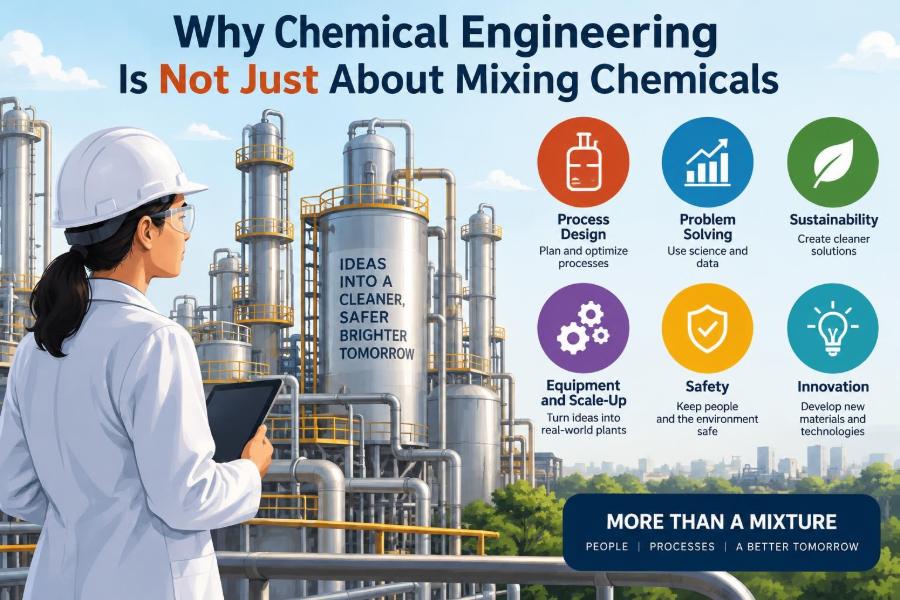
This is where chemical engineering enters. The discipline uses chemistry, physics, mathematics, biology, and design to turn laboratory knowledge into controlled processes and useful products.
Understanding that distinction matters for students choosing a field, professionals collaborating across disciplines, and anyone curious about the industrial systems that shape everyday life.
🧭 The Short Answer: Engineering the Whole System
Chemical engineering is often introduced as “applied chemistry,” which is partly true but incomplete. Chemists commonly investigate what substances are, how they react, and how to create or measure them. Chemical engineers focus on making those transformations work as practical systems.
That system includes raw materials, equipment, energy use, separation steps, controls, operators, safety barriers, waste treatment, product specifications, and economics. A process is successful only when these parts work together.
🧪 Chemistry Is Essential, but It Is Not the Entire Job
A chemical engineer needs chemistry to understand molecular interactions, reaction pathways, acidity, solubility, and material compatibility. Without it, selecting a reaction route or anticipating a hazardous by-product would be guesswork.
But knowing that a reaction can occur does not establish that it should be used in a plant. The reaction may be too slow, release too much heat, require an impractical catalyst, or create a mixture that is extremely difficult to purify.
📈 From a Beaker to a Production Plant
At laboratory scale, a researcher may make grams of product in a flask, using careful manual additions and a sophisticated purification method. At manufacturing scale, the same idea might require tonnes of material, continuous operation, and consistent quality across months or years.
Scale changes the physics. Heat escapes quickly from a small vessel because of its relatively large surface area. A large reactor has much more volume relative to surface area, so heat generated inside may accumulate. A reaction that appears calm in a beaker can become difficult to control in a large vessel.
🔺 The Scale-Up Problem
Scale-up is the effort to translate a process from one size to another without losing safety, quality, or performance. It is not simply multiplying every dimension by the same factor.
Mixing, heat transfer, pressure drop, residence time, and mass transfer all respond differently when equipment gets larger. Engineers therefore use pilot plants, models, process data, and staged design decisions rather than assuming laboratory results will transfer directly.
🌡️ Heat Transfer Controls More Than Temperature
Many processes absorb or release heat. An exothermic reaction releases heat; an endothermic reaction requires a heat supply. Engineers must remove or add that heat at the rate the process demands.
A reactor jacket, internal coils, heat exchanger, or cooling loop may sound like supporting equipment, but it can determine whether a process remains stable. Inadequate heat removal can speed up an exothermic reaction, which produces still more heat—a dangerous feedback loop.
🔄 Mixing Is a Design Question, Not a Simple Motion
Mixing chemicals is real work in chemical engineering, but it means far more than stirring. Engineers ask whether every region of a vessel has the intended composition, temperature, and reaction environment.
A thick polymer solution may need a different impeller from a low-viscosity liquid. Gas bubbles in a fermentation tank must disperse effectively without harming sensitive cells. Powders can form clumps, settle, or create dust hazards. Each situation calls for equipment and operating choices grounded in fluid mechanics.
🧲 Mass Transfer Moves Molecules Where They Need to Go
Mass transfer describes the movement of a component from one place or phase to another. It occurs when oxygen dissolves from air bubbles into water, when a fragrance evaporates, or when a dissolved compound moves through a membrane.
It is central to processes such as absorption, extraction, drying, crystallization, and bioreactors. A reaction may have excellent chemistry but still underperform if a reactant cannot reach the catalyst surface or if oxygen cannot reach microorganisms fast enough.
⚗️ Reactions Need Kinetics, Not Just Equations
A balanced chemical equation tells us the proportions of reactants and products. It does not reveal how rapidly the reaction proceeds, what intermediate species form, or how temperature and concentration affect the rate.
Reaction engineering uses kinetic information to choose reactor type, operating conditions, catalyst loading, and residence time. It also considers selectivity: the ability to form the desired product rather than unwanted side products.
🏭 Choosing the Right Type of Reactor
There is no universal “chemical reactor.” A batch reactor may suit smaller-volume, flexible production. A continuous stirred-tank reactor can provide steady operation and good mixing. A plug-flow reactor is often useful when conditions should change progressively along a flow path.
Fixed-bed catalytic reactors, slurry reactors, fermenters, and electrochemical cells address other needs. Selecting one means balancing conversion, selectivity, heat removal, cleaning requirements, maintenance, safety, and cost.
🧹 Separation Is Often the Hardest Part
Products rarely emerge from a reactor as a pure, ready-to-sell material. They may be mixed with solvents, unreacted feed, water, catalyst particles, salts, by-products, or closely related compounds.
Separation can consume a major share of a facility’s energy and capital. In many cases, designing an easier-to-separate process is more valuable than slightly increasing reaction yield.
🧰 The Separation Toolbox
Engineers select separations based on physical and chemical differences between components. Boiling point, solubility, particle size, electrical charge, volatility, and affinity for another phase can all be used.
| Method | Useful difference | Typical example |
|---|---|---|
| Distillation | Volatility or boiling behavior | Separating liquid mixtures |
| Filtration | Particle size | Removing solids from a liquid |
| Membrane separation | Selective transport through a barrier | Water purification |
| Extraction | Different solubility in two liquids | Recovering a dissolved compound |
| Crystallization | Solubility changes | Purifying solid products |
No method is automatically best. Distillation is versatile, for example, but may be unsuitable for heat-sensitive materials or mixtures that are difficult to split by boiling behavior.
⚡ Energy Is a Process Variable
Heating, cooling, compressing, pumping, separating, and drying all require energy. Chemical engineers map where energy enters, leaves, and is wasted so that a process can be designed intelligently.
Heat integration is one practical strategy: using heat from a hot stream to warm a cold stream rather than discarding it and generating new heat elsewhere. The details require careful design because streams must remain safely separated and temperatures must be appropriate.
📏 Material Balances Keep the Story Honest
A material balance accounts for what enters, leaves, accumulates, forms, or is consumed in a process. The basic idea is familiar from a household budget: material cannot simply vanish because a spreadsheet is inconvenient.
These balances expose unrealistic proposals. If a process claims to make more product than its feed chemistry permits, or ignores a large waste stream, a material balance will reveal the inconsistency.
🧮 Process Models Turn Assumptions into Testable Ideas
Engineers use equations and computer models to represent equipment and process networks. A model can estimate flows, temperatures, compositions, pressure losses, and energy demands before expensive equipment is built.
Models are not crystal balls. Their value depends on sound assumptions, reliable property data, and validation against measurements. A careful engineer asks where the uncertainty is greatest and whether it could change a design decision.
🎛️ Control Systems Keep Processes on Target
Industrial processes are constantly disturbed by changing feed composition, ambient conditions, equipment wear, and demand changes. Process control uses sensors, controllers, valves, pumps, and alarms to keep key variables near their intended values.
For example, a temperature controller may adjust cooling flow when reactor temperature rises. Control design is not merely about convenience; stable control can protect product quality, reduce waste, and support safe operation.
🛡️ Safety Must Be Built In, Not Added Later
Chemical engineering deals with flammable materials, high pressures, corrosive substances, toxic exposures, stored energy, and reactive mixtures. Not every process has every hazard, but every process needs structured hazard thinking.
Engineers examine what could deviate from normal operation: a blocked outlet, failed cooling water, incorrect material addition, loss of power, or instrument malfunction. They then design layers of protection, such as relief systems, containment, interlocks, procedures, and emergency response plans.
🔥 Process Safety Is Different from Personal Safety
Personal safety includes practices such as wearing appropriate protective equipment and preventing slips or cuts. Those are necessary. Process safety focuses on preventing large releases of hazardous material or energy.
A process can have excellent personal protective practices and still be unsafe if its pressure relief, containment, operating limits, or control logic are poorly designed. The two areas overlap, but neither replaces the other.
🧱 Materials Must Survive Their Environment
Equipment is not chosen only by size. A vessel or pipe must withstand pressure, temperature cycling, corrosion, erosion, and the chemicals it contacts. An unsuitable material can contaminate a product, leak, crack, or fail prematurely.
Compatibility also includes seals, gaskets, coatings, and instrument components. A highly resistant metal might be technically effective yet unjustifiably expensive, so material selection is an engineering trade-off rather than a single-property decision.
💧 Water Engineering Is Chemical Engineering
Clean water systems rely on coagulation, filtration, disinfection, adsorption, membranes, biological treatment, and sludge handling. Each step depends on chemical and physical principles as well as reliable equipment operation.
Wastewater treatment is similarly more than “cleaning water.” Engineers manage variable influent, microbial activity, nutrient removal, solids separation, odor control, energy consumption, and discharge requirements that differ by location and application.
💊 Medicines Demand Consistency
Pharmaceutical manufacturing may involve chemical synthesis, cell culture, filtration, drying, granulation, coating, sterile processing, and packaging. The challenge is not only making an active ingredient once; it is producing material that repeatedly meets tightly defined specifications.
Small changes in moisture, particle size, mixing, or temperature can affect downstream behavior. This is why chemical engineers work closely with analytical scientists, quality teams, pharmacists, and manufacturing specialists.
🍞 Food and Consumer Products Are Processed Materials
Texture, shelf life, taste, stability, and appearance in food products are process outcomes as much as formulation outcomes. Emulsions can separate, powders can cake, and heat treatment can alter flavor or nutritional quality.
The same thinking applies to detergents, cosmetics, paints, adhesives, and household cleaners. Engineers must understand how products behave during manufacture, transport, storage, and use—not only on the day they leave a factory.
🔋 Energy Systems Need Molecular Thinking
Chemical engineers contribute to conventional fuels, hydrogen systems, carbon capture, battery materials, electrolysis, and renewable feedstocks. These areas involve reaction pathways, separations, heat management, transport phenomena, and process integration.
No energy technology is free of trade-offs. A promising material may rely on scarce inputs, demand substantial energy to manufacture, or perform well only under specific operating conditions. Engineering analysis makes those constraints visible.
🌱 Sustainability Means More Than Replacing One Ingredient
A lower-impact process may use less energy, reduce emissions, minimize solvent loss, improve yield, recover by-products, reuse water, or rely on more suitable feedstocks. The right priorities depend on the product and its full process context.
Replacing a petrochemical feedstock with a biological one, for example, is not automatically better in every case. Land use, purification energy, transport, product durability, and end-of-life treatment can all affect the overall picture.
♻️ Waste Is Often a Design Signal
Waste streams carry cost because they contain lost material, require treatment, or create handling obligations. Looking closely at waste can reveal opportunities to improve selectivity, recover solvent, recycle process water, or redesign a separation.
Not every stream can be economically reused, and recycling can introduce impurities that accumulate over time. Good engineering evaluates both the potential benefit and the operational consequences.
💰 A Process Must Be Economically Viable
An elegant laboratory route may need rare reagents, expensive purification, excessive energy, or specialized equipment. Chemical engineers compare capital costs—the cost to build a facility—with operating costs such as utilities, labor, maintenance, raw materials, and waste management.
Economics does not mean choosing the cheapest option at any cost. A lower-cost design that creates unacceptable safety, reliability, or environmental risks is not a sound design.
🧑🏭 Operations Knowledge Matters
Plants are operated by people who observe sounds, vibrations, trends, delays, and practical constraints that may not be obvious in a design calculation. Strong chemical engineering respects this operational knowledge.
Designs should be maintainable, understandable, and workable during start-up, shutdown, cleaning, sampling, and abnormal events. An excellent process on paper can fail in practice if operators cannot safely run or maintain it.
🤝 Chemical Engineering Is Inherently Collaborative
A chemical engineer may work alongside chemists, mechanical engineers, electricians, software specialists, environmental professionals, technicians, operators, supply-chain teams, and business leaders. The work succeeds when expertise is connected rather than isolated.
Communication is therefore a technical skill. Explaining a hazard, design basis, process limit, or uncertain result clearly can prevent costly misunderstandings and improve decisions.
📚 What Students Actually Learn
Chemical engineering curricula typically build from mathematics, chemistry, and physics into thermodynamics, fluid mechanics, heat and mass transfer, reaction engineering, separations, process control, design, and safety.
The goal is not to memorize every industrial process. It is to develop transferable ways to analyze systems: define boundaries, state assumptions, conserve mass and energy, identify limiting mechanisms, quantify uncertainty, and compare alternatives.
🧠 The Habit of Thinking in Constraints
Engineers do not usually ask only, “Can this be made?” They ask, “Can it be made at the required purity, rate, cost, and safety level with the available resources?” Constraints are not obstacles added after creativity; they shape useful creativity.
Consider a hypothetical new biodegradable coating. Its chemistry may work beautifully, but the process may still need to solve drying time, solvent recovery, coating uniformity, equipment cleaning, and storage stability before it becomes a practical product.
⚠️ Common Misconceptions About the Field
- “It is just mixing chemicals.” Mixing is one operation among many, and it often requires sophisticated design.
- “It is the same as chemistry.” The fields overlap, but chemical engineering emphasizes systems, scale, equipment, and implementation.
- “It only means working in refineries.” The field spans water, food, biotechnology, materials, electronics, pharmaceuticals, energy, and more.
- “More production always means a bigger reactor.” Capacity can depend on separation bottlenecks, heat transfer, operating time, reliability, and supply limits.
🔍 Questions to Ask When Evaluating Any Process
Whether you are studying a flowsheet or reviewing a workplace proposal, a few questions reveal the engineering beneath the chemistry:
- What enters the process, and what leaves it?
- Where do heat, pressure, and hazardous energy accumulate?
- What limits production rate or product quality?
- How is the desired product separated and verified?
- What happens when equipment or utilities deviate from normal operation?
- Where do waste, emissions, and energy losses occur?
These questions do not replace detailed design, but they encourage the systems view that defines the discipline.
🌍 Why This Perspective Matters Beyond Industry
Many public discussions about plastics, fuels, medicines, water, and climate technologies focus on a single ingredient or headline claim. Chemical engineering encourages a broader view: feedstock, manufacturing, use, safety, energy, emissions, recovery, and disposal are connected.
That perspective does not make decisions simple. It makes the trade-offs explicit, which is a better basis for responsible technical choices.
🏁 The Core Principle: Transformations Must Work in Reality
Chemical engineering turns scientific possibility into repeatable practice. It asks whether a transformation can be controlled, scaled, separated, powered, monitored, maintained, and performed with acceptable safety and environmental consequences.
The discipline is therefore not defined by a single kind of chemical or a single industry. It is defined by the ability to design and improve processes that transform matter responsibly under real-world constraints.
Chemical engineering is not just about mixing chemicals; it is about designing the complete, connected system that makes useful chemical transformations possible. That systems mindset is what links a lab idea to the products and infrastructure people rely on every day. 🧪⚙️🌍