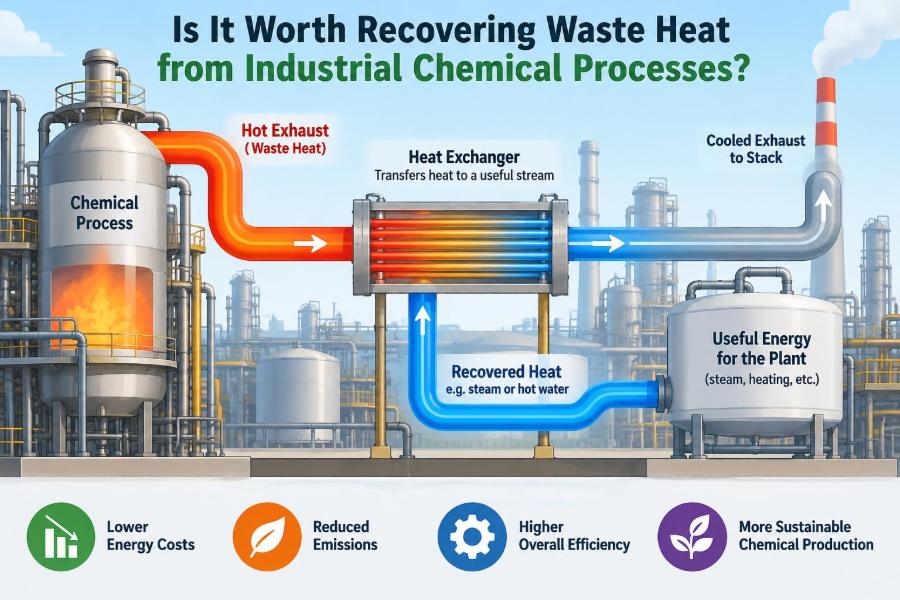

A distillation column may run around the clock, separating valuable products while its overhead condenser rejects heat to cooling water. A furnace may send hot flue gas toward a stack. A reactor effluent may need cooling before the next process step. In each case, energy leaves the plant because it is no longer useful at that location.
That does not automatically make it useless. The same heat might preheat boiler feedwater, generate low-pressure steam, warm a building, drive an absorption chiller, or reduce fuel use in another unit. But it may also be too cool, too intermittent, too contaminated, or too expensive to capture sensibly.
This is why waste-heat recovery is not simply a matter of adding a heat exchanger. It is a process-integration decision involving thermodynamics, equipment reliability, safety, utilities, control, and economics.
For chemical engineers, the worthwhile question is not “Is there heat being rejected?” It is: can this heat be recovered at the right temperature, in the right amount, at the right time, for a dependable use?
🔥 What Counts as Waste Heat?
Waste heat is thermal energy discharged from a process, utility, or piece of equipment without being used further on site. Common sources include stack gas, hot product streams, cooling-water return, compressor aftercoolers, condensate, and exothermic reaction cooling.
“Waste” describes its present destination, not necessarily its inherent value. A hot stream sent to an air cooler may be a valuable heat source if another stream needs heating nearby.
⚖️ Heat Is Not the Same as Useful Energy
Every hot stream contains energy, but not every unit of energy can do the same work. Heat at a high temperature can potentially make steam or drive a turbine; heat near ambient temperature usually cannot.
This difference is often described through energy quality, or more formally, exergy. Exergy measures the maximum useful work theoretically available as a system comes into equilibrium with its surroundings. It helps explain why recovering a little high-temperature furnace exhaust heat can be more valuable than recovering a much larger amount of lukewarm cooling-water heat.
🌡️ The Temperature Level Sets the Opportunity
A practical first screen is the source temperature and the temperature required by the possible user. Heat naturally flows from hot to cold, but a usable exchanger needs a driving force throughout its length.
| Waste-heat level | Typical practical uses | Common limitation |
|---|---|---|
| High temperature | Combustion-air preheat, steam generation, feed preheat | Materials, fouling, corrosion, safety |
| Medium temperature | Process-to-process exchange, hot-water systems, reboiler support | Matching heat demand and avoiding pinch violations |
| Low temperature | Building heat, preheating, heat pumps, absorption cooling | Limited driving force and lower direct value |
Temperature alone is not enough. A small, very hot stream may not contain enough duty to justify equipment, while a large warm stream may become useful when a heat pump upgrades it.
📏 Start with a Reliable Heat Balance
Before discussing technology, establish the duty. For a sensible heating or cooling stream, the basic estimate is Q = m × Cp × ΔT, where m is mass flow rate, Cp is heat capacity, and ΔT is the temperature change.
Phase change requires latent heat as well. Condensing steam or a vapor can release substantial duty at nearly constant temperature, which often makes it particularly attractive for recovery.
Plant data deserve scrutiny. Flow meters can drift, temperatures can be poorly located, and normal operation may differ sharply from a short test period. Design decisions should use representative operating cases, including turndown and start-up where relevant.
🧭 Find the Heat Sink Before Choosing Equipment
The most common conceptual error is beginning with the hot stream: “We have 8 MW of waste heat; what machine should we buy?” A better sequence begins by identifying a stable heat sink: a stream, utility, or service that regularly needs heat.
Potential sinks include cold feeds, boiler feedwater, deaerator makeup, wash water, combustion air, building hot-water loops, and thermal regeneration duties. The best sink is often inside the same process area because pipe runs, heat losses, and operating dependencies are lower.
🔁 Direct Process Integration Usually Comes First
Direct recovery means exchanging heat from one process stream to another through a heat exchanger. It generally offers the highest efficiency because heat is used at its existing temperature rather than converted into another energy form.
For example, a hot reactor effluent that must be cooled may preheat reactor feed. This can reduce both cooling utility demand and furnace or steam demand. The concept is simple; designing it safely and controllably may not be.
🧩 Pinch Analysis Reveals System-Level Limits
Pinch analysis is a structured method for matching hot and cold process streams across an entire plant or process unit. Instead of optimizing exchangers one at a time, it identifies theoretical utility targets and the temperature region where heat recovery is most constrained: the pinch.
The method does not replace engineering judgment. It provides targets based on stream data and a chosen minimum approach temperature, then the proposed network must still account for pressure drop, fouling, layout, controllability, cleaning, and operating flexibility.
A key lesson is that a seemingly sensible exchanger can increase total utility demand if it transfers heat across the pinch in the wrong direction.
🧪 A Simple Hypothetical Match
Imagine a process product leaving a reactor at 180°C and needing cooling to 90°C. A feed stream enters at 40°C and must reach 130°C before a trim heater. A feed-effluent exchanger may recover a significant share of the duty.
That result is not guaranteed. If the product fouls, polymerizes, contains solids, or must remain isolated from feed for safety reasons, a direct exchanger may create unacceptable risk. The example illustrates a screening opportunity, not a universal design recommendation.
♨️ Steam Systems Are Often the Best First Target
Chemical plants commonly distribute steam at multiple pressure levels. This creates several places to use recovered heat: generating steam, preheating boiler feedwater, heating condensate, or reducing extraction steam to a reboiler.
Steam is convenient because it transports heat effectively and serves many users. Yet generating steam from waste heat requires a sufficiently high and dependable source temperature, plus protection against tube failure, dry-out, unstable circulation, and pressure excursions.
💧 Recovering Heat Through Hot Water
Where the source cannot economically make steam, hot-water loops can transport lower-grade heat to suitable users. They are common for wash systems, space heating, low-temperature process heating, and preheat duties.
Hot water is less thermodynamically versatile than steam, but it can be simpler and safer for modest temperature applications. Its weakness is distribution: long piping routes can cost money, lose heat, and complicate expansion, insulation, and freeze protection.
🏭 Flue Gas Recovery Needs Careful Engineering
Furnace, boiler, incinerator, and thermal-oxidizer exhaust may carry valuable high-temperature heat. Economizers recover part of this energy to heat boiler feedwater; air preheaters transfer it to combustion air.
The limiting issue is often not heat transfer but cold-end corrosion. As exhaust cools, water and acid-forming species can condense. Fuel composition, sulfur-containing compounds, halides, particulate loading, and excess oxygen all affect the risk. Material selection and outlet-temperature limits must be based on the actual gas chemistry.
🌀 Compressors, Refrigeration, and Hot Oil Loops
Compressor discharge cooling is a frequent but sometimes overlooked source. The recovered heat may be useful for hot water, feed preheat, or regeneration steps, particularly where compressors operate steadily.
Refrigeration condensers reject heat at a temperature that can support water heating or selected process uses. Hot-oil systems can also offer recoverable duty, although any change to an oil circuit needs close attention to fluid degradation, leak management, and fire protection.
🧊 Low-Grade Heat Can Still Have a Role
Cooling water returning from exchangers can appear disappointing because it is only moderately warmer than ambient conditions. Direct reuse is limited, but a nearby user with a low supply temperature may still benefit.
Examples include greenhouse heating, low-temperature washing, or tempering a feed before final heating. The viable application depends heavily on local conditions, seasonal demand, distance, and whether the recovered heat displaces a fuel, electricity, or another already-low-cost source.
⚡ Heat Pumps Upgrade Temperature, Not Magic
A heat pump uses work—usually electricity—to move heat from a lower temperature to a higher temperature. It can make low-grade heat useful for process hot water or moderate-temperature heating duties.
Its attractiveness depends on the required lift: the larger the temperature difference between source and delivery, the more demanding the system becomes. A heat pump also needs stable source flow, refrigerant safety management, suitable maintenance capability, and an electricity-versus-fuel comparison that reflects local operating conditions.
❄️ Absorption Cooling Can Turn Heat into Cooling
Absorption chillers use heat rather than a large mechanical compressor to produce cooling. They may be appropriate where waste heat is available while chilled water is genuinely needed, such as for process cooling, dehumidification, or building loads.
They are not a way to avoid thermodynamic trade-offs. Their cooling output and operating range depend on the heat source temperature and cooling-water conditions. Integration should include an honest assessment of part-load operation and seasonal cooling demand.
🔌 Power Generation Is Usually a Higher Bar
Organic Rankine cycle systems and other bottoming-cycle technologies can generate electricity from certain waste-heat sources. This is most plausible when temperature, flow, and annual operating hours are sufficiently high and stable.
Electricity is valuable, but conversion introduces capital cost, auxiliary loads, working-fluid management, and lower overall efficiency than direct heat use. If a nearby process can use the heat directly, direct recovery will often deserve evaluation before power generation.
🧱 Fouling Changes Both Economics and Safety
Heat exchangers perform according to clean-surface assumptions only briefly in many real services. Scale, coke, polymer, salts, biofouling, corrosion products, and suspended solids add thermal resistance and raise pressure drop.
A recovered-heat exchanger that gradually loses duty can force higher fuel use elsewhere while remaining in service unnoticed. Designs should consider fouling resistance, velocity, filtration, bypasses, cleaning access, online monitoring, and a realistic cleaning strategy from the outset.
🧯 Contamination and Cross-Leakage Matter
Direct heat exchange keeps streams physically separated by a wall, but tube leaks can still create cross-contamination. The consequence can range from product loss to a serious process hazard, depending on the fluids and pressures involved.
Engineers may choose double-tube-sheet designs, intermediate loops, leak detection, pressure arrangements that favor the safer leak direction, or isolation between incompatible services. The extra barrier can reduce thermal efficiency but improve risk management.
🛡️ Review Process Safety Early
Heat recovery alters temperatures, pressures, inventories, and operating dependencies. A feed-effluent exchanger, for instance, may preheat a reactor feed more strongly after a disturbance, potentially reinforcing an upset if controls are poorly designed.
Hazard reviews should address credible exchanger leaks, blocked outlets, thermal expansion, loss of cooling, loss of heat sink, overpressure, flashing, ignition sources, and maintenance isolation. Relief systems and safeguards must be reassessed when the thermal configuration changes.
🎛️ Controllability Is Part of the Design
A recovery system should work during normal operation without making abnormal operation harder. Heat sources and sinks rarely change at exactly the same rate, so bypasses, trim heaters, control valves, split-range control, and buffer tanks may be necessary.
Consider what happens when the sink disappears. A furnace exhaust economizer may need a bypass to protect downstream equipment; a process exchanger may need a safe cooling path when feed flow falls. A design that has no credible fallback is fragile.
📆 Match Operating Profiles, Not Nameplate Duties
Two streams can look perfectly matched in a steady-state simulation but operate on different schedules. Batch processes, grade changes, shutdowns, seasonal heating demand, and variable throughput all reduce actual recovered energy.
Engineers should compare time profiles: how many hours is the source hot, how many hours is the sink available, and what happens at minimum and maximum rates? Annual energy is determined by overlap, not by peak duty alone.
💰 Evaluate More Than Fuel Savings
A preliminary business case starts with avoided utility consumption, but the full evaluation includes installed equipment, piping, structural work, insulation, controls, electrical supply, water treatment, maintenance, downtime, and engineering.
It should also capture changes in cooling demand, steam balance, emissions obligations where applicable, and production impacts. A project with modest fuel savings may be attractive if it removes a cooling bottleneck; another with impressive energy savings may fail if installation requires a long shutdown.
🧮 Use Marginal Utility Value
The value of recovered heat is the cost of the utility it actually displaces, not necessarily the average cost shown on a site-wide bill. Replacing high-pressure steam, low-pressure steam, natural-gas firing, and electric heating produces different benefits.
Likewise, reducing cooling water may have little marginal value at one site but relieve a constrained cooling tower at another. Clear utility models prevent inflated project claims and help rank competing opportunities fairly.
🏗️ Brownfield Constraints Can Dominate
Existing plants impose physical realities: congested pipe racks, inaccessible exchangers, inadequate foundations, limited tie-in windows, hazardous-area requirements, and operators who already manage complex systems.
A technically elegant match can become impractical when it requires a long pipe route or disruptive outage. Early field verification—rather than relying only on drawings—often reveals the actual cost and constructability risks.
🔍 Metering Turns an Idea into a Verified Result
Once installed, recovery should be measured. Temperature alone is not enough; flow, pressure drop, utility rates, bypass position, and operating status help distinguish genuine recovery from changes in production rate or weather.
Useful performance indicators include recovered duty, exchanger approach temperature, fouling trend, avoided utility use, and availability. Verification also catches problems such as a stuck bypass valve or a control strategy that silently favors the old utility path.
🚫 Common Mistakes in Waste-Heat Projects
- Chasing the hottest stream: it may have no dependable user or may be too dirty for economical recovery.
- Ignoring minimum approach temperature: a spreadsheet match can be physically impossible in a real exchanger.
- Assuming continuous operation: intermittent source and sink profiles can erase expected annual savings.
- Underestimating fouling: clean-duty calculations do not define long-term performance.
- Forgetting the fallback path: loss of the heat sink must not create an unsafe or production-limiting condition.
- Counting savings twice: steam, fuel, power, and cooling changes must be reconciled in one utility balance.
🗺️ A Practical Screening Workflow
- Collect representative stream data: flow, temperature, pressure, composition, phase, variability, and contamination risk.
- Identify existing heating and cooling demands, then rank them by temperature level and operating overlap.
- Estimate recoverable duty with feasible approach temperatures and account for fouling.
- Compare direct exchange, utility-loop, heat-pump, cooling, and power options in that order of thermodynamic simplicity.
- Review safety, control, layout, maintenance, and tie-in constraints before refining economics.
- Develop a preliminary design and verify savings after installation.
This workflow avoids spending detailed engineering effort on an attractive source that has no viable sink.
👷 Operator Experience Is Valuable Design Data
Operators and maintenance teams know which exchangers plug, which control valves hunt, which lines freeze, and which seasonal changes upset the unit. Their observations may reveal constraints absent from process-flow diagrams.
Engaging them early improves operability and maintainability. It also makes the eventual system more likely to be used rather than bypassed whenever conditions become inconvenient.
🌍 Environmental Benefits Depend on the Displaced Utility
Recovering heat can reduce fuel combustion, electricity use, cooling-water demand, or cooling-tower evaporation. The environmental benefit depends on what the recovered duty replaces and how the site generates or purchases its utilities.
For that reason, emissions claims should be calculated from a defined baseline and stated with appropriate assumptions. Heat recovery is often a sound efficiency measure, but its environmental value is not identical for every plant or every hour of operation.
🔄 Recovery Can Support Electrification
As plants consider electric boilers, electric heaters, and heat pumps, reducing thermal demand becomes even more useful. A well-designed exchanger network can lower the size and operating burden of new electrified utility equipment.
At the same time, electrification may change the relative value of low-grade heat. A heat pump paired with recovered cooling-water heat can become more attractive when it displaces a higher-temperature heating duty, provided the process temperature target is realistic.
✅ So, Is Waste-Heat Recovery Worth It?
Often, yes—but not because heat is visibly leaving a plant. The strongest projects pair a steady source with a nearby, compatible, dependable sink; preserve a sufficient temperature driving force; and remain safe, cleanable, controllable, and economic over actual operating cycles.
Direct process integration is usually the first option to investigate. Utility loops, heat pumps, absorption cooling, and power generation each have a place when the temperature level, distance, operating pattern, and economics support them.
The central principle is straightforward: recover heat where it displaces a real demand at the lowest practical level of complexity. That approach respects thermodynamics while recognizing that chemical plants must run reliably, not merely look efficient on a flowsheet.
Waste-heat recovery is worth pursuing when the full process system—not just the hot stream—makes it useful. Start with sound data, match source and sink honestly, and let safety and operability shape the final design. ♨️🏭🧪