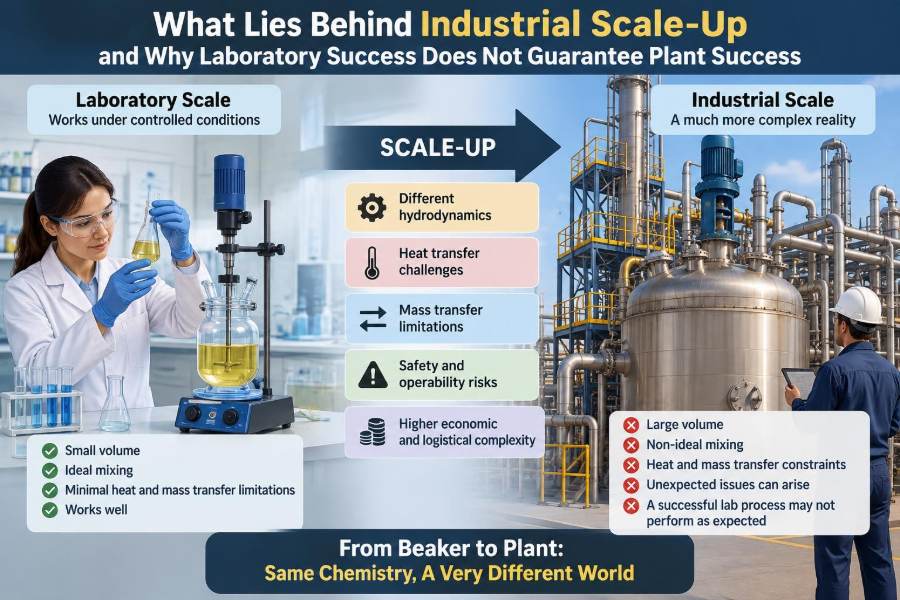

A reaction can look beautifully simple in a laboratory. A chemist adds reagents to a flask, turns on a stirrer, controls the temperature, and obtains a promising yield from a few hundred millilitres of material.
Then the same chemistry is moved toward a pilot unit or production plant. The yield falls, a filter blocks, temperature control becomes sluggish, an impurity appears, or the process takes far longer than expected. None of these outcomes necessarily means the laboratory work was wrong.
They reveal a central reality of chemical engineering: a process is not enlarged like a photograph. It becomes a different physical system, with new flow patterns, heat-transfer paths, operating constraints, and safety consequences.
Understanding scale-up helps students interpret the purpose of transport phenomena and helps working professionals ask better questions before capital is committed. The aim is not to distrust lab data, but to learn what that data can—and cannot—tell us.
🔍 Scale-Up Is More Than Making a Bigger Batch
Industrial scale-up is the structured transition from small experimental equipment to larger equipment that can safely, reliably, and economically make a product at the required rate. It may pass through bench, pilot, demonstration, and commercial scales.
A laboratory vessel is often designed for flexibility. A plant is designed for continuous operation, maintenance access, containment, energy use, product consistency, and safe response to deviations. Those objectives create constraints that a flask rarely exposes.
Increasing volume also changes geometry. A vessel that holds one thousand times more liquid does not have one thousand times more surface area for heat removal. That mismatch is one reason small-scale success cannot simply be multiplied.
📐 Geometry Changes the Physics
When geometrically similar vessels are enlarged, volume increases with the cube of a characteristic length, while area increases with its square. A larger reactor therefore has less heat-transfer area per unit volume.
Mixing length also grows. Material near an impeller, feed point, wall, or cooling jacket may experience very different conditions before the vessel is fully blended. In a small beaker, those differences may disappear in seconds; in a large vessel, they can persist long enough to affect chemistry.
Scale-up is therefore governed by dimensionless and physical relationships, not by a single volume ratio. Engineers ask which phenomena control quality, rate, safety, or separation, then choose scale-up criteria around those phenomena.
🧪 What a Laboratory Experiment Actually Proves
A successful experiment can establish that a reaction pathway is feasible under particular conditions. It can reveal likely products, approximate kinetics, sensitivity to temperature, catalyst activity, solvent compatibility, and initial purification options.
It does not automatically demonstrate that the process can tolerate realistic raw-material variation, remove heat at high throughput, maintain uniform mixing, recover solvent efficiently, or meet emissions and waste-handling requirements.
Laboratory success is best treated as evidence with a boundary. The boundary includes the apparatus, operating method, batch size, sampling method, reagent quality, and degree of manual attention used to obtain the result.
🌡️ Heat Removal Often Becomes the First Barrier
Many reactions release heat. At small scale, a flask has a high surface-area-to-volume ratio and can lose heat readily to a bath, jacket, or room surroundings. At plant scale, heat generation grows with reacting volume while removal depends heavily on available area and temperature driving force.
If heat is generated faster than it can be removed, temperature rises. Because reaction rates commonly increase with temperature, a rise can accelerate heat release further. This feedback is the basis of a thermal runaway hazard.
Heat-transfer performance also depends on fouling, coolant flow, jacket design, agitation, and the viscosity of the process fluid. A calculated overall heat-transfer coefficient should be treated as an estimate until supported by representative equipment and operating data.
🔥 Reaction Calorimetry Turns Concern into Data
Reaction calorimetry measures or estimates heat release during a reaction under controlled conditions. It helps determine the heat generated per amount reacted, the rate of heat generation, and the consequences of abnormal feed or cooling conditions.
This information supports decisions about feed rate, cooling capacity, emergency relief, quench strategy, and safe inventory. It is particularly valuable for fast, exothermic, gas-forming, or poorly understood reaction systems.
Calorimetry does not replace a full process safety assessment. Decomposition, incompatible mixtures, gas evolution, accumulation of unreacted feed, and loss-of-utility scenarios may require separate investigation.
🌀 Mixing Is Not One Number
“Well mixed” is convenient language, but a large vessel can be well mixed on average while still containing short-lived local zones of high concentration, temperature, acidity, or catalyst loading. Those local conditions may control impurity formation or reaction selectivity.
Agitator speed alone does not describe mixing. Impeller type, impeller diameter, liquid level, baffles, viscosity, density, gas dispersion, feed position, and vessel geometry all matter.
A reaction that tolerates slow addition in a laboratory funnel may behave differently when a concentrated feed enters a plant reactor through a pipe. The question is not only how fast material is added, but what it encounters during the first moments after addition.
💧 Feed Points Can Create Hidden Microenvironments
Consider a hypothetical neutralization reaction. A small flask may disperse acid rapidly throughout a stirred liquid. In a larger vessel, acid entering near the wall or in a low-turbulence region can create a temporary low-pH zone.
That zone may hydrolyze a sensitive intermediate, corrode equipment, generate localized heat, or produce a different crystal form later in the batch. Bulk pH measurements may never show the excursion.
Engineers can reduce this risk by evaluating feed location, injection velocity, feed dilution, recirculation loops, static mixers, and addition time. The appropriate solution depends on the chemistry and the mixing regime.
🧬 Selectivity Can Shift with Scale
Selectivity describes how strongly a reaction favors the desired product over by-products. It can change when temperature histories, concentrations, residence times, or mass-transfer rates change.
For parallel reactions, hotter zones may favor an unwanted pathway. For consecutive reactions, holding material too long can convert the desired intermediate into a by-product. Catalytic systems may be sensitive to trace contaminants that are insignificant in purified laboratory reagents.
Average reactor temperature and final conversion are useful measurements, but they may not capture the history that created a specific impurity. Process development must identify which local and time-dependent variables matter most.
⏱️ Residence Time Is a Distribution, Not Just an Average
In a continuous process, residence time is often estimated as reactor volume divided by volumetric flow rate. This gives a mean value, not the exact time every molecule spends inside the equipment.
Real vessels may have bypassing, stagnant zones, recirculation, or channeling. The resulting residence time distribution can broaden product specifications, lower conversion, or expose a heat-sensitive material to excessive time at temperature.
Tracer tests and suitable flow models help characterize this behavior. A plug-flow reactor, a mixed tank, and a cascade of tanks can have different conversion and selectivity even when their nominal volume and throughput are similar.
🫧 Gas–Liquid Systems Add Another Scale-Up Problem
Hydrogenation, oxidation, fermentation, absorption, and many other processes depend on transferring a gas into a liquid. The rate depends on gas bubble size, interfacial area, liquid mixing, pressure, temperature, and chemical consumption of the dissolved gas.
A sparger that produces fine bubbles in a small unit may behave differently at larger scale. Higher liquid depth changes hydrostatic pressure, while altered agitation can change bubble coalescence and gas hold-up.
For oxygen-sensitive biological processes, oxygen-transfer capacity can directly limit productivity. For reactive gases, insufficient transfer can alter conversion; excessive gas flow can cause foaming, entrainment, or off-gas treatment challenges.
🧱 Solids Rarely Behave Like Ideal Liquids
Slurries, suspensions, crystallizing mixtures, and polymer solutions create some of the most difficult scale-up problems. Solids may settle in quiet zones, erode pipes, form deposits, or make agitation dramatically less effective.
At laboratory scale, a magnetic stir bar may keep a small amount of solids moving. At plant scale, engineers must consider just-suspended speed, impeller clearance, particle size distribution, slurry density, and whether solids can be drained and cleaned safely.
Once solids are present, sampling also becomes harder. A sample from one point may not represent the vessel as a whole, especially if crystals or catalyst particles are unevenly distributed.
❄️ Crystallization Depends on Thermal History
Crystallization is not merely “cool until solids form.” Crystal size, shape, purity, filtration behavior, and downstream drying can depend on supersaturation, cooling profile, seeding, mixing, solvent composition, and residence time.
A small experiment may cool quickly and uniformly, producing acceptable crystals. A larger batch may cool unevenly near a jacket, generate excessive fine particles, or experience nucleation before the intended seed is added.
Scale-up work should examine seeding strategy, cooling ramps, anti-solvent addition, slurry aging, and crystal breakage. The desired result is a reproducible particle population, not simply a high isolated mass.
🧺 Separation Steps Can Defeat a Good Reaction
A reaction may reach high conversion and still fail commercially if its product is difficult to isolate. Filtration, centrifugation, extraction, distillation, adsorption, and drying often determine cycle time, solvent demand, and final purity.
For example, a filter funnel may handle a few grams of fine crystals with patient manual washing. The same cake in a large filter can blind the medium, retain large quantities of mother liquor, or take an impractical time to dry.
Early development should therefore measure properties that affect separability: settling behavior, filter resistance, particle size, phase disengagement time, emulsion tendency, volatility, and thermal stability.
🌊 Liquid–Liquid Extraction Is Sensitive to Hydrodynamics
Extraction separates components between immiscible liquid phases. It is often demonstrated by shaking a separatory funnel, but industrial contactors must balance interfacial area against easy phase separation.
Too little mixing reduces mass transfer. Too much mixing can create stable dispersions or emulsions that are slow to separate, especially when surfactants, fine solids, polymers, or natural feed impurities are present.
Settling tests, actual feed compositions, and representative agitation conditions are more informative than an idealized lab extraction using fresh, pure components.
🏭 Distillation Brings Energy and Operability Constraints
Distillation can appear straightforward in a small apparatus, where a researcher can adjust reflux, collect fractions slowly, and observe behavior closely. A production column must maintain separation across changing feed conditions and throughputs.
Relative volatility, heat sensitivity, foaming, pressure drop, tray or packing performance, condenser duty, reboiler duty, and non-condensable gases all influence design. Some mixtures also form azeotropes, where simple distillation cannot achieve the desired composition.
A workable laboratory separation may be too energy-intensive, too slow, or too unstable to operate economically at plant scale. Alternatives such as extraction, membranes, crystallization, or solvent changes may deserve evaluation.
🧹 Fouling and Cleaning Are Process Variables
Deposits on heat exchangers, reactors, filters, and transfer lines reduce performance over time. They can arise from polymerization, salt precipitation, coking, crystallization, biological growth, or degradation products.
Fouling matters because a process that performs well in its first hour may not perform well after several days. It also increases cleaning frequency, solvent use, downtime, and potential exposure during maintenance.
Development should define cleanability alongside chemistry. Questions include whether all wetted surfaces can drain, whether dead legs trap material, what cleaning agent works, how cleaning is verified, and whether residues create cross-contamination risk.
📦 Raw Materials Are Less Perfect Than Laboratory Reagents
Laboratory studies often begin with high-purity chemicals from a single supplier. Commercial raw materials may contain water, salts, isomers, stabilizers, trace metals, color bodies, or seasonal variation in composition.
These differences can affect catalyst activity, phase behavior, pH, corrosion, product color, and impurity profiles. A process should have realistic specifications for critical inputs and a plan for handling material near specification limits.
Robust processes are not necessarily indifferent to variation. They are processes where the important variations are understood, monitored, and controlled before they cause an unacceptable result.
🧪 Materials of Construction Can Change the Chemistry
Glassware is chemically resistant and easy to inspect, but commercial equipment may use stainless steel, glass-lined steel, nickel alloys, polymers, or specialized linings. Each choice has limits related to corrosion, temperature, pressure, abrasion, and cleaning chemicals.
Metal ions can sometimes affect sensitive reactions or catalysts. Corrosion products may contaminate product, while aggressive media may attack seals, gaskets, instruments, and transfer hoses before visibly damaging the main vessel.
Compatibility testing should include all relevant materials, not just the reactor wall. It should account for normal operation, cleaning, start-up, shutdown, concentration changes, and credible upset conditions.
⚙️ Batch and Continuous Routes Fail Differently
Batch processing offers flexibility and is common where products change frequently or campaign sizes are modest. Its risks include batch-to-batch variability, long cycle times, and large inventories at particular stages.
Continuous processing can improve consistency and reduce inventory for some applications, but it requires stable feeds, reliable control, suitable start-up and shutdown procedures, and a clear response to disturbances.
Neither mode is automatically superior. The best choice depends on production rate, reaction kinetics, hazard, separation needs, demand pattern, operational capability, and the consequences of off-specification material.
📊 Scale-Up Criteria Must Match the Limiting Phenomenon
Engineers sometimes try to preserve one variable during scale-up, such as impeller tip speed, power per unit volume, mixing time, or heat-transfer area per unit volume. No single criterion works for every process.
| Primary concern | Useful questions during scale-up |
|---|---|
| Heat release | Can heat be removed during normal and upset operation? |
| Mixing-sensitive chemistry | Will feed dispersion and blend time remain acceptable? |
| Gas transfer | Will gas–liquid contact meet reaction or biological demand? |
| Suspended solids | Will particles remain suspended, transferable, and filterable? |
| Crystallization | Will supersaturation and seeding remain controlled? |
The scale-up basis should be explicit and tested. Preserving power per volume may help one liquid-mixing problem, while limiting tip speed may be necessary to avoid crystal breakage or shear damage.
🧭 Pilot Plants Reduce Uncertainty, Not All Risk
A pilot plant sits between laboratory work and full production. It can test integrated operation: reaction, transfer, phase separation, filtration, solvent recovery, controls, cleaning, and recycle streams.
Its value is not just its size. A useful pilot unit resembles the intended plant in the phenomena that matter most. A pilot with unrealistic materials, mixing, residence time, or separation equipment can create false confidence.
Not every process needs every intermediate scale. But skipping piloting should be a deliberate decision based on sound similarity arguments, relevant data, and an understanding of remaining uncertainty.
🧠 Design of Experiments Finds Interactions Earlier
Changing one laboratory variable at a time can miss interactions. For example, a temperature change may appear harmless at one feed concentration but create impurities at a higher concentration or slower mixing condition.
Design of experiments uses planned combinations of factors to identify which variables and interactions affect a response. It can support development of an operating region rather than a single “best” recipe.
The outcome should be practical: ranges for temperature, concentration, addition time, agitation, and hold time that consistently meet quality targets. These ranges later inform control strategies and operating procedures.
📏 Measurement Error Can Become a Process Error
Laboratory instruments may be carefully calibrated, but sampling and measurement still have limits. A temperature probe can sit in a well-mixed zone while a feed region is hotter. A sample can change while cooling, filtering, or waiting for analysis.
At plant scale, instrument placement, response time, calibration, analyzer reliability, and sample representativeness become design questions. Operators need measurements that are meaningful fast enough to support decisions.
A process cannot be controlled better than it can be observed. Where direct measurement is difficult, engineers may use validated indirect indicators such as flow, pressure, heat balance, density, or conductivity.
🛡️ Process Safety Must Be Designed In
Safety is not an add-on after chemistry has been selected. It influences reactor size, feed strategy, vent handling, utility design, containment, inerting, relief systems, and the allowable inventory of hazardous material.
Hazard identification methods examine deviations such as no flow, high temperature, reverse flow, loss of cooling, wrong material addition, blocked outlet, and overpressure. The useful question is not whether an event is expected, but what happens if it occurs.
Safeguards may include alarms, interlocks, relief devices, emergency cooling, quench systems, inert atmospheres, procedures, and physical separation. Their adequacy depends on scenario-specific engineering, not on a generic checklist.
🚦Control Strategy Turns a Recipe into an Operable Process
A written recipe might state “add reagent over two hours at 25°C.” A plant must translate that instruction into control loops, setpoints, flow limits, permissives, alarms, operator actions, and responses to instrument failure.
For an exothermic feed, temperature control may need to limit feed rate automatically. For a distillation, pressure control and reflux control may be tightly linked. For crystallization, cooling and agitation must cooperate with the seeding plan.
Good control design recognizes process dynamics. A slow temperature sensor and a rapidly accelerating reaction demand a more conservative strategy than a stable, slow reaction.
👷 Operability Includes the People Running the Plant
A process may be chemically sound and still be difficult to operate. Valves may be inaccessible, hoses may be easily misconnected, samples may require awkward manual handling, or a crucial visual observation may disappear inside an opaque vessel.
Operators contribute essential practical knowledge about draining, line clearing, startup, cleaning, abnormal noises, recurring blockages, and the difference between a normal variation and an emerging problem.
Involving operations, maintenance, analytical, safety, and quality personnel early often reveals issues that a process flow diagram alone cannot show.
💰 Economics Favors Reliable Simplicity
Scale-up must meet technical requirements within cost and schedule constraints. A route with an excellent laboratory yield may be unattractive if it uses difficult-to-recover solvent, expensive catalyst, very long filtration, or large quantities of waste treatment chemicals.
Capital cost matters, but operating cost and lost production matter too. A slightly lower-yield route can be preferable if it is safer, faster, easier to clean, more robust to feed variation, and less likely to create off-specification batches.
Economic evaluation should include utilities, labor, maintenance, waste, solvent recovery, cycle time, and expected availability—not only the price of starting materials.
🌿 Waste and Emissions Shape Feasible Choices
Industrial feasibility includes what leaves the process: wastewater, vent gases, spent catalyst, solvent losses, salt streams, and contaminated cleaning fluids. A laboratory method may hide these burdens because its quantities are small.
At larger scale, separating dilute contaminants can consume substantial energy or require specialized treatment. Recycle streams can reduce material use, but may also accumulate trace impurities unless a purge or purification step is designed.
Considering waste early can lead to better solvent selection, fewer isolation steps, improved recovery, or a route that avoids problematic by-products altogether.
⚠️ Common Scale-Up Mistakes
- Assuming equal conversion means equal process performance. Yield may match while impurity, filtration, safety, or cycle time does not.
- Using only final samples. Intermediate samples and temperature histories can reveal where a deviation begins.
- Ignoring hold times. Material often waits for testing, shift changes, or downstream equipment; degradation may continue during that time.
- Designing around ideal feeds. Realistic impurity and moisture ranges should be tested where they are chemically relevant.
- Treating pilot results as universally transferable. Pilot observations must be connected to a defined scale-up basis.
These are not signs of poor engineering alone. They are predictable blind spots when development focuses too narrowly on the chemical reaction.
🗺️ A Practical Scale-Up Workflow
- Define product quality, production rate, safety constraints, and likely equipment boundaries.
- Identify the phenomena most likely to limit performance: heat transfer, mixing, mass transfer, solids handling, or separation.
- Measure representative physical properties and reaction behavior over realistic operating ranges.
- Develop an operating region, including acceptable limits and consequences of excursions.
- Test integrated steps at an appropriate pilot or demonstration scale.
- Use results to design controls, safeguards, cleaning methods, analytical plans, and operating procedures.
- Commission cautiously, compare plant behavior with predictions, and refine the model with real operating data.
This workflow is iterative. New information from larger equipment should improve the process understanding rather than be treated merely as an unexpected setback.
🔗 The Core Principle: Preserve What Controls the Outcome
Laboratory success does not guarantee plant success because scale changes the relative importance of physical phenomena. Heat moves differently, fluids mix differently, gases dissolve differently, solids settle differently, and people operate equipment under different constraints.
The most reliable approach is to identify what truly controls the desired outcome—safe temperature, local concentration, gas transfer, crystal properties, separation rate, or another critical factor—and preserve or manage that factor as scale changes.
That is the real discipline behind industrial scale-up. It combines chemistry with transport phenomena, equipment design, measurement, safety, operations, and economics into one coherent process.
A laboratory result proves that chemistry may work; successful scale-up proves that the complete process can work repeatedly in the real world. 🧪🏭📈