
A laboratory formula can look deceptively simple: weigh the ingredients, mix them in a beaker, heat or cool as needed, and evaluate the result. If the material meets the target, the next question sounds straightforward: can the same formula be made by the tonne?
That question sits behind products as different as water-treatment chemicals, coatings, detergents, adhesives, polymers, food ingredients, and pharmaceutical intermediates. A successful bench experiment proves that a chemistry may work. It does not yet prove that it can be made consistently, safely, economically, and responsibly at industrial scale.
At larger volumes, heat moves differently, mixing becomes uneven more easily, raw materials vary, and a few seconds of delayed addition can change the course of a reaction. Equipment is not just a bigger flask; it is part of the process itself.
Scale-up is therefore a disciplined exercise in translating chemical intent into reliable manufacturing reality. The goal is not merely to produce more material, but to preserve the product’s required properties while controlling risk and waste.
🧭 What Chemical Scale-Up Actually Means
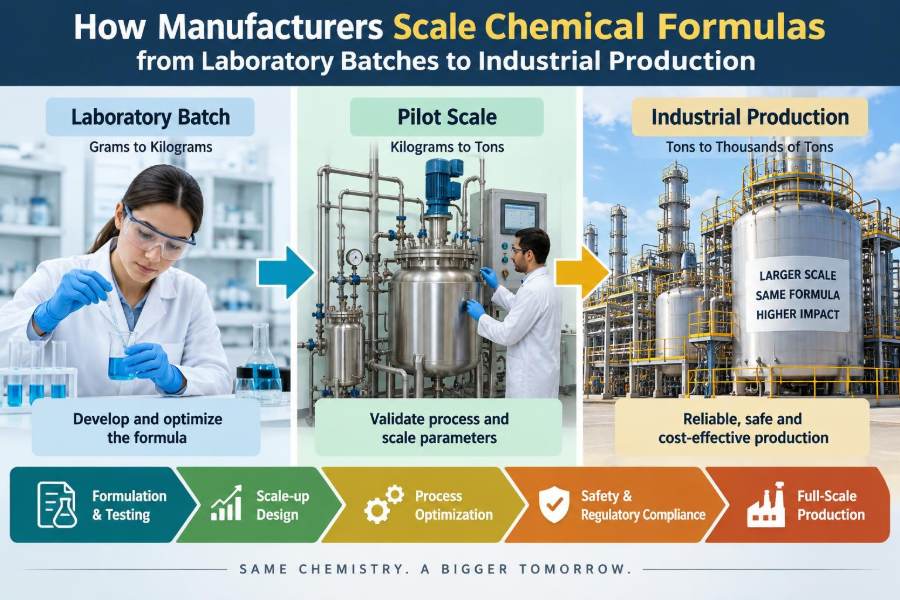
Chemical scale-up is the structured transition from a small experimental preparation to a production process. It commonly moves through laboratory work, pilot trials, demonstration or pre-commercial runs, and full manufacturing.
A formula specifies ingredients and proportions. A manufacturing process must additionally define equipment, addition order, mixing intensity, temperature limits, residence time, filtration, packaging, sampling, cleaning, and controls. These details often determine whether the formula succeeds outside the laboratory.
📏 Why a Bigger Batch Is Not a Bigger Beaker
Volume rises faster than surface area as a vessel gets larger. This geometric fact has practical consequences: a large reactor has less heat-transfer area per unit of reacting material than a small flask.
Mixing also changes. A magnetic stir bar can rapidly circulate a small liquid volume, while an industrial agitator must move fluid through a much larger tank with baffles, impellers, pipework, and sometimes multiple phases. Simply multiplying every ingredient by the same factor rarely produces the same conditions.
🎯 Start with the Product Specification
Before choosing a reactor or writing a batch sheet, define what “the same product” means. A useful specification identifies properties that affect customer use, processing, safety, and shelf life.
- Composition, concentration, and purity
- Viscosity, density, particle size, or pH where relevant
- Color, odor, moisture content, and appearance
- Impurity limits and stability over the intended storage period
- Packaging requirements and allowable batch-to-batch variation
Not every measured laboratory feature is a critical product requirement. Focusing on attributes that truly affect performance prevents the team from overcontrolling harmless variation while missing meaningful risks.
🔬 Separate Formula, Process, and Product
These three terms are often blurred together. The formula lists what goes into a product. The process describes how those inputs are transformed. The product is the material delivered to the user and judged against specifications.
For example, two coating batches may contain the same pigments, resin, solvent, and additive levels. If one batch disperses pigments poorly, it can have different gloss, color strength, settling behavior, and application performance. Same formula; different process history; different product quality.
🧪 Build a Laboratory Baseline Worth Scaling
Scale-up starts with reproducible small-scale work, not one excellent result. The laboratory procedure should record actual temperatures, addition times, agitation method, observations, sampling points, and final test results.
It is especially useful to test reasonable operating ranges rather than relying on a single nominal condition. If a reaction only works at one narrowly controlled temperature or an emulsion breaks when mixing changes slightly, those sensitivities should be understood before a larger trial.
🗺️ Map the Material and Energy Flows
A process flow diagram turns a recipe into a sequence of physical operations: storage, charging, reaction, separation, washing, drying, blending, finishing, and packaging. At this stage, engineers identify where material enters, changes form, or leaves as product, by-product, emission, recycle stream, or waste.
Material balances check whether the inputs and outputs make chemical sense. Energy balances estimate heating, cooling, evaporation, and reaction heat duties. These are not paperwork exercises; they expose missing streams and equipment limits early.
⚗️ Understand Reaction Kinetics Before Chasing Throughput
Reaction kinetics describes how fast a reaction proceeds and how that rate changes with concentration, temperature, catalysts, and mixing. A reaction that appears complete in a small flask may contain unreacted material in poorly mixed zones of a production vessel.
Temperature is particularly influential. Raising it may accelerate the desired reaction, but it can also increase side reactions, decomposition, color formation, pressure, or heat release. Scale-up must find an operating window rather than simply maximize speed.
🔥 Treat Heat Release as a Design Problem
Many reactions release heat. At laboratory scale, the vessel wall and surrounding air may remove enough heat to make the reaction seem mild. At production scale, heat may accumulate faster than the jacket or coil can remove it.
Engineers examine the likely heat-release rate, the available cooling capacity, the effect of delayed cooling, and the consequences of a failed or interrupted feed. For potentially hazardous chemistry, appropriate calorimetric testing and formal process-safety review are needed; assumptions based only on flask behavior are not sufficient.
🧊 Design Heating and Cooling for Real Operations
Heating and cooling are limited by heat-transfer area, utility temperature, circulation rate, fouling, and the temperature difference between the process and utility. A jacket that can hold a batch at temperature may not be able to control a fast exotherm during reagent addition.
Thermal design should also consider the full batch cycle. Time is needed to heat raw materials, cool after reaction, and bring the vessel to a safe condition for transfer. These periods affect plant capacity as much as reaction time does.
🌀 Make Mixing Measurable
“Stir well” is adequate laboratory shorthand but not an industrial instruction. Mixing quality depends on impeller type and diameter, rotational speed, vessel shape, liquid height, baffles, viscosity, and the location of feeds.
For liquid-liquid systems, poor mixing can cause concentration pockets. For solids, it can leave undispersed agglomerates. For gas-liquid reactions, it can limit gas absorption. Engineers often use mixing time, power input, circulation patterns, or related scale-up criteria to evaluate whether an agitator can perform the required duty.
🌪️ Choose a Scale-Up Criterion That Fits the Job
No single rule preserves every physical effect during scale-up. Holding tip speed constant may help limit shear-related damage. Holding power per volume constant may be useful for some blending duties. Holding a gas-flow-related parameter may matter more for aeration.
| Process concern | Common focus during scale-up | Why it matters |
|---|---|---|
| Shear-sensitive material | Impeller tip speed | Excess shear can damage structure or destabilize a dispersion. |
| Bulk liquid blending | Power input and mixing time | Helps reduce concentration and temperature gradients. |
| Gas-liquid reaction | Gas dispersion and mass transfer | Gas must reach the liquid efficiently. |
| Solid suspension | Bottom suspension and circulation | Settled solids can cause nonuniform composition. |
The correct choice depends on the product and its dominant limitation. A useful scale-up program explicitly states what is being preserved and what trade-off is acceptable.
🧱 Account for Viscosity and Non-Newtonian Flow
Many industrial mixtures become thicker as solids are added, polymers dissolve, or a reaction advances. Some are non-Newtonian: their apparent viscosity changes with shear rate or time.
Such materials may mix well near the impeller but poorly near vessel walls or corners. A formulation that pours easily at low concentration can become difficult to circulate late in the batch, which changes heat transfer, dispersion, and pumping requirements.
💨 Control Mass Transfer Between Phases
When a reaction involves gas absorption, extraction, crystallization, evaporation, or solids dissolution, molecules must move between phases. This is called mass transfer, and it can become the bottleneck even when the chemistry is fast.
Consider a hypothetical hydrogenation or oxidation process: the reactant gas may be present in abundance above the liquid, yet the reaction can remain slow if gas bubbles are large, contact time is short, or the liquid is poorly circulated. Increasing temperature alone may not solve that limitation.
🧂 Plan Raw-Material Variability
Commercial raw materials are supplied within specifications, not as chemically identical substances. Their moisture, particle size, assay, acidity, inhibitor content, impurity profile, or temperature can vary from lot to lot.
Robust processes anticipate this variation. Incoming testing, approved supplier specifications, correction calculations, and defined hold points help prevent an otherwise sound recipe from drifting when a new shipment arrives.
🧾 Translate the Method into a Batch Record
A production batch record converts development knowledge into instructions that operators can execute consistently. It should use clear units, verified material identities, tolerances, equipment identifiers, addition rates, process limits, sampling steps, and actions for deviations.
Ambiguous language creates risk. “Add slowly” should become a defined maximum feed rate or a condition tied to temperature and pressure. “Mix until uniform” should be supported by a time, speed, test, or other observable acceptance criterion.
🏭 Select Equipment for the Whole Process
Reactor volume is only one equipment decision. Materials of construction must resist corrosion and avoid contaminating the product. Pumps must handle the viscosity and solids content. Filters, dryers, condensers, and transfer lines must be sized for actual flow behavior.
Dead legs, inaccessible seals, and poorly drained lines can create cleaning and cross-contamination problems. The most elegant reaction design is of little value if the product cannot be transferred, recovered, or cleaned out reliably.
🛡️ Build Safety into the Process, Not Around It
Safe scale-up considers chemical hazards, pressure generation, flammability, toxic exposure, dust formation, incompatible materials, static electricity, and credible equipment failures. It also considers how people interact with the process during charging, sampling, cleaning, and maintenance.
Layers of protection may include controlled feeds, temperature and pressure monitoring, interlocks, ventilation, containment, emergency relief systems, and written operating procedures. Their exact design requires site-specific engineering and applicable regulatory review; no general article can replace a formal hazard assessment.
📈 Use Pilot Plants to Learn Efficiently
A pilot plant is not merely a miniature factory. It is a learning environment where teams test process assumptions using equipment that better resembles manufacturing equipment than bench glassware does.
Pilot work can reveal foaming, pump limitations, filtration behavior, heating and cooling constraints, unexpected deposits, and sampling difficulties. It also provides material for customer trials or longer stability testing when appropriate.
🔍 Define Sampling and In-Process Controls
Final testing alone tells a team whether a batch passed or failed; it may not explain why. In-process controls measure critical conditions during production, such as temperature, pH, viscosity, conversion indicator, solids content, or particle-size trend.
Sampling plans must account for where material is sampled, how it is mixed before sampling, how quickly the test is performed, and whether the sample is representative. A sample drawn from a stagnant line can give a misleading picture of the vessel contents.
✅ Validate Quality Without Testing Everything
Quality assurance seeks evidence that the process repeatedly delivers material within specification. This includes calibrated instruments, documented methods, controlled changes, training, traceable raw materials, and appropriate review of batch records.
More testing is not always better. A process with well-understood controls can target tests toward critical quality attributes. Conversely, a process with weak control may produce extensive test data without reliably preventing failures.
📊 Use Data to Find the True Source of Variation
Production data become valuable when linked to process conditions and product results. Trends in raw-material properties, agitation load, heating time, pH adjustment, filter pressure, or final viscosity can reveal where variation begins.
A structured investigation asks whether the change came from materials, method, equipment, measurement, people, or environment. Changing several variables at once may rescue one batch, but it makes root-cause learning much harder.
⏱️ Think in Terms of Residence Time and Batch Cycle Time
Residence time is how long material remains in a piece of equipment. In continuous processing, its distribution can affect conversion and product consistency. In batch processing, hold times and transfer delays may affect settling, reaction completion, or stability.
Batch cycle time includes more than reaction time: charging, heating, cooling, filtration, cleaning, testing, and changeover all matter. A process that reacts quickly but spends hours waiting for a filter or analytical result may not meet production demand.
♻️ Minimize Waste and Recover Value Carefully
Scale-up provides an opportunity to reduce solvent use, off-spec material, wastewater load, energy demand, and product losses in lines and filters. Recycling a solvent or recovering a wash stream can improve efficiency, but it also introduces potential impurity accumulation.
Any recycle loop needs a defined composition target, monitoring approach, and purge strategy where necessary. “Nothing wasted” is not a sound objective if reuse quietly degrades quality or creates a new safety concern.
💰 Connect Technical Decisions to Manufacturing Economics
Industrial viability depends on more than raw-material cost. Yield, utilities, labor, equipment occupancy, waste treatment, cleaning frequency, maintenance, packaging, and quality losses all influence the cost of goods.
A lower-priced ingredient can be expensive if it requires longer processing, causes filtration problems, or increases batch rejection. Likewise, a more capable reactor may justify its cost if it shortens cycles, improves consistency, or enables safer operation.
🚚 Design for Storage, Transfer, and Packaging
A product can pass final testing and still fail in the supply chain. It may settle in a drum, crystallize in a cold warehouse, absorb moisture, lose solvent, build pressure, or react with unsuitable packaging.
Scale-up should include realistic storage and handling assessments. Transfer temperature, pump selection, headspace, container compatibility, labeling, and transport conditions can all be part of preserving the product specification until it reaches the customer.
🔄 Manage Changes with Discipline
Once a process is established, seemingly minor changes deserve structured review. A different impeller, supplier, vessel, test method, cleaning agent, or automation setting can alter product quality or process safety.
Change control does not mean avoiding improvement. It means defining the change, assessing its impact, testing it at an appropriate scale, updating documentation, and communicating it to the people who operate and inspect the process.
⚠️ Avoid Common Scale-Up Shortcuts
Several mistakes recur across chemical industries because they are tempting under schedule pressure:
- Assuming laboratory stirring represents industrial mixing.
- Using a single successful batch as proof of robustness.
- Ignoring heat removal until the first large trial.
- Specifying ingredients but not addition order and rate.
- Scaling volume without checking pumps, filters, utilities, and transfers.
- Treating off-spec results as isolated events rather than process information.
These shortcuts can lead to inconsistent batches, lost capacity, costly rework, or more serious safety consequences. Early experiments and clear records are usually cheaper than emergency troubleshooting during a production run.
🧠 A Practical Stage-Gate Approach
A useful development path asks a different question at each stage. Laboratory work asks whether the chemistry and target attributes are feasible. Pilot work asks whether the process behaves predictably in representative equipment. Manufacturing qualification asks whether the site can repeatedly make conforming material under controlled conditions.
Teams should not advance merely because a calendar date arrives. They should advance when the key uncertainties for that stage have been reduced to an acceptable level and remaining risks are understood.
🤝 Make Scale-Up a Cross-Functional Effort
Chemists understand formulation and reaction behavior. Chemical engineers bring transport phenomena, equipment, and process-control thinking. Operators know how equipment behaves in practice, while quality, maintenance, supply-chain, environmental, and safety specialists see risks that may not be visible in the lab.
Involving these perspectives early improves the design. The most effective scale-up teams treat operator feedback and production observations as technical evidence, not as an afterthought.
🏁 The Core Principle of Successful Scale-Up
Successful chemical scale-up preserves the critical relationships behind product performance: temperature history, mixing, mass transfer, reaction time, material quality, and controlled handling. The exact equipment and operating numbers may change, but the conditions that govern the product must remain understood and managed.
That is why scale-up is neither guesswork nor simple arithmetic. It is the careful integration of chemistry, transport phenomena, mechanical design, safety, quality systems, and operating experience into one repeatable process.
A laboratory formula becomes an industrial product only when the entire process—not just the ingredient list—can deliver the intended material reliably and safely. That is the practical discipline at the heart of chemical manufacturing. 🧪🏭📈