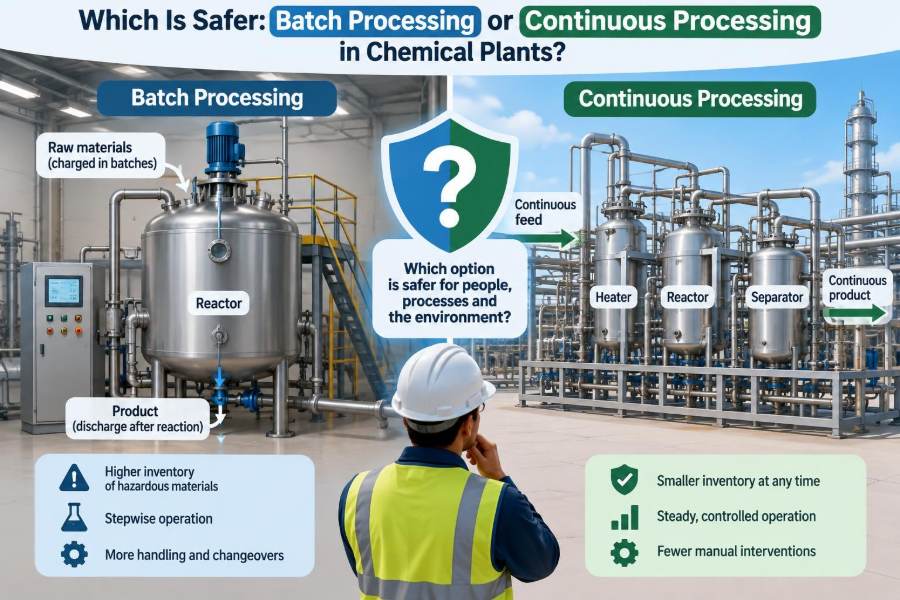

A plant team is preparing to make a solvent blend. In one unit, operators charge ingredients into a vessel, heat and mix them, test the batch, then empty the vessel before starting again. In another unit, feed streams enter continuously and product leaves continuously through pipes and control valves.
Both arrangements can make the same chemistry look very different from a safety perspective. One has frequent starts, stops, transfers, and cleaning activities. The other may run for months, but can contain a larger connected inventory moving through a tightly coupled system.
It is tempting to ask which design is simply safer. That question matters when selecting a production route, reviewing a process hazard analysis, or deciding where to focus operating discipline and capital investment.
The useful answer is not a universal winner. Batch and continuous plants concentrate risk in different places, and the safer choice depends on the reaction, materials, scale, equipment design, automation, and quality of management.
🧭 The Short Answer: Safety Depends on the System
Neither batch processing nor continuous processing is inherently safe in every situation. A well-designed batch operation can safely produce hazardous materials at modest scale. A poorly understood continuous unit can propagate an upset rapidly through several pieces of equipment.
Continuous processing often offers advantages when it reduces hazardous material held at one time, stabilizes operating conditions, and limits manual handling. Batch processing can offer advantages when production is intermittent, recipes change often, or the process needs deliberate hold points for testing and decision-making.
The comparison must therefore consider the whole lifecycle: startup, normal operation, grade changes, shutdown, cleaning, maintenance, abnormal situations, and emergency response.
🏭 What Batch Processing Means
In batch processing, a defined quantity of raw materials is charged to equipment such as a reactor, blender, crystallizer, or dryer. The materials are processed for a set time, often through several steps, then discharged before the next batch begins.
A batch can be as small as a laboratory vessel or as large as an industrial reactor. Recipes may vary between campaigns, with changes in raw material ratios, temperatures, solvents, and processing times.
The familiar analogy is cooking: ingredients are measured, added to a pot, heated or mixed, checked, and served. That flexibility is valuable, but every new batch creates opportunities for charging, sequencing, and identification errors.
🔄 What Continuous Processing Means
In continuous processing, feeds enter and products leave while the plant is running. Examples include distillation columns, pipelines, polymerization trains, many refinery units, and continuous tablet manufacturing lines.
The material inside a continuous unit is still real inventory, not an abstraction. It occupies pipes, vessels, columns, filters, heat exchangers, and surge drums. Its amount is often described by residence time: the average time material remains in the system.
Once the process reaches stable conditions, it may operate near a steady state. But “steady” never means unattended; flows, compositions, temperatures, pressures, and levels still require control.
⚖️ A Useful High-Level Comparison
| Safety factor | Batch processing tendency | Continuous processing tendency |
|---|---|---|
| Material inventory | Can be large in a single vessel during a batch | May be lower per reactor, but spread across connected equipment |
| Human interaction | Frequent charging, sampling, transfers, and cleaning | Lower during stable operation, but critical during transitions |
| Operating conditions | Change deliberately through the recipe | Often stable after startup, with fast upset propagation possible |
| Flexibility | High for multiple products and changing recipes | Lower; changes can be complex and disruptive |
| Quality checks | Clear batch hold points are common | May rely on online monitoring and rapid control response |
| Primary challenge | Reliable execution of many steps | Reliable control of an integrated dynamic system |
This table describes tendencies, not rules. A continuous facility can have extensive manual work, and a batch plant can be highly automated.
📦 Hazardous Inventory Is Often the First Question
The quantity of flammable, toxic, reactive, or pressurized material available for release strongly influences consequence potential. A smaller inventory can reduce the amount available to fuel a fire, form a toxic cloud, or sustain a runaway reaction.
Continuous equipment is sometimes designed with small reactor volumes and short residence times. For highly energetic chemistry, this can be a meaningful advantage because only a limited amount of reacting material is present at one moment.
However, analysts must include connected vessels, recycle loops, feed tanks, separation equipment, and relief systems. Looking only at the reactor can badly understate the actual inventory.
🔥 Runaway Reactions Behave Differently
An exothermic reaction releases heat. If heat generation exceeds heat removal, temperature rises, reaction rates may accelerate, and pressure can increase. This feedback is the central danger in a thermal runaway.
In a batch reactor, a full charge may be present when cooling fails or an incorrect addition occurs. The heat-release potential can be substantial, especially if reactants accumulate before the reaction begins.
A continuous reactor may limit the reacting hold-up, but it introduces its own concerns: feed ratio failures, blockages, loss of flow, and inadequate mixing can create off-spec or unstable zones. The safest arrangement is the one whose reaction kinetics, heat transfer, and upset behavior are understood and controlled.
🌡️ Heat Removal Is About More Than Reactor Size
Heat removal depends on surface area, temperature difference, mixing, coolant availability, fouling, and control response. A small continuous reactor may have a favorable surface-area-to-volume ratio, making it easier to remove heat relative to its contents.
Batch vessels can face their most demanding period during reagent addition, when the reaction rate changes quickly. Safe operating procedures may specify addition rate, jacket temperature, agitation speed, and maximum allowable temperature.
Neither design should rely on normal cooling alone. Independent safeguards can include high-temperature trips, emergency quench systems where appropriate, pressure relief, and procedures that place the process in a safer state.
🧪 Mixing Quality Can Decide the Hazard
Poor mixing can create local pockets of high concentration, elevated temperature, or incorrect pH. These pockets may not be visible in bulk measurements, yet they can trigger side reactions, gas evolution, or product degradation.
Batch mixing changes as liquid level, viscosity, and solids content change. Continuous mixing must remain effective across expected flow ranges and during disturbances. A mixer that works at design throughput may perform poorly at a much lower startup rate.
Scale-up deserves particular care. A laboratory flask and a production vessel do not mix in the same way simply because both have an impeller.
👷 Human Exposure Is Usually Higher in Batch Work
Batch manufacturing often requires operators to connect hoses, open bags or drums, charge powders, take samples, change filters, and clean equipment. Each task can expose people to chemical splashes, vapors, dust, ergonomic strain, or line-of-fire hazards.
Closed charging systems, local exhaust ventilation, contained sampling, and well-designed transfer connections can reduce those exposures. Personal protective equipment remains necessary, but it should not be the only barrier.
Continuous plants may reduce routine intervention through permanent piping and automation. Yet manual work returns during line breaks, maintenance, plugging events, startup, and shutdown—often when conditions are less predictable.
🧾 Recipe Errors Are a Major Batch Risk
Batch operations rely on accurate identification, quantities, and sequence. A wrong raw material, an incorrect setpoint, or an addition made too early can change the chemistry completely.
Strong batch systems use controlled recipes, barcode or electronic verification where justified, independent checks for critical additions, and clear vessel status labeling. These tools address common human-performance limits rather than assuming people will never make mistakes.
Paperwork alone is not protection. The instructions must match the actual equipment, and operators need enough process understanding to recognize when a step does not look or sound normal.
🎛️ Automation Changes Risk Rather Than Removing It
Automation can make both modes safer by enforcing sequences, holding interlocks, recording data, and responding faster than a person to some deviations. For example, a batch control system can prevent an addition until agitation and cooling are confirmed.
In continuous service, automatic control loops maintain flow, pressure, temperature, and level. Safety instrumented functions may independently act when dangerous limits are reached.
But automation introduces sensor failures, bad configuration, bypassed alarms, cybersecurity concerns, and overreliance on screens. Operators must understand what the controls are intended to do and what they cannot do.
🚨 Startup and Shutdown Deserve Their Own Hazard Review
Normal operating data can hide the fact that the most vulnerable periods are transitions. During startup, equipment may be cold, air may still be present, flows may be below design range, and composition can be changing rapidly.
During shutdown, residual reactive material may remain in dead legs or equipment that is losing cooling, agitation, or inert gas protection. A continuous plant can pass through many non-steady states before it is safely empty.
Batch plants also face transitions with every cycle. The practical lesson is simple: hazard reviews should examine each operating mode, not just the intended production condition.
🛑 Alarms Need Clear Operator Actions
An alarm is useful only if it arrives early enough, is distinguishable from routine noise, and tells a trained person what to do. Alarm floods can overwhelm an operator precisely when attention is most needed.
Batch operations may use phase-specific alarms because acceptable conditions differ during charging, reaction, and discharge. Continuous plants need alarm priorities that account for the speed with which an upset can move downstream.
Every critical alarm should connect to a practical response: verify, reduce feed, isolate, initiate a controlled shutdown, or activate an engineered safeguard. “Investigate” by itself is rarely an adequate response instruction.
🧯 Relief Systems Must Match the Actual Scenario
Pressure relief devices protect equipment from exceeding its design pressure, but their adequacy depends on the scenario used to size them. Thermal expansion, blocked outlet, external fire, gas generation, and runaway reaction can require very different calculations.
Batch reactors require special attention when reactions can generate vapor or noncondensable gas rapidly. Continuous systems can have multiple pressure sources and isolation configurations that change the relieving path.
Relief discharge also matters. Sending flammable or toxic material to a location that cannot safely contain or dispose of it merely moves the hazard elsewhere.
🧱 Containment and Layout Limit Consequences
Good process safety does not stop at preventing a release. Secondary containment, drainage, ventilation, blast-resistant siting where warranted, fire protection, and equipment spacing can reduce harm if prevention layers fail.
Batch areas often benefit from contained charging stations and segregated storage for incompatible materials. Continuous units benefit from clear isolation access, appropriately routed drains, and layouts that avoid exposing operators to likely leak points.
Layout decisions are easiest to improve during design. Retrofitting access or containment after a plant is operating can be costly and disruptive.
🔁 Recycle Loops Can Make Continuous Plants Less Intuitive
Many continuous processes recycle unreacted feed, solvent, catalyst, or off-spec material. Recycling can improve efficiency, but it creates feedback paths that complicate material balance and upset response.
An impurity that enters slowly may build up over time. A control action that seems sensible locally can affect composition elsewhere after a delay. These interactions are a common reason to use dynamic simulation and structured operating envelopes.
Batch processes can also recycle materials, but a batch boundary may make accumulation easier to detect and manage before the next run.
🧼 Cleaning and Changeovers Carry Real Hazards
Batch facilities often need frequent cleaning between products. This can involve solvents, hot water, steam, caustic solutions, confined spaces, and temporary hoses. Cleaning-in-place reduces some exposure but does not eliminate chemical incompatibility or pressure hazards.
Continuous plants may operate longer between cleanings, but fouling or plugging can demand difficult intervention. A blocked line containing hazardous material is not a routine maintenance problem; it requires isolation, depressurization, verification, and a planned method of work.
Changeovers should be treated as process operations, with defined flushing criteria and confirmation of what material remains in each section.
🔧 Maintenance Creates a Different Risk Picture
Maintenance can expose workers to residual chemicals, stored pressure, hot surfaces, rotating equipment, and unexpected energy release. Lockout and tagout, line-breaking controls, gas testing, and positive isolation are essential regardless of processing mode.
Continuous plants may have fewer routine openings but can be harder to take out of service because interconnected equipment must be isolated systematically. Batch equipment may be opened more frequently, increasing exposure opportunities.
A useful question is not “How often is maintenance needed?” but “Can maintenance be performed with verified isolation and realistic access?”
📈 Quality Control Has Safety Implications
Quality deviations sometimes signal a safety problem before an alarm occurs. Unexpected color, viscosity, impurity profile, or conversion can indicate wrong feed composition, inadequate mixing, catalyst loss, or developing contamination.
Batch processing naturally provides hold points for laboratory testing. This can prevent a questionable batch from progressing, although lab results may arrive after a hazardous condition has already developed.
Continuous processing often uses online analyzers or process analytical technology to observe conditions in near real time. These instruments require calibration, maintenance, and a clear response plan when readings drift or become unavailable.
🧠 Process Knowledge Sets the Safety Ceiling
No control system can fully compensate for missing knowledge of reaction chemistry. Developers need to understand hazards such as exothermicity, decomposition, incompatibilities, gas evolution, sensitivity to impurities, and the effects of loss of cooling or agitation.
For new chemistry, small-scale calorimetry and carefully planned development work can help characterize heat release and stability. The exact test program depends on the material and process; no single test answers every scale-up question.
Continuous processing sometimes makes hazardous chemistry more manageable, but only after engineers understand residence-time distribution, mixing, heat transfer, and what happens during interruption of feeds or utilities.
🗺️ Hazard Studies Must Fit the Operating Mode
Structured methods such as hazard and operability studies, what-if reviews, failure mode analysis, and layers-of-protection analysis can identify credible deviations and safeguards. Their quality depends on participants having current drawings, procedures, chemistry knowledge, and operational experience.
For batch plants, reviews should walk through every recipe phase and manual action. For continuous plants, they should examine control-loop failures, interactions between units, utility losses, and startup or shutdown paths.
The goal is not to create a long list of hypothetical disasters. It is to identify credible causes, understand consequences, and ensure independent, workable protection layers exist.
🧩 Layers of Protection Should Be Independent
Effective safeguards often include several layers: inherently safer conditions, basic controls, alarms with operator response, automatic trips, relief systems, containment, and emergency plans. Layers are strongest when one failure does not disable them all.
For example, a temperature controller and a high-temperature trip using the same sensor may not be truly independent. Similarly, an operator cannot reliably be the sole protection against a reaction that accelerates faster than human response.
Both batch and continuous designs benefit from asking: what initiates the event, which barrier acts first, and what remains if that barrier fails?
💰 Economics Can Influence Safety Decisions
Continuous processing may reduce production cost through steady operation, lower labor requirements, and efficient heat integration. Batch processing may avoid the capital cost and rigidity of a dedicated continuous line when demand is low or products change frequently.
Safety decisions should not be reduced to a simple capital-versus-operating-cost argument. A cheaper design that creates difficult manual handling, inadequate isolation, or an unmanageable emergency scenario can create costs and risks later.
The sound approach evaluates production needs alongside hazard severity, control complexity, maintainability, and the resources needed to operate the plant safely over its life.
🏷️ Product Type Often Determines the Better Fit
High-volume, stable-demand commodities often suit continuous production because conditions can be optimized and held near a narrow operating range. This does not automatically make them low hazard; refinery and petrochemical operations demonstrate the need for rigorous process safety management.
Specialty chemicals, multiproduct facilities, and low-volume formulations often suit batch production because equipment can be reused for different recipes. The safety focus shifts toward robust procedural control, material identification, and safe cleaning.
Some plants use hybrid designs: a continuous reaction followed by batch finishing, or batch synthesis followed by continuous separation. The safety review must follow the material across every boundary.
🧪 Example: A Hypothetical Exothermic Synthesis
Consider a hypothetical reaction between two liquid reactants that releases substantial heat. In a batch design, one reactant might be added gradually to a cooled, stirred vessel. The key concerns are addition rate, cooling capacity, mixing, and preventing accumulation.
In a continuous design, the same reactants could enter a small, well-mixed reactor at controlled flow rates. The smaller reacting inventory may reduce runaway consequences, but a blocked outlet or ratio-control failure could still create a hazardous condition.
The example does not prove that one mode is safer. It shows why engineers compare credible deviations and consequences rather than choosing based on the word “continuous” or “batch.”
📋 Practical Questions for a Safer Design Choice
Before selecting a process mode, teams should build the decision around specific hazards and operations.
- What is the maximum credible inventory of hazardous material in each design?
- How quickly can the reaction or pressure rise during an upset?
- Which tasks require workers to open, connect, sample, clean, or repair equipment?
- Can the process be placed in a safe state after loss of power, cooling, air, or inert gas?
- Are critical safeguards independent, tested, and understandable to operators?
- What happens during startup, shutdown, low-rate operation, and off-spec production?
- Can emergency isolation, relief, drainage, and response be carried out safely?
Answers should be documented and challenged by people from process engineering, operations, maintenance, instrumentation, safety, and chemistry.
🚩 Common Mistakes in the Comparison
One mistake is assuming continuous means “hands-off” and therefore safe. Automated units still need competent people, robust alarms, reliable instruments, and planned responses to abnormal conditions.
Another is assuming batch is safer because operators can stop and inspect each batch. A hazardous reaction may develop faster than sampling or human intervention can manage.
A third mistake is comparing only normal production. Real safety performance depends heavily on non-routine work, degraded equipment, abnormal feed quality, and transition periods.
🎓 Training Must Build Judgment, Not Just Compliance
Operators need procedures, but they also need to understand the reason behind critical limits. Knowing that a feed rate protects cooling capacity makes it easier to recognize why bypassing a sequence is dangerous.
Training should include realistic abnormal scenarios: rising reactor temperature, loss of agitator, low instrument air, plugged filter, analyzer failure, or a suspicious material identification. Drills are most useful when they test decisions and communication, not only memorized actions.
Working professionals should also be encouraged to report weak signals: repeated nuisance alarms, difficult valve access, unclear labels, recurring leaks, and workarounds. These conditions often reveal gaps before a major event occurs.
🔍 Learning From Near Misses Improves Either Mode
A near miss may be a wrong hose connection caught before transfer, an unexpectedly high temperature arrested by a trip, or a continuous unit drifting toward an unsafe composition before intervention. These events provide information about barrier strength.
Good investigation asks what made the error or deviation possible: confusing design, inadequate procedure, alarm design, poor maintenance, incomplete training, or unrealistic workload. Blaming an individual without fixing the system leaves the underlying hazard in place.
Trends across minor events can be especially valuable. Repeated small process upsets may indicate that the operating envelope is too narrow or poorly understood.
🌱 Inherently Safer Design Comes Before Add-On Protection
Where feasible, the strongest safety improvement is to eliminate or reduce the hazard itself. This may mean using less hazardous chemistry, reducing inventory, moderating conditions, simplifying connections, or choosing equipment that prevents mischarging.
Continuous processing can support inherently safer design by reducing reactive hold-up. Batch design can support it by allowing smaller campaigns, lower inventory, or a less severe route. The concept applies to both.
Controls and protective equipment are still needed, but they work best when they are not asked to compensate for an unnecessarily hazardous basic design.
🏁 The Core Principle: Match the Process to the Hazard
The safer choice is the process configuration that best controls the specific hazards while people operate, maintain, and recover the plant over time. For some strongly exothermic reactions, continuous equipment with low hold-up may offer a compelling advantage. For variable, lower-volume work, a carefully designed batch process may provide clearer control and safer flexibility.
Inventory, reaction behavior, human interaction, transition states, automation, relief design, and organizational discipline all belong in the decision. A label such as “batch” or “continuous” cannot replace this analysis.
Safety comes from understanding the process, reducing hazards at the source, and designing reliable layers of protection for the way the plant is actually run.
The best question is therefore not which mode wins in the abstract, but which design gives this chemistry, this workforce, and this facility the most credible path to safe operation. 🧪🏭🛡️