
A plant is behind schedule, a reactor campaign is underperforming, and demand is rising. The tempting question is simple: can the reaction be made faster?
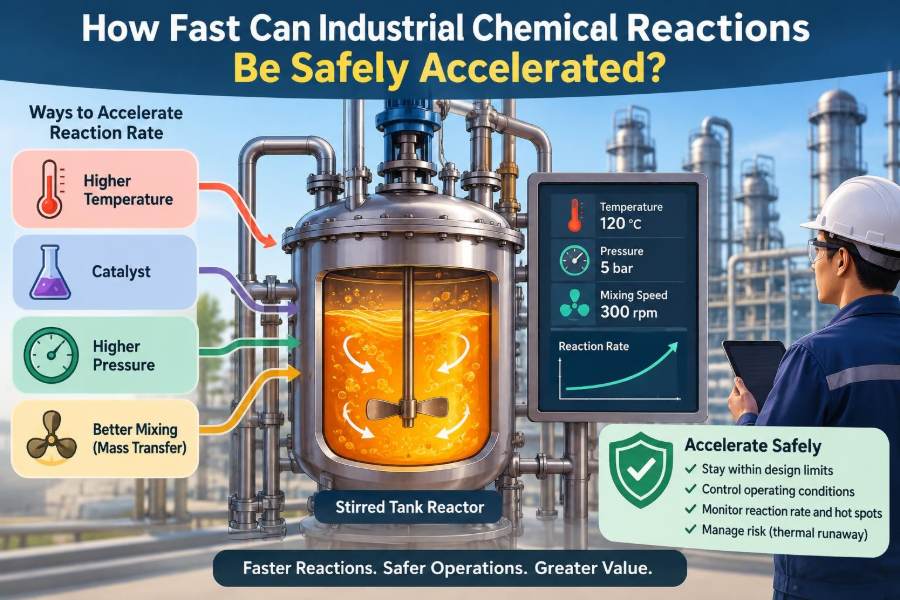
In a laboratory, the answer may seem straightforward. Raise the temperature, add more catalyst, stir harder, or feed reactants more quickly. At industrial scale, however, each of those changes can alter heat release, pressure, mixing, product quality, equipment loads, and the time available for operators and safeguards to respond.
That is why “faster” is not a single operating target. A reaction that is chemically fast may still be unsafe to run quickly in a vessel, poorly selective in a continuous reactor, or impossible to control during a disturbance.
The central engineering task is not to find the maximum reaction rate. It is to identify the highest rate that remains controllable, stable, and compatible with the entire process system.
⚗️ Reaction Rate Is More Than a Chemistry Number
Reaction rate describes how quickly reactants are consumed or products are formed. It may be expressed as a concentration change over time, a molar production rate, or a rate per unit mass of catalyst.
In industrial equipment, the observed rate is often shaped by more than intrinsic chemistry. Heat transfer, mass transfer, mixing, catalyst condition, feed composition, and residence time can all become the real limit.
A useful distinction is between intrinsic kinetic rate—the rate predicted when molecules can react freely—and the rate actually achieved in equipment. A reactor can contain very reactive chemistry while still being limited by how fast heat can leave the vessel or gas can dissolve into a liquid.
🎯 The Real Goal Is Productive Control
Accelerating a reaction is worthwhile only if the result improves useful output. More conversion is not automatically better if selectivity falls, purification becomes harder, or the catalyst deactivates sooner.
Industrial teams therefore consider several connected targets:
- Production rate and campaign duration
- Product yield and impurity profile
- Reactor temperature and pressure margin
- Utility capacity, especially cooling and heating
- Reliability of control systems and safety layers
- Equipment life, corrosion, fouling, and maintenance needs
The best operating point is frequently below the theoretical maximum rate because it provides a wider and more reliable operating window.
🔥 Why Temperature Is the Most Powerful Lever
Many reactions accelerate strongly as temperature rises. Molecules collide more energetically, and a larger fraction can overcome the activation energy barrier needed to react.
This relationship is commonly represented by the Arrhenius equation. Its practical message is more valuable than its mathematical form: a modest temperature increase can produce a disproportionately large rate increase.
That sensitivity creates both opportunity and hazard. In an exothermic reaction, the reaction generates heat, the heat raises temperature, and the higher temperature further increases the reaction rate. This feedback loop is the foundation of thermal runaway risk.
🌡️ Exothermic Reactions Can Outrun Cooling
For an exothermic reactor, safe acceleration depends on the balance between heat generation and heat removal. At steady operation, cooling surfaces, jackets, internal coils, recirculation loops, or evaporative cooling must remove heat at least as fast as it is generated.
The difficult moment is often not normal operation but a deviation: loss of cooling water, a hot feed, excessive catalyst addition, an agitator failure, or delayed quench. If heat generation rises faster than the cooling system can respond, temperature may climb rapidly.
At larger scale, volume grows faster than heat-transfer area. This is one reason a process that behaved calmly in a small laboratory vessel may require much more careful design in a production reactor.
📈 Understanding the Heat-Generation Curve
Engineers often compare the rate at which a reaction produces heat with the rate at which a reactor can remove it. Heat removal commonly rises roughly with the temperature difference between reactor contents and coolant.
Heat generation, by contrast, may rise sharply with temperature because kinetics are nonlinear. Where these curves intersect, stable operation may be possible. Under certain conditions, multiple intersections can exist, including an unstable one where a small temperature increase drives the system toward a much hotter state.
This is why a temperature controller alone does not guarantee safety. The process must have a stable response to realistic disturbances, not merely a stable-looking setpoint during ideal operation.
🧊 Cooling Capacity Includes More Than a Jacket
Cooling duty is not defined only by the area of a reactor jacket. The whole chain matters: coolant flow, coolant inlet temperature, exchanger fouling, circulation pumps, utility availability, control-valve capacity, and the ability to maintain mixing near the heat-transfer surface.
A chilled-water system may perform adequately in winter and become constrained during hotter weather or high plant utility demand. Similarly, fouling can gradually reduce heat-transfer performance without producing an immediate alarm.
Safe rate increases should therefore be checked against credible degraded conditions, not only clean-equipment design assumptions.
🌀 Mixing Determines Whether Temperature Means Anything
A temperature probe measures conditions near its own location. It does not automatically reveal hot spots elsewhere in the vessel.
Poor mixing can create regions with high reactant concentration, high catalyst concentration, or inadequate cooling. Those local conditions may cause side reactions, polymer formation, gas evolution, or damage before the bulk temperature noticeably changes.
Mixing becomes especially important when reactants are fed into a vessel. A fast feed into a poorly dispersed zone can create a brief but intense local reaction. Better feed location, improved impeller design, or slower metered addition may be safer than simply increasing total cooling.
💧 Feed Rate Is a Built-In Safety Lever
In semibatch operation, one reactant is charged initially and another is added gradually. The feed rate directly limits how much fresh reactive material is available at any moment.
This makes controlled dosing a powerful method for managing exotherms. If temperature begins to rise, reducing or stopping the feed can reduce heat generation—provided the material already in the reactor cannot continue reacting uncontrollably.
Feed control is not a substitute for reaction understanding. It must account for transport delay, pump capacity, line hold-up, possible siphoning, and whether a failed valve might continue to pass material.
🧪 Concentration Can Improve Throughput—and Intensify Hazards
Higher reactant concentration often increases reaction rate and reduces solvent handling. It can also increase the total heat released per unit reactor volume.
Concentrated systems may become more viscous, harder to mix, and less able to transfer heat. Some also have narrower solubility limits, making precipitation or crystallization more likely during a temperature change.
Before increasing concentration, engineers should examine whether the reactor remains well mixed and whether emergency cooling, venting, and quench strategies still work with the changed physical properties.
🧲 Catalysts Make Reactions Faster, Not Automatically Safer
A catalyst lowers the effective energy barrier for a reaction. It can deliver major productivity gains at lower operating temperature or pressure, which may improve both economics and safety.
But a more active catalyst can also make the process less forgiving. A catalyst overdose, a change in impurity level, or uneven catalyst distribution may cause a much faster rate than expected.
For heterogeneous catalysts, activity can vary across a fixed bed. Local hot spots are a particular concern in strongly exothermic gas-phase systems, where temperature gradients can reduce selectivity and accelerate catalyst aging.
🧱 Mass Transfer May Be the Actual Bottleneck
Some reactions occur between phases: gas and liquid, liquid and liquid, or fluid and solid catalyst. Molecules must reach the reaction zone before they can react.
For example, increasing the pressure of a gas reactant can increase its dissolved concentration, but only if gas-liquid contact and agitation are sufficient. Faster stirring can improve dispersion, yet it may also increase power demand, entrainment, foam, or mechanical wear.
When mass transfer limits the observed rate, raising temperature may not solve the problem efficiently. Improving sparger design, interfacial area, circulation, or catalyst geometry may be the more effective route.
⏳ Residence Time Shapes Continuous Reactor Performance
In continuous processing, residence time is the average time material spends in a reactor. Increasing flow usually lowers residence time; whether output rises depends on the reaction kinetics and conversion target.
A faster feed can raise production temporarily while lowering conversion. Unreacted material may then burden downstream separation, recycle systems, flare capacity, or wastewater treatment.
Residence-time distribution also matters. Real reactors contain some mixing, bypassing, or stagnant zones. Two reactors with the same average residence time can produce different conversion, selectivity, and temperature behavior.
🔄 Selectivity Often Falls When a Reaction Is Pushed
Desired and undesired reactions may respond differently to temperature, concentration, and residence time. A condition that speeds the main reaction may speed a decomposition pathway even more.
Consider a hypothetical intermediate that can either become the desired product or form a heavy byproduct. Higher temperature might shorten reaction time but produce more heavy material, increasing filter loading and distillation difficulty downstream.
The relevant metric is therefore not only conversion. It is often yield of saleable product per unit time, including the cost and capacity consequences of impurities.
🧮 Kinetic Models Need Validation Beyond the Laboratory
Kinetic models help engineers predict how rates change with temperature, concentration, and catalyst loading. They are valuable for scale-up, control design, and hazard assessment.
Yet data collected in small, well-mixed experiments may not represent plant conditions. A laboratory test may have faster heat removal, different mixing intensity, cleaner feedstocks, or a narrower range of disturbances.
Models should be challenged with representative materials and operating conditions. Their uncertainty should be explicit, especially when predictions are used to define maximum feed rates or emergency response time.
🔬 Calorimetry Reveals the Thermal Story
Reaction calorimetry measures heat flow during a reaction. It can help identify how quickly heat is released, when the reaction begins, and how changes in addition rate or temperature affect thermal behavior.
Adiabatic calorimetry examines what can happen when a reacting system loses its ability to reject heat. Because the system is closer to insulated conditions, it can reveal self-heating and pressure-generation behavior that ordinary process measurements may miss.
No single test answers every question. Good safety assessment combines calorimetry with reaction chemistry, decomposition screening, gas-generation information, physical-property data, and realistic equipment analysis.
💥 Runaway Is a System Failure, Not Just a Hot Reactor
A thermal runaway occurs when heat generation overtakes heat removal and the reaction accelerates beyond intended control. It can involve temperature rise, pressure rise, gas formation, boiling, foaming, or decomposition.
The initiating event may be minor. The consequence becomes serious when several protections are unavailable, undersized, bypassed, or based on incorrect assumptions.
Runaway prevention therefore includes chemistry, equipment, operating procedures, maintenance, alarm management, training, and emergency design. Treating it as only a temperature-control problem leaves critical gaps.
🛑 Safety Layers Buy Time and Limit Consequences
Reliable process safety uses multiple independent layers rather than relying on a single operator action or control loop. The exact arrangement depends on the process, but common layers include:
- Basic controls that regulate temperature, pressure, flow, and level
- Alarms with clear operator response procedures
- Independent high-temperature or high-pressure trips
- Automatic feed isolation or emergency quench systems
- Pressure-relief devices leading to suitable containment or treatment
- Physical separation, drainage, and emergency response arrangements
Independence matters. A high-temperature trip should not fail for the same reason as the controller it backs up. Safety functions also need testing and maintenance; an untested safeguard is an assumption, not a dependable barrier.
🌬️ Pressure Relief Is Not a Shortcut for Weak Control
Relief devices protect equipment from excessive pressure, but they must be designed for the actual scenario. A runaway can create vapor, noncondensable gas, foam, solids, or two-phase flow, all of which can complicate vent sizing and disposal.
Relief discharge must go somewhere safe. Releasing flammable, toxic, corrosive, or environmentally harmful material to an unsuitable location simply transfers the hazard.
A properly designed relief system is essential, but it is the last line of defense—not permission to operate routinely close to instability.
🏭 Scale-Up Changes the Physics
Scale-up is not accomplished by multiplying batch size and keeping every other condition unchanged. Larger vessels often have different mixing times, heat-transfer area per unit volume, hydrostatic pressure, feed dispersion, and sensor response.
Geometric similarity is helpful but incomplete. Maintaining the same impeller speed, tip speed, power per volume, or Reynolds number can each preserve different aspects of mixing, and they cannot always all be held constant.
Pilot work, modeling, and conservative commissioning steps help reveal which scale-dependent effects control the real process.
🧭 Define a Safe Operating Envelope
A safe operating envelope is the set of conditions within which the process has been evaluated and can be controlled. It typically includes limits for temperature, pressure, feed rate, reactant ratios, agitation, utility conditions, and allowable inventory.
These limits should be tied to a reason. “Do not exceed 45°C” is stronger when personnel understand whether the limit protects product quality, prevents an accelerating side reaction, preserves catalyst stability, or maintains adequate cooling margin.
Operating envelopes need review when feedstocks, catalysts, equipment, automation, or production targets change. A small change can invalidate a previously safe assumption.
📊 Measure Leading Indicators, Not Just Final Output
Production rate and final conversion are lagging indicators: they show what has already happened. Safe acceleration requires attention to leading indicators that reveal loss of margin early.
Examples include jacket temperature approach, cooling-water flow, agitator power, feed-to-temperature response, reactor pressure trend, catalyst activity, impurity concentration, and differential temperature across a catalyst bed.
Trend data are especially useful. A gradual increase in required cooling duty at the same throughput may indicate fouling, altered chemistry, or declining heat-transfer performance before an operating limit is reached.
🧑🏭 Operators Need Clear, Usable Response Rules
Procedures should tell operators what to do when a reaction behaves differently, not merely state normal setpoints. Useful instructions identify early warning signs, immediate actions, escalation thresholds, and conditions that require stopping a feed or placing the reactor in a safe state.
Training is strongest when it connects actions to process behavior. An operator who understands that a delayed temperature rise may reflect accumulated unreacted feed can recognize why restarting a pump blindly may be hazardous.
Complex emergency response should be automated where practical, but automation does not remove the need for human understanding and well-rehearsed decision-making.
🔧 Maintenance Protects Reaction Control
A reaction may be safe on paper yet vulnerable in service because of a sticking control valve, inaccurate temperature sensor, worn agitator, fouled exchanger, or blocked vent line.
Maintenance priorities should reflect safety function. A backup cooling pump, trip sensor, emergency isolation valve, or relief path may have a much larger consequence of failure than ordinary utility equipment.
Proof testing, calibration, inspection, and management of temporary bypasses are part of maintaining the process’s real operating margin.
🧾 Management of Change Prevents “Small” Surprises
Many incidents begin with changes considered routine: a new supplier, different solvent grade, revised cleaning method, alternate catalyst batch, control-system update, or higher production target.
Management of change is the disciplined review of whether a modification affects chemistry, heat removal, materials compatibility, control logic, emissions, relief capacity, or operating procedures.
The review should include temporary changes. A temporary hose routing or overridden alarm can persist long enough to become an unexamined part of normal operation.
🧠 Common Acceleration Mistakes
Several errors recur because they focus on a single variable rather than the full process response:
- Raising temperature first: This may increase side reactions or eliminate thermal margin.
- Using average temperature as the only indicator: Local hot spots can be missed.
- Assuming more cooling solves everything: Mixing, feed dispersion, and decomposition can still dominate.
- Copying laboratory conditions directly: Scale changes heat and mass transfer behavior.
- Increasing feed rate without checking downstream capacity: Separations and storage can become the new bottleneck.
- Treating relief as the primary control strategy: Relief manages consequences; it does not provide stable operation.
A disciplined review often finds that a modest change to feed sequencing or mixing delivers more value than an aggressive temperature increase.
⚖️ A Practical Framework for Faster, Safer Operation
When evaluating a proposed rate increase, ask a sequence of connected questions:
- What mechanism currently limits production: kinetics, mixing, heat transfer, mass transfer, or downstream capacity?
- How will the change affect heat release, pressure, selectivity, viscosity, and gas evolution?
- What is the minimum cooling, mixing, and control performance expected during credible upsets?
- Which independent safeguards act if normal control fails?
- Can relief, containment, and downstream systems handle the resulting scenario?
- What measurements will confirm that the process remains inside its safe operating envelope?
This approach changes the question from “How much faster can we run?” to “What evidence shows that this higher rate is controlled?”
🚀 The Core Principle: Accelerate Within a Defensible Margin
Industrial reactions can often be accelerated safely, but only when reaction engineering and process safety move together. Temperature, concentration, catalyst activity, feed rate, mixing, and residence time are not independent knobs.
The most robust improvements usually increase control as well as speed: better heat transfer, more uniform mixing, improved measurement, staged addition, stronger catalyst management, or removal of a genuine mass-transfer bottleneck.
Operating close to a limit may look efficient until a disturbance occurs. A defensible margin gives the process, the control system, and the people operating it time to detect, decide, and act.
The safest way to accelerate an industrial chemical reaction is to raise useful reaction rate only as fast as heat, mass transfer, equipment, safeguards, and operating discipline can reliably keep up. That is not a constraint on productivity; it is the foundation for productivity that lasts. 🧪🌡️🏭