
A chemical plant can look surprisingly calm from the outside: pipes, vessels, pumps, heat exchangers, and storage tanks arranged in orderly networks. Inside the control room, however, conditions are constantly changing. Feed composition drifts, ambient temperature changes, equipment wears, and demand shifts.
If an operator had to manually adjust every valve, motor, and heater in response, stable production would be nearly impossible. A small correction at the wrong time could travel through the process and become an off-specification product, wasted energy, or a safety concern.
This is why modern plants rely on process control systems. These systems combine instruments, computers, communication networks, control logic, and human judgment to keep physical processes near their intended operating conditions.
The “software behind a chemical plant” is therefore not one program. It is a layered operational system that observes the plant, calculates responses, records history, alerts people to abnormal conditions, and—within carefully designed limits—takes routine corrective action.
🏭 What a Process Control System Actually Does
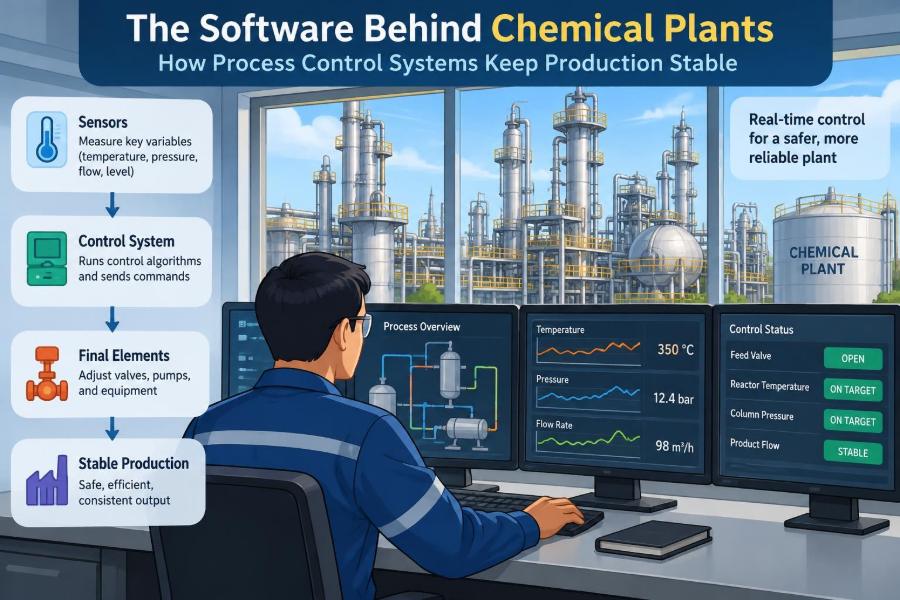
A process control system manages variables that determine how a plant behaves. Typical variables include temperature, pressure, flow rate, liquid level, composition, pH, and equipment speed.
Its basic job is simple: measure a condition, compare it with the desired condition, and adjust something that can influence it. In practice, this must happen reliably across thousands of instruments and many interconnected process units.
For example, a reactor temperature controller may read a temperature sensor and adjust cooling-water flow through a control valve. The software does not “understand chemistry” in a human sense, but it applies configured control rules quickly and consistently.
🎯 Why Stable Conditions Matter in Chemical Production
Chemical processes are often sensitive to operating conditions. A modest temperature change can alter reaction rate, selectivity, viscosity, vapor pressure, or separation performance. A change in feed flow can affect residence time in a reactor or upset a distillation column.
Stability helps plants meet several goals at once:
- Consistent product quality and specification compliance
- Safe pressure, temperature, and inventory limits
- Efficient use of energy, raw materials, and utilities
- Predictable operation for downstream equipment
- Reduced wear from frequent cycling and manual intervention
Stable does not mean motionless. It means the process responds to normal disturbances without drifting into unacceptable or unsafe conditions.
🔁 The Feedback Loop: The Core Control Idea
Most basic control uses a feedback loop. The system measures the process variable, compares it with a target called the setpoint, calculates the difference, and changes an output to reduce that difference.
Consider the water level in a tank. If the measured level rises above the target, a controller might open the outlet valve further. If level falls, it closes the valve somewhat. The new valve position changes the level, which the sensor measures again.
This repeating cycle is similar to adjusting a shower’s hot-water valve after feeling the temperature. The difference is that industrial controllers can repeat the cycle continuously and coordinate many loops simultaneously.
📡 Instruments Turn Physical Reality into Data
Control software cannot act on conditions it cannot detect. Field instruments provide the plant’s measurements: pressure transmitters, thermocouples, flowmeters, level devices, analyzers, switches, and position indicators.
A transmitter generally converts a physical measurement into a standardized electronic or digital signal. The control system interprets that signal as an engineering value, such as 4.2 bar, 85°C, or 12 m³/h.
Measurement quality matters. A controller operating on a biased, plugged, poorly located, or badly calibrated sensor can make decisions that are logically correct but physically harmful.
🦾 Final Control Elements Create Physical Change
Measurements alone do not control a process. The system also needs final control elements: devices that physically affect flow, heat transfer, pressure, or mechanical motion.
Control valves are the most familiar example, but variable-speed drives, dampers, electrical heaters, pump start/stop commands, and compressor guide vanes can also serve this role. An output signal from the controller tells an actuator what position or speed to adopt.
A useful mental model is that sensors are the plant’s senses, controllers make routine decisions, and final elements are its muscles. Failure in any part of that chain can weaken overall control.
🧮 PID Control and Its Three Responses
The most common controller algorithm is PID control, short for proportional, integral, and derivative control. It remains widespread because it can handle many industrial loops when applied and tuned appropriately.
The proportional action responds to the current error. Integral action accumulates past error so that a persistent offset is corrected. Derivative action responds to the rate of change and can help anticipate rapid movement, although it is not useful in every noisy industrial measurement.
PID settings must suit the process. Aggressive tuning can cause cycling and valve movement; overly cautious tuning can make the process slow to recover. Good performance is a balance, not a quest for the fastest possible response.
🧊 A Temperature-Control Example
Imagine a jacketed batch reactor that must remain within a defined temperature range. An exothermic reaction releases heat, while cooling water in the jacket removes heat. The reaction rate and heat release may change as the batch progresses.
The temperature transmitter sends a measurement to the controller. If temperature rises beyond the setpoint, the controller may open the cooling-water valve. If temperature falls, it may reduce cooling. Operators still supervise the batch, especially at critical stages, but the routine adjustment is automated.
This is a hypothetical example, yet it illustrates a central principle: control quality depends not only on software, but also on heat-transfer capacity, valve response, sensor placement, and a sound understanding of reaction hazards.
🖥️ PLCs and DCSs: Two Common Platforms
Two major types of industrial control platforms are programmable logic controllers (PLCs) and distributed control systems (DCSs). Both can read inputs, execute logic, and send outputs, but they have traditionally been used in somewhat different ways.
| Platform | Typical strengths | Common applications |
|---|---|---|
| PLC | Fast discrete logic, machinery control, flexible packaged systems | Skids, conveyors, burners, packaging, pump sequences |
| DCS | Large numbers of continuous loops, integrated operator displays and process functions | Refineries, chemical units, utility systems, continuous production |
The boundary is not absolute. Modern systems can overlap substantially. The appropriate choice depends on process needs, existing infrastructure, lifecycle support, and how the plant will be operated and maintained.
🧩 Distributed Control Means More Than One Computer
A DCS is called “distributed” because control tasks are shared among controllers located across the system rather than placed in one central computer. Controllers near process areas can continue executing their assigned logic while operator workstations provide visualization and supervisory access.
This arrangement supports large plants and helps isolate some failures. It also allows engineering teams to organize control by process area, such as utilities, reaction, separation, storage, and wastewater treatment.
Distribution does not eliminate risk. Network architecture, power supplies, configuration management, and redundancy still require deliberate design.
🖼️ The HMI Is the Operator’s Window into the Plant
The human-machine interface, or HMI, is the screen environment through which operators view process conditions, respond to alarms, make authorized changes, and follow procedures. It may show overview displays, piping and instrumentation diagrams, trends, alarm lists, and faceplates for individual control loops.
A good HMI emphasizes what matters now. It makes abnormal conditions visible without drowning operators in decorative graphics or thousands of equally urgent-looking values.
Color, symbols, and layout should be used consistently. During a disturbance, an operator needs rapid comprehension, not an attractive but ambiguous display.
📈 Trends Turn Momentary Values into Process Understanding
A single reading tells an operator where a variable is now. A trend shows where it has been and how quickly it is moving. That difference is crucial when diagnosing a process upset.
If column pressure is rising slowly while condenser cooling-water temperature also rises, the pattern may suggest a utility limitation. If a valve output repeatedly swings while the measured flow barely changes, valve stiction or poor tuning may be involved.
Historical data is useful for troubleshooting, handovers, audits, optimization, and learning from unusual events. It should be interpreted with process knowledge, not treated as automatic proof of cause.
🚨 Alarms Demand Attention, Not Just Noise
An alarm is a signal that an operator needs to know about a condition requiring assessment or action. It is not simply any value that moves beyond a preferred range.
Poor alarm design creates alarm floods, where many messages appear during a disturbance. When everything seems urgent, operators can struggle to identify the initiating problem and the most consequential risks.
Useful alarm management involves choosing meaningful limits, defining priorities, removing nuisance alarms, documenting expected responses, and reviewing performance after upsets. An alarm is effective only if it supports timely, correct human action.
🛑 Safety Instrumented Systems Have a Different Job
Basic process control keeps a process operating normally. A safety instrumented system (SIS) is designed to move the process to a safer state when predefined hazardous conditions occur.
For instance, a high-high pressure trip might close feed valves, stop a pump, or initiate another engineered shutdown action. The precise response depends on the process hazard analysis and plant design.
Control and safety functions may exchange information, but they should not be casually treated as interchangeable. Independence, testing, reliability requirements, and documented safety functions are central considerations for safety systems.
🔒 Interlocks Prevent Unsafe or Damaging Sequences
An interlock prevents or initiates an action based on defined conditions. It can be used for personnel protection, equipment protection, product quality, or orderly sequencing.
A pump may be prevented from starting unless its suction valve is open and the source tank has adequate level. A furnace may require airflow confirmation before fuel is admitted. These rules reduce reliance on memory during routine operation and abnormal situations.
However, interlocks are not substitutes for understanding. Bypassing one without formal review can remove a critical safeguard or produce an unexpected process path.
⚙️ Sequence Control Makes Repeated Operations Consistent
Many plant activities occur in a defined order: start a pump, line up valves, purge equipment, heat a vessel, add ingredients, hold a temperature, then transfer product. Sequence control encodes parts of this order into logic.
Batch production especially benefits from clear phase logic because each batch may pass through charging, reaction, separation, cleaning, and transfer stages. Automation can make the sequence repeatable while recording what occurred.
Not every step should be fully automatic. Manual confirmation is often appropriate when a task requires field inspection, material verification, or judgment about an unusual condition.
🧪 Batch and Continuous Plants Need Different Emphases
Continuous plants aim to sustain steady operation over long periods. Their control systems emphasize disturbance rejection, inventory balance, throughput control, and coordinated behavior across connected units.
Batch plants repeatedly change state. They need recipe management, procedural steps, transitions, timing, material traceability, and strong handling of startup and shutdown conditions. A batch reactor may operate at several setpoints in one production cycle.
Both types use measurements, control loops, alarms, and safeguards. The difference lies in how often operating objectives and process states change.
🧾 Recipes Are Controlled Instructions, Not Just Formulas
In automated batch operations, a recipe can specify materials, quantities, equipment, process steps, targets, hold conditions, and allowable ranges. It provides a structured way to run an approved production method.
Recipe control can improve consistency, but it introduces its own discipline. Changes must be reviewed, tested, authorized, and traceable. A mistaken unit, wrong material identifier, or unreviewed parameter change can affect an entire batch.
For regulated or high-value products, electronic records and access control may be especially significant. Exact requirements depend on the industry and jurisdiction.
🌡️ Advanced Process Control Looks Beyond One Loop at a Time
Basic PID loops usually control one variable using one main manipulated input. Some process problems involve many variables that influence one another, time delays, and operating constraints. Advanced process control (APC) addresses these more complex situations.
For example, a multivariable controller may coordinate several flows, temperatures, and pressures in a distillation system while keeping the unit within operating limits. Model predictive control is one approach that uses a process model to anticipate future behavior.
APC can improve constraint handling and economic performance in suitable applications, but it depends on reliable measurements, maintainable models, and a stable underlying control layer. It is not a remedy for neglected valves or bad instruments.
📊 Optimization Is Not the Same as Control
Control asks, “How do we hold the process near the requested target safely?” Optimization asks, “What targets or operating choices best meet an objective within constraints?” The objectives may involve throughput, energy use, yield, quality, or utility cost.
An optimizer may recommend a different reflux target for a column, while lower-level controllers keep the column at that target. This layered arrangement separates routine fast control from slower economic or planning decisions.
Optimization must respect equipment limits, product specifications, emissions requirements, and safety boundaries. The most profitable target on paper may be unsuitable when uncertainty or changing plant conditions are considered.
🧠 Operators Remain Central to Reliable Operation
Automation changes the operator’s role; it does not remove it. Operators monitor the broader process, recognize patterns that are not captured by simple logic, coordinate field activities, manage transitions, and respond to novel or escalating situations.
They also decide when an automatic response is insufficient or inappropriate. This requires training that connects screen indications to the actual equipment, chemistry, procedures, and hazards outside the control room.
The strongest systems are designed around realistic human capabilities. They provide clear information, manageable workloads, and procedures that support judgment rather than assuming perfect attention at all times.
🔧 Control Performance Depends on Mechanical Health
A control loop can appear to be a software problem when the real issue is mechanical. A sticky valve may move only after its command changes substantially. An oversized valve may make tiny flow adjustments difficult. A worn pump may no longer deliver expected capacity.
Common symptoms include oscillation, slow response, excessive controller output movement, and a persistent difference between commanded and observed behavior. Maintenance and control engineers need to investigate together.
This is why loop tuning should not be the first answer to every unstable trend. Verify the measurement, actuator, process conditions, and configuration before changing controller settings.
🧰 Tuning Is a Disciplined Engineering Task
Controller tuning determines how strongly and how quickly a loop reacts. Engineers may use plant tests, process models, historical data, and established tuning methods, but the final settings must work under real operating conditions.
Good tuning considers process delay, measurement noise, actuator limits, interactions with other loops, and the consequences of overshoot. A level loop in a surge vessel may be intentionally slow; a pressure loop protecting an operating boundary may need a faster response.
Changes should be documented and controlled. A setting that helps one operating point can perform poorly after a change in feedstock, production rate, equipment configuration, or control strategy.
🗂️ Configuration Management Protects the Logic
Control-system configuration includes loop definitions, alarm limits, graphics, sequences, interlocks, controller settings, and communications. These items are operational assets, not casual files.
Plants need a disciplined way to review, approve, test, implement, back up, and document changes. This is often part of a broader management-of-change process, particularly where a modification affects safety, environmental performance, or established operating procedures.
Unauthorized “temporary” edits are particularly risky because they can outlive the circumstance that prompted them. A reliable system makes its current configuration knowable and recoverable.
🌐 Industrial Networks Connect the Layers
Control networks carry information among instruments, controllers, operator stations, historians, engineering workstations, and higher-level business systems. Their design must account for speed, reliability, segmentation, and maintainability.
Not every signal has the same timing need. A routine production report can tolerate delay that would be unacceptable for a fast control function. Separating critical control traffic from less critical services helps protect performance.
Network changes should be assessed like other process changes. A communication outage can affect visibility, coordination, and—in some architectures—control capability.
🛡️ Cybersecurity Is Part of Process Reliability
Industrial control systems increasingly connect to enterprise networks, vendors, remote-support tools, and data platforms. These connections can be useful, but they also create routes through which unauthorized access or disruptive software could reach operational technology.
Practical defenses include network segmentation, least-privilege access, strong account management, controlled remote access, backups, patch planning, asset inventories, and incident procedures. The right approach depends on the specific plant architecture and operational constraints.
Cybersecurity must be coordinated with operations. Applying a change without considering availability can disrupt a plant, while ignoring known vulnerabilities can leave unacceptable exposure. Reliability and security are linked goals.
🔋 Redundancy Helps, but It Is Not Magic
Important systems may use redundant controllers, power supplies, network paths, servers, or communication components so that one failure does not necessarily stop the function. Redundancy can improve availability when it is designed, tested, and maintained properly.
Yet identical backup components may share the same environmental exposure, configuration error, software defect, or power source. These are examples of common-cause vulnerabilities.
Resilience therefore includes more than duplicate hardware. It requires tested failover behavior, good backups, spare-part planning, clear recovery procedures, and a realistic understanding of what happens when automation is unavailable.
🧑🏫 Training Must Include Abnormal Situations
Normal operation teaches only part of the job. Operators and engineers need to understand startup, shutdown, instrument failures, utility losses, alarm floods, controller malfunction, and emergency response according to site procedures.
Simulators, tabletop exercises, trend reviews, and supervised field training can help teams practice recognition and response. The objective is not to memorize every screen but to understand process cause and effect.
Training should also explain automation limits. People need to know which actions are automatic, which safeguards are independent, and when field verification is required before assuming an equipment state.
⚠️ Common Mistakes in Control-System Thinking
Several mistakes recur when plants treat automation as a purely software issue:
- Assuming an alarm is a safeguard without defining the required human response
- Tuning around a failing valve, sensor, or process-design limitation
- Adding alarms instead of resolving the source of recurring disturbances
- Allowing undocumented logic changes or informal bypasses
- Connecting systems for convenience without examining cybersecurity and availability impacts
- Designing screens around equipment drawings rather than operator decisions
Each mistake obscures the relationship between the digital system and the physical process. The remedy is usually cross-functional work among operations, process engineering, maintenance, automation, and safety specialists.
🔍 A Practical Way to Diagnose an Unstable Loop
When a loop cycles or drifts, begin with evidence rather than immediately changing the tuning. Review trends for the measurement, setpoint, controller output, valve position if available, related flows, and recent operating changes.
- Confirm that the measurement is plausible and correctly scaled.
- Check whether the final element responds smoothly to its command.
- Identify disturbances, constraints, manual actions, and interacting loops.
- Verify the control strategy and mode are appropriate for the current operation.
- Only then assess whether retuning or redesign is needed.
This method does not solve every problem, but it avoids treating every oscillation as an algorithm failure.
🌱 Control Systems Support Efficiency and Environmental Performance
Stable control can reduce avoidable energy use by holding temperatures, pressures, and flows closer to appropriate targets. It can also support consistent combustion, vapor recovery, wastewater treatment, and emissions-control equipment performance.
These benefits depend on the full process. A controller cannot compensate indefinitely for fouled heat exchangers, poor insulation, unsuitable equipment sizing, or an inherently inefficient operating scheme.
Still, accurate measurements and well-maintained control strategies give engineers the visibility needed to identify losses and operate within environmental requirements.
🧭 The Core Principle: Software Serves the Process
The most useful way to view plant automation is as a bridge between process knowledge and repeatable action. Sensors reveal conditions, logic and controllers apply defined responses, actuators change the process, and people oversee the whole system.
Reliable control requires sound process design, suitable instruments, healthy equipment, clear operating philosophy, independent safeguards where needed, secure infrastructure, and trained people. No software layer can reliably compensate for weaknesses in all the others.
When these elements work together, automation does more than keep numbers near setpoints. It helps a complex chemical operation remain understandable, controllable, and resilient as real-world disturbances occur.
Process control systems keep chemical production stable by connecting trustworthy measurements, appropriate automated actions, and informed human oversight into one disciplined operating system. That partnership is what turns a collection of equipment into a dependable process plant. 🧪⚙️📈