
A production target is missed, and the first reaction is often to push harder: raise temperature, extend reaction time, add excess reactant, or run equipment faster. The batch may eventually meet specification, but the energy bill rises and more off-spec material appears downstream.
This pattern is familiar in laboratories, pilot plants, and full-scale facilities. A process can look productive at one unit operation while quietly losing value through unreacted feed, solvent evaporation, unnecessary heating, purge streams, or repeated rework.
Increasing yield is not simply about making more product from a reactor. It means understanding where molecules, heat, time, and utility consumption are actually going—and improving the system without shifting the problem elsewhere.
The best improvements usually come from disciplined measurement and a clear view of the whole process. That perspective helps engineers reduce waste while protecting safety, product quality, and operability.
🎯 Define Yield Before Trying to Improve It
Yield is the amount of desired product obtained relative to the amount that could theoretically be formed from the limiting reactant. It is commonly expressed as a percentage, but the calculation boundary matters.
Reaction yield describes chemistry. Overall plant yield includes losses in separation, transfer, filtration, drying, storage, and packaging. A reactor can have excellent conversion while the plant still loses valuable product in mother liquor or dust collection.
Start by stating the basis clearly: per batch, per tonne of feed, per operating hour, or per campaign. Without a consistent basis, apparent improvement may only reflect a change in feed rate or inventory.
🧭 Separate Conversion, Selectivity, and Recovery
These three terms are closely related but answer different questions. Conversion asks how much reactant disappeared. Selectivity asks how much reacted material became the desired product rather than a by-product. Recovery asks how much desired product survives downstream processing.
| Measure | Main question | Typical loss mechanism |
|---|---|---|
| Conversion | Did reactant react? | Short residence time or equilibrium limitation |
| Selectivity | Did it form the right product? | Side reactions, hot spots, or poor dosing |
| Recovery | Was product captured? | Entrained liquid, filtration loss, or degradation |
For example, increasing reactor temperature may raise conversion but lower selectivity if undesired reactions accelerate faster. An improvement is only real when the relevant metrics move in the right direction together.
🗺️ Build a Complete Material Balance
A material balance is the most direct way to expose losses. For each key component, account for material entering, leaving in products and wastes, accumulating in equipment, and disappearing through known reactions or degradation.
Do not treat “other” as a permanent category. A large unexplained balance gap can indicate sampling errors, poor flow measurement, leaks, incorrect composition data, evaporation, or material left in vessels and transfer lines.
Trace the limiting reactant and valuable product through the process. The exercise often reveals that a small, neglected stream has a surprisingly large annual cost.
📏 Establish a Reliable Baseline
Improvement work needs a baseline representing normal operation, not one unusually good or bad batch. Gather production records across enough operating conditions to see routine variability.
Useful baseline measures include:
- Mass of saleable product per mass of limiting reactant
- By-product generation and disposal quantity
- Steam, electricity, fuel, cooling water, and compressed-air use per unit product
- Rework rate, batch cycle time, and off-spec frequency
- Solvent makeup, solvent recovery, and purge quantities
Normalize utility use to production output. A plant may consume less energy during a reduced-rate run but use more energy for every kilogram of product.
🔍 Find the True Constraint First
The obvious bottleneck is not always the real one. A slow filter may appear to limit throughput, yet the deeper cause may be crystal size created by unstable reactor cooling. Increasing filter area alone would then add cost without fixing the source.
Map the process from feed receipt to final product. Identify where queues form, where operators intervene, where quality failures originate, and where heating or cooling continues while no value-adding transformation occurs.
A constraint can be chemical, mechanical, thermal, analytical, or organizational. Solving the correct constraint is one of the fastest ways to avoid wasted capital.
⚗️ Improve Stoichiometry Without Blind Excess
Using an excess reactant can drive a reaction toward completion, especially for equilibrium-limited systems. But excess material must eventually be separated, recycled, neutralized, or discarded.
The goal is not always the smallest excess. It is the lowest economically and operationally sensible excess, considering reaction rate, selectivity, separation difficulty, recycle purity, and safety.
Small trials or validated process models can identify whether a tighter reactant ratio preserves yield. In continuous systems, accurate feed-flow control may deliver this benefit more reliably than changing the nominal recipe.
🌡️ Control Temperature Where the Chemistry Happens
A temperature reading at the jacket outlet does not necessarily represent the bulk reaction mixture. In viscous systems, poorly mixed vessels, or highly exothermic reactions, local temperatures can differ substantially from a single sensor value.
Hot spots can promote decomposition, discoloration, polymer formation, or unwanted isomers. They may also force downstream purification to work harder, increasing both waste and energy demand.
Assess sensor placement, mixing quality, heat-transfer area, cooling capacity, and addition rate together. Better temperature control often improves selectivity more safely than simply operating at a lower setpoint.
⏱️ Match Residence Time to Reaction Kinetics
Residence time is how long material remains in a reactor or process unit. Too little time leaves unconverted feed; too much time can expose product to degradation or secondary reactions.
Batch processes face a similar issue through hold time. Product may meet specification at the end of reaction but deteriorate while waiting for a downstream vessel, filter, or dryer.
Use representative sampling to understand the time profile of reactants, intermediates, and impurities. The ideal endpoint is rarely “as long as possible”; it is the point at which additional time no longer creates enough value to justify its cost and risk.
🌀 Treat Mixing as a Yield Variable
Mixing determines whether reactants, catalyst, heat, and pH are distributed uniformly. Poor mixing can make a nominally correct recipe behave like several different reactions occurring in separate parts of a vessel.
Warning signs include inconsistent batch results, long response after dosing, localized solids, variable particle size, and sensitivity to agitator speed. Scale-up is particularly challenging because vessel geometry and power input per volume change.
Before changing chemistry, check impeller selection, liquid level, baffles, feed-point location, gas dispersion, and viscosity. A revised addition point can sometimes prevent a concentrated reagent zone and sharply reduce impurity formation.
🧪 Protect Catalyst Activity
Catalysts can improve reaction rates and selectivity, but they are vulnerable to poisons, fouling, sintering, attrition, and incorrect activation. A gradual yield decline may be mistaken for normal feed variability when catalyst condition is the actual cause.
Track activity using a practical indicator, such as conversion at fixed conditions or a fitted kinetic parameter. Analyze likely contaminants in feeds, recycle streams, and wash liquids before increasing catalyst loading.
Regeneration or replacement may be appropriate, but prevention is often cheaper. Better filtration, drying, feed purification, or controlled startup procedures can extend useful catalyst life.
💧 Manage Water and Moisture Deliberately
Water can be a reactant, a contaminant, a solvent component, or a heat-transfer medium. Its effect depends on the chemistry: some reactions require controlled water content, while others undergo hydrolysis or catalyst deactivation in its presence.
Moisture can enter through raw materials, humid air, wash steps, condensate, and incomplete drying. It may also alter phase behavior, making extraction or crystallization less efficient.
Specify and measure moisture where it matters. Drying every stream to an extreme level is not automatically efficient; the right target is the level that protects chemistry and separation performance with reasonable energy use.
♻️ Design Recycle Loops Carefully
Recycling unreacted reactant or solvent can reduce fresh material use, but recycle loops accumulate impurities unless a purge or purification step controls them. The impurity may be inert, reactive, corrosive, or harmful to product quality.
Calculate the recycle composition at steady state rather than assuming it resembles fresh feed. Even a trace impurity can build up when its removal route is weak.
A well-designed loop balances recovery against contamination, separation duty, and inventory. Sometimes a modest purge is less wasteful overall than operating a larger, more energy-intensive purification system.
🧫 Improve Separation Before Adding More Reactant
When yield falls, teams often focus first on reactor conditions. Yet separation losses can be equally important. Product can remain dissolved in raffinate, vaporize in a vent, pass through a filter, or leave with centrifuge cake moisture.
Examine concentration gradients and phase splits. Measure product in all relevant outlet streams, including washings, condensate, filter cake, and cleaning residues.
For a hypothetical crystallization process, changing the cooling profile may produce larger, more easily filtered crystals. The chemistry is unchanged, but recovery improves and the dryer may need less energy because less mother liquor is retained.
🧊 Use Heat Integration Intelligently
Heat integration uses heat released by one stream to warm another stream that needs heating. Examples include using hot reactor effluent to preheat incoming feed or using condenser heat for low-temperature washing.
It can lower fuel and cooling demand, but the temperature match must be practical. A hot stream is not automatically useful if its temperature is too low, its availability is intermittent, or cross-contamination risk is unacceptable.
Start with a heat-and-energy balance. Identify large heating and cooling loads, then consider direct exchange, intermediate loops, insulation, and operating-schedule changes before major equipment investment.
🔥 Avoid Overheating and Overcooling
Utilities are often wasted through opposing loads: one unit heats a stream while another later cools it, or a control loop adds steam and cooling water in rapid alternation. This can occur with poorly tuned controls, oversized valves, or unstable process conditions.
Review trends for steam flow, cooling-water flow, temperature, and controller output. Oscillation is not just a controls issue; it can increase fouling, variability, and product losses.
Dead bands and operating limits should be selected with process understanding. Tight control is valuable only when the measurement is trustworthy and the response does not create needless utility cycling.
🏭 Reduce Distillation Energy at Its Source
Distillation is frequently energy-intensive because it repeatedly vaporizes and condenses material. Reducing its burden begins upstream: avoid unnecessary solvent volume, prevent contamination that demands deep separation, and select feasible solvent systems with downstream recovery in mind.
Operational improvements may include maintaining insulation, controlling reflux appropriately, checking tray or packing performance, and minimizing air ingress into vacuum systems. Fouling and poor vacuum can increase energy use while reducing separation quality.
Alternatives such as extraction, adsorption, membranes, crystallization, or evaporation may help in specific cases. Their suitability depends on mixture behavior, product sensitivity, fouling tendency, and required purity—not on novelty alone.
💨 Capture Valuable Vapors and Vents
Vents can carry solvent, reactant, product, and heat. They may be needed for pressure control and safety, but treating every vent as unavoidable loss overlooks recovery opportunities.
Condensers, knock-out drums, adsorption systems, and vapor balancing can reduce losses when properly engineered. Their design must account for flow variation, non-condensable gases, freezing risk, flammability, and emission requirements.
Never restrict a safety relief path merely to reduce emissions or recover material. Safety systems require formal design and review; recovery should be arranged so it does not compromise their protective function.
🧹 Minimize Startup, Shutdown, and Changeover Losses
Steady-state mass balances can hide substantial losses during transitions. Lines are flushed, vessels are drained, specifications are approached gradually, and early or late material may be downgraded.
Track these periods separately. Better sequencing, smaller line hold-up, compatible product campaigns, validated heel management, and accurate cutover criteria can reduce material sent to rework or waste.
Automation can help, but only after the sequence itself is understood. Automating an inefficient flushing routine simply repeats its waste more consistently.
🧼 Treat Cleaning as Part of the Process
Cleaning-in-place and manual cleaning protect quality and safety, yet they can consume large quantities of water, chemicals, steam, and time. Excessive cleaning also produces wastewater requiring treatment.
Use risk-based cleaning limits supported by process knowledge, residue behavior, and product requirements. Monitor conductivity, turbidity, or other suitable indicators where validated, rather than relying only on fixed-duration rinses.
Cleaning reductions must never weaken contamination control. The objective is to remove the required residue with the least appropriate resource use, not to shorten cleaning indiscriminately.
📊 Use Process Data to Detect Drift Early
Process data become useful when they are connected to physical meaning. Trends in yield, feed ratio, heat duty, pressure drop, impurity profile, and cycle time can reveal deterioration before a major quality failure occurs.
Statistical process control can distinguish common operating variation from unusual signals that deserve investigation. It does not replace engineering judgment, especially when sensors drift or samples are not representative.
Prioritize measurements that support a decision. A dashboard with dozens of unverified tags can distract from the few variables that determine selectivity, recovery, or utility intensity.
🧠 Combine First-Principles Models With Plant Evidence
Mass and energy balances, phase equilibria, heat-transfer calculations, and reaction kinetics provide a disciplined starting point. They explain why a change may work and identify constraints that a purely data-driven correlation can miss.
Plant data test whether those assumptions remain valid under real fouling, feed variability, operator practices, and equipment limitations. Neither models nor historical trends should be accepted uncritically.
A practical approach is to use a simple model to screen ideas, then verify them through controlled trials with defined success criteria and safety limits.
🧷 Improve Measurement Quality Before Optimizing
An optimization built on biased flowmeters or delayed laboratory results can move a process in the wrong direction. Calibration, sampling location, analyzer maintenance, and data reconciliation are therefore yield-improvement tools.
Consider a feed ratio controlled by two inaccurate meters. The displayed ratio may be constant while the true ratio moves enough to cause poor selectivity. A laboratory assay may then be blamed on “process noise.”
Confirm measurement uncertainty and response time. Where practical, reconcile redundant measurements against conservation laws to identify values that cannot all be correct.
🧯 Keep Safety and Relief Design Outside the Trade-Off
Energy reduction must not erode protective layers. Lowering reflux, reducing purge, changing temperatures, or intensifying heat recovery can affect pressure control, flammability, reaction stability, and relief loads.
Every meaningful process change should pass through the facility’s management-of-change process. Include operations, process safety, maintenance, quality, and environmental perspectives, because each group may see a different failure mode.
A yield gain is not an improvement if it creates an unacceptable safety risk. This is especially relevant for reactive systems, high-pressure operations, hazardous solvents, and processes with narrow thermal margins.
🧑🔧 Involve Operators in Improvement Work
Operators observe sounds, delays, sticking valves, unusual foam, and difficult transfers that may never appear in a historian. Their practical knowledge can identify why a procedure is routinely adjusted in the field.
Invite operators into problem definition and trial planning, not only implementation. Clear instructions should explain what to monitor, which limits cannot be crossed, and how to return safely to the previous condition.
Improvements that make operation more stable and understandable are more likely to persist than changes that depend on constant expert intervention.
🧪 Run Structured Trials, Not Uncontrolled Experiments
Changing several variables at once makes it difficult to know what caused the result. A structured trial changes selected factors, holds other important conditions steady, and records both intended and unintended outcomes.
Before testing, define the hypothesis, operating window, sampling plan, stopping criteria, and measures of success. Include energy use, waste generation, quality, and cycle time—not just reactor conversion.
Scale matters. A laboratory result may not transfer directly because industrial mixing, heat removal, residence-time distribution, and impurity inventory differ. Pilot or staged implementation reduces that uncertainty.
💰 Evaluate Total Cost, Not Just Utility Cost
A project that reduces steam use can still be unattractive if it increases solvent loss, maintenance burden, downtime, or quality risk. Conversely, a modest utility increase may be justified when it substantially improves recovery of a high-value product.
Evaluate changes using a system boundary wide enough to capture material cost, treatment cost, labor, equipment reliability, emissions, and production capacity. Avoid double-counting savings that depend on the same underlying change.
The strongest projects create several benefits at once: less raw material loss, lower separation duty, more stable quality, and fewer disruptions.
⚠️ Watch for Common Improvement Mistakes
Some recurring mistakes consume time and can worsen performance:
- Optimizing one unit operation while increasing losses downstream
- Comparing batches with different feed quality or production rates
- Using averages that hide short, damaging excursions
- Reducing a purge without calculating impurity buildup
- Installing recovery equipment without considering fouling and maintenance
- Declaring success before repeatability has been demonstrated
These errors are not reasons to avoid improvement. They are reasons to define boundaries, validate assumptions, and keep operational reality visible.
📈 Create a Practical Improvement Roadmap
Begin with low-risk actions that improve understanding: close material balances, calibrate key instruments, inspect insulation, characterize loss streams, and review operating trends. These steps often identify opportunities with minimal capital.
Next, test operational changes such as feed-ratio control, endpoint optimization, cooling profiles, recycle management, or cleaning sequences. Larger projects—heat integration, separation redesign, or equipment replacement—should follow when evidence shows they address a persistent constraint.
Document the new operating window, training needs, control logic, and expected indicators. Without standardization, gains can disappear when personnel, feedstock, or production schedules change.
🌱 Make Yield and Resource Efficiency One Objective
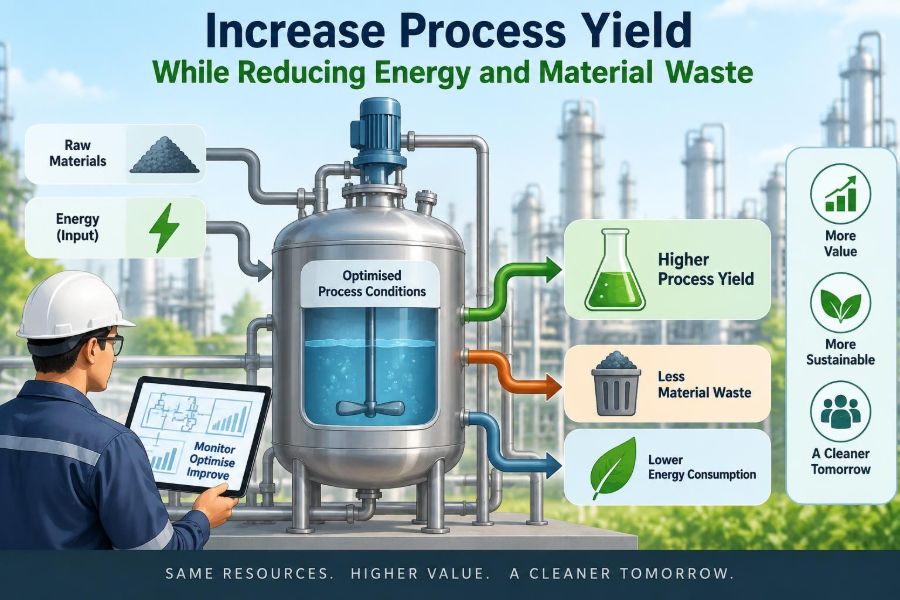
The central principle is simple: material waste and energy waste often have the same root cause—poor control of where molecules and heat go. Better selectivity reduces by-products that must be separated or treated. Better recovery prevents valuable product from being recreated with fresh energy and feed.
There are genuine trade-offs. A recovery step may require energy; a lower-temperature reaction may require more residence time; tighter control may require better instrumentation. Good engineering makes these trade-offs explicit and compares them on safety, quality, cost, and environmental performance.
When teams follow the material through the full process, measure carefully, and test changes systematically, yield improvement becomes more than a reactor adjustment. It becomes a method for operating the whole plant with less waste.
Increase process yield most effectively by preventing losses at their source, recovering what cannot be prevented, and judging every change across the entire process rather than one isolated unit. That approach turns efficiency into a durable engineering habit. 🧪♻️⚙️