
A tank is filling, a separator is producing two outlet streams, or a reactor is converting feed into product. Someone asks a seemingly simple question: “Where did the material go?” A material balance provides the disciplined answer.
At first, process information often arrives as scattered flow rates, assay values, operating notes, and process diagrams. The challenge is not usually advanced mathematics. It is deciding what to count, where to draw the boundary, and which quantities can reasonably be compared.
For students, material balances are a foundation for almost every later chemical engineering calculation. For working professionals, the same logic supports troubleshooting, inventory control, yield tracking, emissions estimates, and checks on process data.
A simple balance does not need to be intimidating. Once the system is defined carefully, it becomes an organized accounting exercise: material enters, material leaves, material accumulates, and material may be generated or consumed by reaction.
🧭 Start With the Question You Need to Answer
Before writing an equation, state the purpose of the balance. Are you finding an unknown outlet flow rate, estimating a tank’s fill time, checking whether a sample result is plausible, or calculating product yield?
The question determines the useful basis, the required measurements, and the level of detail. A balance intended to size a pump may need volumetric flow and density. A balance around a distillation column may need component flow rates instead.
Write the goal in one sentence. For example: Determine the mass flow rate of water leaving a mixer at steady state. This small step prevents a common error: collecting numbers without knowing which unknown the numbers should resolve.
📦 Define the System Boundary
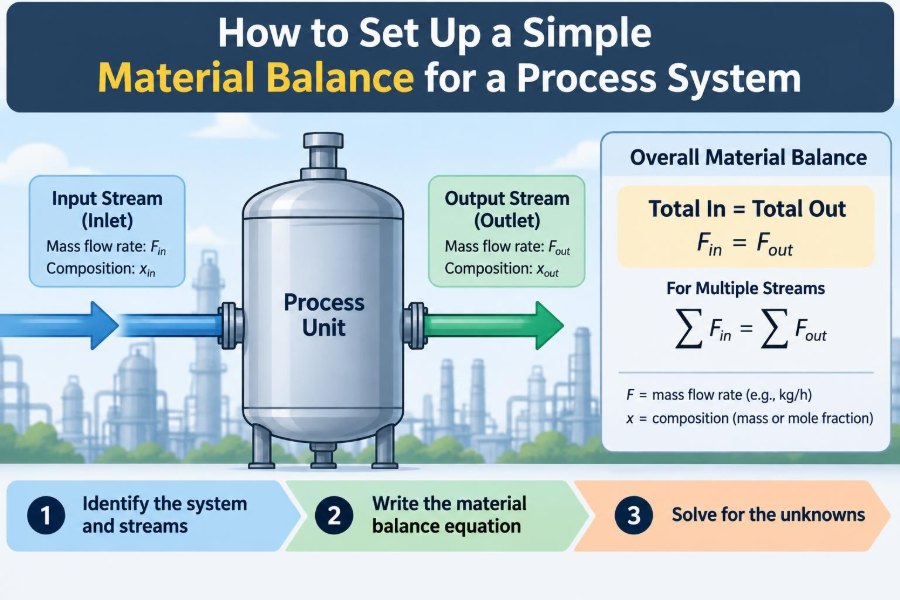
A system boundary is an imagined closed surface around the equipment or region being analyzed. Material crossing inward is an input; material crossing outward is an output. What happens inside is considered part of the system.
The boundary can enclose a single mixer, a storage tank, a heat exchanger, an entire production line, or even a site. There is no universally correct boundary. The best choice is the one that makes the question manageable and matches available data.
Draw a box around the chosen system on a process sketch. Label every stream that crosses that box. Do not label internal pipes as inputs or outputs when both ends remain within the boundary.
🗺️ Turn the Process Into a Clear Sketch
A process sketch is the working map for the calculation. It does not have to look like a formal piping and instrumentation diagram, but it must show equipment, stream directions, and known conditions.
Use arrows for each stream and give every arrow a unique label, such as F for feed, P for product, W for water, or S1 and S2. Add known flow rates, compositions, temperatures, pressures, and phase information beside the arrows when relevant.
A sketch exposes omissions early. If liquid enters a vessel but no liquid outlet is shown, ask whether the vessel is accumulating liquid, venting vapor, draining intermittently, or simply missing a stream from the diagram.
⚖️ Learn the General Material-Balance Statement
The general material balance is:
Input − Output + Generation − Consumption = AccumulationEach term refers to a mass or amount of a specified material over a stated time interval, or to its rate per unit time. The same structure works for total mass, an individual chemical component, or an inert tracer.
Generation and consumption result from chemical reactions, nuclear transformations, or biological conversion. They do not mean material appearing or disappearing overall; total mass remains conserved in ordinary process calculations.
For a nonreacting process, generation and consumption are zero. That reduction is why mixers, splitters, filters, and many tanks are ideal places to build confidence.
🔍 Choose Total Mass or a Component Balance
A total mass balance counts all material together. It is useful when composition does not matter or when the total outlet flow is the only unknown.
A component balance follows one species, such as salt, ethanol, oxygen, or solids. It is essential when streams have different compositions. A total balance alone cannot tell how much salt leaves a brine mixer.
Use the simplest balance that answers the question. Then add component balances only when needed. More equations are not automatically better if the available data cannot support them.
| Balance type | Tracks | Typical use |
|---|---|---|
| Total mass balance | All material combined | Finding a combined outlet mass flow |
| Component mass balance | One chemical or material component | Calculating mixture composition or recovery |
| Molar balance | Amount of substance in moles | Reaction stoichiometry and gas processes |
🧪 Know When a Mole Balance Is Better
Mass is conserved in chemical reactions, but individual molecular species may be produced or consumed. For reaction problems, a mole balance is often more convenient because reaction equations are written in molar stoichiometric coefficients.
For example, hydrogen and oxygen react in a molar ratio specified by the reaction equation, not by equal mass. A molar balance lets you connect reactant consumption and product formation directly.
Do not mix mass flow rates and molar flow rates in the same equation without conversion. Molecular weight bridges the two: mass flow equals molar flow multiplied by molecular weight.
⏱️ Decide Whether the Process Is Steady State
A process is at steady state when the amount of material inside the chosen boundary does not change with time. Inputs and outputs may still flow continuously; they simply balance in a way that keeps inventory constant.
For a nonreacting steady-state system, the balance becomes:
Input = OutputSteady state is a model assumption, not a label that automatically applies because equipment operates continuously. Startup, shutdown, tank filling, batch operation, changing feed conditions, and fouling can all create accumulation.
🌊 Recognize Transient or Unsteady Operation
When the quantity within the system changes with time, the process is transient or unsteady state. The accumulation term must remain in the balance.
A tank that receives 10 kg/min and discharges 8 kg/min gains material at 2 kg/min, provided there is no reaction or other unlisted stream. Over time, the level rises unless operating conditions change.
Transient balances may use a finite time period, such as one hour, or a differential rate form. For a first calculation, a time-period balance is often easier: compare total input and output during a clearly defined interval.
📏 Select a Practical Calculation Basis
A basis is a convenient reference amount or time used to express the calculation. Common choices include 100 kg of feed, 1 hour of operation, 1 kmol of feed gas, or one batch.
If a composition is given in percentages but no flow rate is supplied, choose 100 kg of the mixture. Then each mass percentage immediately becomes kilograms, making the component quantities easy to visualize.
State the basis explicitly. It gives every number a physical meaning and makes it possible for another engineer to reproduce your work.
🏷️ Label Flows With Units and Directions
Every stream label should include a direction and consistent units. Mass flow rate may be expressed as kg/h, kg/s, or lbm/h; molar flow as kmol/h or mol/s; volumetric flow as m³/h or L/min.
A bare number such as “25” is not process information. It could represent 25 kg/h, 25%, 25 °C, or 25 m³. Units are part of the quantity, not a decoration added at the end.
Choose one unit system for the calculation whenever possible. Converting all flow rates before writing the balance reduces hidden errors and makes subtraction meaningful.
🧮 Distinguish Mass Fractions From Percentages
Composition can be stated as mass fraction, mole fraction, mass percent, mole percent, concentration, or ratio. These descriptions are not interchangeable.
A mass fraction of 0.15 means 15% by mass. For a 200 kg stream, the component mass is 0.15 × 200 = 30 kg. A component balance using mass flow rates should use mass fractions, not mole fractions.
Always identify the composition basis. “10% ethanol” is incomplete unless the context specifies whether it is mass, mole, volume, or another percentage basis.
🔄 Convert Volumetric Flow Only When Necessary
Many plant instruments report volumetric flow, while material balances are often most reliable on a mass or molar basis. Density converts volumetric flow to mass flow:
mass flow rate = volumetric flow rate × densityDensity can depend strongly on temperature, pressure, and composition, especially for gases and mixed liquids. Use a density appropriate to the stream conditions, not a familiar value taken from a different state.
For gases, volumetric flow also requires careful attention to the reference condition. “Standard” or “normal” volumetric flow must be interpreted according to the convention used at the facility or in the problem.
🧱 Identify Every Physical Stream
Streams are sometimes less obvious than inlet pipes and product lines. A vent, drain, purge, recycle, sampling line, condensate return, dust collector discharge, or dissolved-gas release may cross the boundary too.
Missing a small stream may have little effect in one process and a major effect in another. A purge in a recycle loop, for example, can control the buildup of an inert contaminant.
Ask three questions while reviewing the diagram:
- What material enters from outside the boundary?
- What material leaves to outside the boundary?
- Could material cross unnoticed as vapor, solids, leaks, or intermittent discharge?
🥣 Work Through a Simple Mixer Example
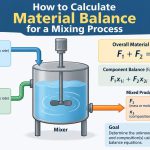
Consider a hypothetical steady-state mixer. Stream 1 delivers 100 kg/h of a solution containing 10 mass% salt. Stream 2 delivers 50 kg/h of pure water. The mixed outlet has no reaction and no loss.
The total mass balance is 100 + 50 = 150 kg/h outlet. For salt, Stream 1 supplies 0.10 × 100 = 10 kg/h, while Stream 2 supplies none. Therefore, the outlet contains 10 kg/h salt.
The salt mass fraction in the outlet is 10/150 = 0.0667, or 6.67 mass%. The water balance provides a useful check: 90 + 50 = 140 kg/h water, and 10 + 140 = 150 kg/h total.
✂️ Understand Splitters and Flow Division
A splitter divides one stream into two or more streams with the same composition as the feed, assuming no separation occurs. Only the flow rate changes.
If 120 kg/h of a homogeneous liquid enters an ideal splitter and 45 kg/h leaves through one branch, the other branch carries 75 kg/h. A component balance gives the same split fraction for every component.
Do not treat equipment as a simple splitter if it separates phases or preferentially removes solids. A cyclone, filter, decanter, membrane, and distillation column generally produce outlets with different compositions.
🪣 Set Up a Tank Inventory Balance
Tanks make accumulation visible. For a nonreacting liquid tank over a time interval:
Change in tank mass = total mass in − total mass outSuppose a tank receives 500 kg over one hour and discharges 420 kg during that hour. Its inventory increases by 80 kg. If the liquid density is reasonably constant, that mass change can be converted to a volume and then to a level change using tank geometry.
A level measurement can therefore serve as an independent check on flow-meter data. If inlet minus outlet predicts a rising level but the level falls, the data, boundary, timing, or assumptions need review.
⚗️ Include Reaction Terms With Care
For a reacting system, write component balances rather than assuming each chemical has equal input and output. A reactant has a consumption term, while a product has a generation term.
For a species A, the rate form is:
Input of A − Output of A + generation of A − consumption of A = accumulation of ATotal mass still balances when all streams are counted, but reaction can change the number of moles, composition, and gas volume. Stoichiometry relates the component generation and consumption terms; it does not replace the need to identify actual inlet and outlet streams.
🧷 Use Independent Equations, Not Repeated Information
A calculation can only be solved when it has enough independent equations for the unknowns. Two equations that say the same thing in different forms do not add new information.
For a nonreacting system with n components, there can be up to n useful component balances. The total balance is usually the sum of those component balances, so it may not be independent when every component balance is already used.
Count unknown flow rates and compositions before solving. If unknowns exceed independent equations, you need additional measured data, a stated specification, or a defensible process relation.
🧩 Apply Specifications and Physical Constraints
Process statements often provide constraints beyond material balances. Examples include a product concentration, a recovery fraction, a fixed split ratio, a conversion, a tank volume, or the fact that all fractions sum to one.
Composition fractions must satisfy:
sum of all component fractions = 1Physical limits also matter. Flow rates cannot be negative, mass fractions must fall between zero and one, and a liquid tank cannot hold more than its available volume. These basic checks often catch algebraic solutions that have no physical meaning.
🔁 Choose the Boundary to Simplify Recycles
Recycle streams can make a flowsheet look circular, but the balance principle does not change. One useful approach is to draw an overall boundary around the entire recycle loop first. The recycle then becomes internal and disappears from the overall balance.
After finding overall feed and product relationships, draw smaller boundaries around individual units to determine internal flow rates. This outside-in approach prevents counting recycle material as if it were fresh feed.
Purge streams deserve special attention. They are often included specifically to prevent a nonreacting component or impurity from accumulating in the loop.
🌡️ Keep Material and Energy Balances Separate
Material balances track what and how much crosses the boundary. Energy balances track heat, work, and energy carried by streams. The two are closely connected, but they are not the same equation.
Heating water can change its density and phase, affecting a material-balance calculation based on volume. A reaction may release heat without creating total mass. Separating the two ideas at first makes both calculations clearer.
When a problem requires both, solve or organize the material balance before relying on energy calculations. The material flow and composition frequently determine heat capacity, enthalpy flow, and phase behavior.
🧾 Build a Stream Table Before Solving
A stream table keeps known and unknown quantities in one place. It is particularly helpful when several streams and components are involved.
| Stream | Total mass flow | Salt mass fraction | Water mass fraction |
|---|---|---|---|
| Feed 1 | 100 kg/h | 0.10 | 0.90 |
| Feed 2 | 50 kg/h | 0 | 1.00 |
| Product | 150 kg/h | 0.0667 | 0.9333 |
For unknown entries, use symbols rather than guessing. A visible blank or variable is safer than an unstated assumption hidden in a spreadsheet cell or notebook margin.
✍️ Write Equations Before Substituting Numbers
Write the symbolic balance first, then insert numerical values. For the mixer example, the salt balance is:
F1 x1,salt + F2 x2,salt = P xp,saltThis format makes the logic easy to inspect. It also makes the equation reusable if a feed rate or composition changes later.
Substituting numbers too early can hide whether a term belongs on the input or output side, whether the composition basis is correct, or whether an omitted stream should appear in the equation.
✅ Check Units, Signs, and Magnitudes
After solving, check the equation dimensionally. Every term in a mass-flow balance must have units of mass per time. Adding kg/h to kmol/h without conversion is invalid, even if the numbers happen to look reasonable.
Then check signs and scale. An outlet larger than total inlet may be valid in a draining tank, but not in a steady-state nonreacting mixer. A negative flow may indicate a reversed assumed direction, but it can also reveal inconsistent data.
A quick component sum is valuable: component flow rates should add to the stream’s total mass flow, subject to rounding.
🚫 Avoid the Most Common Setup Errors
Most incorrect balances fail during setup rather than algebra. The following mistakes are especially common:
- Assuming steady state without checking whether inventory changes.
- Mixing mass fractions with mole fractions.
- Forgetting vents, drains, purges, samples, or moisture losses.
- Using inconsistent time bases, such as kg/min in one term and kg/h in another.
- Double-counting an internal recycle as an external input.
- Applying a total balance when a component balance is required.
- Rounding intermediate values so heavily that the final check no longer closes.
Each has a practical cure: redraw the boundary, label units, state assumptions, and perform a final closure check.
🕵️ Treat a Balance as a Data Reconciliation Tool
In operating plants, measured flows rarely close perfectly. Instruments have uncertainty, samples may not represent a fluctuating stream, densities may be estimated, and readings may be recorded at different times.
A mismatch is not automatically evidence of a leak or an equipment failure. First check timestamps, meter calibration status, operating stability, unmeasured side streams, and whether all flows were converted to the same basis.
When a persistent discrepancy remains, the balance narrows the investigation. It can point toward a missing stream, an incorrect composition, a failing instrument, or changing inventory inside the boundary.
🧠 State Assumptions Where Readers Can See Them
Every simplified material balance rests on assumptions. Examples include no reaction, negligible evaporation, constant density, complete mixing, no leaks, and steady operation.
List assumptions beside the sketch or before the equations. This is not a formality. It tells others exactly when the result is usable and what should be reconsidered if plant behavior differs.
For example, assuming a liquid is incompressible is often adequate for a simple tank estimate, but assuming constant density across a large temperature change may introduce meaningful error.
🧰 Use Spreadsheets Without Hiding the Logic
Spreadsheets are excellent for repeated calculations, sensitivity checks, and stream tables. They are less useful when formulas obscure the underlying boundary and balance structure.
Set up inputs, units, assumptions, equations, and checks in separate, clearly labeled areas. Include a closure cell that calculates input minus output plus generation minus consumption minus accumulation.
For larger systems, simulation software can solve interconnected material and energy balances. Still, a hand-drawn boundary and a simple manual balance remain the best first test of whether the model reflects the intended process.
📈 Know What a “Closed” Balance Really Means
A balance closes when the difference between the two sides is acceptably small for the intended use and the quality of the available data. In a textbook problem with exact inputs, it should close apart from rounding.
For real measurements, a small residual may be expected. The acceptable size depends on instrument performance, process variability, the quantity being tracked, and the decision being made. There is no single percentage that fits every system.
Report the residual and the likely uncertainty rather than forcing numbers to agree by altering a result without justification.
🔧 Scale Up From One Unit to a Process Section
The same method applies as systems become larger. Begin with an overall balance around the whole process section, then use unit balances to determine internal streams.
This hierarchy is efficient because overall balances eliminate internal flows. Unit-level balances then reveal where material is split, separated, reacted, stored, or lost.
For complex systems, maintain consistent stream numbers across every sketch and table. A clear naming convention may seem minor, but it prevents major confusion when multiple teams review the calculation.
📝 Follow a Repeatable Setup Workflow
A reliable workflow reduces rushed assumptions and makes your calculation auditable:
- State the question and select the quantity to track.
- Draw the system boundary and label all crossing streams.
- Choose a basis and convert data to consistent units.
- Identify steady or transient operation and whether reaction occurs.
- List assumptions and create a stream table.
- Count unknowns and independent equations.
- Write symbolic total and/or component balances.
- Solve, then verify units, physical limits, and closure.
This sequence works for an introductory mixing problem and for a preliminary review of a production process.
🎯 Bring the Core Principle Together
A material balance is fundamentally a conservation statement applied to a carefully chosen boundary. Its power comes less from complicated algebra than from precise definitions: what is the system, what crosses it, what is being tracked, and does inventory change?
When the boundary is clear, units are consistent, compositions are correctly defined, and assumptions are visible, the equation becomes straightforward. When a result looks wrong, return to those foundations before searching for a more elaborate formula.
The most useful habit is to make the process visible on paper before calculating. A labeled sketch, a stated basis, and a balance written in words will often reveal the answer—or reveal exactly what information is still missing.
Set up the boundary first, account for every stream, and let conservation organize the calculation. With that approach, even complicated process systems become easier to understand and troubleshoot. 🧪⚖️📊