
A process operator blends a concentrated syrup with water. A formulation engineer combines two solvent streams. A wastewater plant mixes a recycle flow with incoming liquid. The equipment may look different, but each task starts with the same question: what enters, what leaves, and what is in the mixture?
Material balances turn that question into a disciplined calculation. They help engineers size pumps, check batch recipes, estimate product composition, identify measurement problems, and communicate clearly across operations, laboratory, and design teams.
Mixing is often the first material-balance problem students encounter because no chemical reaction is required. Yet simple mixers expose habits that remain essential in complex processes: defining a system boundary, using consistent units, selecting a basis, and checking whether an answer is physically possible.
This guide develops the method from first principles, then applies it to practical steady-state and batch examples. The arithmetic is usually short; the engineering value comes from setting up the problem correctly.
🧭 Start with the Material-Balance Idea
A material balance, also called a mass balance, accounts for a conserved quantity within a chosen system. For total mass, the general statement is:
Accumulation = Input − Output + Generation − Consumption
For a nonreacting mixing process, there is no generation or consumption of material by reaction. If the mixer runs continuously at steady state, its contents do not change with time, so accumulation is also zero. The equation then reduces to input equals output.
Balances may be written for total mass, for a particular component, or for a useful property such as a dissolved solute. Total mass tells how much mixture is produced; component balances tell its composition.
🥣 What Counts as a Mixing Process?
A mixing process combines two or more feed streams into one stream or batch. The feeds may be liquids, gases, solids, or slurries. Examples include blending acids with water, combining polymer pellets, mixing air streams, and diluting a salt solution.
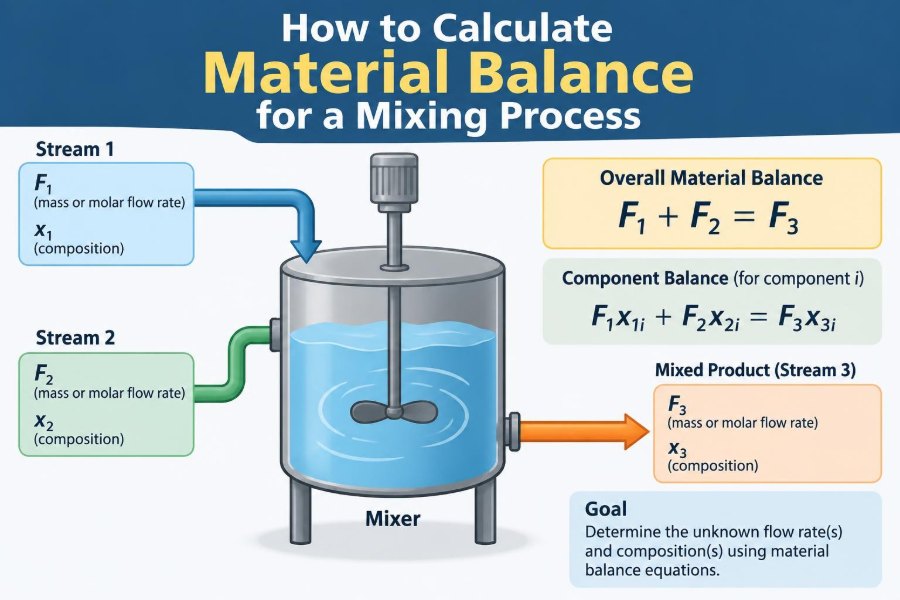
For introductory calculations, a mixer is commonly treated as a control volume with several inlets and one outlet. The impeller, tank, and piping inside the boundary do not create or destroy mass; they distribute it and, ideally, make composition uniform.
A mixer need not contain a rotating impeller. A pipe junction, static mixer, stirred vessel, or tank receiving sequential additions can all be analyzed with the same conservation principle.
🔲 Draw the System Boundary First
The system boundary is an imagined surface that separates the process being analyzed from everything outside it. Draw a box around the mixer and show every stream crossing that box. This small sketch prevents many errors.
Label each inlet and outlet with the known flow rate and composition. If a stream is not yet known, assign it a symbol such as ṁ3 or F. Also mark whether the process is continuous or batch.
Keep the boundary purposeful. If the question concerns only the mixer outlet, do not include an upstream storage tank unless its accumulation matters. If a recycle enters the mixer, however, it must cross the boundary and must be included.
⚖️ Choose Mass, Moles, or Volume Carefully
Material balances can use mass flow rate, molar flow rate, or—under suitable conditions—volumetric flow rate. A mass flow rate may be written as kg/h, while molar flow rate may be mol/h or kmol/h.
For liquid solution mixing, mass is often the safest basis because total mass is conserved even when volumes do not add exactly. For gas mixing, molar flow is often convenient because gas composition is commonly expressed as mole fraction.
Volumetric flow can be used when density is known and conditions are compatible, but it deserves care. Mixing ethanol and water, for example, can produce a final volume different from the arithmetic sum of the initial volumes. A volume balance is therefore not automatically a mass balance.
🏷️ Define Composition Before Using It
A component concentration can be expressed in several ways. For a binary mixture of solute A and solvent B, a mass fraction is:
wA = mass of A / total mass of mixture
A mole fraction has the same form but uses moles. Concentrations may also appear as kg solute/m³ solution, mol/L, mass percent, mole percent, or parts per million. The notation is not interchangeable.
Before calculating, translate every composition into a clearly defined quantity. A solution described as 20 wt% salt contains a salt mass fraction of 0.20, not 20 kg salt per 100 kg water. It contains 20 kg salt in 100 kg of total solution.
🧩 Separate Total and Component Balances
A total mass balance for a steady mixer with two inlets and one outlet is:
ṁ1 + ṁ2 = ṁ3
For component A, the corresponding balance is:
ṁ1 wA,1 + ṁ2 wA,2 = ṁ3 wA,3
The first equation determines or checks total outlet flow. The second determines or checks how much A leaves. In a binary, nonreacting system, a balance on component B is usually redundant once the total balance and A balance are satisfied.
This distinction matters because streams can have identical total flow rates but very different compositions. A total balance alone cannot tell whether the product meets its formulation target.
🧱 Count Unknowns and Independent Equations
Before inserting numbers, list the unknown variables. Then count the independent equations available. This is a quick degrees-of-freedom check.
Suppose two known feed streams enter a steady mixer and the outlet flow and composition are unknown. The total balance and one component balance provide two equations for two unknowns. The problem is solvable.
If both an inlet flow rate and outlet composition are unknown, but no extra specification is given, the problem may be underdetermined. More algebra cannot manufacture missing information. A target composition, density measurement, or additional flow measurement would be needed.
🧮 Select a Sensible Calculation Basis
A basis is a convenient assumed amount of material or time interval used to turn fractions into quantities. It does not change the physical result; it makes the arithmetic manageable.
For a continuous process, choose a time basis such as one hour when flows are in kg/h. For a batch blend specified only by percentages, assume 100 kg of final mixture. Then a 15 wt% solute concentration immediately means 15 kg solute.
Choose a basis that avoids awkward decimal values when possible. State it explicitly, especially when solving composition-only problems.
🚰 Use a Steady-State Balance for Continuous Mixers
At steady state, the mass inside the control volume remains constant over time. Flows and compositions may be idealized as constant, so accumulation is zero.
For any component i in a nonreacting continuous mixer:
Σ(ṁin wi,in) = Σ(ṁout wi,out)
This equation applies whether there are two feeds or ten. A single well-mixed outlet usually has the same composition as the material in the tank, but that mixing assumption is not required merely to balance the streams.
Steady state does not mean the equipment is motionless. Liquid may circulate vigorously while the average inventory and outlet composition remain unchanged.
🪣 Recognize When a Batch Balance Is Different
In a batch operation, material is charged to a vessel, mixed, and later discharged. During charging, material accumulates in the vessel; there may be no outlet. The balance must retain the accumulation term.
If 40 kg of a 10 wt% solution is combined with 60 kg of water in a closed tank, total final mass is 100 kg. The solute mass is 4 kg, so the final solute mass fraction is 4/100 = 0.04, or 4 wt%.
The same conservation law is operating, but the time interpretation differs. Do not set input equal to output during a charging period when no material is leaving.
🧾 A Reliable Seven-Step Workflow
- Read the process statement and identify components, streams, and requested results.
- Draw the boundary and label every inlet and outlet.
- Choose units and a basis that fit the available data.
- Write known compositions consistently as fractions, concentrations, or molar quantities.
- Write the total balance when total flow is relevant.
- Write independent component balances for the needed species.
- Solve and validate the result with units and physical checks.
This workflow seems formal for a two-stream problem, but it becomes essential when a process includes recycle, purge, phase separation, or reaction.
🧪 Worked Example: Diluting a Salt Solution
Consider a hypothetical continuous mixer. A 200 kg/h stream containing 25 wt% salt is blended with 300 kg/h pure water. Find the outlet flow rate and salt mass fraction.
The total mass balance gives:
ṁout = 200 + 300 = 500 kg/h
The salt entering with the first stream is 200 × 0.25 = 50 kg/h. Water contributes no salt. The salt component balance therefore gives:
50 = 500 wSalt,out
Thus wSalt,out = 0.10, or 10 wt% salt. The outlet contains 50 kg/h salt and 450 kg/h water, which sum to the 500 kg/h total.
🔍 Interpret the Dilution Result Physically
The final 10 wt% lies between the feed compositions of 25 wt% and 0 wt%. That is exactly what should happen when two streams containing the same components are mixed without reaction or separation.
The outlet is not the simple average of 25% and 0%, because the feed flow rates are unequal. It is a flow-weighted average. The larger water flow exerts more influence on the final composition.
This intuition is useful as a fast check, but the component balance is the method that remains reliable when streams contain more than two components or have different units.
📊 See Composition as a Weighted Average
For two streams carrying component A, the outlet mass fraction can be written as:
wA,out = (ṁ1 wA,1 + ṁ2 wA,2) / (ṁ1 + ṁ2)
When both inlet mass flow rates are positive, this expression guarantees that the outlet fraction lies between the two inlet fractions. It cannot exceed the richer feed or fall below the leaner feed unless another mechanism is present.
| Situation | Expected outlet composition | Reason |
|---|---|---|
| Two nonreacting feeds, same component basis | Between the inlet compositions | Flow-weighted mixing |
| Reaction occurs | May lie outside inlet range | Component is generated or consumed |
| Evaporation or separation occurs | May differ from simple mixer result | Components leave in different proportions |
| Measurement basis is mixed up | May appear impossible | Mass, mole, and volume quantities were confused |
🔁 Solve a Blend-Ratio Problem
Often the desired product composition is known, while one feed rate must be found. Suppose 30 wt% acid solution is mixed with pure water to make 500 kg/h of 12 wt% acid solution.
Let ṁacid be the 30 wt% solution flow. An acid balance gives 0.30 ṁacid = 0.12 × 500. Therefore, ṁacid = 200 kg/h.
A total balance then gives the required water flow: 500 − 200 = 300 kg/h. Writing the component equation first is often the most direct route when a product specification drives the calculation.
🧠 Use Algebra Without Losing the Process Meaning
Symbols are useful because they expose structure. For two feeds with a specified outlet composition, rearranging the component balance can provide the required ratio:
ṁ2 / ṁ1 = (wA,1 − wA,out) / (wA,out − wA,2)
This form is valid when the target composition lies between the two feed compositions. If it does not, the computed ratio becomes negative or undefined, signaling that ordinary mixing cannot achieve the target.
That “impossible” result is valuable engineering information. It may mean the wrong feed concentration was selected, a third stream is needed, or a separation or reaction step is being overlooked.
🔢 Convert Volumetric Flow Using Density
Many plant instruments report L/min or m³/h, while formulations are specified by mass fraction. Convert a volumetric flow rate to mass flow rate using:
ṁ = ρ V̇
For example, a liquid flowing at 2.0 m³/h with density 950 kg/m³ has a mass flow rate of 1900 kg/h. Use density at conditions appropriate to the process, particularly when temperature or composition changes substantially.
If density is unavailable, do not quietly assume every liquid has the density of water. A rough assumption may be suitable for an early estimate, but it should be labelled and checked before it supports equipment sizing or a product specification.
🌡️ Account for Temperature and Pressure When Needed
Mass conservation does not depend on temperature, but flow measurements and density do. Heating a liquid can change its density, so a fixed volumetric flow may correspond to a different mass flow at another temperature.
For gases, pressure and temperature strongly affect volume. A gas stream at 10 m³/min cannot be combined meaningfully with another gas volume unless their temperature and pressure bases are known or both streams are converted to molar flow.
When a mixer is adiabatic or involves streams at different temperatures, a separate energy balance may be required to predict outlet temperature. Do not assume a mass balance alone determines thermal conditions.
🧬 Use Molar Balances for Gas Mixtures
For gases and reacting systems, moles often provide the clearest component accounting. For a nonreacting gas mixer:
Σ(ṅin yi,in) = ṅout yi,out
Here yi is the mole fraction of component i. If ideal-gas behavior is a reasonable approximation and all streams are expressed at the same temperature and pressure, volumetric flow fractions equal mole fractions.
That convenience has limits. At elevated pressure, unusual temperatures, or for mixtures with nonideal behavior, engineers may need an equation of state or property data. The balance remains correct; the conversion between measured volume and moles becomes the challenging part.
🧱 Handle More Than Two Components Systematically
For a mixture with several components, construct a component table before writing equations. Each row is a stream; each column is a component fraction or component flow.
For a stream containing A, B, and C, the fractions must satisfy wA + wB + wC = 1 on a mass basis. If they do not, investigate whether an unlisted component exists, whether values were rounded, or whether different composition bases were mixed.
For a nonreacting system with N components, the total balance plus N−1 component balances are usually sufficient. The balance for the final component follows from the others and the fact that fractions sum to one.
🧯 Know When “Mixing Only” Is an Invalid Model
The simple mixer model assumes no reaction, no leak, no accumulation at steady state, and no significant preferential removal of one component. Real equipment may violate one or more assumptions.
Evaporation can remove volatile material. Precipitation can create a solid phase. An acid-base neutralization changes species through reaction. A vessel with an overflowing foam layer may carry out a different composition than the bulk liquid.
Use the simplest model consistent with the physical process, but state its limits. If reaction occurs, include generation and consumption terms based on stoichiometry. If phases separate, write balances around the separator rather than assuming one uniform outlet.
🌀 Distinguish Perfect Mixing from Material Conservation
A balance can be correct even if mixing is imperfect. Conservation only tracks how much enters and leaves; it does not guarantee that every point in a vessel has identical composition.
The perfectly mixed assumption means any sample of the tank has the same composition as the outlet. It is often reasonable for a well-designed agitated tank after adequate mixing time, but it can fail with viscous fluids, poor impeller selection, short-circuiting flow, or stratification.
When product uniformity matters, mixing hydraulics must be assessed separately through residence time, agitation, sampling location, and sometimes tracer testing. A correct spreadsheet cannot compensate for a poorly mixed vessel.
⏱️ Understand Start-Up and Transient Accumulation
When a continuous mixer starts, stops, or changes feed rate, the outlet composition may change with time. The tank inventory is then accumulating or depleting one or more components.
For component A in a well-mixed tank, the unsteady balance has the form:
d(mA,tank)/dt = Σ(ṁin wA,in) − ṁout wA,tank
Solving this equation may require differential equations and an initial composition. The practical point is simple: a steady-state calculation predicts the eventual condition, not necessarily what a downstream analyzer sees immediately after a valve adjustment.
📏 Check Units at Every Equation
Dimensional consistency catches errors early. In a component mass balance, every term must have units of component mass per time, such as kg salt/h.
Mass fraction has no units, so multiplying kg solution/h by kg salt/kg solution gives kg salt/h. In contrast, adding kg/h directly to L/min is invalid until a density and time conversion are applied.
Write units alongside intermediate values rather than only on the final answer. This habit is especially valuable when moving between ppm, percent, density, and molecular-weight conversions.
✅ Perform Three Fast Reality Checks
After solving, test the answer before trusting it. First, confirm that the total of outlet component flows equals the outlet total flow. Second, ensure fractions are between zero and one and add to one within rounding.
Third, compare the result with process intuition. In a simple two-feed blend, the final composition should lie between inlet compositions. A required negative feed flow, a 130% mass fraction, or a product flow smaller than the only inlet are warnings, not merely inconvenient numbers.
- Check that flow directions match the signs used in the balance.
- Check whether a stated percentage is mass-based or mole-based.
- Check rounding only after preserving adequate calculation precision.
🚫 Avoid Common Mixing-Balance Mistakes
A frequent mistake is averaging percentages without weighting by flow. Another is treating a 10 wt% solution as 10 parts solute plus 100 parts water, rather than 10 parts solute in 100 parts total solution.
Students also sometimes write a component balance using total stream flow but omit the component fraction. Others use volume flows with mass fractions without density conversion. These errors can produce plausible-looking answers, which makes systematic checks essential.
Finally, do not count the same equation twice. In a binary nonreacting system, the total balance, A balance, and B balance contain only two independent pieces of information.
📝 Organize Calculations in a Stream Table
A stream table makes assumptions visible and helps others review the work. List each stream, its total flow, composition basis, and component flow rates.
| Stream | Total flow (kg/h) | Salt mass fraction | Salt flow (kg/h) | Water flow (kg/h) |
|---|---|---|---|---|
| Salt solution feed | 200 | 0.25 | 50 | 150 |
| Water feed | 300 | 0.00 | 0 | 300 |
| Mixed outlet | 500 | 0.10 | 50 | 450 |
Tables are particularly useful in multi-component systems because they reveal missing components and make it easy to verify that each stream’s component flows add to its total.
💻 Use Spreadsheets and Software Wisely
A spreadsheet can automate repeated blend calculations, sensitivity checks, and unit conversions. Set it up so inputs, assumptions, equations, and outputs are visibly separated. Include balance residuals that should equal zero.
Process simulators are valuable when property models, phase equilibrium, reactions, or recycle loops are involved. But software does not replace defining a correct boundary or understanding the selected composition basis.
A sound practice is to calculate a simple case by hand first. If the software result disagrees, inspect units, stream definitions, density models, and hidden specifications before assuming the hand calculation is wrong.
🎯 Connect the Balance to Process Control
In production, a blend target may be maintained by flow controllers, ratio control, density measurement, conductivity, or online composition analyzers. The material balance provides the expected relationship between these measurements.
For example, if a concentrated feed flow rises while dilution water remains fixed, the product concentration should rise. If the analyzer reports the opposite trend, possible explanations include instrument bias, a misrouted stream, delayed residence time, or an assumption that no longer holds.
Balances therefore support troubleshooting as well as design. A persistent mismatch between measured input and output is a prompt to investigate leaks, sampling errors, calibration, unmeasured streams, or inventory changes.
🛡️ Include Safety and Quality Boundaries
Some mixing operations release heat, generate vapors, or form hazardous local concentrations even when the overall balance is simple. Adding concentrated acid to water, for instance, is operationally different from casually combining two benign aqueous streams.
A material balance does not determine safe addition order, ventilation needs, compatibility, or relief requirements. These require chemical-specific hazard information, operating procedures, and often energy and equipment assessments.
For quality, consider uncertainty in feed concentration and flow measurement. A mathematically correct nominal recipe can still miss a narrow product specification if instruments drift or incoming materials vary.
📚 Practice with a General Template
For a nonreacting steady mixer with feeds 1 through n and one outlet, use this template:
Total:     Σ ṁj = ṁout
Component i: Σ(ṁj wi,j) = ṁout wi,out
For batch charging with no outlet, replace the right side with the amount accumulated in the vessel. For a reacting system, add component generation or consumption. For multiple outlets, include each outlet component flow separately.
The template is deliberately simple. Its strength is that it can grow with the problem without changing its underlying logic.
🏁 Bring the Method Together
Every dependable mixing calculation begins by defining what crosses a boundary and by choosing a consistent basis. From there, total and component balances convert stream data into flow rates and compositions.
The most useful habits are not advanced mathematics: draw the process, distinguish mass from volume and moles, state assumptions, use a component balance, and check whether the result makes physical sense. These habits scale from a classroom dilution problem to a real blending operation.
When the system is not at steady state, does not mix uniformly, reacts, or separates into phases, the basic balance is still the starting point. It simply needs terms and property relationships that reflect the actual process.
A material balance for mixing is conservation made practical: account for every component entering, leaving, and accumulating, and the mixture becomes calculable.
Start with a clear boundary and a component balance, then let consistent units and physical checks guide the rest of the calculation. 🧪⚖️📈