
A glass of water may look simple, but the route from a mixed stream to a usable product is rarely simple. The same is true for gasoline, pharmaceutical ingredients, industrial gases, edible oils, and purified solvents. Before they reach a tank, pipeline, or package, they often pass through several carefully chosen separation steps.
It is tempting to ask why a plant cannot just use one powerful separator. If a distillation column can separate liquids, why add an absorber, a membrane, a filter, a decanter, or another column afterward?
The answer is not that engineers enjoy making flowsheets complicated. Real mixtures contain components with different physical properties, impurities at very different concentrations, changing feed conditions, and product specifications that can be extremely tight.
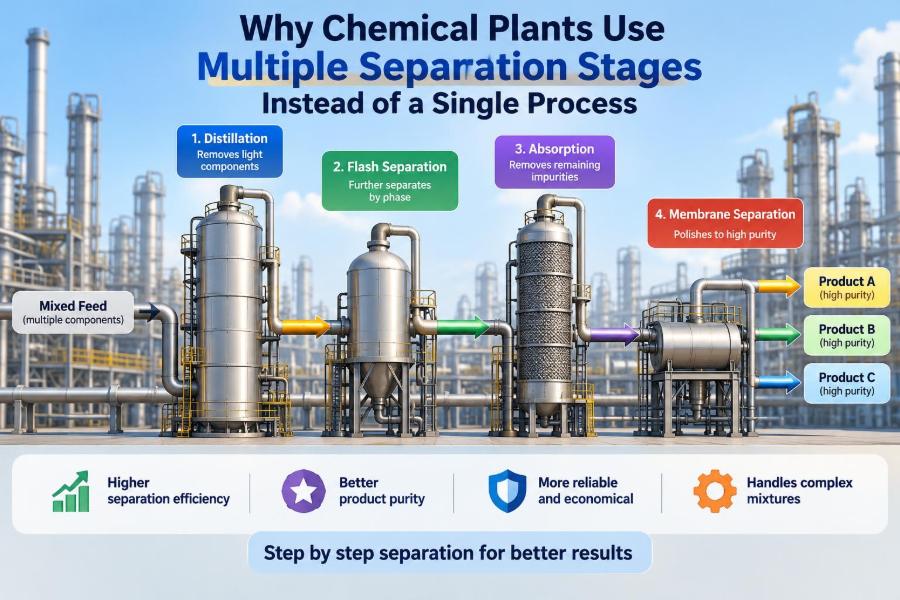
Multiple stages let a plant divide one difficult task into smaller, controllable ones. That approach can reduce energy use, protect equipment, improve recovery, and produce materials that are safe and fit for purpose.
🔍 Separation Is Usually the Central Plant Task
Many chemical processes create a mixture rather than a finished product. A reactor effluent may contain desired product, unreacted feed, solvent, catalyst residues, by-products, water, and dissolved gases.
Separation processes isolate useful materials, remove unwanted ones, and return valuable reactants for reuse. In numerous plants, separation equipment occupies more space and consumes more utility energy than the reactor itself.
🧩 Real Process Streams Are Not Two-Component Mixtures
Introductory examples often describe a binary mixture: component A and component B. A single technique may perform well in that setting, especially when their boiling points, densities, or particle sizes differ greatly.
Industrial feeds are usually multicomponent. A method that separates A from B may leave C and D together, concentrate a troublesome impurity, or lose product into a waste stream. Several steps provide different “handles” for resolving that complexity.
⚖️ Every Separation Relies on a Property Difference
Equipment works because components behave differently under selected conditions. Distillation uses volatility, filtration uses particle size, extraction uses solubility, adsorption uses surface affinity, and membranes use selective transport.
No property difference is universally large enough to exploit economically. Plants therefore select a sequence in which each unit operation targets the difference that is most useful at that point.
🪜 What Engineers Mean by a Separation Stage
The word stage can mean two related things. At the flowsheet level, it may mean a separate operation, such as filtration followed by distillation. Inside a unit, it can mean one repeated contacting step, such as a tray in a distillation column.
Both meanings reflect the same idea: gradual improvement is often more practical than demanding a complete split in one jump.
🌡️ Distillation Gains Strength Through Repeated Contact
In a distillation column, rising vapor contacts descending liquid many times. At each idealized stage, the vapor becomes richer in more volatile components while the liquid becomes richer in less volatile components.
A single flash drum performs only one equilibrium split. It can be useful for removing light gases or making a rough division, but it normally cannot produce two high-purity liquid products from a demanding mixture.
🔁 Reflux Makes a Column More Than a Single Flash
Part of the condensed overhead liquid is returned to the top of a distillation column as reflux. This internal recycle provides repeated opportunities for mass transfer and sharpening of the separation.
Reflux improves purity, but it also increases condenser and reboiler duties. Engineers balance the number of stages and reflux ratio rather than assuming that more of either is automatically better.
🧪 Some Mixtures Resist Distillation
Close-boiling components need many equilibrium stages because their relative volatility is low. The vapor composition changes only modestly after each contact, so an ordinary column can become very tall or energy intensive.
Azeotropes pose another limitation. At an azeotropic composition, vapor and liquid can have the same composition under given conditions, preventing a conventional distillation column from crossing that boundary.
💧 Water Often Creates a Second Separation Problem
Water appears in feeds, reactions, washing operations, steam stripping, and ambient contamination. Even a small amount can affect corrosion, catalyst activity, product stability, phase behavior, or downstream specifications.
Removing bulk water may be easy by decanting two immiscible phases. Achieving trace-level dryness can be far harder and may require distillation, adsorption on molecular sieves, pervaporation, or another polishing step.
🧱 Bulk Removal Comes Before Fine Purification
A sound sequence usually removes the largest and easiest impurity load first. Sending a slurry directly to a high-performance membrane or packed adsorption bed would quickly foul or overload equipment.
For example, a stream might be settled to remove coarse solids, filtered for fine particles, distilled to recover solvent, and finally treated with adsorption to remove trace color bodies or moisture.
🧹 Pretreatment Protects Sensitive Equipment
Pretreatment is not merely housekeeping. Suspended solids can plug column internals, foul heat exchangers, abrade pumps, or form deposits on membrane surfaces.
Acid gases, salts, reactive contaminants, and free liquids can also damage downstream units or make their performance unpredictable. A relatively simple upstream separator can prevent expensive reliability problems later.
🧫 Different Techniques Have Different Selectivity
Selectivity describes how strongly a process favors one component over another. A highly selective operation may achieve an excellent split but have limited capacity, high cost, or sensitivity to contaminants.
Low-cost bulk methods and high-selectivity finishing methods often work well together. This is why a plant rarely asks one unit to simultaneously process a huge flow, achieve ultra-high purity, and tolerate every impurity.
📉 Concentration Determines the Best Tool
Removing 20% water from an organic liquid is a fundamentally different duty from reducing water from a few hundred parts per million to a much lower residual level. The amount to remove and the remaining concentration both matter.
Evaporation or decanting may handle the first task economically. An adsorbent bed can be effective for the final trace removal, but using it for the bulk load would mean frequent regeneration or replacement.
🔋 Energy Use Is a Major Design Constraint
Thermal separations commonly require heating and cooling, often repeatedly. Distillation is versatile, but vaporizing large flows can be costly when latent heat requirements are high.
Adding another operation can sometimes lower total energy consumption. A membrane, liquid-liquid extraction, or phase separator may reduce the load entering a distillation column, allowing it to be smaller or operate with less reflux.
♨️ Heat Integration Changes the Best Sequence
A plant does not evaluate a separator in isolation. Hot streams may preheat cold feeds, condenser heat may serve another process duty, and pressure changes may make heat recovery possible.
This is called heat integration. A sequence with more equipment can still be preferable if it creates useful temperature matches and reduces the net demand for steam, fuel, refrigeration, or cooling water.
🛢️ Pressure Is Another Separation Lever
Changing pressure alters boiling temperatures, vapor-liquid equilibrium, gas solubility, and compression requirements. Lower pressure can help separate heat-sensitive compounds by reducing boiling temperature.
Conversely, higher pressure may permit condensation with available cooling water or make a downstream recovery step easier. Multi-stage systems may use pressure changes deliberately rather than treating pressure as a fixed background condition.
🌪️ Phase Splitting Can Simplify a Hard Problem
When a mixture separates into two liquid phases, a decanter can make a useful bulk split with little energy input. This can be especially valuable after condensation or extraction.
Engineers may intentionally adjust temperature, composition, or pressure to create a phase split. The resulting streams are not necessarily final products, but each is often much easier to purify than the original combined mixture.
🧲 Adsorption Is Powerful but Capacity-Limited
Adsorbents such as activated carbon, silica gel, alumina, and molecular sieves retain selected molecules on internal surfaces. They are widely used for drying, impurity removal, and gas purification.
Because adsorption sites eventually fill, beds must be regenerated, replaced, or operated in alternating service cycles. It is typically a poor choice for large quantities of easily removable material, but an excellent finishing tool for difficult trace contaminants.
🧬 Membranes Offer a Different Kind of Split
Membranes separate through selective permeation rather than boiling the entire feed. Depending on the membrane and service, they can remove gases, salts, water, particulates, or particular organic compounds.
They can save energy in suitable applications, but concentration polarization, fouling, pressure requirements, and limited selectivity must be managed. A pretreatment train is often essential for stable membrane operation.
🧴 Extraction Can Break an Unhelpful Boiling-Point Relationship
Liquid-liquid extraction transfers a solute from one liquid phase into another, selected solvent. It is useful when volatility differences are too small or when distillation would expose a heat-sensitive product to damaging temperatures.
Extraction creates a new task: recovering and recycling the solvent. That trade-off is acceptable when the extraction step makes a previously impractical separation feasible or substantially reduces overall energy demand.
🧊 Crystallization Can Deliver High-Purity Solids
For solid products, crystallization can reject many dissolved impurities as a crystal lattice forms. Cooling, evaporation, antisolvent addition, or reaction can create the required supersaturation.
Yet crystals must still be separated from mother liquor, washed, and dried. Crystal size distribution, trapped liquid, and polymorphism can all affect downstream performance, so crystallization is commonly embedded in a broader separation train.
🧺 Filtration and Centrifugation Handle Solid-Liquid Duties
Filters retain solids while allowing fluid to pass; centrifuges accelerate settling by applying rotational force. They are often the practical link between a reaction or crystallization step and later drying or purification.
Neither method necessarily removes dissolved impurities. A filtered cake may require washing, while the filtrate may require further recovery. Recognizing that distinction prevents an incomplete separation design.
🏭 A Typical Sequence: Reactor to Product
Consider a hypothetical process that produces an organic liquid in a catalytic reaction. The outlet contains catalyst fines, unreacted feed, product, heavy by-products, dissolved light gases, and some water.
- A flash vessel removes much of the light gas.
- Filtration or a catalyst separator protects downstream equipment.
- A decanter removes free water if phases form.
- One distillation column recovers unreacted feed for recycle.
- Another column separates product from heavier material.
- A final dryer or adsorbent bed meets a low-water specification.
Each device has a limited, well-defined assignment. The sequence is not universal, but it illustrates why a single unit would be asked to do incompatible jobs.
♻️ Recovery and Recycle Depend on Good Separations
Unreacted feedstocks and solvents may be too valuable to discard. Separation systems recover them for recycle, which can improve material efficiency and reduce waste generation.
Recycle also introduces a design challenge: impurities can accumulate if there is no purge or adequate purification. The separation train must control what returns to the process, not simply maximize every recycle flow.
🎯 Product Specifications Are Usually Multi-Dimensional
“Pure” is not one universal condition. A product may need limits on water, acidity, color, sulfur, particles, residual solvent, odor, metals, or specific related compounds.
One operation rarely controls all of these independently. Multiple stages allow engineers to assign a specification to the method that addresses it most reliably and to verify performance with appropriate sampling and analysis.
🛡️ Safety Can Require Removing Components Early
Separation order can affect hazards. Removing flammable dissolved gases before heating a liquid, eliminating oxygen before handling a reactive stream, or taking out corrosive acids before sensitive equipment can reduce operational risk.
Design still requires case-specific hazard analysis. A separation sequence that is efficient on paper may be unsuitable if it creates dangerous pressure, temperature, static electricity, toxic exposure, or runaway scenarios.
📏 Equipment Size Does Not Tell the Whole Story
A larger column with more stages may lower reflux needs, while a smaller column may require greater energy input. A high-capacity membrane system may need more frequent cleaning. An adsorption bed may require parallel vessels to maintain continuous service during regeneration.
Capital cost, operating cost, maintenance, utility availability, controllability, and product losses all influence the design. The best separation train is an optimization problem, not a contest to use the fewest units.
📊 Recovery, Purity, and Throughput Pull in Different Directions
Increasing purity can reduce recovery when more valuable product is rejected with an impurity-rich stream. Increasing throughput may worsen contact time, pressure drop, flooding risk, or filter performance.
| Design objective | Common consequence | Typical response |
|---|---|---|
| Higher purity | More energy, stages, or polishing duty | Use targeted finishing equipment |
| Higher recovery | More recycle or a smaller impurity rejection margin | Optimize cut points and purge rates |
| Higher throughput | Reduced residence or contacting time | Increase area, stages, or parallel capacity |
| Lower energy use | Potentially lower driving force | Integrate heat or add a complementary method |
Process design identifies an acceptable balance rather than maximizing every objective independently.
⚙️ Control Becomes Easier When Duties Are Distributed
Feed composition, ambient temperature, utility pressure, and equipment condition vary over time. If one unit must perform an extreme separation, small disturbances can cause a product to fall out of specification.
Distributed duties give operators more adjustment points: reflux, temperature, pressure, solvent ratio, wash rate, regeneration cycle, or recycle flow. Properly designed intermediate tanks and analyzers can further stabilize the train.
🚧 More Stages Also Create Real Drawbacks
Additional equipment adds piping, instrumentation, footprint, startup complexity, maintenance requirements, and potential failure points. Every transfer can create product hold-up, emissions opportunities, pressure losses, or contamination risk.
For simple feeds with a large property difference, a single operation may genuinely be best. Engineers add stages only when the gain in performance, economics, safety, or reliability justifies the added complexity.
❌ A Common Mistake: Choosing by Familiarity
Distillation is familiar and broadly useful, so it is sometimes treated as the default answer. But forcing every separation into a thermal column can create excessive energy demand or thermal degradation.
The opposite mistake is choosing a fashionable technology without considering fouling, solvent recovery, cleaning, scale-up uncertainty, or operator experience. A strong design starts with feed data and separation targets, not a preferred piece of equipment.
🧭 A Practical Way to Build a Separation Train
Engineers commonly begin by characterizing the feed: phases, flow rate, particle content, volatility, equilibrium behavior, corrosivity, thermal stability, and impurity specifications. Laboratory tests and validated process models help reveal which options are realistic.
- Remove solids, free phases, or gases that interfere with later equipment.
- Use a robust bulk separation for the largest material flows.
- Recover valuable reactants and solvents where recycling is justified.
- Apply selective polishing for trace contaminants or demanding specifications.
- Check utilities, control strategy, safety, waste handling, and maintenance needs for the complete system.
This order is a useful pattern, not a rule. Some processes need a different arrangement because equilibrium, reaction kinetics, or heat recovery changes the economics.
🧠 The Core Principle: Divide the Difficulty
Chemical plants use multiple separation stages because difficult mixtures rarely yield to one economical, reliable operation. Each stage changes the stream so the next stage sees a smaller, cleaner, more favorable problem.
That logic appears across industries: coarse filtration before fine filtration, bulk evaporation before final drying, gas removal before liquid purification, and rough fractionation before high-purity finishing. The sequence turns a complex mixture into manageable decisions.
Multiple separation stages are not unnecessary complication; they are the practical engineering strategy of matching each part of a difficult separation to the tool best suited to it. 🧪⚙️🌿