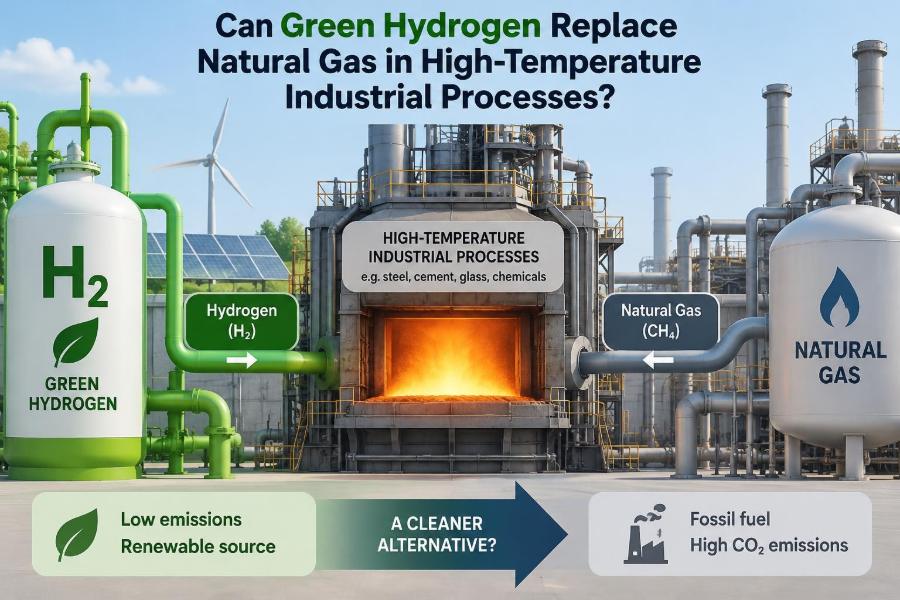

A steel plant, glass furnace, cement kiln, and chemical complex may look very different from the outside. Inside, however, many depend on the same thing: a controllable stream of high-temperature heat, delivered continuously and reliably through combustion of natural gas, coal, coke oven gas, or other fuels.
Replacing that fuel is not as simple as changing the pipe connection. The flame changes, the furnace atmosphere changes, the equipment materials may see different stresses, and the economics depend on electricity, water, storage, and local infrastructure.
Green hydrogen is often presented as a route to decarbonize industrial heat that is difficult to electrify. That possibility is real, especially for processes that need very high temperatures or a chemically reducing gas. But whether it can replace natural gas depends strongly on the process rather than on hydrogen alone.
For chemical engineers, the useful question is not “Can hydrogen burn?” It clearly can. The better question is: can a specific plant obtain the required heat, atmosphere, safety performance, product quality, and operating flexibility at an acceptable system cost?
🔥 Why high-temperature heat is a difficult decarbonization problem
Industrial heat spans a wide temperature range. Low-temperature duties such as washing, drying, and building heating can often use heat pumps, electric boilers, or waste heat. High-temperature processes are harder because they may require heat well above 800°C, fast heating rates, precise flame geometry, and operation around the clock.
Many furnaces also use fuel for more than heat. Combustion products influence radiation, gas chemistry, pressure, and the transfer of heat to the load. A fuel substitution can therefore alter the process itself.
🌿 What “green hydrogen” means
Hydrogen is not inherently green, gray, or blue; these labels describe how it is made. Green hydrogen generally refers to hydrogen produced by water electrolysis using low-carbon electricity, ideally electricity from renewable sources.
An electrolyzer splits water into hydrogen and oxygen. The hydrogen can then be compressed, stored, transported, and used in a burner, fuel cell, reactor, or direct-reduction unit. Its climate benefit depends on the electricity source and the wider supply chain, not just on the absence of carbon in the hydrogen molecule.
⚗️ The combustion chemistry changes fundamentally
Natural gas is mainly methane. When methane burns completely, it produces carbon dioxide and water. Hydrogen combustion produces water vapor, assuming no carbon-containing fuel is present.
This removes direct carbon dioxide emissions from the flame, but it does not make combustion chemistry irrelevant. Hydrogen flames can have different reaction speeds, temperature fields, and radiative behavior. In air-fired systems, the nitrogen in air can still form nitrogen oxides, commonly called NOx.
🌡️ Flame temperature is not the whole temperature story
Hydrogen has a high adiabatic flame temperature under suitable conditions, meaning the theoretical temperature reached if combustion occurs without heat loss. A furnace, however, does not operate under adiabatic conditions.
Useful furnace performance depends on heat transfer to the load, heat losses through walls and exhaust, flame placement, dilution, excess air, and control response. A hotter theoretical flame does not automatically mean a higher product temperature or lower fuel consumption.
📏 Comparing hydrogen and natural gas by volume and mass
Hydrogen has high energy per unit mass but low energy per unit volume at ordinary pressure. This distinction matters immediately for pipework, compressors, storage vessels, trucks, and burner capacity.
| Property | Hydrogen | Natural gas | Practical consequence |
|---|---|---|---|
| Carbon at point of use | None | Present as methane and other hydrocarbons | Hydrogen avoids direct combustion CO₂ |
| Energy per unit mass | High | High, but lower than hydrogen | Mass flow alone can be misleading |
| Energy per unit volume at low pressure | Low | Much higher | Hydrogen needs larger volumetric flow or compression |
| Combustion product | Mainly water vapor | Water vapor and CO₂ | Furnace atmosphere and heat transfer change |
For an existing furnace, the low volumetric heating value of hydrogen may require larger fuel lines, valves, meters, and burner passages. A “drop-in” conversion may be feasible for some blended-fuel cases, but full conversion deserves a complete hydraulic and combustion review.
🌈 Why flame radiation can decrease
Natural-gas flames often contain carbon dioxide and water vapor, both of which emit thermal radiation. Depending on burner design and operating conditions, hydrocarbon flames may also have luminous regions associated with soot precursors.
A hydrogen flame contains water vapor but no carbon dioxide from fuel combustion and is often less luminous. For furnaces where radiative heat transfer dominates, this can reduce heat transfer to the charge even if the flame is hot. The remedy may involve burner redesign, altered furnace geometry, oxygen enrichment, or changed operating conditions.
🏭 Which industries have the strongest case
Hydrogen is most compelling where it can provide both decarbonized energy and a valuable chemical function. Ironmaking is a major example: hydrogen can act as a reducing agent in direct reduction, producing water rather than carbon dioxide from the reduction reaction.
Other candidates include high-temperature glass melting, some ceramic and refractory operations, specialty metals heat treatment, and chemical furnaces. The opportunity varies widely because each process has its own furnace design, product sensitivity, and available alternatives.
🔩 Steelmaking: heat and chemical reduction are separate questions
In an electric arc furnace, electricity is already the primary energy source for melting scrap or direct-reduced iron. Hydrogen may still have a role in burners, ladle heating, or the upstream production of direct-reduced iron.
For direct reduction, hydrogen is especially interesting because it can remove oxygen from iron ore. Yet the reaction is endothermic under important conditions, so reactor temperature control and renewable power availability remain central design issues. Hydrogen does not eliminate the need for carefully managed heat.
🪟 Glass furnaces face product-quality constraints
Glass melting requires enormous, stable heat input and close control of furnace temperature. Switching fuel can affect flame luminosity, local heat flux, batch melting behavior, refractory wear, and emissions.
Water vapor in a hydrogen-fired atmosphere may also matter for glass quality or furnace chemistry, depending on the composition and process. A pilot campaign should examine more than fuel consumption: it should track temperature uniformity, defects, emissions, furnace pressure, and refractory condition.
🧱 Cement has a different carbon problem
Cement kilns need high temperatures, and hydrogen could replace some fossil fuel used to provide heat. However, a substantial share of cement-sector carbon dioxide comes from calcining limestone, where calcium carbonate decomposes into lime and carbon dioxide.
Hydrogen can reduce fuel-related emissions but cannot by itself remove process emissions from calcination. This is why cement decarbonization discussions also include clinker substitution, alternative binders, energy efficiency, and carbon capture.
🧪 Chemical furnaces may need hydrogen as feedstock
In chemical manufacturing, hydrogen can be more valuable as a reactant than as a fuel. Ammonia synthesis, methanol pathways, hydroprocessing, and many emerging e-fuel routes require hydrogen as chemical feedstock.
Burning scarce low-carbon hydrogen for heat may be less attractive when electricity, waste heat, or another fuel can serve the thermal duty. Allocation matters: the highest-value use is not always the highest-temperature use.
⚡ Direct electrification is the key competitor
Resistance heating, induction, plasma, electric arc systems, and electric furnaces can convert electricity to heat at the point of use. Avoiding the intermediate steps of electrolysis, compression, storage, and combustion can reduce total energy demand.
That does not mean direct electrification fits every plant. Retrofitting a large continuous furnace may require grid upgrades, new power electronics, different refractory design, and production interruptions. Still, it should be evaluated before assuming hydrogen is the default clean-heat solution.
🔌 A useful efficiency chain
Every conversion step loses energy. To make green hydrogen, electricity runs an electrolyzer; then hydrogen may be dried, compressed, stored, transported, and finally burned. The resulting useful heat is lower than the original electrical input.
This is not an argument against hydrogen. It is an argument for matching energy carriers to the job. Hydrogen may justify its conversion losses when direct electricity is impractical, when long-duration storage is needed, or when hydrogen provides a necessary chemical service.
💨 Oxygen versus air firing
Most conventional burners use air, carrying nitrogen into the furnace. Nitrogen absorbs heat and exits in the flue gas, increasing exhaust volume. It also creates conditions under which thermal NOx can form at high flame temperatures.
Oxy-fuel combustion uses oxygen instead of air. With hydrogen, this creates a water-rich exhaust stream that may simplify water recovery or carbon capture elsewhere in an integrated system, but oxygen production, burner design, refractory loading, and temperature control become major considerations.
🌬️ NOx remains an emissions challenge
Hydrogen contains no fuel-bound nitrogen and produces no carbon dioxide when burned. But air contains nitrogen, and high-temperature flames can convert some of it into NOx.
Control methods include staged combustion, flue-gas recirculation, dilution, low-NOx burner geometry, lower local oxygen concentration, and careful management of peak flame temperature. A hydrogen conversion should never assume that zero-carbon fuel automatically means low local air-pollutant emissions.
💧 Water vapor changes the furnace atmosphere
Water is not chemically inert in every process. A higher water-vapor partial pressure can affect oxidation, reduction, dew point, corrosion, and reactions at material surfaces.
For instance, heat treatment of metals often relies on deliberately controlled atmospheres to limit scale formation or achieve a desired surface condition. The suitability of hydrogen firing therefore depends on where combustion gases contact the product and whether indirect heating can isolate the load.
🧯 Hydrogen safety requires process-specific design
Hydrogen is colorless, odorless, and has a wide flammability range in air. Its small molecule can escape through leakage paths that may be insignificant for natural gas, and its flame can be difficult to see in daylight.
Good safety practice is not a generic checklist. It includes hazardous-area classification, ventilation, leak detection, purge procedures, ignition-source control, emergency isolation, material compatibility, training, and maintenance planning. Existing natural-gas safeguards provide a foundation but may not be sufficient without modification.
🔧 Materials, seals, and embrittlement
Some metals can lose ductility or crack more readily when exposed to hydrogen under particular combinations of material, pressure, temperature, stress, and environment. This phenomenon is broadly called hydrogen embrittlement, but its severity is highly context-dependent.
Engineers should assess pipelines, valves, welds, fittings, compressors, storage vessels, and burner components rather than treating “hydrogen-compatible” as a universal label. Polymers and elastomer seals also need review for permeability, swelling, and aging behavior.
🛢️ Storage is often the real bottleneck
A furnace may consume fuel continuously, while renewable electricity output varies by hour and season. If hydrogen production follows variable generation, storage must bridge the mismatch between production and demand.
Small buffers can smooth short disturbances. Large storage for multi-day or seasonal reliability is a much bigger infrastructure problem, potentially involving compressed gas, liquid hydrogen, underground caverns, or converted carriers. The appropriate option depends on scale, geology, location, and supply strategy.
🚚 Transport and site location shape feasibility
Hydrogen can be produced on site, delivered by pipeline, trucked in compressed form, or supplied through another carrier that is later converted. Each route introduces different energy use, capital equipment, operating complexity, and reliability risks.
A coastal chemical complex with access to power, water treatment, and shared infrastructure faces a different decision from an inland ceramics plant. Local constraints frequently determine whether hydrogen is a near-term option or a future possibility.
💧 Water demand should be assessed honestly
Electrolysis consumes purified water, and large projects may require water treatment systems as well as electricity. The water requirement is usually manageable in regions with adequate supply, but it can become significant in water-stressed areas or where desalination is required.
The engineering question is broader than the electrolyzer feed. Consider cooling, purification losses, wastewater handling, competing local demand, and the environmental impact of the chosen water source.
📉 The carbon result depends on electricity
Hydrogen made with electricity from a carbon-intensive grid can carry substantial upstream emissions. Conversely, hydrogen associated with low-carbon power can sharply reduce the combustion-related carbon footprint of a furnace.
Accounting boundaries matter. A credible evaluation considers electricity procurement, electrolyzer operation, compression, transport, methane leakage avoided or displaced, and any backup fuel used during supply interruptions. Labels alone are not a life-cycle assessment.
💰 Economics are a system calculation
Comparing only the purchase price of natural gas and hydrogen is inadequate. The full comparison includes burner conversion, piping, compression, storage, power connection, electrolyzers, oxygen handling where relevant, maintenance, downtime, emissions controls, and the value of avoided emissions.
Operating hours matter greatly. Equipment with low utilization spreads capital cost over fewer units of useful heat. A plant able to adjust production around low-cost electricity may have a different business case from a continuous process that requires firm fuel supply every hour.
🧭 Retrofitting is rarely a single-equipment project
A practical conversion begins with the furnace but extends beyond it. Fuel trains, control valves, flow meters, flame scanners, ignition systems, safety instrumented functions, exhaust treatment, and operator procedures may all need reassessment.
Control logic deserves special attention because hydrogen’s combustion behavior can alter light-off, flame stability, turndown ratio, and response to load changes. A successful retrofit treats these systems as an integrated combustion package.
🧫 Start with blends, but do not overgeneralize
Blending hydrogen into natural gas can provide operational experience and may reduce some direct combustion emissions. It can also reveal meter, burner, and control issues before a full conversion.
However, a blend is not simply a smaller version of pure-hydrogen operation. Combustion behavior, volumetric flow, materials exposure, and emissions can change nonlinearly with composition and equipment design. Results from one burner cannot be assumed for another.
🧰 A disciplined feasibility workflow
Before committing capital, a plant should define the actual thermal and chemical duty. “Replace natural gas” is too broad; the project team needs temperatures, heat fluxes, furnace atmosphere, annual load profile, allowable outages, emissions limits, and product-quality requirements.
- Map fuel use by furnace, temperature level, operating mode, and process role.
- Screen direct electrification, hydrogen, biomass-derived fuels, waste heat, and process redesign options.
- Model combustion, heat transfer, furnace atmosphere, and emissions for the leading options.
- Audit equipment compatibility, utility capacity, safety systems, and storage requirements.
- Run pilots or staged demonstrations with defined quality and reliability criteria.
- Compare life-cycle emissions, capital requirements, operating cost ranges, and supply risks.
📊 What a pilot should measure
A pilot is most useful when it tests the limiting uncertainties rather than merely proving that a flame exists. The measurement plan should connect combustion changes to production outcomes.
- Fuel composition, flow, pressure, and burner stability
- Furnace temperature distribution and heat-up rate
- NOx, oxygen, moisture, and flue-gas conditions
- Product defects, yield, surface condition, or composition
- Refractory temperatures and signs of accelerated wear
- Leak detection performance, purge behavior, and operator workload
🚫 Common mistakes in hydrogen-for-heat proposals
One common mistake is treating combustion CO₂ as the entire carbon inventory. Another is assuming a burner conversion will preserve heat transfer and product quality without testing.
Projects also fail when they neglect hydrogen supply reliability. A furnace that requires continuous fuel cannot rely on an intermittent source without storage, backup, flexible production, or another firm supply arrangement.
- Using mass-based energy intuition while undersizing gas-flow equipment
- Ignoring NOx because hydrogen has no carbon
- Assessing only fuel price while omitting infrastructure and downtime
- Assuming every natural-gas material or seal is automatically suitable
- Burning hydrogen where direct electricity can perform the duty more efficiently
🔄 Hybrid systems may be more realistic than one-fuel systems
Many plants will not switch in a single step. A hybrid strategy may combine electric heating for controllable duties, hydrogen for high-temperature peaks or reducing atmospheres, and a limited backup fuel for resilience during transition.
Hybrid design can lower early capital risk and create operating flexibility. It also increases controls and planning complexity, so the benefits depend on the plant’s ability to manage multiple energy streams safely and economically.
🗺️ Where hydrogen is most likely to arrive first
Early industrial applications are likely to cluster where low-carbon electricity, hydrogen infrastructure, industrial demand, and supportive investment conditions overlap. Facilities that already consume hydrogen as feedstock or have access to shared pipelines and storage may have an advantage.
The first projects may not represent every industrial furnace. Demonstrations in one region or sector should inform future design, but engineers must still assess local power, water, equipment, and regulatory conditions.
🎯 The central decision principle
Green hydrogen can replace natural gas technically in many high-temperature applications, but technical possibility is not the same as universal suitability. Its strongest role is likely where very high-temperature combustion is genuinely needed, direct electrification is difficult, and hydrogen offers a chemical or storage advantage.
For other duties, electricity used directly may provide more useful heat per unit of low-carbon power. The best decarbonization pathway is therefore process-specific: reduce heat demand first, recover waste heat where possible, electrify suitable loads, and reserve hydrogen for roles where its properties solve a real engineering constraint.
Green hydrogen is best viewed not as a one-for-one natural-gas replacement, but as one carefully chosen tool in an industrial heat-transition portfolio. The winning design will be the one that protects product quality and safety while reducing emissions across the full energy system. 🧪🔥🌿