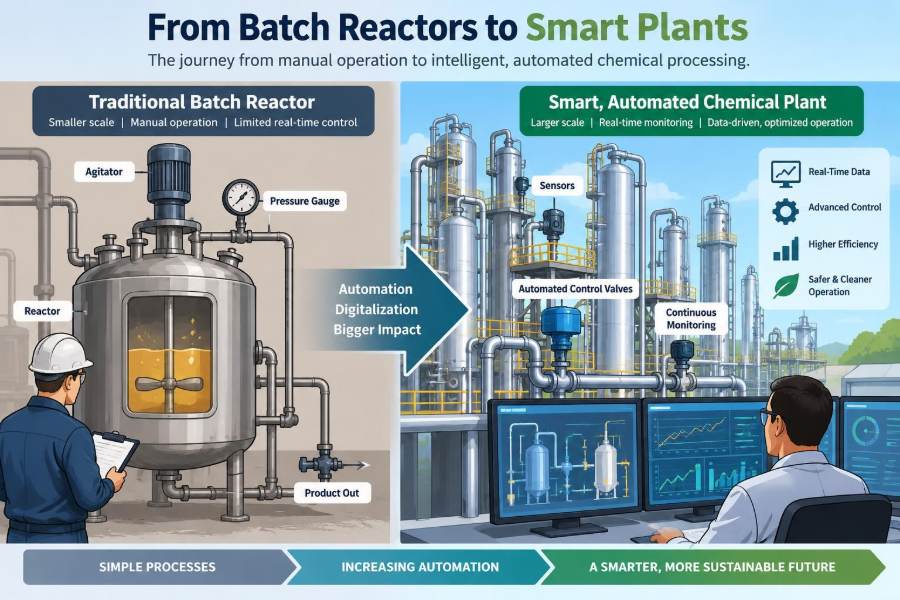

A batch of specialty resin reaches its target viscosity just before the afternoon shift change. Decades ago, an operator might have judged the endpoint by watching a chart recorder, taking a sample to the lab, and making a decision from experience. Today, that same decision may be supported by online measurements, a control algorithm, electronic batch records, and alarms that explain which variable is drifting.
That change is not simply about replacing people with computers. Chemical plants handle heat release, pressure, corrosive materials, changing feed quality, and products whose properties depend on a precise sequence of events. Automation developed because these processes demand attention that is fast, repeatable, and continuous.
Yet a smart plant is not a plant that runs without human judgment. It is a plant where measurements, control systems, procedures, and people are connected well enough to make operations safer, steadier, and easier to improve.
Understanding how processing moved from manual batch work to modern automation helps engineers make better choices about design, troubleshooting, data, and risk. The story also explains why a simple-looking control room can represent decades of chemical engineering progress.
⚗️ The Starting Point: Batch Processing
In a batch process, a defined quantity of materials is charged to equipment, processed through a sequence of steps, then discharged. Mixing, heating, reaction, separation, and cleaning may all happen in stages.
Batch operation suits products made in smaller volumes, products with frequent recipe changes, and processes that need flexible scheduling. Pharmaceuticals, specialty chemicals, coatings, and food ingredients commonly use batch or semi-batch methods.
Early batch processing relied heavily on written instructions and operator observation. The approach offered flexibility, but results could vary when timing, charging order, mixing, or temperature control depended mainly on individual practice.
🔄 Why Continuous Plants Changed the Scale
A continuous process receives feeds and produces material continuously after startup. Petroleum refining, bulk polymers, air separation, and many commodity chemical operations use this approach because production rates are high and products are comparatively standardized.
Instead of repeatedly filling and emptying a vessel, continuous plants must maintain a stable operating state. A small disturbance in feed flow, temperature, or pressure can propagate downstream, making ongoing measurement and control essential.
Continuous operation did not eliminate operators. It shifted their work from carrying out individual steps to supervising interconnected equipment, responding to disturbances, and managing starts, stops, and abnormal conditions.
📏 The Need for Repeatability
Chemical products are often sensitive to conditions that appear minor on paper. A few degrees of temperature difference can affect reaction rate, molecular weight distribution, crystal form, color, impurity formation, or viscosity.
Automation makes repeatability practical by executing a defined recipe or holding a defined operating target. It also records what happened, allowing engineers to distinguish a true process change from normal variation or inconsistent operation.
Repeatability does not mean every run is identical. Raw materials and equipment behavior vary. The objective is to recognize variation early and keep it within conditions that protect quality, safety, and throughput.
🌡️ Measuring the Process Before Controlling It
Automation begins with instruments. A temperature controller cannot regulate a reactor unless a sensor provides a trustworthy temperature signal; a flow controller needs a measurement of flow, not an assumption based on pump speed.
Common measured variables include temperature, pressure, level, flow, pH, conductivity, composition, vibration, and valve position. These are called process variables, and each measurement has limitations related to location, calibration, response time, and maintenance.
A probe mounted near a reactor jacket may not represent the temperature in a poorly mixed vessel. Good automation therefore starts with process understanding and instrument placement, not with software selection.
🧭 From Local Gauges to Centralized Visibility
Older plants often used local pressure gauges, sight glasses, hand valves, and pneumatic controllers located beside equipment. Operators walked regular rounds to observe conditions and manually adjust them.
Central control rooms brought signals together on panels, then on computer screens. This gave operators a broader view of upstream and downstream effects: a falling feed-tank level, for example, could be connected to a flow disturbance at a reactor.
Centralization improves coordination, but it can also distance people from the physical plant. Effective sites retain field verification, clear equipment labeling, and training that connects a screen symbol to real piping, valves, and hazards.
🎛️ Feedback Control: The Essential Loop
The basic automation structure is a feedback control loop. A sensor measures the process variable, a controller compares it with a desired value called the setpoint, and a final control element—often a valve—adjusts the process.
Consider steam heating a reactor. If measured temperature falls below setpoint, the controller may open the steam valve. As the reactor warms, the controller reduces steam flow to avoid excessive temperature.
This sounds simple, but chemical processes introduce delay, heat transfer limits, nonlinear behavior, and disturbances. A controller tuned too aggressively can cause cycling; one tuned too slowly can allow unacceptable deviations.
🧮 PID Control and Its Practical Limits
Many industrial loops use proportional-integral-derivative, or PID, control. The proportional action responds to present error, integral action corrects persistent offset, and derivative action can respond to how quickly the measurement is changing.
PID is widely useful because it is understandable and adaptable, not because it is magic. A badly located sensor, a sticking valve, or an inappropriate process design cannot be repaired by changing tuning constants.
For slow level loops, the goal may be smooth inventory control rather than rapid correction. For a highly exothermic reactor, fast and carefully validated temperature control may be needed, alongside independent protective systems.
🚰 Valves, Pumps, and the Reality of Final Control
Control decisions only affect the plant through physical equipment. Control valves, variable-speed drives, dampers, pumps, and electrical heaters are called final control elements.
A valve may have friction, dead band, leakage, limited range, or an incorrect size. If a valve spends most of its time nearly closed, it may provide poor resolution; if it is too small, the process cannot reach required flow during disturbances.
Automation projects sometimes focus on displays and logic while overlooking valve performance. In practice, reliable control often depends as much on maintenance of the actuator and positioner as on the controller configuration.
🧱 Distributed Control Systems Take Hold
A distributed control system, commonly called a DCS, organizes many control loops, alarms, displays, and historical records across a plant. It replaced much of the wiring-heavy, single-location control architecture of earlier generations.
“Distributed” means control functions can be placed across multiple controllers while operators use integrated interfaces. This structure supports large plants where reactors, distillation columns, utilities, storage, and treatment systems must work together.
DCS platforms made it easier to standardize displays, share signals, and coordinate plant-wide control. They also introduced a need for disciplined configuration management: a small logic change can have broad operational consequences.
🧩 PLCs and Discrete Operations
Programmable logic controllers, or PLCs, are especially common where equipment must follow discrete actions: start a pump, verify flow, open a valve, wait for level, then proceed to the next step.
PLCs are widely used for packaging, utilities, machine sequencing, burner management, and many skid-mounted systems. A modern facility may use both PLCs and a DCS, with responsibilities divided according to process needs.
The distinction is not absolute. What matters is whether the selected system can provide reliable control, clear operator interaction, secure communication, maintainable logic, and appropriate safety functions.
📜 Recipes Turn Practice into Executable Procedure
Batch automation converts a procedure into an executable sequence. A recipe may specify material quantities, charging order, agitation speed, temperature ramps, hold times, sampling prompts, and discharge conditions.
For example, a semi-batch polymerization might charge solvent, begin agitation, add monomer gradually while controlling heat removal, hold at temperature, then cool before transfer. The automation system can enforce order and record actual conditions.
Recipes should not become opaque computer scripts that operators cannot interpret. The best designs show the current phase, the next expected action, held conditions, permissives, and the reason a sequence cannot advance.
✅ Interlocks and Permissives Prevent Wrong Moves
A permissive is a required condition before an action can occur. A pump might require adequate suction level, an open discharge path, and a confirmed seal system before it can start.
An interlock takes or blocks an action when a hazardous or damaging condition exists. For instance, it may stop a feed pump if reactor pressure exceeds a defined limit.
These functions prevent predictable mistakes, but their design needs care. Too few safeguards leave operations exposed; too many poorly chosen interlocks encourage bypassing, confusion, or repeated nuisance trips.
🛡️ Control Is Not the Same as Safety Protection
A normal control loop attempts to keep a process near target. A safety function acts when control has failed, when conditions become dangerous, or when the process enters a scenario beyond normal operating control.
Examples can include pressure relief devices, emergency shutdown actions, independent high-high level trips, and systems designed to bring equipment to a safer state. Their required independence and reliability depend on hazard analysis and applicable engineering practice.
Never treat a routine control loop as the only protection against a serious hazard. Chemical engineers must identify credible failures, understand consequences, and ensure that layers of protection are designed, tested, and maintained appropriately.
🚨 Alarm Management: Attention Is a Limited Resource
An alarm should signal a condition that requires timely operator response. If a screen floods with alarms during an upset, the most urgent problem can be hidden by lower-value messages.
Good alarm management defines priorities, response expectations, and rational reasons for each alarm. It also investigates recurring nuisance alarms rather than asking operators to tolerate them.
Alarm shelving or suppression may be legitimate during maintenance or known operating states, but it must be controlled. Silencing an alarm without correcting its cause is not risk reduction.
📊 Historians Turn Signals into Operational Memory
A process historian stores time-stamped operating data. Instead of relying on memory after a batch deviation, an engineer can examine temperature, flow, pressure, valve position, and sequence events over the relevant period.
Trends are powerful because chemical behavior unfolds over time. A rising column pressure may follow a gradual loss of condenser performance; an unstable pH loop may coincide with a change in reagent concentration or mixing behavior.
Data is only useful if its context is retained. Sensor status, operating mode, maintenance events, laboratory results, and batch phase can be as informative as the raw value itself.
🔬 Online Analyzers Bring Quality Closer to Real Time
Many critical quality attributes are traditionally measured in a laboratory after sampling. Online analyzers can measure properties such as composition, moisture, oxygen, pH, conductivity, or spectra closer to the process and more frequently.
This supports faster adjustment, but analyzer data needs validation. Sampling systems can plug, instruments drift, and an analyzer may measure a property indirectly through a calibrated model.
The practical question is not whether an analyzer is sophisticated. It is whether its measurement is reliable enough, fast enough, and relevant enough to improve a decision compared with laboratory testing or a simpler proxy variable.
🧪 Process Analytical Technology in Batch Manufacturing
Process analytical technology, often abbreviated PAT, refers to using timely measurements and process understanding to manage quality during manufacturing. It is especially relevant when a final test alone cannot fully explain whether a product was made under suitable conditions.
In a crystallization, for example, monitoring supersaturation or particle characteristics can help guide cooling and seeding. In a blending operation, spectral measurements may help assess uniformity before discharge.
PAT does not remove the need for sound development work. A measurement must be connected to a meaningful quality attribute and a defensible control strategy, rather than treated as a dashboard feature.
🧠 Advanced Process Control Handles Interactions
Basic loops usually regulate one variable at a time. But a distillation column may have interacting temperatures, pressures, reflux flows, steam inputs, and product specifications. Changing one control action can influence several outcomes.
Advanced process control, or APC, uses models and optimization methods to coordinate such interactions. Model predictive control is a common approach: it predicts likely future behavior and selects moves while respecting operating constraints.
APC can improve stability and efficiency when the process model, measurements, and maintenance support it. It can disappoint when deployed onto poorly controlled equipment or when feed conditions lie outside the range represented by its model.
🔮 Digital Twins Are Models, Not Crystal Balls
A digital twin is a digital representation of an asset or process that may combine engineering models, current data, and operating history. It can support training, what-if analysis, equipment monitoring, or planning.
A reactor model might estimate heat-release behavior under different feed rates, while a pump model might compare expected and observed performance. These are useful ways to ask structured questions before making changes in the plant.
Its limits matter. A model is only as credible as its assumptions, input data, and validation. A digital twin should inform engineering judgment, not create false confidence about rare failures or unmeasured conditions.
🤖 Where Artificial Intelligence Can Help
Machine-learning methods can identify patterns in large operational datasets, estimate soft sensors for hard-to-measure variables, or flag behavior that differs from prior operation. A soft sensor estimates a variable from related measurements rather than directly measuring it.
Potential applications include predicting fouling, classifying batch trajectories, and prioritizing maintenance investigation. They are generally strongest when the task has clear data, a stable purpose, and human review of outputs.
AI cannot substitute for mass balances, thermodynamics, hazard evaluation, or good instrumentation. If historic data includes flawed operation, a model may learn misleading relationships; if conditions change, its predictions may no longer apply.
🧹 Automation Extends to Cleaning and Changeover
Cleaning-in-place systems automate circulation, rinsing, heating, chemical concentration, and sometimes verification steps for equipment that cannot be easily dismantled. This can improve consistency and reduce manual exposure to cleaning chemicals.
In multiproduct facilities, changeover is often a major source of lost time and contamination risk. Automated recipes can make cleaning sequences repeatable, but they must still reflect equipment geometry, residues, utilities, and validation requirements.
Engineers should avoid assuming that a completed automated sequence proves a surface is clean. The sequence shows that instructions ran; verification must be based on the process and quality strategy.
⚡ Energy Management Becomes a Control Problem
Automation can reduce avoidable energy use by coordinating boilers, compressors, heat exchangers, chilled water systems, and heat recovery networks. It can also prevent unnecessary simultaneous heating and cooling.
For a batch plant, scheduling may matter as much as an individual loop. Starting several high-demand heating operations at once can strain utility systems, while coordinated timing can smooth demand and protect capacity.
Energy optimization must respect safety and product requirements. Pushing temperature approaches too close in a heat exchanger, for instance, may increase fouling risk or reduce the flexibility needed during a disturbance.
🌿 Environmental Monitoring and Waste Reduction
Automated measurement helps facilities monitor emissions-control equipment, wastewater treatment, tank inventories, and resource consumption. Better visibility can reveal losses such as leaking valves, excessive purge rates, off-spec batches, or inefficient wash cycles.
Waste prevention is often more effective than treating waste after it is generated. Stable reaction control can reduce by-products, and accurate dosing can reduce excess reagent use, provided the underlying chemistry permits it.
Environmental performance still requires sampling plans, maintenance, and engineering review. A sensor that is out of service or poorly calibrated cannot provide meaningful assurance.
🧑🏭 The Operator’s Role Has Evolved
Automation changes operator work from repeated manual adjustment toward supervision, verification, diagnosis, field response, and decision-making during nonroutine events. This can reduce routine burden, but it raises the need for deeper system understanding.
An operator may need to recognize when an automatic sequence is behaving abnormally, whether an instrument is believable, and when to transition safely between manual and automatic control. These are skilled tasks, not passive monitoring.
Good automation is built with operator input. People who run the process can identify confusing displays, unrealistic timing, missing field conditions, and recovery steps that engineers may overlook during design.
🎓 Training Must Cover Automation Failure Modes
Training should teach normal operation and what happens when normal automation is unavailable. Teams need practice with failed instruments, stuck valves, communication loss, utility interruptions, manual operation, and controlled shutdown.
Simulators are valuable where available because they allow realistic consequence-free practice. Even without a simulator, procedure walk-throughs and scenario discussions can reveal whether instructions give people enough information to act safely.
Overreliance is a real risk. If personnel only observe stable automated operation, they may lose familiarity with process cues needed when a system fails or an unusual condition develops.
🔐 Connectivity Creates Cybersecurity Responsibilities
Connecting operational technology to business networks, remote support tools, and data platforms can improve visibility and troubleshooting. It also creates paths that must be managed against unauthorized access and accidental disruption.
Industrial cybersecurity includes network segmentation, access control, patch planning, backup and recovery, vendor management, and clear response procedures. The goal is not merely confidentiality; it is the reliable and safe operation of physical processes.
Security changes should be evaluated like other plant changes. A rushed update, an unmanaged remote account, or an undocumented network connection can affect availability and, in some cases, safety-related operations.
🛠️ Maintaining Automation Is Plant Maintenance
Transmitters need calibration checks, impulse lines need inspection, analyzers need service, valves need stroking, and control-system backups need verification. Automation reliability is inseparable from mechanical and instrument maintenance.
Maintenance data can help prioritize work, but a prediction is not a maintenance plan by itself. A vibration trend may indicate a developing pump issue, yet engineers still need to assess process criticality, operating window, and failure consequences.
Configuration backups and tested restoration procedures deserve special attention. A controller replacement is far less stressful when current logic, setpoints, graphics, and documentation can be recovered accurately.
📐 Design Automation Around the Process, Not the Screen
A common project mistake is to start with a preferred software platform or impressive dashboard. A stronger approach begins with process objectives, material and energy balances, operating envelopes, hazards, control narratives, and the decisions each measurement must support.
Before automating a step, ask what can go wrong, what confirms success, what action follows a deviation, and whether the equipment can physically perform the requested action. This exposes missing sensors, weak procedures, and unrealistic assumptions early.
- Define normal, startup, shutdown, and upset operating states.
- Specify ownership for alarms, recipes, setpoints, and software changes.
- Design displays around decisions and process flow, not decorative graphics.
- Test logic against credible abnormal scenarios before commissioning.
🧾 Change Management Protects Process Knowledge
Control changes can alter product quality, equipment stress, energy use, and safety behavior. Even a setpoint adjustment may have broader effects if it changes pressure, residence time, or downstream separation performance.
Formal management of change helps ensure that modifications are reviewed, documented, tested, and communicated. It also preserves the reasoning behind design choices, which is invaluable when staff change or equipment is upgraded years later.
Fast troubleshooting does not require undocumented changes. It requires clear authority, good diagnostics, and a practical route for temporary actions to be reviewed and either formalized or removed.
🏭 A Realistic Path Toward the Smart Plant
Most facilities do not transform overnight. A sensible path may start by fixing unreliable instruments, standardizing basic controls, improving historian use, and rationalizing alarms before adding advanced analytics or optimization.
A hypothetical specialty-chemical site might first automate charging verification, then improve reactor temperature control, then connect batch records with laboratory results. Each step supplies cleaner data and a more stable foundation for the next.
The smart plant is therefore less a single technology than a mature operating system: dependable measurements, well-designed control, usable information, competent people, and disciplined improvement.
🌟 The Core Principle: Better Decisions at the Right Time
The evolution from batch reactors to smart plants reflects a continuing effort to make chemical processing more observable, controllable, and resilient. Manual expertise remains valuable, but it is reinforced by instruments that see continuously and systems that execute repeatable actions.
The best results come from balancing automation with engineering judgment. Use simple control where it is sufficient, apply advanced tools where they solve a defined problem, and preserve independent protection for hazards that must not rely on ordinary operation.
For students and professionals alike, the key lesson is that automation is not separate from chemical engineering. It is one of the ways chemical engineering knowledge is translated into safer, more consistent, and more efficient physical reality.
Smart chemical plants succeed when reliable technology strengthens—rather than replaces—clear process understanding and responsible human decisions. 🧪⚙️🌿