
A catalytic converter beneath a car, enzymes in a washing detergent, and the catalyst bed in a chemical plant may look unrelated. Yet each exists for the same reason: many useful chemical reactions are far too slow under ordinary conditions.
Industry often needs to make fuels, fertilizers, polymers, medicines, and clean-water chemicals at practical rates. Living cells face a similar challenge, carrying out complex reactions quickly enough to sustain life at temperatures that would not damage delicate biological molecules.
The obvious question is why a catalyst can repeatedly accelerate a reaction without becoming part of the final products. It seems, at first, as though anything that participates in a reaction should be used up.
The answer lies in reaction pathways. A catalyst does participate—but it does so in a cycle that is regenerated before the cycle ends.
⚗️ A catalyst changes the route, not the destination
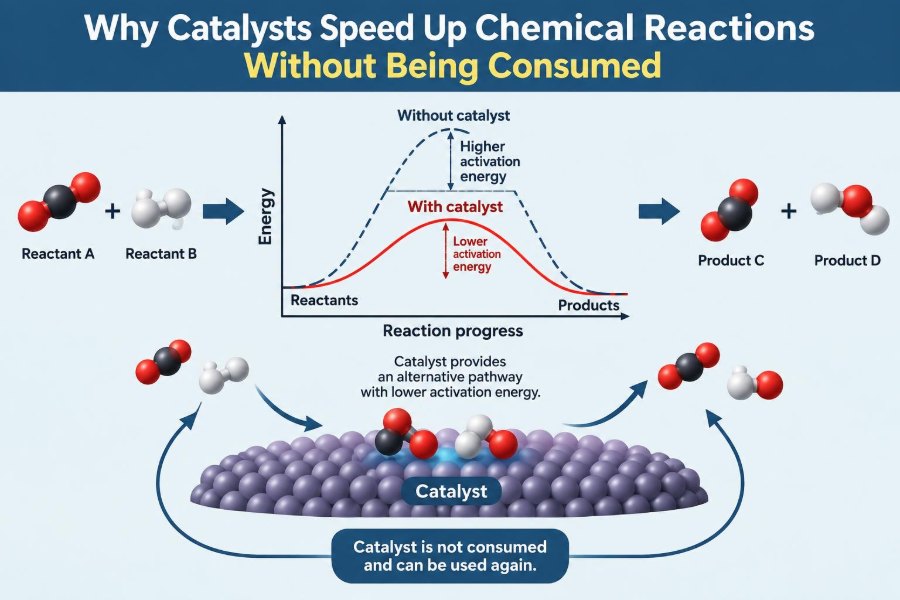
A catalyst is a substance that increases the rate at which a reaction approaches its equilibrium state without being consumed overall. It provides an alternative sequence of elementary chemical steps.
Reactants and products still have the same starting and ending energy. What changes is the route between them: the catalyzed route has a lower energy barrier at one or more crucial points.
🚧 Reactions must cross an energy barrier
For molecules to react, specific bonds must stretch, bend, break, or form. Even reactions that release energy overall can require an initial input of energy to reach a reactive arrangement called the transition state.
This required input is the activation energy. At a given temperature, only a fraction of molecular encounters have enough energy and the right orientation to cross that barrier.
🏔️ Activation energy is the kinetic obstacle
Activation energy governs reaction speed, or kinetics. A high barrier means relatively few successful molecular events per unit time; a lower barrier permits successful events much more frequently.
A catalyst does not supply free energy indefinitely or violate thermodynamics. It makes a chemically plausible, lower-barrier route available. Think of a mountain pass: the two valleys have not moved, but travel between them becomes easier.
⚖️ Catalysts do not shift equilibrium by themselves
A common misconception is that a catalyst makes a reaction “go further.” In a closed system at fixed conditions, it does not change the equilibrium constant, equilibrium composition, or the reaction’s overall Gibbs free-energy change.
It accelerates both the forward and reverse reactions by offering lower-barrier pathways in both directions. The system therefore reaches equilibrium sooner, rather than reaching a different equilibrium.
📈 Rate and yield are different engineering questions
Reaction rate asks how rapidly material is converted. Equilibrium yield asks what composition is favored after sufficient time. Selectivity asks which products form when several reactions compete.
Catalysts strongly affect rate and often affect selectivity, because different pathways can lead to different products. But a catalyst cannot make an equilibrium-limited conversion exceed the thermodynamic limit without changing conditions or continuously removing a product.
🔁 The catalytic cycle explains “not consumed”
Most catalysis is best understood as a repeating sequence called a catalytic cycle. The catalyst enters an early step, forms one or more temporary intermediates, transfers atoms or electrons, and is regenerated in a later step.
If all elementary steps are added together, the catalyst appears on both sides of the summed equation and cancels out. It is changed temporarily, but it is not changed overall.
🧩 A simple abstract catalytic cycle
Suppose reactant A must become product P, but the direct transformation is slow. A catalyst C may first form an intermediate CA, which then becomes CP, followed by release of P and regeneration of C.
C + A ⇌ CA
CA → CP
CP → C + P
The individual species CA and CP can be real surface complexes, dissolved molecular complexes, or enzyme-bound intermediates. Their concentrations may be small, but their formation can make the route much faster than direct conversion of A to P.
🤝 Catalysts create productive molecular encounters
Many collisions between molecules do not lead to reaction. Molecules may strike with insufficient energy, at the wrong angle, or with their reactive parts inaccessible.
A catalyst can bind reactants close together, align them, polarize bonds, or transfer a proton or electron at the right moment. This increases the probability that an encounter follows a productive path rather than simply separating again.
🧲 Adsorption starts many heterogeneous reactions
In heterogeneous catalysis, the catalyst and reacting chemicals are in different phases. A common industrial example is a solid catalyst contacted by gases or liquids.
Reactant molecules often attach to active sites on the solid surface through adsorption. Adsorption can weaken selected bonds and concentrate reactants at the place where reaction can occur.
🧱 Active sites are not the whole surface
An active site is a location on a catalyst where a particular reaction sequence can occur efficiently. It may be a metal atom, a defect, an edge, an acid site in a porous solid, or a combination of nearby atoms.
Surface area matters because it can provide more accessible sites, but surface area alone does not guarantee good catalytic performance. The chemical identity, geometry, and accessibility of those sites are decisive.
🪄 The adsorption–reaction–desorption sequence
A simplified surface mechanism often has three stages: reactants adsorb, they react while bound, and products desorb. Product release is essential because a site that remains blocked cannot begin another cycle.
- Reactant molecules reach and attach to an available active site.
- The catalyst stabilizes intermediates or enables bond rearrangement.
- Product molecules detach, leaving the site ready for reuse.
Real mechanisms can include several adsorbed species and many intermediate steps, but this pattern captures why a solid catalyst can process a continuous stream of reactants.
🌡️ The Sabatier principle: neither too weak nor too strong
Useful adsorption requires balance. If reactants bind too weakly, the catalyst cannot sufficiently activate them. If intermediates or products bind too strongly, they occupy the sites and are difficult to remove.
This qualitative design idea is often called the Sabatier principle. The best catalyst for a given reaction tends to bind key species strongly enough to facilitate transformation, but not so strongly that the catalytic cycle stalls.
💧 Homogeneous catalysts work in one phase
In homogeneous catalysis, catalyst and reactants share the same phase, often a liquid solution. Dissolved acids, bases, metal complexes, and organocatalysts can all act this way.
Because the molecules are mixed at the molecular scale, homogeneous catalysts can be highly selective and easier to study mechanistically. Their practical drawback is separation: recovering a dissolved catalyst from a product stream can be difficult.
🧬 Enzymes are highly selective biological catalysts
Enzymes are usually proteins that catalyze reactions in living systems. Their folded structures create active sites with carefully positioned chemical groups, allowing impressive selectivity for certain substrates and products.
An enzyme is not simply a rigid lock for a molecular key. Binding can alter the enzyme and substrate shapes, exclude water, position reactive groups, and stabilize the transition state. After product release, the enzyme returns to a catalytically competent form.
🍲 Everyday enzymes make the concept tangible
Lactase helps break down lactose in lactose-free dairy processing. Amylases help cleave starches, while proteases are used in applications such as detergents and food processing.
These examples also show a limitation: enzymes work best within particular ranges of temperature, pH, and chemical environment. Conditions that unfold the protein or alter its active site can sharply reduce activity.
🔩 Metals excel at electron and bond activation
Metal catalysts are especially useful when reactions involve hydrogen, oxygen, carbon monoxide, or electron transfer. Their electronic structures can interact with adsorbed molecules in ways that weaken bonds and stabilize reactive intermediates.
Hydrogenation illustrates the principle. On a suitable metal surface, hydrogen molecules can split into surface-bound atoms; an unsaturated organic molecule can also adsorb, allowing hydrogen atoms to add across a multiple bond through a lower-barrier sequence.
🧪 Acids and bases can catalyze proton transfers
Acid-base catalysis is common in laboratory and process chemistry. An acid can donate a proton to make a functional group more reactive, while a base can remove a proton to create a more reactive species.
Crucially, a catalyst is regenerated. In a simplified acid-catalyzed sequence, the acid protonates a reactant early and receives a proton back later. The acid changes form transiently but is restored at the end.
🔌 Redox catalysts shuttle electrons
Some reactions are slow because electrons must move between reactants in an unfavorable or poorly organized way. A redox catalyst can cycle between oxidation states, accepting electrons in one step and donating them in another.
The catalyst may therefore appear chemically different midway through the cycle. That temporary change is not consumption; the subsequent step restores its original oxidation state and closes the loop.
🏭 The Haber–Bosch example shows catalytic leverage
Ammonia synthesis combines nitrogen and hydrogen. Nitrogen is abundant, but its nitrogen–nitrogen triple bond is exceptionally strong, making direct reaction kinetically difficult under mild conditions.
Industrial iron-based catalysts provide surfaces that help activate nitrogen and support the sequence of hydrogenation steps. The catalyst does not eliminate the need for demanding operating conditions, recycle loops, or heat management, but it makes the process practical at industrial scale.
🚗 Catalytic converters treat exhaust gases
Automotive catalytic converters contain catalyst-coated structures with high surface area. They promote reactions that convert harmful exhaust components, such as carbon monoxide and unburned hydrocarbons, into less harmful products, while also helping manage nitrogen oxides under appropriate exhaust conditions.
The catalyst repeatedly adsorbs, transforms, and releases molecules. Its effectiveness depends on temperature, exhaust composition, and the integrity of the catalyst coating; it is not an unlimited or invulnerable device.
🧼 Catalysis can lower energy demand
Lower activation barriers can allow useful rates at lower temperatures or pressures than an uncatalyzed route would require. This can reduce heating, compression, and residence-time requirements.
That benefit is conditional. A catalyst may require energy-intensive preparation, periodic regeneration, specialized separation, or strict feed purification. Engineers evaluate the whole process, not only the speed of the reactor chemistry.
🎯 Selectivity can matter more than raw activity
A very active catalyst is not automatically the best catalyst. If it also accelerates undesired side reactions, it can generate waste, consume valuable reactants, complicate separation, and create safety or environmental burdens.
For many processes, the goal is a combination of conversion, selectivity, stability, and manageable operating conditions. A slightly slower catalyst that strongly favors the desired product may provide the better process outcome.
📏 How engineers describe catalyst performance
Performance measures should be interpreted carefully because they depend on conditions and definitions. Common concepts include:
- Activity: how rapidly reactant is converted under specified conditions.
- Selectivity: the fraction of converted reactant or formed product following a desired pathway, depending on the chosen definition.
- Stability: how well performance is retained over operating time.
- Turnover number: the total number of catalytic cycles per active site or catalyst amount before deactivation, where that quantity can be meaningfully estimated.
- Turnover frequency: cycles per site or catalyst amount per unit time under defined conditions.
Comparisons are only meaningful when temperature, pressure, feed composition, reactor design, and basis of normalization are stated.
⏱️ A catalyst is not literally unchanged at every instant
The phrase “not consumed” can be misleading if interpreted too literally. During operation, catalyst atoms or molecules may bind reactants, change charge, change oxidation state, or form detectable intermediates.
The correct meaning is that the catalyst is regenerated overall after each completed cycle. It is present at the end of the ideal cycle in the same functional form needed to start another one.
🧯 Real catalysts can deactivate
Although catalysts are not reactants in the net equation, they can lose activity. Deactivation means fewer effective cycles occur over time and may result from chemical, thermal, or physical changes.
Common deactivation pathways
- Poisoning: strongly bound impurities block active sites.
- Fouling: deposits, including carbon-rich materials in some systems, cover the surface.
- Sintering: small particles merge at elevated temperature, reducing accessible active area.
- Leaching: active material dissolves into a liquid stream.
- Structural change: the active phase or support changes under harsh conditions.
Thus, “not consumed” does not mean “never replaced.” It describes net stoichiometry, not guaranteed lifetime.
🛡️ Feed purification protects valuable active sites
Industrial feeds are rarely chemically perfect. Trace sulfur compounds, halides, water, particulates, or metal-containing contaminants can damage particular catalysts, depending on the chemistry.
Upstream cleanup, filtration, drying, guard beds, and careful material selection can be as important as the catalyst itself. Protecting a catalyst is often cheaper and safer than responding after a reactor has lost performance.
♻️ Regeneration can restore some catalysts
Some deactivation modes are reversible. For instance, controlled treatment may remove deposits or restore a desired oxidation state, allowing the catalyst to return to service.
Regeneration must be designed cautiously. Deposits can burn rapidly, regeneration gases may be hazardous, and excessive temperature can permanently sinter a catalyst. The appropriate method depends on the catalyst, contaminants, and reactor hardware.
🧱 Supports and reactor design influence performance
Many industrial catalysts are dispersed on supports such as porous oxides, shaped into pellets, coated onto monoliths, or structured for improved heat and mass transfer. The support can influence dispersion, acidity, conductivity, stability, and resistance to mechanical damage.
Reactor design also matters. If reactants cannot diffuse efficiently into catalyst pores, or if heat cannot be removed from an exothermic reaction, observed performance may be limited by transport rather than intrinsic chemistry.
🌪️ Mass transfer can disguise the true reaction rate
A reactant must travel from the bulk fluid to the catalyst surface and sometimes into internal pores. Products must travel back out. At high rates or in poorly mixed systems, these transport steps can become bottlenecks.
When that happens, changing catalyst chemistry may have less effect than improving mixing, particle size, flow distribution, or temperature control. Chemical engineers distinguish intrinsic kinetics from rates influenced by mass and heat transfer.
🔥 Heat management is part of catalytic safety
Fast catalytic reactions can generate or consume heat quickly. In exothermic systems, local hot spots may reduce selectivity, accelerate deactivation, or create hazardous temperature excursions.
Temperature measurement, staged reactant addition, dilution, recycle, cooling, and suitable reactor geometry are common ways to manage these risks. A highly active catalyst must be paired with a process that can control the heat it enables.
🧠 Common misconceptions to avoid
- “A catalyst supplies energy.” It provides a lower-barrier pathway; it is not a perpetual energy source.
- “A catalyst changes equilibrium.” It normally changes the speed of reaching equilibrium, not the equilibrium position at fixed conditions.
- “A catalyst never changes.” It forms intermediates during a cycle and can deactivate over longer operation.
- “More catalyst always solves a slow process.” Extra catalyst may not overcome equilibrium limits, heat-transfer limits, or a poisoned feed.
- “A catalyst is always selective.” Selectivity depends on the catalyst, conditions, feed, and competing pathways.
🔬 A practical way to reason through catalytic claims
When evaluating a catalyst or a reported improvement, ask four questions. What is the proposed reaction pathway? Which barrier or transport limitation is being reduced? How is the catalyst regenerated? What causes activity or selectivity to decline?
Then examine the operating context: temperature, pressure, concentration, impurities, mixing, catalyst age, and product separation. A credible explanation connects molecular mechanism to measurable reactor behavior rather than treating “catalyst” as a magical label.
🌍 Catalysis shapes cleaner and more efficient chemistry
Catalysts are central to emissions treatment, selective synthesis, renewable-feedstock conversion, and routes that reduce unwanted by-products. Their role is especially valuable when a lower-barrier, more selective pathway avoids extreme conditions or difficult separations.
However, sustainable catalysis also includes catalyst sourcing, the use of scarce elements, toxicity, recovery, and end-of-life handling. A process is not automatically sustainable simply because it uses a catalyst.
✅ The core principle: participation followed by regeneration
Catalysts speed reactions because they participate in the mechanism, not because they stand outside it. They bind, orient, activate, shuttle, or stabilize chemical species so that the system can move through a lower-activation-energy sequence.
At the end of that sequence, the catalyst is regenerated. This repeating cycle explains both its power and its limits: it can increase rate and influence selectivity, but it does not rewrite thermodynamics, and real catalysts can still be damaged or deactivated.
A catalyst is not consumed overall because every productive cycle returns it to an active form ready to help another set of reactant molecules cross the barrier. That simple idea connects an enzyme in a cell to a reactor catalyst producing materials on a global scale. 🧪⚙️🌿