
A tablet fizzes more vigorously in warm water than in cold water. Food lasts longer in a refrigerator. A chemical reactor can produce too little product on a cool day—or generate heat faster than its cooling system can remove it after a temperature increase.
These situations look different, but each involves the same engineering question: how fast is a chemical reaction occurring? Reaction rate determines production capacity, product quality, energy use, safety margins, and, in biological systems, even how rapidly a drug may degrade.
Concentration and temperature are two of the most powerful rate levers. They influence what molecules encounter, how often they collide, and whether those encounters have enough energy to rearrange chemical bonds.
The formulas are compact, but their practical meaning is richer. Understanding them helps engineers move from “the reaction got faster” to a defensible explanation of why it changed and what should be done next.
⚙️ What Chemists Mean by Reaction Rate
A reaction rate is the change in the amount or concentration of a reactant or product per unit time. For a reactant, concentration falls; for a product, it rises.
For a reaction written as A → products, a simple expression is rate = -d[A]/dt. The minus sign makes the rate positive because the concentration of A decreases. Rates may be reported in mol L−1 s−1, commonly written as M/s.
In a real plant, rate can also be expressed per reactor volume, catalyst mass, or reactor mass. The definition must match the decision being made: laboratory kinetics and production-scale throughput do not always use the same basis.
🧭 Why Rate Matters Beyond the Laboratory
Reaction rate is not merely a classroom calculation. It controls how long material must remain in a reactor, which affects reactor size and capital cost. A slower reaction may require a larger vessel or more catalyst to meet a production target.
Rate also affects selectivity. If a desired reaction and an unwanted side reaction accelerate differently with temperature, changing the operating temperature can shift the product distribution rather than simply increasing output.
For batch processes, kinetic understanding helps establish heating profiles, dosing times, and safe endpoints. For continuous processes, it supports residence-time selection and stable control.
🎯 The Core Rate-Law Formula
Many reactions can be represented over a useful operating range by a rate law:
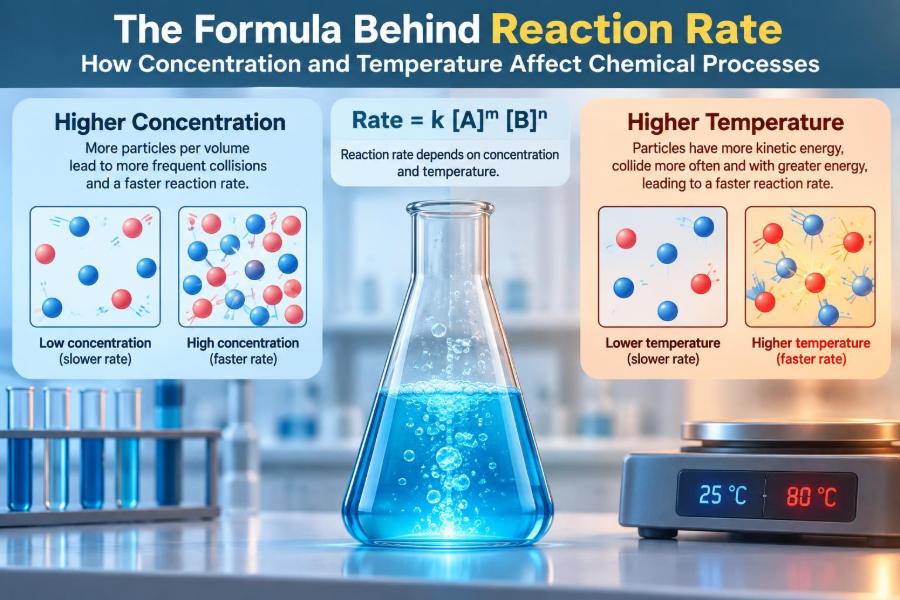
rate = k[A]^m[B]^n
Here, k is the rate constant; [A] and [B] are reactant concentrations; and m and n are reaction orders. The formula says that rate depends both on the chemical environment and on the inherent kinetic speed captured by k.
Concentration changes affect the bracketed terms. Temperature usually changes k, often strongly. Keeping those two roles separate prevents many interpretation errors.
🧩 Rate Laws Must Be Measured, Not Assumed
The balanced chemical equation does not usually reveal the rate law. For example, a reaction that overall appears as A + B → products may have a rate proportional to [A][B], but it could also show a more complicated dependence.
Rate laws are determined experimentally or derived from a validated reaction mechanism. They can change if the mechanism changes, such as when a catalyst deactivates, a phase changes, or mass transfer begins to limit the observed process.
Stoichiometric coefficients can be used as kinetic exponents only for a genuinely elementary reaction: one occurring in a single molecular event. Most overall industrial reactions consist of multiple elementary steps.
📈 Understanding Reaction Order
The exponent on each concentration term is the order with respect to that reactant. The sum of the exponents is the overall reaction order for that rate-law form.
| Observed dependence | Meaning when concentration doubles | Example rate effect |
|---|---|---|
Zero order in A: [A]^0 |
Rate does not change | 1× |
First order in A: [A]^1 |
Rate doubles | 2× |
Second order in A: [A]^2 |
Rate becomes four times as large | 4× |
An exponent may be zero, fractional, or even negative in an empirical rate expression. A negative order means raising that species’ concentration slows the observed reaction, which can occur when it inhibits a catalyst or participates in a competing surface process.
💥 Collision Theory: A Useful Starting Picture
Collision theory gives an intuitive explanation for concentration effects. When more reactant particles occupy the same volume, collisions between potentially reacting particles generally occur more often.
Yet collision frequency alone is not enough. Molecules must collide with suitable orientation, and they must have sufficient energy to cross the barrier separating reactants from products. Many collisions are therefore unproductive.
The theory is especially helpful for simple gas-phase reactions. Liquids, solids, enzymes, and porous catalysts introduce diffusion, adsorption, mixing, and surface effects that require a broader view.
🧪 How Higher Concentration Changes Rate
Suppose an experimentally determined reaction is first order in A: rate = k[A]. At unchanged temperature, doubling A doubles the initial rate because twice as much A is available in the same volume.
If the rate is second order overall, rate = k[A][B], doubling both A and B makes the initial rate four times larger. That is a consequence of the measured exponents, not a universal rule for all reactions.
Concentration may be increased by feeding more reactant, reducing solvent, raising gas pressure, or removing a product that inhibits the reaction. Each route can also alter heat transfer, viscosity, equilibrium, and safety behavior.
🔍 Initial Rates Reveal Concentration Effects
The method of initial rates compares reaction rates at the very beginning of several experiments. At that point, reactant concentrations have changed very little, so the effect of a deliberately varied starting concentration is easier to isolate.
For a hypothetical experiment, if doubling A while holding B and temperature constant doubles the measured initial rate, the result is consistent with first-order behavior in A. If it quadruples the rate, second-order behavior in A is consistent.
Good experiments control mixing speed, temperature, purity, and sampling delay. Otherwise, an apparent concentration effect may actually be caused by a changing temperature or incomplete blending.
⏳ Concentration Does Not Stay Constant
As a batch reaction progresses, reactants are consumed. Even when temperature remains constant, the rate commonly declines because the concentration terms in the rate law become smaller.
This is why an initial rate is not necessarily the average rate over a batch. A reaction can begin rapidly and then slow substantially near completion, particularly when it is first or second order in a limiting reactant.
Engineers use integrated rate laws or numerical reactor models to connect concentration with time. The appropriate approach depends on the rate expression and whether temperature, volume, and feed conditions change during the operation.
🌡️ Temperature Changes the Rate Constant
Temperature primarily affects the rate constant, k. At higher temperature, molecular energy distributions shift so a larger fraction of molecules can overcome the energy barrier for reaction.
A common expression for this relationship is the Arrhenius equation:
k = A exp(−Ea/RT)
A is the pre-exponential factor, Ea is activation energy, R is the gas constant, and T is absolute temperature in kelvin. The exponential term explains why a modest temperature change can sometimes produce a large rate change.
🏔️ Activation Energy Is the Reaction Barrier
Activation energy is the energy barrier associated with reaching a reactive state. It is not simply the energy released or absorbed by the overall reaction.
Imagine a cyclist crossing a hill between two valleys. Even if the destination valley is lower, the cyclist must first climb. Reactants likewise may need to distort bonds, align in a particular way, or form an unstable intermediate before products can form.
Reactions with larger activation energies are generally more temperature-sensitive over the range where the same mechanism applies. This is why temperature changes can also alter the balance between competing reactions.
📉 Reading an Arrhenius Plot
Taking the natural logarithm of the Arrhenius equation gives:
ln(k) = ln(A) − Ea/(RT)
A plot of ln(k) against 1/T can be approximately linear when a single mechanism dominates. Its slope is −Ea/R, allowing an apparent activation energy to be estimated from kinetic data.
Curvature or abrupt slope changes deserve attention. They may indicate experimental error, a mechanism shift, catalyst changes, phase effects, or transport limitations. A straight line is useful evidence, not automatic proof of a complete mechanism.
🧊 Why Refrigeration Slows Many Processes
Cooling food slows many chemical deterioration reactions and biological processes because their rate constants tend to decrease at lower temperature. It does not stop all change, nor does it eliminate the role of oxygen, moisture, contamination, or packaging.
The same principle matters for reactive chemicals. Cooler storage can reduce degradation or unwanted polymerization, but a suitable storage temperature must come from material-specific hazard information and process knowledge.
Low temperature can create other problems: increased viscosity, crystallization, reduced solubility, or slower mixing. Rate reduction is valuable only when the complete operating behavior remains manageable.
🔥 Why Heating Is Not Always the Best Answer
Heating often increases the desired reaction rate, but it also increases energy demand and can accelerate side reactions, thermal decomposition, corrosion, or catalyst deactivation. The fastest reaction is not automatically the best process.
For reversible reactions, temperature also affects equilibrium. Kinetics tells how quickly equilibrium is approached; thermodynamics determines where equilibrium lies. These are related operating concerns but not interchangeable concepts.
A sound temperature choice balances conversion rate, selectivity, equipment limits, heat-removal capacity, and product specifications rather than optimizing one number in isolation.
⚖️ Kinetics and Equilibrium Answer Different Questions
Kinetics asks, “How fast will the system change?” Equilibrium asks, “What composition is favored after sufficient time under these conditions?” A reaction may be thermodynamically favorable but proceed extremely slowly without heat, a catalyst, or another activation method.
Conversely, a rapid reaction may stop at an equilibrium mixture containing significant reactants. Raising temperature can accelerate forward and reverse reactions simultaneously.
This distinction is crucial during troubleshooting. Low conversion does not automatically mean the reaction is slow; it may mean equilibrium, poor contacting, or insufficient reactant ratio is limiting the achievable conversion.
🧫 Catalysts Change the Path, Not the Destination
A catalyst increases reaction rate by providing an alternative pathway with a lower effective activation barrier. It is regenerated by the catalytic cycle rather than consumed in the overall reaction.
Catalysts do not alter the equilibrium constant for a reaction at a given temperature. They help the system approach equilibrium faster by accelerating forward and reverse pathways.
Catalyst performance depends on more than chemistry. Surface area, poisoning, fouling, moisture sensitivity, pressure drop, and temperature history can all determine whether a catalyst delivers its expected activity.
🪨 Heterogeneous Catalysts Add Surface Kinetics
In heterogeneous catalysis, reactants and catalyst occupy different phases, commonly gases or liquids reacting on a solid surface. Molecules may need to diffuse to a pore, adsorb onto an active site, react, desorb, and diffuse back into the bulk fluid.
The measured rate may therefore reflect intrinsic surface chemistry, transport resistance, or both. Raising temperature can speed surface reaction while changing adsorption and diffusion behavior in the opposite direction.
Using an intrinsic rate law without checking transport effects can lead to misleading scale-up predictions. Pellet size, fluid velocity, and reactor geometry become part of the kinetic problem.
🌊 Mixing and Mass Transfer Can Masquerade as Kinetics
If two liquid reactants are poorly mixed, each may be abundant in separate zones but scarce where reaction actually occurs. The measured overall rate then reflects mixing and mass transfer rather than only molecular reaction kinetics.
Gas–liquid reactions add another step: gas must dissolve before it can react in the liquid. Agitation, bubble size, interfacial area, and solubility can strongly influence the observed rate.
A useful warning sign is a rate that changes when stirrer speed or flow rate changes. That observation does not prove transport control, but it calls for a careful diagnostic test.
🏭 From Flask Data to Reactor Behavior
Laboratory kinetic data are often collected in well-mixed, carefully controlled equipment. A production reactor may have temperature gradients, nonuniform residence times, feed fluctuations, and much larger heat-transfer distances.
Batch, continuous stirred-tank, and plug-flow reactors expose molecules to different concentration histories. For the same reaction and feed, they need not achieve the same conversion at the same total volume.
Scale-up requires coupling kinetics with material balances, energy balances, transport behavior, and process control. A rate constant from a small experiment is a starting input, not a complete reactor design.
🌡️ Exothermic Reactions and Heat-Release Feedback
An exothermic reaction releases heat. If temperature rises, the rate constant may rise; the faster reaction then releases heat more quickly. This feedback can become severe when heat removal cannot keep pace.
The risk is highest when reactants, catalyst, and accumulated energy are present together and cooling is inadequate. A rapid rate increase can affect pressure, boiling, gas generation, and vessel integrity.
Safe design considers credible deviations such as cooling loss, overcharge, wrong concentration, delayed quench, or unintended catalyst addition. Reaction calorimetry and hazard testing may be needed for systems with significant thermal risk.
🛡️ Temperature Control Is a Safety System
Temperature measurement alone is not control. A robust system requires an appropriate sensor location, a responsive cooling or heating utility, sensible setpoints, alarms, and procedures for abnormal conditions.
For fed-batch reactions, controlling the feed rate can be as important as controlling the jacket temperature. Slower addition limits how much reactive material is present at one time and can reduce the maximum heat-release rate.
Emergency actions must be compatible with the chemistry. A quench, vent, inhibitor, or shutdown procedure should be evaluated before it is needed, not improvised during an upset.
🧮 A Simple Rate Calculation
Consider a hypothetical reaction with the experimentally determined rate law rate = k[A][B]. If temperature is held constant and both A and B are doubled, the new rate is:
new rate = k(2[A])(2[B]) = 4k[A][B]
The initial rate becomes four times the original value. If only A doubles, the rate doubles. This direct proportionality is valid only because the rate law was specified as first order in each reactant.
If temperature also changes, k changes too. The concentration calculation alone would no longer predict the full rate change.
📏 Units Provide a Fast Error Check
Rate always has concentration-per-time units, but the units of k depend on overall reaction order. This follows directly from dimensional consistency.
- For a zero-order rate law,
khas concentration/time units. - For a first-order rate law,
khas 1/time units. - For a second-order rate law,
khas 1/(concentration × time) units.
Checking units catches common errors, especially when concentrations are entered in mol/L but a model expects mol/m3. A numerical answer with incompatible units is not physically meaningful.
🧷 Pseudo-First-Order Behavior Simplifies Analysis
Sometimes one reactant is present in such large excess that its concentration changes very little during the measurement. For rate = k[A][B], if B is effectively constant, the expression can be written as rate = k'[A], where k' = k[B].
This is called pseudo-first-order behavior. It is a practical experimental simplification, not a claim that the underlying reaction is truly first order in all circumstances.
The approximation becomes unreliable if the “excess” reactant is depleted, its concentration varies due to evaporation or feed changes, or it affects temperature and transport properties.
🧠 Common Misconceptions About Rate
- “Higher concentration always makes every reaction faster.” Only reactants with positive order in the valid rate law have that direct effect; inhibition and saturation can occur.
- “Every 10-degree increase doubles the rate.” This is a rough rule of thumb in limited contexts, not a universal law. Temperature sensitivity depends on activation energy and mechanism.
- “A catalyst makes more product at equilibrium.” It changes how quickly equilibrium is reached, not the equilibrium position at fixed temperature.
- “A faster rate means better operation.” Selectivity, control, heat removal, and equipment constraints may make a moderate rate preferable.
🔬 Designing Better Kinetic Experiments
Useful kinetic data begin with a question: intrinsic chemistry, formulation behavior, catalyst screening, or reactor design. The measurement strategy should match that purpose.
Vary one main factor at a time when establishing basic dependencies, while maintaining reliable control of temperature, composition, pressure, agitation, and sampling. Then use a planned matrix of conditions to identify interactions where needed.
- Measure actual temperature, not only the jacket or oven setpoint.
- Verify that samples are quenched or analyzed quickly enough to stop further reaction.
- Repeat key runs to identify random variation.
- Document mixing, feed, and catalyst preparation because they can change apparent rates.
📊 Model Limits and Parameter Uncertainty
A rate law fitted over a narrow temperature and concentration range should not be confidently extrapolated far beyond those conditions. New phases, new mechanisms, catalyst damage, or transport limits can emerge outside the tested window.
Rate constants and activation energies also carry uncertainty because measurements contain noise and model choices matter. Reporting more digits than the data justify creates a false impression of precision.
For design and safety work, sensitivity analysis is valuable: ask how conversion, peak temperature, or required residence time changes when kinetic parameters vary within a plausible range.
🧰 Practical Levers for Process Improvement
When a reaction is too slow, the first instinct may be to raise temperature. A better approach is to identify the controlling limitation and choose a lever that addresses it.
- Increase temperature only within selectivity, materials, and heat-removal limits.
- Adjust reactant concentration or ratio when the rate law and downstream separation support it.
- Use or improve a catalyst when activation barriers dominate.
- Improve mixing, interfacial area, or flow distribution when transport is limiting.
- Change residence time or reactor configuration when the concentration profile is the constraint.
These levers interact. A concentration increase may help kinetics but complicate cooling; a catalyst may reduce temperature requirements but introduce sensitivity to contaminants.
📝 A Structured Troubleshooting Sequence
When a process slows unexpectedly, avoid treating every low-rate observation as a chemistry failure. Start by confirming the measurement: analytical method, sample timing, flow readings, and temperature calibration.
Next, compare actual conditions with the validated operating window. Check feed composition, concentration, pH where relevant, pressure, catalyst condition, agitation, and residence time.
Then distinguish intrinsic kinetic change from transport or heat-transfer limitations. Trend data from before and after the change, coupled with targeted tests, often gives a clearer answer than making several uncoordinated adjustments at once.
🌍 Reaction Rates in Everyday Systems
The same ideas appear outside chemical plants. Yeast fermentation changes with temperature and sugar availability. Rusting depends on reactants reaching a metal surface. A glow stick’s brightness and lifetime reflect temperature-dependent chemistry.
These examples are useful reminders that a rate is shaped by conditions, not by a substance’s name alone. The same chemical system can behave very differently when concentration, temperature, contact area, or mixing changes.
Everyday analogies should still be used carefully. Biological and consumer systems may involve multiple reactions, enzymes, diffusion barriers, and changing compositions, so a single elementary rate law may not describe the whole behavior.
✅ The Core Principle Behind Reaction Rate
Concentration and temperature influence reaction rate through different parts of the kinetic picture. Concentration changes the availability of reacting species according to the rate law. Temperature changes the rate constant by changing the fraction of molecular encounters able to cross the activation barrier.
Neither lever operates in isolation in a practical process. Equilibrium, catalysis, mixing, mass transfer, selectivity, and heat removal can all influence what rate is observed and whether a faster rate is actually desirable.
The most reliable approach is to use measured kinetics within their valid range, verify the physical conditions around the reaction, and treat rate changes as coupled process behavior rather than as a single-variable problem.
Reaction engineering begins with a simple question—how fast?—but the best answer connects molecular chemistry to the real concentration, temperature, and transport conditions inside the process. 🧪🌡️⚙️