
A kettle on a stove, a heat exchanger in a refinery, and a fermentation tank in a food plant all raise the same practical question: where is the energy going?
When a process stream gets hotter, colder, faster, slower, or changes phase, energy has crossed the system boundary or been converted from one form to another. An energy balance gives engineers a disciplined way to account for that change.
The calculation can look intimidating when it appears beside long thermodynamic property tables. Yet the first useful energy balances are built from a small set of ideas: define the system, choose a time basis, identify energy streams, and apply conservation.
That method is useful far beyond homework. It helps with estimating steam demand, selecting heat-transfer equipment, checking utility bills, troubleshooting unexpected temperatures, and recognizing when a design assumption is unsafe.
⚖️ What an energy balance actually says
An energy balance is an application of the first law of thermodynamics: energy is conserved. Energy cannot be created or destroyed, although it can cross a boundary as heat, work, or material flow, and it can change form within the system.
For a process system, the most general accounting statement is:
Accumulation = Input − Output + Heat added − Work done by the system
The signs can be written differently in other textbooks. What matters is selecting a convention and using it consistently. This article uses positive Q for heat transferred into the system and positive W for work performed by the system.
🧭 Start by defining the system boundary
The system boundary is an imaginary surface separating the equipment or material being analyzed from everything else. It determines which energy transfers count as inputs or outputs.
A boundary could enclose a tank, one side of a heat exchanger, an entire boiler, or a section of piping. There is no universally correct boundary; the useful choice is the one that makes the question easier to answer.
For example, if the goal is to find cooling-water flow for a heat exchanger, draw the boundary around the process fluid first. Its heat loss then becomes the cooling-water heat gain in a second balance.
🚪 Distinguish closed systems from control volumes
A closed system contains a fixed amount of matter. Energy may cross its boundary as heat or work, but mass does not. A sealed, rigid vessel being heated is a common idealized example.
A control volume, also called an open system, allows mass to enter and leave. Most continuously operated chemical-process equipment—pumps, compressors, turbines, mixers, heat exchangers, and flow reactors—is treated this way.
This distinction matters because flowing material carries energy with it. In a control-volume balance, inlet and outlet streams must be included explicitly.
⏱️ Choose steady state or transient operation
At steady state, conditions inside the chosen system do not change with time. Mass and energy may flow continuously, but the system does not store more or less energy overall. Accumulation is therefore zero.
At transient or unsteady-state conditions, the system is warming up, cooling down, filling, emptying, or otherwise changing. Accumulation cannot be ignored.
A tank heated from room temperature is transient. The same tank held at a constant temperature with equal inlet and outlet flows may be steady state. Always ask which physical situation the problem describes before simplifying the equation.
📦 Identify every way energy can cross the boundary
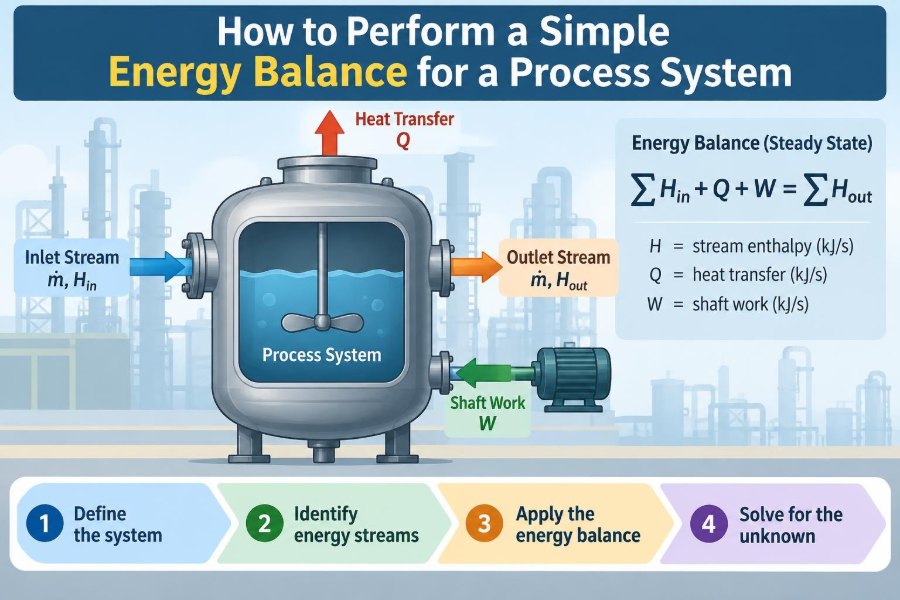
Energy crosses a process boundary in three main ways: material streams, heat transfer, and work. A complete sketch labels each one before any arithmetic begins.
- Material streams: inlet and outlet flows carrying enthalpy, kinetic energy, and potential energy.
- Heat, Q: transfer caused by a temperature difference, such as through a heating jacket or furnace wall.
- Work, W: energy transfer associated with force and displacement, including shaft work from motors, pumps, turbines, and compressors.
Electrical power to a motor is often handled as work crossing the boundary. The resulting heat eventually released by the motor may be inside or outside the boundary depending on how the system is drawn.
🌡️ Understand sensible heat
Sensible heat is energy that changes a substance’s temperature without changing its phase. Heating liquid water from 20°C to 60°C is a sensible-heating process.
For a substance with approximately constant heat capacity, the required energy is:
Q = m Cp ΔT
Here, m is mass, Cp is heat capacity at constant pressure, and ΔT is final temperature minus initial temperature. If temperature rises, the calculated Q is positive under the sign convention used here.
💨 Account for latent heat during phase change
Temperature does not tell the whole story when a substance melts, boils, condenses, or freezes. Energy transferred during a phase change is called latent heat.
For example, boiling water at a fixed pressure requires substantial energy even while the liquid and vapor are both at the saturation temperature. That energy separates molecules into the vapor phase rather than raising temperature.
For a simple phase-change estimate, use Q = mλ, where λ is the appropriate latent heat. If a stream both warms and vaporizes, calculate sensible and latent contributions separately, then add them.
🔁 Why enthalpy is used for flowing streams
Flowing material must be pushed into and out of a control volume. The energy associated with that pushing is called flow work. Rather than list internal energy and flow work separately, engineers combine them as enthalpy, represented by H.
For a flowing stream, the useful property is specific enthalpy, h, in energy per unit mass or per mole. The enthalpy flow rate is then ṁh.
For liquids and solids over modest pressure ranges, enthalpy changes can often be estimated with Δh ≈ CpΔT. For steam, refrigerants, high-pressure gases, and phase-changing mixtures, property tables, charts, or validated software are usually required.
🧮 Write the general steady-flow energy balance
For a control volume operating at steady state, a widely used form is:
Q̇ − Ẇs + Σ(ṁ hin) − Σ(ṁ hout) + Σ(ṁ Vin²/2) − Σ(ṁ Vout²/2) + Σ(ṁ g zin) − Σ(ṁ g zout) = 0
Ẇs is shaft work rate, V is velocity, and z is elevation. Dots indicate rates, such as kJ/s or kW.
It looks lengthy because it is deliberately complete. The practical skill is not memorizing every term; it is deciding, with justification, which terms matter for the equipment and conditions being studied.
✂️ Simplify only after stating assumptions
Many introductory balances omit kinetic and potential energy changes because they are small compared with heating, cooling, or shaft-work terms. That can be sensible, but it is still an assumption rather than a rule.
A typical heat-exchanger balance may assume steady state, no shaft work, negligible velocity and elevation changes, and no reaction. Under those conditions:
Q̇ = Σ(ṁ hout) − Σ(ṁ hin)
Writing assumptions beside the equation makes the work auditable. It also signals when the result may fail, such as in a high-speed nozzle, a tall pumping system, or a strongly exothermic reactor.
📏 Keep units consistent from start to finish
Unit inconsistency is one of the fastest ways to produce an energy balance that is numerically neat and physically wrong. Choose one compatible unit set before substituting values.
| Quantity | Common compatible choices | Useful reminder |
|---|---|---|
| Mass flow rate | kg/s or kg/h | Match the time basis to heat duty. |
| Heat capacity | kJ/(kg·K) or kJ/(kg·°C) | Temperature differences in K and °C have equal numerical size. |
| Heat duty | kJ/s = kW, or kJ/h | Do not call kJ/h “kW.” |
| Specific enthalpy | kJ/kg | Multiply by kg/s to obtain kW. |
For instance, multiplying a flow in kg/h by a heat capacity in kJ/(kg·°C) and a temperature difference in °C gives kJ/h. Divide by 3,600 to express that duty in kW.
🗺️ Draw a process sketch before equations
A clear diagram often prevents more errors than a calculator check. Draw a box around the system, then add arrows for every inlet and outlet.
Label each stream with the information available: mass flow rate, composition, temperature, pressure, phase, and velocity if relevant. Add arrows for heat transfer and shaft work, with a tentative direction.
This simple habit exposes missing information early. If the diagram has no outlet temperature, no heat duty, and no property data, the balance may be under-specified rather than difficult.
🧾 Select a useful reference state
Absolute enthalpy values depend on a chosen reference state. Fortunately, most energy balances use enthalpy differences, so the reference cancels as long as it is used consistently.
For a simple liquid-heating calculation, setting the inlet state as zero enthalpy makes the outlet change easy to express as Cp(Tout − Tin). For multi-stream problems, property data must share a compatible reference basis.
Do not combine enthalpy values from unrelated sources without checking their reference conventions. A hidden mismatch can create a large false duty.
🔥 Work through a simple heater example
Consider a hypothetical steady-flow electric heater warming 2.0 kg/s of liquid water from 20°C to 70°C. Assume no phase change, negligible kinetic and potential energy changes, no heat loss to the surroundings, and a constant heat capacity of 4.18 kJ/(kg·°C).
The required heat-transfer rate is:
Q̇ = ṁ Cp (Tout − Tin)
Q̇ = (2.0 kg/s)(4.18 kJ/(kg·°C))(70 − 20)°C
Q̇ = 418 kJ/s = 418 kW
The positive result means energy must enter the water. If the electric heater is ideal and lies within the selected boundary, it must supply 418 kW of work or heat equivalent to the water.
🧱 Add heat loss to make the example realistic
Real equipment is rarely perfectly insulated. Suppose the same heater loses 18 kW to the surrounding air while warming the water.
The heater must now provide energy for both the water and the loss:
Power input = 418 kW + 18 kW = 436 kW
This does not mean the water needs more energy. Its enthalpy rise is still 418 kW. The additional input compensates for energy that leaves through a different path across the boundary.
🔄 Balance a heat exchanger without guessing heat duty
In an idealized heat exchanger with no heat loss to the surroundings and no shaft work, heat lost by the hot stream equals heat gained by the cold stream.
ṁhot (hhot,in − hhot,out) = ṁcold (hcold,out − hcold,in)
If both streams remain liquid and heat capacities are reasonably constant, replace enthalpy changes with CpΔT. This lets you solve for an unknown outlet temperature or required flow rate.
Keep the streams conceptually separate. The hot-side temperature decrease is not automatically equal to the cold-side temperature increase; differing flow rates and heat capacities determine those changes.
⚙️ Recognize when shaft work matters
In a pump, compressor, turbine, or agitator, shaft work can dominate the energy balance. A pump raises fluid pressure by receiving work, while a turbine produces work as a fluid expands.
For a well-insulated compressor, the gas often leaves hotter because shaft work raises its enthalpy. For a turbine, the reverse commonly occurs: a drop in fluid enthalpy supplies output work.
Motor nameplate power is not automatically equal to energy delivered to a process fluid. Mechanical losses, electrical losses, and the location of the system boundary determine how that power enters the balance.
🏃 Include kinetic energy in high-velocity systems
Kinetic energy becomes significant when velocity changes are large, as in nozzles, jets, gas pipelines with major area changes, and some pressure-relief systems. The specific kinetic-energy term is V²/2.
A nozzle may convert enthalpy into velocity with little heat transfer or shaft work. Ignoring velocity there would miss the main physical effect.
In contrast, liquid flow through a large, slowly moving process vessel usually has a very small kinetic-energy change relative to its heating duty. State that it is negligible rather than deleting it silently.
🏔️ Consider potential energy for elevation changes
Potential energy is represented by gz. It matters when a stream moves through a meaningful elevation difference, especially in pumping systems, hydropower equipment, and tall process structures.
Raising fluid requires energy; allowing it to descend can release energy. In many compact plant units, the effect is minor, but it can be material when flow rates are large or vertical distances are substantial.
The key comparison is scale. Estimate the potential-energy term and compare it with enthalpy and work terms before deciding whether it can be neglected.
🧪 Include chemical reaction when composition changes
A reacting system needs careful property accounting because chemical composition changes alter enthalpy. Combustion, polymerization, neutralization, oxidation, and many biological processes may release or absorb substantial energy.
One approach uses heats of formation and reaction stoichiometry. Another uses stream enthalpies from a process simulator or reliable thermodynamic model. Both require a clearly defined reference basis and accurate compositions.
A simple CpΔT calculation alone is not enough for a reactor when reaction heat is significant. It captures sensible temperature change but not the chemical-energy change driving it.
🧊 Handle mixing with an energy balance
Mixing streams is a common application. If two streams of the same liquid mix adiabatically, with no shaft work and negligible kinetic and potential effects, the outlet enthalpy flow equals the sum of inlet enthalpy flows.
For similar heat capacities and no phase change, the mixed temperature is a heat-capacity-flow-weighted average, not necessarily the simple average of the two temperatures.
If the liquids differ in composition, their heat capacities may differ, and mixing can release or absorb heat. Use appropriate mixture properties rather than assuming every blend behaves like pure water.
🛢️ Use accumulation for a batch heating tank
For a batch tank with no inlet or outlet during heating, energy accumulation appears directly as an internal-energy or temperature change. If the liquid is well mixed and remains liquid, a simple approximation is:
Q̇in − Q̇loss = m Cp dT/dt
This equation says that net heat into the tank raises the temperature of the stored material. The heating rate falls if heat loss increases or if the tank contains more material.
In practice, the vessel wall, agitator, coils, and internal hardware may also store energy. Early design estimates may neglect them; more accurate warm-up predictions should include their heat capacities.
🧷 Use mass balance alongside energy balance
An energy balance rarely stands alone. Mass flow rates, compositions, and phase fractions are often found from a mass balance first.
For a nonreacting steady unit, total mass in equals total mass out. For a reacting process, total mass is still conserved, but individual species change according to reaction stoichiometry.
Solving mass and energy balances together is especially necessary for evaporators, distillation columns, flash drums, and reactors. A temperature result can be meaningless if it was calculated from an impossible material flow pattern.
🔍 Check degrees of freedom before solving
A degrees-of-freedom check asks whether there are enough independent equations to determine the unknowns. Count the unknown variables, then count the independent mass balances, energy balances, equilibrium relations, property relations, and specifications.
If unknowns exceed equations, more information is needed. If equations exceed unknowns, some equations may be redundant or the specifications may conflict.
This check saves time. It distinguishes a genuinely unsolvable problem from one that merely needs algebra, and it prevents forcing a numerical answer from incomplete data.
🚫 Avoid common energy-balance mistakes
Several errors recur in student work and plant calculations. Most are avoided by returning to the diagram and the selected boundary.
- Using temperature instead of enthalpy when a stream changes phase.
- Mixing mass-based and molar-based heat capacities without conversion.
- Forgetting heat loss while assuming a real vessel is adiabatic.
- Applying a steady-state equation during startup or shutdown.
- Adding work with the wrong sign because the convention changed mid-calculation.
- Using inlet and outlet temperatures without confirming pressure and phase.
- Reporting many decimal places despite uncertain flow or temperature measurements.
A result that violates physical intuition is a prompt to inspect assumptions, not merely re-enter numbers.
✅ Perform quick reality checks on the result
First, check direction. A cold stream should not become hotter in an insulated exchanger unless the other stream, a reaction, or work input provides the required energy.
Second, check magnitude. A large flow rate, a large heat capacity, or a large temperature change should correspond to a large duty. Compare the answer with known utility capacities or equipment ratings when available.
Third, check limits. In an ordinary exchanger with no phase change and finite area, the cold-stream outlet temperature should not exceed the hot-stream inlet temperature. Such checks catch sign and unit errors quickly.
🧰 Organize calculations for others to review
A professional energy-balance calculation should be traceable. Someone else should be able to see the process basis, assumptions, property source, equations, substitutions, units, and conclusion.
A useful format is: process sketch; known and unknown quantities; assumptions; governing mass balance; governing energy balance; property calculations; numerical solution; and reasonableness check.
Spreadsheets and simulation software can accelerate this work, but they do not replace the model. A spreadsheet faithfully repeats a wrong formula, and a simulator can produce misleading output when feeds, phases, or property methods are incorrectly specified.
🦺 Recognize safety and operating implications
Energy balances are closely tied to safe operation. Underestimating an exothermic reaction duty can lead to inadequate cooling capacity. Ignoring vaporization can underestimate pressure generation, and overlooking heat loss can affect freeze protection or product quality.
For operating decisions, use verified plant data and approved engineering methods. A simplified hand balance is valuable for screening and understanding, but it is not by itself a substitute for detailed relief design, equipment rating, or hazard analysis.
Uncertainty deserves explicit treatment. Temperature sensors, flow meters, compositions, and property estimates all have limitations, so a calculated duty should be interpreted as an estimate consistent with the quality of its inputs.
🧠 Build a repeatable solution workflow
The same sequence works for most introductory process energy balances:
- Define the system boundary and the purpose of the calculation.
- Draw and label all mass, heat, and work interactions.
- Choose a time basis and decide whether operation is steady or transient.
- Write the full relevant energy-balance form.
- State and justify simplifications.
- Obtain consistent properties and units.
- Solve algebraically, then calculate.
- Check signs, magnitude, physical limits, and uncertainty.
With repetition, this becomes less like a formula-selection exercise and more like a structured description of what the process is doing.
🎯 The core principle to carry forward
A simple energy balance is not about finding a number as quickly as possible. It is about building a model that accounts for each meaningful energy path across a clearly defined boundary.
Start broad enough to include accumulation, stream enthalpy, heat, work, kinetic energy, and potential energy. Then simplify only when the physics and operating conditions support doing so.
Whether you are estimating a heater duty, diagnosing a cooling problem, or preparing a reactor model, the central question remains the same: does every important energy input, output, and storage mechanism have a place in the balance?
Define the system carefully, conserve energy consistently, and let sound assumptions—not habit—determine the equation you solve. 🧪⚖️🔧