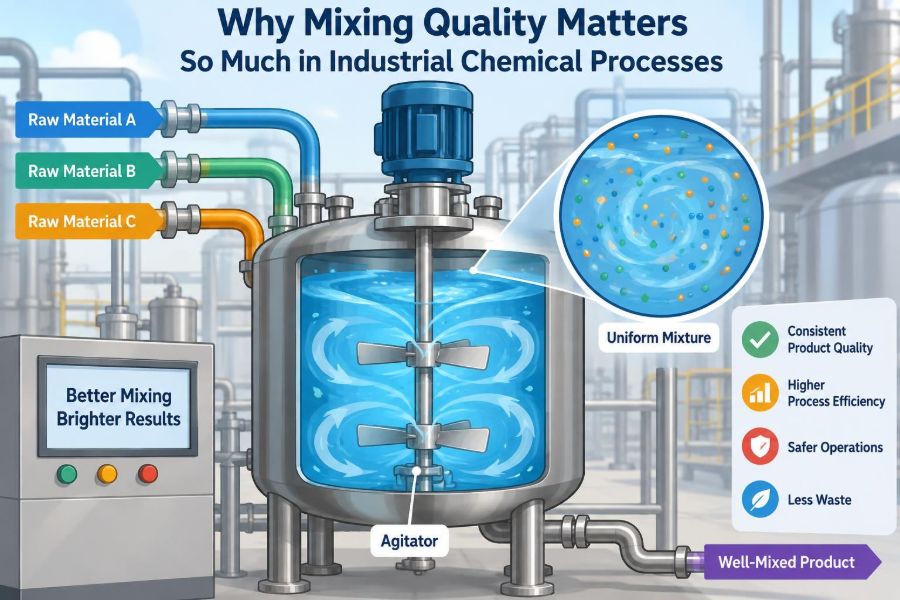

A batch can look perfectly uniform from the top of a tank and still be poorly mixed. A powder may be sitting in a dense layer near the bottom, a reactant may be concentrated around an inlet, or a hot pocket may be forming beside a jacket wall.
These differences are easy to miss when an agitator is turning and the liquid appears to be moving. Yet they can change reaction rate, product consistency, filtration behavior, energy use, and sometimes the safety of the operation.
Consider making a salad dressing: oil, water, salt, and spices need more than motion. They need the right kind of motion, for long enough, in the right container. Industrial mixing follows the same basic idea, but with fluids that can be viscous, reactive, abrasive, flammable, or sensitive to small concentration changes.
Mixing quality is therefore not a cosmetic measure of whether a vessel “looks stirred.” It is a process variable that connects equipment design to chemistry, product performance, and reliable scale-up.
🔄 What “good mixing” actually means
Good mixing means achieving the degree of uniformity needed for a particular process objective. That objective may be equal concentration of a dissolved ingredient, uniform temperature, stable suspension of solids, controlled gas dispersion, or rapid contact between reactants.
It does not always mean making every point in a vessel identical. Some crystallization, polymerization, and multiphase processes intentionally maintain gradients. The engineering question is whether the remaining variation is acceptable for the chemistry and product specification.
🧭 Mixing has several different jobs
“Mixing” covers several physically different tasks. An impeller that blends two low-viscosity liquids effectively may perform poorly when asked to suspend dense particles or disperse gas.
- Blending: distributing miscible liquids or dissolved components.
- Suspension: keeping solid particles from settling and creating stagnant beds.
- Dispersion: breaking one phase into droplets or bubbles within another.
- Heat transfer: reducing temperature differences within a vessel.
- Reaction contact: bringing reactants together at the required local rate.
Defining the actual duty is the first step in judging quality.
🧪 Uniform concentration controls product consistency
Many formulations depend on each portion of a batch containing the same amount of active ingredient, solvent, stabilizer, pigment, or catalyst. If the concentration varies by location, samples taken from one point may pass quality checks while material elsewhere in the vessel does not.
This is especially consequential in specialty chemicals, coatings, detergents, food ingredients, and pharmaceutical intermediates. A poorly distributed additive can alter color, viscosity, cure behavior, shelf stability, or downstream performance even when the average composition is correct.
⚗️ Local concentration can change reaction pathways
Reactions occur where molecules meet, not at the vessel-average composition shown in a recipe. Near a feed point, one reagent can briefly exist at a far higher concentration than intended. That local environment may favor a side reaction, unwanted by-product, excessive molecular weight, or rapid consumption of an additive.
Fast reactions are particularly sensitive because chemistry can proceed before the feed is distributed through the bulk liquid. A process with a perfectly calculated overall stoichiometric ratio can still deliver inconsistent chemistry if its micromixing is inadequate.
🔍 Macromixing and micromixing are not the same
Macromixing describes circulation throughout the vessel: whether material from the top, bottom, wall, and center is exchanged over time. It is often assessed through mixing time after adding a tracer.
Micromixing occurs at much smaller scales, where thin fluid layers are stretched and diffused until molecules can react uniformly. A tank may have good bulk circulation yet poor local mixing around a reactive feed nozzle. Both scales matter, but their relative importance depends on reaction speed.
🌡️ Temperature uniformity protects chemistry
Heat released or absorbed by a process must be spread through the vessel. If circulation is weak, a cooled jacket may produce a cold zone near the wall while the core stays warm, or an exothermic reaction may create a hot spot near the addition point.
Temperature gradients matter because reaction rates often change strongly with temperature. They can also affect viscosity, solubility, evaporation, crystal growth, and the behavior of temperature-sensitive products. A single temperature sensor may not reveal the full thermal picture.
🔥 Exotherms become harder to manage when mixing is poor
In an exothermic reaction, heat generation and heat removal must remain balanced. Poor mixing can concentrate both reactant and released heat in one region, creating conditions substantially different from the measured bulk temperature.
This does not mean every imperfectly mixed vessel will experience a thermal incident. It does mean safety assessment must consider credible local conditions, feed rate, cooling capacity, viscosity changes, and what happens if agitation is reduced or lost. Mixing is part of the protection strategy, not an optional production detail.
🧊 Cooling and heating depend on circulation
Jackets, internal coils, and external heat exchangers transfer heat at surfaces. The liquid must continually carry heat to or from those surfaces. Without adequate circulation, increasing jacket temperature difference may mainly intensify conditions near the wall rather than efficiently changing the whole batch.
Higher agitation can improve heat-transfer performance, but the result is not unlimited. Vessel geometry, fouling, fluid viscosity, heat-transfer area, and the allowable shear all influence the practical benefit.
🫧 Gas-liquid mixing needs bubble control
Hydrogenation, oxidation, fermentation, chlorination, and many aerated operations require gas to contact liquid effectively. The impeller breaks incoming gas into bubbles and distributes them through the tank, while circulation keeps bubbles from simply rising out near the sparger.
Small bubbles usually provide more interfacial area, but more power is not automatically better. Excessive gas loading can cause flooding, where the impeller loses its ability to disperse gas effectively. Foaming, entrainment, and mass-transfer limits must be managed together.
🪨 Suspending solids prevents hidden dead zones
Particles settle when gravity overcomes the upward and turbulent forces created by fluid motion. A settled layer can lead to nonuniform composition, variable reaction exposure, poor heat transfer, and difficult cleaning. In some systems, it can also increase wear or block outlets.
Complete suspension is not always necessary. The target may be “no permanent deposit,” a specified degree of solids uniformity, or enough movement to prevent caking. The required standard should reflect the process rather than an assumption that every particle must be continuously airborne.
🧱 Viscosity changes the mixing problem
Water-like liquids readily develop turbulent flow under common industrial conditions. Thick resins, creams, polymer solutions, and pastes often remain in laminar flow, where fluid moves in more orderly layers and molecular diffusion becomes relatively more important.
In viscous systems, a fast small impeller may churn material locally while leaving remote regions poorly renewed. Large, slow-moving impellers that sweep close to the vessel wall can be more effective because they create broad-scale displacement rather than relying only on turbulence.
🌀 Impeller choice determines the flow pattern
Impellers are designed to create characteristic flow patterns. Axial-flow designs push liquid largely parallel to the shaft and are commonly useful for bulk circulation and solids suspension. Radial-flow designs throw liquid outward toward the wall and can provide intense local turbulence and gas dispersion.
High-shear rotor-stator devices, anchors, helical ribbons, and disperser disks serve other duties. There is no universally best impeller: the proper selection follows the fluid properties, vessel shape, phases present, and desired result.
🏗️ Vessel geometry is part of the mixer
An agitator cannot be judged separately from its vessel. Tank diameter, liquid height, bottom shape, impeller clearance, nozzle locations, and liquid level all alter the flow field. A mixer that performs well in a test vessel may behave differently after installation in a taller or wider production tank.
Wall-mounted coils, dip pipes, probes, and internal supports can interrupt circulation. These features are sometimes unavoidable, but they should be considered during design rather than treated as minor details after a mixing problem appears.
🚧 Baffles stop unhelpful swirling
In an unbaffled round tank, a rotating impeller can create a vortex that spins much of the liquid as a body. The surface may look dramatic while vertical circulation and blending remain weak. Air may also be drawn into the liquid unintentionally.
Baffles are vertical strips mounted on the vessel wall that disrupt this rotation and redirect energy into useful circulation and turbulence. Their design must still suit the service; highly viscous products or cleaning constraints can justify other arrangements.
📏 Scale-up is more than making the tank bigger
A laboratory beaker may mix rapidly with a magnetic stirrer, whereas a production vessel holds far more material and has a different ratio of surface area to volume. The distance a fluid element must travel increases, heat-removal behavior changes, and feed addition becomes more localized.
Engineers use dimensionless groups and scale-up criteria to guide design, such as maintaining similar tip speed, power per volume, pumping capacity, or mixing time. These criteria can conflict. Selecting one requires knowing which physical phenomenon—shear, circulation, gas dispersion, or heat transfer—governs product quality.
📐 Key dimensionless numbers give useful clues
The Reynolds number compares inertial forces with viscous forces and helps indicate whether mixing is likely to be laminar or turbulent. The power number relates impeller power draw to fluid density, speed, and impeller diameter.
For gas-liquid and mass-transfer problems, engineers may also examine gas flow number, Froude number, and correlations involving mass-transfer coefficients. These tools are valuable for organizing experience, but they do not replace pilot testing when rheology, multiphase behavior, or reaction kinetics are uncertain.
⏱️ Mixing time is useful, but incomplete
Mixing time is often measured by adding a tracer—such as a conductivity, pH, dye, or temperature disturbance—and recording how long a sensor takes to reach a chosen stable range. It provides a practical measure of bulk blending.
However, one sensor can miss poorly mixed regions, and a benign tracer may not mimic a reactive feed. For critical duties, measurements at several locations, visual studies in transparent models, or computational analysis may be needed to understand the real flow pattern.
📍 Feed-point placement can make or break a batch
Where and how a material enters the vessel matters greatly. Adding a reactant into a high-circulation region can distribute it quickly; feeding into a stagnant corner can create a concentrated plume. Feed velocity, pipe orientation, addition depth, and timing all affect the result.
For fast or hazardous reactions, the best location is often determined through process development rather than intuition. A feed pipe that is convenient to install may be chemically unsuitable if it delivers reactant into a poorly renewed zone.
💧 Liquid-liquid dispersion is a balance of breakage and coalescence
When two immiscible liquids such as oil and water are mixed, droplets are created by disruptive stresses from the flow. Those droplets can also collide and merge again, a process called coalescence. The resulting droplet-size distribution affects emulsion stability, reaction area, appearance, and separation behavior.
Surfactants can slow coalescence, while viscosity and interfacial tension influence how easily droplets break. A stable-looking emulsion is not automatically desirable; some extraction and separation steps need droplets large enough to separate afterward.
🧬 Polymer systems bring special challenges
During polymerization or dissolution of polymeric materials, viscosity can rise sharply as the batch progresses. The mixer that worked at the beginning may no longer circulate the material effectively near the end. Local monomer concentration or temperature can then become more difficult to control.
Polymer chains may also be shear-sensitive. The engineering goal is often enough mixing to control heat and composition without damaging the desired structure or incorporating excessive air. This is a classic example of competing process requirements.
💎 Crystallization depends on local supersaturation
Crystals form and grow when a solution becomes supersaturated. Poor mixing can create localized supersaturation near a cooling surface or antisolvent feed, leading to sudden nucleation, broad particle-size distributions, agglomeration, or unwanted deposits.
Gentle, well-distributed mixing is often needed to keep the bulk condition consistent while avoiding crystal breakage. The right agitation level depends on crystal fragility, slurry density, cooling rate, and the product’s required particle properties.
🧼 Mixing quality affects cleaning and changeover
Dead zones and poorly swept surfaces do not only affect the product during operation. They can trap residues after draining, making clean-in-place procedures less reliable and increasing the risk of cross-contamination between batches.
Equipment designed for cleanability should avoid unnecessary pockets, provide adequate spray coverage, and ensure cleaning fluid reaches surfaces with enough mechanical action. A process that is easy to mix but hard to clean is not necessarily a good production design.
⚡ More power is not always the solution
Increasing rotational speed can shorten mixing time and improve dispersion, but it also raises energy demand, mechanical loads, seal requirements, heat generation, and sometimes foam formation. In shear-sensitive systems, it can alter the product itself.
Before specifying a larger motor, ask what limitation actually exists. A change in impeller diameter, clearance, feed location, baffle arrangement, vessel aspect ratio, or addition schedule may solve the problem with less energy and less risk.
🔊 Process signals can reveal a mixing problem
Unexpected drift in temperature, pH, viscosity, density, conductivity, torque, pressure drop, or product appearance may point to poor mixing. None of these signals alone proves the cause, but trends can reveal when circulation has changed as a batch thickens or as solids accumulate.
Operators also notice practical clues: a persistent vortex, erratic foam, solids visible after sampling, repeated need for longer agitation, or batches that vary despite identical recipes. These observations deserve investigation rather than being normalized as routine variability.
🧰 Troubleshooting should start with the process history
When product quality changes, begin with what changed: raw-material properties, liquid level, addition sequence, impeller speed, batch size, temperature profile, maintenance activity, or cleaning outcome. Mixing failures are frequently caused by an operating change rather than an obvious broken component.
- Confirm actual rotation direction, speed, and liquid level.
- Inspect impellers, baffles, feed pipes, and internals for damage or fouling.
- Review whether viscosity or solids loading has shifted.
- Compare samples from multiple vessel locations where safe and practical.
- Check whether the quality issue tracks a particular stage of the batch.
This structured approach prevents a costly redesign from being used to solve a simple operating problem.
🖥️ Modeling helps, but needs validation
Computational fluid dynamics, commonly called CFD, can estimate velocity fields, turbulence, gas distribution, heat transfer, and regions with weak circulation. It is particularly useful for comparing design options before fabricating equipment.
Its predictions depend on assumptions about fluid properties, turbulence, free surfaces, and multiphase behavior. Complex real fluids may behave differently from the model. Physical measurements, pilot runs, and plant data remain essential for validating decisions.
🧑🔧 Operators and engineers need a shared mixing language
Useful specifications describe outcomes, not only equipment. “Run agitator at 120 rpm” is an operating instruction; “maintain suspension during feed,” “reach a defined conductivity uniformity,” or “avoid visible settling before transfer” expresses the process purpose.
Clear language helps operations, maintenance, process engineering, and quality teams recognize why a speed change or altered feed sequence matters. It also makes deviations easier to assess when production conditions cannot exactly match the original procedure.
📋 Define acceptance criteria before choosing equipment
A robust mixing design starts with measurable requirements. These may include allowable blend variation, maximum mixing time, required solids concentration at transfer, temperature spread, droplet size range, gas uptake, or absence of settled material after a specified hold period.
The criteria should be realistic and linked to product needs. Demanding extreme uniformity where it provides no benefit wastes capital and energy; using vague criteria leaves teams unable to tell whether a mixer is truly adequate.
🛡️ Mixing is a process-safety consideration
Agitation failure, wrong rotation direction, reduced speed, or an unexpectedly viscous batch can affect heat removal, reactant distribution, vent behavior, and the ability to keep solids mobile. These possibilities should be considered in hazard reviews and operating procedures.
Safeguards may include interlocks on feed addition, alarms for drive load or speed, conservative addition rates, backup cooling strategies, and clear response steps for loss of agitation. The appropriate measures depend on the process hazards and must be developed for the specific installation.
🌱 Efficient mixing supports sustainability goals
Mixing consumes electrical energy, and inefficient designs may demand unnecessary power or extended batch times. Better circulation can also reduce off-spec material, repeated processing, solvent use, cleaning burden, and waste from failed batches.
Efficiency should be considered over the whole process, not only at the motor. The lowest-power mixer is not sustainable if it causes poor heat transfer, inconsistent yield, or frequent rework. The best design achieves the required duty with appropriate energy and reliability.
🎯 The central principle: match the flow to the process
Mixing quality matters because industrial processes are governed by local conditions as well as average conditions. Concentration, temperature, phase contact, and solids distribution determine what molecules, droplets, particles, and heat actually experience inside the vessel.
The practical goal is not maximum agitation. It is a deliberate combination of vessel geometry, impeller type, power input, feed strategy, operating sequence, and verification methods that creates the conditions the process truly requires.
When mixing is designed around the chemistry and physical behavior of the system, it becomes a reliable way to protect quality, safety, and productivity rather than a background utility. A tank may be simple equipment, but the flow inside it can determine the success of the entire process. 🧪⚙️🌡️