
A bottle of detergent, a smartphone screen, a medicine blister pack, and the paint on a bridge all begin with chemical manufacturing. Most arrive in our hands with no visible trace of the solvents, heat, catalysts, rinse water, off-spec material, and packaging waste involved in making them.
That hidden material footprint matters. A process can produce a valuable tonne of product while also consuming large amounts of energy, generating wastewater, releasing recoverable vapours, or creating residues that need treatment. The engineering challenge is not simply to clean up after production.
It is to design production so that fewer unwanted materials arise in the first place. That shift changes the questions engineers ask: Can the reaction make fewer by-products? Can heat be reused? Can a solvent stay in the loop rather than become waste?
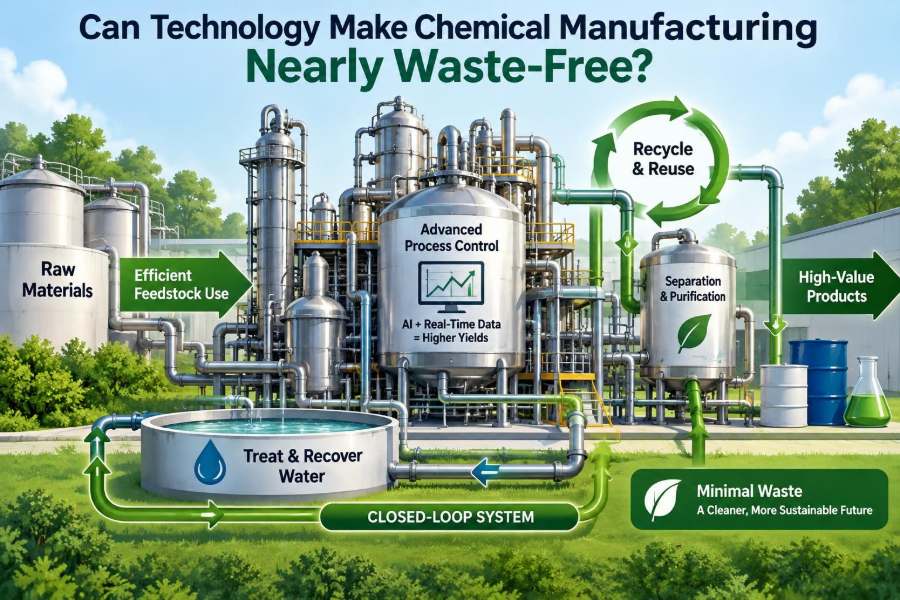
Technology can move chemical manufacturing much closer to that goal, but “nearly waste-free” is not a switch that any plant can flip. It is a design direction that combines chemistry, separation science, control systems, equipment choices, and honest accounting.
🧭 What Nearly Waste-Free Manufacturing Really Means
Nearly waste-free manufacturing does not mean that a chemical plant has no emissions, no purges, and no discarded material under any condition. Real processes need maintenance, startup and shutdown procedures, safety relief systems, and quality controls. Some streams cannot safely or economically be reused.
The more useful goal is minimizing waste across the full process while keeping materials at their highest practical value. A recovered solvent that returns to the reactor is usually more valuable than the same solvent sent to an incinerator for energy recovery. A by-product sold as a raw material is better than one treated as a disposal problem, provided its use is genuine and safe.
🗑️ Where Waste Actually Comes From
Waste is often created at several points, not just in the reactor. Feedstocks may contain impurities, reactions may form unwanted molecules, and downstream purification can create dilute streams that are difficult to separate.
- Reaction losses: unreacted starting material, side products, catalyst residues, and salts.
- Separation losses: spent adsorbents, still bottoms, contaminated solvents, and filter cakes.
- Utility-related streams: cooling-tower blowdown, boiler blowdown, water-treatment sludge, and used lubricants.
- Operational waste: off-spec batches, cleaning liquids, laboratory samples, and packaging materials.
Finding the dominant streams is more useful than treating every stream as equally significant. A small hazardous stream can deserve more attention than a large but harmless water stream, while a large hot stream may represent the biggest energy opportunity.
⚖️ Mass Balance: The Starting Point for Prevention
Every waste-reduction project should begin with a mass balance: an accounting of what enters, leaves, accumulates, or reacts within a defined system boundary. Matter is not lost; it is merely transferred, transformed, or overlooked.
For a batch process, the balance may reveal that product yield looks acceptable but a substantial fraction of an expensive reactant leaves dissolved in mother liquor. For a continuous unit, it may show that a recycle loop is carrying impurities until a large purge becomes unavoidable.
Without a reliable balance, “zero waste” claims are usually guesses. Good balances also expose measurement gaps, such as an unmetered drain, uncertain tank inventory, or a waste contractor record that does not identify the material composition.
🧪 Atom Economy Changes the Chemistry
Yield tells us how much desired product is obtained from the limiting reactant. Atom economy asks a different question: how many atoms in the reactants become part of the desired product? A high-yield reaction can still have poor atom economy if it produces a large stoichiometric salt or protecting-group waste stream.
Consider a hypothetical synthesis in which a reagent activates a molecule but leaves behind one equivalent of inorganic salt. Improving isolation may reduce losses, yet the salt is built into the reaction concept. A catalytic route that avoids that reagent can eliminate the waste at its source.
This is why chemical route selection has more leverage than end-of-pipe treatment. The best separation system cannot turn an inherently wasteful reaction into an atom-efficient one.
🔬 Catalysts Replace Disposable Reagents
A catalyst increases reaction rate or guides selectivity without being consumed in the ideal reaction cycle. In practice, catalysts deactivate, require recovery, and may need careful handling, but they can replace large quantities of stoichiometric reagents.
Selective catalysts can reduce by-products, lower reaction temperatures, and simplify purification. Enzymes, for example, can offer remarkable selectivity in certain pharmaceutical and specialty-chemical steps, although they may be sensitive to temperature, pH, impurities, or solvent choice.
Catalyst choice is not automatically greener. Engineers must consider metal sourcing, catalyst lifetime, recovery efficiency, toxicity, and whether trace catalyst contamination is acceptable in the product.
🎯 Selectivity Is a Waste-Reduction Tool
Most industrial reactions have competing pathways. A selectivity problem creates more than lower yield: it often creates molecules with properties close to the product, making purification energy-intensive and generating difficult residue streams.
Better temperature control, reactant addition strategy, mixing, residence time, catalyst formulation, or feed purity can improve selectivity. In a strongly exothermic reaction, poor mixing can create local hot spots that accelerate side reactions even when the measured vessel temperature appears acceptable.
Improving selectivity early prevents a chain of downstream burdens. Less impurity formation means less solvent, less distillation duty, fewer reprocessing cycles, and fewer off-spec lots.
🧫 Continuous Processing Can Shrink Losses
Batch plants are flexible and often essential for multi-product facilities. Yet a batch vessel can spend considerable time being filled, heated, sampled, emptied, and cleaned. Each transition presents opportunities for hold-up losses, contamination, and off-spec material.
Continuous processing moves material steadily through smaller equipment. It can provide tighter temperature and residence-time control, especially for fast or hazardous reactions. Smaller inventories can also reduce the quantity of material at risk during an upset.
Continuous operation is not universally preferable. It may be harder to justify for low-volume products, variable campaigns, or chemistries prone to fouling. The transition requires robust control, feed consistency, and a thoughtful plan for startup, shutdown, and grade changes.
🧼 Solvent Choice Has Outsized Effects
Solvents are often the largest material stream in fine-chemical and pharmaceutical production because they dissolve reactants, carry heat, enable crystallization, and wash solids. They may not appear in the final product, but they can dominate purchases, recovery energy, and emissions controls.
A better solvent can improve reaction rate, selectivity, phase separation, crystallization, or safety. Sometimes a solvent change allows a product to crystallize directly, avoiding a lengthy chromatography or extraction sequence.
There is no universal “green solvent.” Water may be attractive but can require substantial heating to remove, promote corrosion, or create large wastewater volumes. A solvent should be assessed for performance, hazard, recoverability, energy demand, and compatibility with the whole process.
🔄 Recovering Solvents Without Chasing Perfection
Distillation, evaporation, membranes, adsorption, and phase separation can recover solvents for reuse. The practical target is rarely absolute purity. It is the purity needed for the next use without harming reaction performance, product quality, or safety.
Overpurifying a recovered solvent can consume more energy and equipment capacity than the benefit warrants. Conversely, reusing it without controlling accumulating impurities can gradually reduce yield or introduce quality failures.
A sound reuse program defines specifications, sampling plans, maximum recycle counts where needed, and a route for removing concentrated contaminants. This is a managed loop, not simply a decision to “use it again.”
♨️ Heat Integration Cuts Invisible Waste
Waste is not only a material issue. Hot product streams are frequently cooled while other streams are separately heated using steam, fuel, or electricity. Heat integration uses exchangers to transfer energy from a stream that must be cooled to one that must be warmed.
Pinch analysis is a systematic method for identifying the theoretical and practical limits of heat recovery across a process. It helps engineers avoid a common mistake: installing a convenient exchanger that saves some energy but blocks a more valuable network-wide opportunity.
Fouling, corrosion, operability, cleaning access, and safety separation must be considered. A heat exchanger that causes repeated production interruptions may waste more resources than it saves.
💨 Capturing Vapours Before They Escape
Volatile organic compounds can escape from tanks, reactors, dryers, and loading operations. These losses may represent worker-exposure concerns, air-emission concerns, lost raw material, or all three.
Condensers can recover vapours when cooling is effective. Carbon adsorption can capture certain organics, while closed vent systems can direct vapours to recovery or destruction equipment. The best option depends on concentration, flow variability, chemical compatibility, and the value of the recovered material.
Leak detection and repair matters here. A sophisticated recovery unit cannot compensate for valves, seals, flanges, and pumps that leak because inspection and maintenance practices are weak.
💧 Water Cascades Reduce Freshwater Demand
Water is used for washing, cooling, steam generation, scrubbing, and cleaning. Treating every used-water stream as identical is expensive and can make recycling unnecessarily difficult.
A water cascade matches water quality to the next use. For example, relatively clean cooling-water blowdown might be suitable for a lower-grade utility use after appropriate assessment, while high-purity boiler-feed applications demand far stricter treatment.
Reuse must never compromise hygiene, product quality, equipment reliability, or environmental compliance. Trace organics, salts, microbes, and corrosive species can accumulate in surprising ways, so water loops need monitoring and clear boundaries.
🧂 Salts and Brines Need a Different Strategy
Salt-containing wastewater is especially challenging because conventional biological treatment does not remove dissolved salts. Evaporating water to recover salts may be technically possible but energy-intensive, and the recovered mixed salt may have no useful market.
The strongest solution is often upstream: avoid salt-forming reagents, use catalytic alternatives, or redesign neutralization steps. Where brines are unavoidable, segregating them from dilute wastewater prevents a small difficult stream from contaminating a much larger one.
Zero-liquid-discharge systems can reduce liquid releases in suitable cases, but they transfer much of the burden into energy use and solid-residue management. They are a tool, not a universal definition of sustainability.
🧱 Designing Products for Circular Material Flows
Manufacturing waste is only one part of the picture. A polymer, coating, battery material, or formulated product may create its largest impacts after it leaves the factory if it cannot be repaired, separated, recycled, or safely treated at end of life.
Chemical engineers can influence this through material selection and formulation. Simplifying a multi-material structure, avoiding problematic additives where performance allows, and designing for compatible recycling routes can make recovery more realistic.
Circularity is not achieved merely by labeling a product recyclable. Collection systems, sorting quality, contamination, economics, and available reprocessing technology determine whether recycling occurs in practice.
🧠 Sensors Make Waste Visible
Many losses originate from ordinary process variation: a feed composition drifts, a filter begins to blind, a distillation column floods, or a reaction endpoint is missed. Online sensors and analyzers can detect these changes sooner than manual samples alone.
Useful measurements include flow, temperature, pressure, conductivity, pH, spectroscopy, composition, and equipment vibration. A process historian then turns time-stamped measurements into a record that can reveal recurring patterns.
More data is not automatically better. An analyzer that is poorly maintained or not connected to a decision can create false confidence. Measurement quality, calibration, and operator usability determine whether instrumentation actually reduces waste.
🤖 Advanced Control Prevents Off-Spec Production
Basic control maintains a variable near a set point. Advanced process control uses process models, multiple measurements, and constraints to keep a unit closer to its most efficient operating region.
For example, a distillation system may balance reflux, energy input, feed rate, and product purity more consistently than manual adjustments during changing conditions. This can reduce energy use and prevent batches from falling outside specification.
Machine-learning tools may help identify complex relationships, but they should not replace chemical understanding or safety safeguards. Models can fail when feedstocks, equipment condition, or operating regimes differ from the data used to develop them.
📈 Digital Twins Need Physical Grounding
A digital twin is a computational representation of equipment or a process that is updated with operating data. It can be used to test scenarios, estimate unmeasured conditions, schedule maintenance, or compare operating strategies without immediately disturbing the plant.
Its value depends on its purpose. A simple heat-and-mass-balance model can be highly useful for energy optimization, while a detailed dynamic model may help evaluate control changes or abnormal situations.
A twin cannot correct bad instrumentation, missing chemistry, or inaccurate assumptions. Validation against plant data and periodic review are essential, especially after equipment modifications or changes in raw material supply.
🧩 Separation Technology Is Often the Bottleneck
In many processes, making the molecule is easier than separating it from everything else. Distillation is robust and familiar, but it can demand substantial energy when boiling points are close or when large amounts of solvent are present.
Membranes, crystallization, extraction, adsorption, and hybrid systems can reduce separation burden in the right application. A membrane may concentrate a stream before distillation; crystallization may isolate product with less solvent than repeated extraction.
Each method has limits. Membranes can foul, adsorbents need regeneration, extractants can be lost, and crystallization requires careful control of impurity behavior. Selecting a separation is a process-wide optimization, not a search for fashionable equipment.
🌡️ Electrification Depends on the Heat Level
Replacing combustion-based heating with electricity can reduce direct plant emissions where low-carbon electricity is available. Electric boilers, heat pumps, resistance heating, and induction can serve different temperature ranges and duties.
Heat pumps are particularly useful when a process has low- or medium-temperature waste heat that can be upgraded for reuse. Very high-temperature duties and some reaction furnaces remain more difficult, though technologies continue to develop.
Electrification should be evaluated with the local power supply, grid reliability, demand charges, and the full energy balance in mind. Moving a duty from fuel to electricity is not automatically a reduction in total environmental burden everywhere.
🌿 Renewable Feedstocks Have Trade-Offs
Biomass-derived feedstocks, recycled carbon, and carbon dioxide-derived intermediates can reduce dependence on fossil inputs in some value chains. But origin alone does not determine sustainability.
Biomass can compete with land, water, food production, or ecosystems. Recycled feedstocks may contain contaminants or have variable composition. Carbon dioxide conversion requires energy and a source of low-carbon hydrogen or electrons to create reduced chemicals.
The relevant question is not “Is this feedstock renewable?” but “What resources, emissions, land use, processing steps, and alternative uses are associated with this specific supply chain?”
🛡️ Safety Cannot Be Traded for Lower Waste
Recycling material can concentrate impurities. Reducing purge rates can allow reactive contaminants to build up. Recovering solvents may introduce peroxide-forming species, incompatible residues, or static-electricity hazards if the system is not designed correctly.
Waste-prevention modifications therefore require management of change, hazard review, and updated operating procedures. Engineers should consider normal operation, deviations, cleaning, maintenance, and emergency conditions rather than evaluating only the intended steady state.
A waste-reduction project succeeds only if it remains safe, controllable, and compliant over its operating life.
🧾 Life-Cycle Thinking Avoids Burden Shifting
A plant may reduce wastewater by using more evaporation, reduce solvent emissions by adding thermal oxidation, or reduce solid waste by sending material for energy recovery. These choices can be reasonable, but each shifts energy, emissions, or material demand elsewhere.
Life-cycle assessment provides a structured way to examine impacts from feedstock production through manufacturing, use, and end-of-life treatment. It does not eliminate judgment; results depend on boundaries, data quality, allocation choices, and the question being asked.
Still, life-cycle thinking discourages simplistic decisions. A solution should be judged by the problem it solves and the new burdens it introduces.
📊 Metrics That Show Whether Progress Is Real
One metric rarely captures process performance. Mass intensity, for instance, compares total material input with product output. The E-factor compares waste generated with product produced. Energy intensity and water intensity track other important dimensions.
| Metric | What it helps reveal | Key caution |
|---|---|---|
| Yield | How much desired product is made | May hide solvent and utility use |
| Atom economy | Waste inherent in reaction stoichiometry | Does not include process solvents |
| Mass intensity | Total material demand per product | Needs clear system boundaries |
| Energy intensity | Energy required per product | Energy source also matters |
| Water intensity | Freshwater demand and reuse performance | Does not show contaminant hazard alone |
Metrics should be normalized to production and tracked over time. Otherwise, a reduction caused by lower output can be mistaken for a genuine process improvement.
🏭 Retrofitting Existing Plants Is Different from Starting Fresh
A new facility can locate equipment to support short transfer lines, heat integration, closed handling, and modular separation. An existing plant must work around foundations, pipe racks, control architecture, shutdown windows, and legacy equipment.
This does not make improvement impossible. High-value retrofits often begin with better segregation, instrumentation, heat recovery around a specific bottleneck, solvent recovery upgrades, or reduction of recurring off-spec events.
Phased projects are usually more credible than a single grand redesign. They create operating experience and can fund later steps through savings in raw materials, waste handling, and energy.
💰 Economics Determine Which Ideas Scale
Waste has a cost beyond disposal fees: purchased materials, energy, lost production time, storage, permits, testing, transport, and liability. Making these costs visible can change the economics of prevention projects.
However, a technically attractive project may still fail if it requires a long shutdown, introduces product-quality risk, or depends on an uncertain market for a by-product. Capital decisions should include sensitivity analysis rather than assuming ideal recovery rates or stable utility prices.
Operational simplicity has value. A modest improvement that operators can run reliably may outperform a theoretically superior system that needs constant intervention.
👷 People and Procedures Close the Loop
Technology works through people. Operators notice abnormal smells, changes in filtration time, unexpected foaming, and equipment behavior before these appear clearly in reports. Their involvement is essential when mapping losses and testing improvements.
Clear procedures also prevent routine waste: correct line clearance, accurate charging, compatible cleaning methods, disciplined sampling, and prompt response to analyzer alarms. These actions may sound basic, but they are where process design meets daily reality.
A constructive reporting culture matters. If near misses, minor spills, and recurring quality deviations are hidden, the organization loses the information needed to prevent larger material losses.
🚫 Common Claims That Deserve Scrutiny
Several shortcuts can make a process appear cleaner than it is. “Recyclable” can mean only that a material is technically capable of recycling under specialized conditions. “Recovered” may mean captured but not actually reused. “Zero discharge” may omit solid residues or upstream impacts.
- Ask where the material goes after it leaves the plant.
- Check whether recovery displaces virgin material or merely creates a lower-value outlet.
- Include startup, cleaning, maintenance, and rejected product in the accounting.
- Separate measured results from projected benefits.
Careful language is not a barrier to progress. It is how engineers distinguish a useful improvement from a shifted or hidden burden.
🛠️ A Practical Road Map for Reducing Waste
A useful program moves from visibility to prevention and then to recovery. Starting with expensive treatment equipment before understanding the source often locks in a poor process.
- Map material, energy, water, and waste flows around a defined boundary.
- Rank streams by quantity, hazard, cost, recoverable value, and operational risk.
- Investigate root causes of the highest-priority losses.
- First prevent waste through chemistry, operating conditions, and process redesign.
- Then reuse or recover materials where quality and safety can be controlled.
- Treat or dispose of the unavoidable remainder responsibly.
- Verify results with normalized metrics and operating data.
This hierarchy reflects a simple engineering truth: avoiding a stream is usually easier than managing it forever.
🔭 What a Nearly Waste-Free Plant Would Look Like
A highly efficient plant would not be defined by a single device. It would use selective chemistry, closed material handling, well-designed recycle loops, heat integration, targeted water reuse, and controls that prevent drift before it produces an off-spec batch.
It would also have deliberate exits from its loops. Concentrated impurities, degraded catalysts, and nonrecoverable residues would be identified, minimized, and handled safely rather than ignored in pursuit of an impossible absolute.
Most importantly, it would treat waste as process information. Every kilogram of lost solvent, unwanted salt, excess heat, or rejected product would prompt the question: what design or operating decision created it?
🌍 The Core Principle: Design Out Waste Before Treating It
Technology can make chemical manufacturing dramatically more resource-efficient, and in selected systems it can create tightly controlled loops with very little material leaving as waste. The greatest gains generally come from combining technologies rather than expecting one solution to solve every problem.
Better reaction pathways reduce what must be separated. Better separations make recovery practical. Better sensing and control prevent losses. Life-cycle thinking ensures that apparent improvements do not simply move impacts from water to air, from the plant to a supplier, or from liquid waste to solid residues.
The realistic aim is not a slogan of absolute zero. It is continuous, evidence-based progress toward processes that make more product from fewer inputs, retain materials in useful circulation, and manage unavoidable residues with care.
Nearly waste-free chemical manufacturing is possible only when waste prevention is designed into chemistry, equipment, operations, and decisions from the beginning. That is both a technical challenge and a practical opportunity for the next generation of chemical engineers. 🧪♻️🌍