
A bag of milk powder that refuses to dissolve, a tablet that crumbles during packaging, and a timber board that warps after installation can all trace their problems back to moisture. In each case, removing water was necessary—but removing it too aggressively, too slowly, or unevenly created a new defect.
Industrial drying sits behind products people rarely think about: coffee, detergents, fertilizers, pharmaceuticals, paper, ceramics, plastics, pigments, and many foods. It may look like a simple task of applying heat, but a dryer is really a carefully controlled heat- and mass-transfer system.
The challenge is not merely to make a material “dry.” Engineers must reach a suitable final moisture level while preserving structure, flavor, chemical stability, particle size, safety, and production economics.
That balance explains why industrial drying equipment comes in so many forms. The best choice depends as much on the product’s behavior as on the water that must be removed.
💧 What Industrial Drying Actually Means
Industrial drying is the removal of a volatile liquid—usually water—from a solid, slurry, paste, or solution. The liquid is converted to vapor and carried away, often by air, steam, vacuum equipment, or an inert gas.
Drying differs from simple draining, filtration, or centrifugation. Those mechanical operations remove free liquid without requiring evaporation. Drying is usually used after those cheaper steps have already removed as much liquid as practical.
The word “dry” is also relative. A ceramic powder, a pharmaceutical granule, and a freeze-dried culture may each have very different acceptable residual moisture levels.
🎯 Why Products Need a Controlled Moisture Level
Moisture can reduce shelf life, encourage microbial growth, support chemical reactions, cause caking, or make powder difficult to flow. In wet solids, excess water also adds shipping mass and can interfere with later processing steps.
Yet very low moisture is not always desirable. Some foods become brittle, some powders develop static or poor compaction behavior, and some biological products lose activity if overdried. The specification is therefore a target moisture range, not an automatic instruction to remove every trace of water.
🌡️ The Two Transfers Happening at Once
Every drying operation combines two linked processes: heat transfer to supply evaporation energy, and mass transfer to move moisture from the product into the surrounding gas or vapor space.
Heat may arrive by convection from hot air, conduction through a heated wall, radiation, dielectric heating, or condensation of steam. Once water becomes vapor, it must be removed. If humid vapor remains near the surface, evaporation slows even when the product is hot.
This is why a dryer needs both an energy source and a vapor-removal route. Heating a wet material inside a sealed container will not produce sustained drying unless vapor can be condensed, vented, or otherwise removed.
🧽 Free Water, Bound Water, and Why They Matter
Not all moisture is held in the same way. Free water occupies pores, channels, or surface spaces and is often comparatively easy to remove. Bound water is associated with material surfaces, cell structures, polymers, or dissolved solids, making it harder to release.
For example, water on the outside of washed crystals can evaporate readily. Water associated with starch, protein, clay, or a polymer matrix may require lower pressure, more time, or carefully controlled heat.
This distinction helps explain why the last portion of drying often consumes disproportionate time and energy.
📉 Understanding the Drying-Rate Curve
Engineers often describe drying through a drying-rate curve. Early in the process, a wet surface may behave much like a pool of water: evaporation is governed mainly by external conditions such as air temperature, humidity, velocity, and pressure.
This interval is called the constant-rate period. Moisture from inside the material reaches the surface fast enough to keep it wet.
Later, the surface begins to dry and internal moisture movement becomes limiting. During this falling-rate period, diffusion through pores or solid material, capillary movement, and desorption control the pace. Many heat-sensitive products spend much of their drying time here.
🌬️ Air Temperature Is Useful but Not Sufficient
Hotter air can transfer heat faster and generally has a greater capacity to carry water vapor. That makes air temperature an important operating variable, but it does not by itself predict product temperature or drying quality.
A rapidly evaporating wet product can remain significantly cooler than the entering air because evaporation consumes heat. Once the surface dries, product temperature may rise sharply toward the gas temperature. This transition is a frequent source of heat damage.
Engineers therefore monitor both inlet conditions and the temperature history of the material itself.
💨 Humidity Sets the Driving Force
Evaporation occurs because water vapor tends to move from a region of higher vapor pressure near the wet product to a lower vapor pressure in the surrounding gas. Dry, hot air usually creates a strong driving force; humid air creates a weak one.
Recirculating exhaust air can save energy, but excessive recirculation raises humidity and may reduce capacity. The optimal balance depends on energy cost, emission control needs, product quality, and the amount of fresh air required to carry away moisture.
🌀 Why Air Velocity Changes Results
Moving air sweeps away the humid boundary layer that forms around a wet surface. A thinner boundary layer improves mass transfer, so greater air velocity can accelerate drying—particularly during the constant-rate period.
More airflow is not automatically better. High velocities can carry fine particles out of a dryer, erode fragile granules, increase fan power, or produce uneven movement through a packed bed. Good design distributes air uniformly rather than simply maximizing speed.
🧭 Residence Time and Moisture Uniformity
Residence time is the period a material spends inside a dryer. A system may achieve the correct average moisture while still producing an unacceptable mixture of wet and overdried particles if some material travels through faster than the rest.
Uneven residence time is common in poorly mixed beds, overloaded conveyors, channeling airflows, and equipment with dead zones. Sampling only the average can hide this problem. Product quality testing should consider variation across batches or across the outlet stream.
🧱 Product Structure Can Change During Drying
Drying removes liquid from spaces that may help support a material’s shape. As water leaves, capillary forces and shrinkage can crack a gel, collapse a porous cake, wrinkle a coating, or deform food tissue.
Some changes are desirable. Controlled shrinkage may densify a ceramic green body before firing. Others are defects, such as cracked paint films or collapsed porous granules that no longer dissolve quickly.
The engineer must treat structure as a process variable, not as a fixed property.
🔥 Case Hardening and Surface Sealing
If the outer layer of a moist material dries too quickly, it can become dense or glassy before internal water has escaped. This condition, often called case hardening, creates a barrier that slows later drying.
It can lead to a dry exterior surrounding a wet core. In food pieces, wood, coated particles, and some polymeric materials, this moisture gradient can later cause cracking, migration, or spoilage risk.
Gentler early conditions, staged temperatures, thinner layers, or intermittent mixing may reduce the problem.
🧪 Water Activity Is Not the Same as Moisture Content
Moisture content tells how much water is present. Water activity describes how available that water is for microbial growth and certain chemical or physical changes. Two products with similar moisture content can have different water activities because sugars, salts, proteins, and matrix structure bind water differently.
This distinction matters greatly in foods, pharmaceuticals, and hygroscopic powders. A moisture specification alone may not predict shelf stability, clumping tendency, or microbial behavior.
Dryer operation should therefore be linked to the quality measurement that truly matters for the product, rather than relying on one convenient number.
🛠️ The Main Families of Industrial Dryers
Dryers are often classified by how heat reaches the product and how the material moves. No equipment type is universally superior; each creates a different combination of temperature exposure, mixing, residence time, footprint, and maintenance demand.
| Dryer type | Best suited to | Key strength | Typical limitation |
|---|---|---|---|
| Tray or cabinet dryer | Small batches, sensitive solids | Simple and flexible | Labor-intensive, slower throughput |
| Rotary dryer | Minerals, grains, bulk solids | Robust continuous operation | Can create dust and broad residence times |
| Fluidized-bed dryer | Granules and particles | High transfer rates and mixing | Particle-size limits and attrition |
| Spray dryer | Solutions and slurries | Converts liquid feed directly to powder | Large energy demand and powder handling needs |
| Vacuum dryer | Heat-sensitive materials | Lower boiling temperature | Batch time and mechanical complexity |
📦 Tray and Cabinet Dryers
Tray dryers hold material in shallow layers on shelves or trays while heated air circulates through the chamber. They are common where flexibility, modest batch size, or gentle handling is more valuable than maximum throughput.
They can work well for wet cakes, specialty chemicals, pigments, and laboratory-scale production. Their main weakness is nonuniformity: trays near air inlets may dry faster than others unless airflow, loading depth, and tray arrangement are carefully managed.
🔄 Rotary Dryers for Bulk Solids
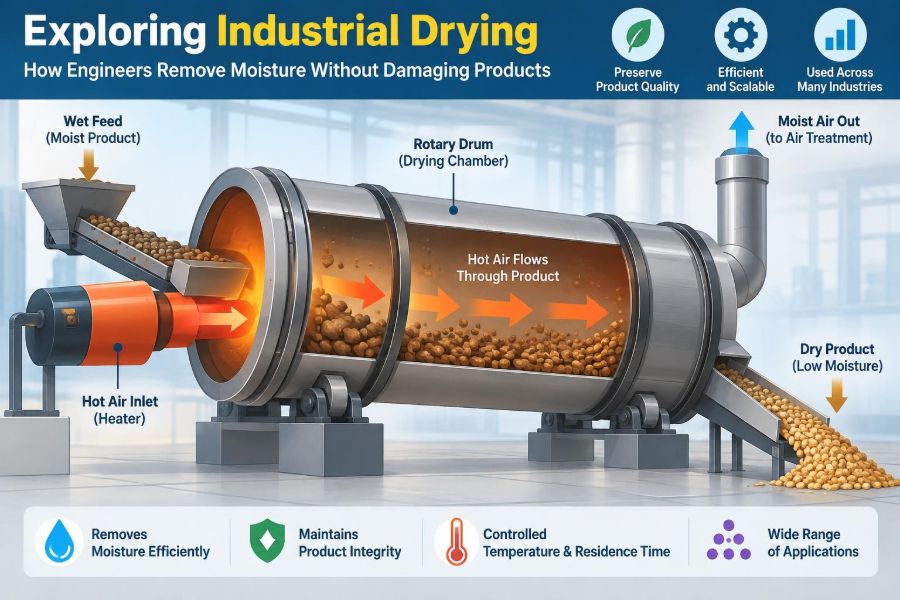
A rotary dryer is a slowly rotating inclined cylinder. Flights inside the drum lift and shower solids through a gas stream, creating repeated contact between particles and hot gas.
These systems handle large flows of minerals, biomass, fertilizer feedstocks, and other rugged bulk materials. They tolerate variable feed better than many precision dryers, but their size, dust generation, and possible product degradation make them less suitable for fragile or tightly specified materials.
🫧 Fluidized-Bed Dryers
In a fluidized bed, upward gas flow suspends particles so that the bed behaves somewhat like a boiling liquid. The particles mix intensely, exposing a large surface area and promoting rapid, relatively uniform heat and mass transfer.
Fluidized beds are widely used for granules, crystals, polymer pellets, and agglomerated powders. They can also cool products after drying. However, particles must have an appropriate size and density; very sticky, broad-size, or highly cohesive materials can fluidize poorly.
🌫️ Spray Drying: Making Powder from a Liquid
Spray drying atomizes a liquid feed into tiny droplets inside a hot gas stream. Because droplets have enormous surface area relative to volume, water can evaporate in seconds, leaving particles that are collected by cyclones, filters, or other separators.
Milk powder, instant coffee, detergents, ceramic powders, and some pharmaceutical excipients are familiar examples. The droplets are briefly exposed to hot inlet gas, but evaporative cooling can protect them while they remain wet.
Still, formulation matters. A sticky material may deposit on chamber walls, while an unsuitable atomizer can create particles with the wrong size, density, or dissolution behavior.
🪜 Belt and Conveyor Dryers
Belt dryers carry material through separate drying zones on a perforated conveyor. Zone-by-zone control makes them useful for pieces, flakes, fibrous materials, and products that should not be tumbled aggressively.
Early zones may use milder conditions to avoid crust formation, followed by stronger conditions once internal moisture can migrate safely. Bed depth is crucial: a deeper layer increases capacity per unit floor area but may create moisture gradients from top to bottom.
🧲 Vacuum Drying and Lower Boiling Temperatures
Reducing pressure lowers the temperature at which water boils. A vacuum dryer can therefore remove moisture at temperatures that are gentler than those required at atmospheric pressure.
This is useful for temperature-sensitive chemicals, extracts, pharmaceutical intermediates, and materials prone to oxidation. Vacuum is not a shortcut that eliminates all limitations: heat must still reach the product, vapor must be condensed or evacuated, and dense wet cakes can remain internally diffusion-limited.
❄️ Freeze-Drying for Fragile Structures
Freeze-drying, or lyophilization, freezes the product and removes ice by sublimation under vacuum. Sublimation is the direct change from solid ice to vapor, avoiding the liquid phase during primary drying.
The method can preserve porous structure and support rapid rehydration, making it valuable for certain biological, pharmaceutical, and specialty food products. Its equipment, refrigeration, vacuum control, and long cycle times make it substantially more demanding than conventional hot-air drying.
It is chosen when retained function or structure justifies the complexity, not simply because it is a more sophisticated method.
⚡ Microwave and Radio-Frequency Assistance
Microwave and radio-frequency systems heat materials volumetrically: electromagnetic energy can generate heat within the product rather than relying only on a hot surface or gas stream. This may speed internal moisture removal in thick or poorly conducting materials.
Uniformity is the engineering challenge. Field patterns, product geometry, changing moisture distribution, and load size can create hot spots. These technologies are often used as carefully controlled assistance to conventional drying rather than as a universal replacement for it.
🧯 When Inert Gas Becomes Necessary
Some organic solvents form flammable vapor-air mixtures, and some products oxidize or discolor in hot air. In those cases, a dryer may use nitrogen or another suitable low-oxygen gas, often within a closed-loop system.
This approach adds requirements for oxygen monitoring, leak control, vapor recovery, pressure management, and reliable interlocks. Inerting reduces one hazard but does not remove the need for a full process safety review; combustible dust and static electricity may still be relevant.
💥 Dust, Explosions, and Powder Handling
Fine combustible powders can create an explosion hazard when dispersed in air with an ignition source inside an enclosed space. Dryers, cyclones, ducts, filters, and transfer points deserve careful attention because they can contain dust clouds, hot surfaces, mechanical sparks, or static charge.
Risk management may involve containment, grounding and bonding, ignition-source control, explosion venting or suppression, isolation between equipment, and suitable housekeeping. The appropriate safeguards depend on the specific material and facility; they should be based on competent testing and engineering assessment rather than assumptions about a powder being harmless.
🌍 Energy Use and Heat Recovery
Evaporating water requires substantial energy, so dryers are often among the largest thermal loads in a plant. The fundamental energy requirement cannot be avoided, but losses can be reduced.
Useful measures include insulating hot surfaces, minimizing air leakage, recovering heat from exhaust where practical, preconcentrating feeds mechanically, and controlling exhaust flow instead of running fans at unnecessarily high rates. Heat recovery must be balanced against fouling, corrosion, contamination risk, and the falling temperature difference available for transfer.
🧮 Start with Mechanical Dewatering
Whenever a slurry or wet solid can be thickened, filtered, pressed, or centrifuged before entering the dryer, the thermal duty may be reduced dramatically. Mechanical liquid removal is usually far less energy-intensive than evaporation.
A practical process sequence might be filtration followed by cake washing, pressing, and final thermal drying. The best arrangement depends on whether the product can tolerate pressure, whether filtrate is valuable, and whether washing introduces additional water that later must be removed.
📏 Measuring Moisture During Production
Loss-on-drying tests, oven methods, infrared instruments, capacitance probes, and near-infrared sensors are among the tools used to measure moisture. Each responds differently to material composition, particle size, temperature, and how water is bound.
An online instrument can provide fast trends, while a validated laboratory method may provide the release value. Good control depends on calibration against representative samples. A sensor that works well on one formulation may give biased results after a raw-material or particle-size change.
🎛️ The Controls That Keep Drying Stable
Key control variables commonly include inlet gas temperature, exhaust temperature, humidity, airflow, pressure, feed rate, atomizer speed, bed depth, and residence time. Which variables matter most depends on the dryer and product.
Exhaust temperature is often informative because it reflects the balance between incoming heat and evaporation. But it is not a direct moisture measurement. A change in feed temperature, solids concentration, airflow, or ambient humidity can alter the same reading for different reasons.
Robust control combines instruments with process understanding, operating limits, sampling plans, and response procedures for disturbances.
🧫 Protecting Color, Flavor, Potency, and Function
Heat exposure can trigger browning, oxidation, loss of volatile aroma compounds, crystal changes, polymer degradation, or reduced biological activity. Damage may depend not only on peak temperature but also on time, oxygen level, local moisture, and pH.
A product may look acceptable immediately after drying but change during storage because the drying cycle left an unfavorable structure or moisture distribution. For sensitive products, quality development should include stability testing and reconstitution, flow, texture, or activity tests—not just a final moisture result.
⚖️ Choosing a Dryer Is a Multi-Variable Decision
Equipment selection begins with the material: particle size, stickiness, heat sensitivity, solvent content, dust behavior, corrosiveness, feed form, and desired final structure. Throughput, batch versus continuous operation, cleaning requirements, utility availability, and emissions also matter.
A useful first question is not “Which dryer is most efficient?” but “What must the product be when it leaves the dryer?” A free-flowing powder, intact granule, porous cake, stable crystal, and dry wood board may each demand very different process paths.
🚫 Common Drying Mistakes
Many drying problems arise from treating the process as a single temperature setting rather than a coupled system. Frequent mistakes include:
- Using excessively hot inlet air to solve a residence-time problem.
- Ignoring humid ambient air and seasonal changes in drying capacity.
- Measuring only average moisture while missing wet pockets or overdried fines.
- Overloading a bed, tray, or conveyor and blocking uniform airflow.
- Skipping mechanical dewatering before thermal drying.
- Assuming a new formulation will behave like an older product without pilot testing.
- Neglecting dust collection, cleaning access, and safe startup or shutdown procedures.
These failures are often preventable when operating data are connected to product observations instead of viewed separately.
🔬 Pilot Trials and Scale-Up
Drying scale-up is challenging because airflow patterns, wall losses, mixing, droplet trajectories, and residence-time distributions can change with equipment size. A laboratory sample that dries well in a thin layer may form an insulating bed or sticky deposits at production scale.
Pilot trials should reproduce the most relevant conditions: feed properties, loading depth, gas humidity, inlet temperature, and collection method. They should also examine off-normal conditions, such as brief feed interruptions or wetter-than-usual incoming material.
Models are valuable for estimating duties and trends, but empirical product testing remains essential where physical structure or quality is sensitive.
🧹 Cleaning, Fouling, and Hygienic Design
Sticky deposits reduce heat transfer, narrow flow paths, contaminate later batches, and may become a safety concern in hot equipment. Spray dryers and vacuum systems are particularly vulnerable when a formulation approaches a sticky or glass-transition region.
Hygienic dryers need drainable geometry, accessible inspection points, appropriate surface finishes, and cleaning methods that actually reach product-contact areas. Cleaning-in-place can improve repeatability, but its effectiveness must be verified for the specific soil and equipment design.
📚 A Practical Troubleshooting Sequence
When outlet moisture drifts, start by separating a feed change from an equipment change. Check feed rate, initial moisture, solids concentration, particle size, and feed temperature before changing dryer settings.
- Confirm that moisture measurement and sample handling are reliable.
- Compare current inlet and exhaust temperature, humidity, pressure, and airflow with normal operation.
- Inspect for plugged distributors, air leaks, fouling, abnormal deposits, or poor material movement.
- Review recent changes in raw materials, formulation, maintenance, and operating sequence.
- Make controlled adjustments and verify both moisture and product quality.
Changing several variables at once can restore the product temporarily while hiding the original cause.
🧠 The Core Principle: Remove Water, Preserve Value
Industrial drying succeeds when energy delivery, moisture movement, equipment behavior, and product quality are considered together. A faster drying rate is useful only if the product remains safe, functional, stable, and within specification.
The most effective strategy is usually to remove easy water mechanically first, select a dryer that matches the material, use conditions that respect the falling-rate period, and measure the quality attribute that truly defines success. Engineers are not simply operating heaters; they are controlling the final properties of a material.
The central lesson is simple: the best drying process removes only the moisture that must go, at a rate and by a method the product can tolerate.
When drying is designed around both transport phenomena and product behavior, moisture removal becomes a controlled manufacturing step rather than a gamble with quality. 🧪💨🏭