
A new process plant can look complete long before it is truly ready to operate. Pumps are installed, piping is connected, instruments appear on drawings, and procedures are being prepared. Yet a single valve left closed, a blocked vent, or a control loop acting in the wrong direction can turn an ordinary startup step into a serious process safety event.
Most major process incidents are not caused by one spectacularly unlikely equipment failure. They emerge when understandable design features, operating assumptions, human actions, and abnormal conditions interact in a way nobody fully examined.
A Hazard and Operability Study, usually called a HAZOP, is a structured way to look for those interactions before chemicals, pressure, heat, and energy enter the system. It asks disciplined “what if?” questions of a process design, then records what could happen and what should be improved.
For students, HAZOP shows how process diagrams become real safety decisions. For working professionals, it is a practical checkpoint: a chance to find hidden risks while changes are still far easier to make than they will be after commissioning.
🔎 What a HAZOP Study Is Designed to Do
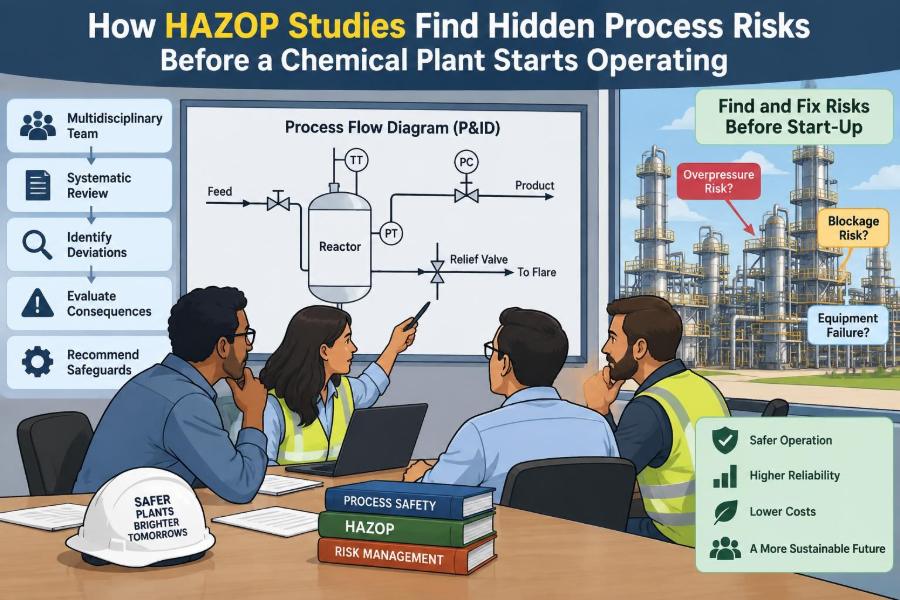
HAZOP is a systematic, team-based review of how a process may deviate from its intended design. The team examines sections of a plant, called nodes, and combines process parameters with guide words to generate credible deviations.
It is not simply a checklist of hazards and it is not a promise that every conceivable failure will be found. Its strength is structure: it makes the team challenge normal assumptions in a repeatable way.
🏭 Why the Review Happens Before Operation
Finding a hazard during design may require changing a line size, adding a relief path, revising logic, or improving access. Finding the same issue during startup can mean shutdown, rework, schedule pressure, and exposure to live hazardous materials.
A pre-startup HAZOP also tests whether the design is operable, not merely buildable. An operator must be able to isolate equipment, drain it, vent it, sample it, and respond to alarms without creating another problem.
🧩 The Intended Design Is the Starting Point
Every HAZOP begins with design intent: a concise statement of what a part of the plant is meant to do under defined conditions. For example, a feed line may be intended to deliver a specified liquid flow from a storage tank to a reactor at controlled pressure.
Without a clear intent, “more flow” or “reverse flow” has no useful meaning. The team must know normal flow direction, expected composition, operating limits, control objectives, and relevant modes such as startup or cleaning.
🗺️ P&IDs Provide the Map for Discussion
The principal drawing in a HAZOP is usually the piping and instrumentation diagram, or P&ID. It shows process equipment, lines, valves, instruments, control loops, relief devices, and many connections that a simplified process flow diagram does not show.
However, drawings alone are not enough. The team also needs process descriptions, line lists, cause-and-effect charts, relief information, operating philosophy, and control narratives. A HAZOP can only be as sound as the design information it reviews.
🧭 Nodes Keep a Complex Plant Manageable
A node is a manageable portion of the process chosen for review. It might be the suction piping to a pump, a reactor and its jacket, a distillation column overhead system, or a transfer line between two vessels.
Good node boundaries matter. A node that is too large encourages vague discussion; one that is too small can hide interactions across an interface. Natural boundaries often occur at major equipment, control valves, branches, or clear changes in process function.
🗣️ Guide Words Turn Assumptions into Questions
Guide words are applied to parameters to prompt deviations from intent. Common pairings include No Flow, More Pressure, Less Temperature, Reverse Flow, and Other Than Composition.
The wording is deliberately simple. Its value lies in forcing a group to ask, “Could this happen here, what would cause it, and what follows?” rather than accepting that normal operation will continue as planned.
| Guide word | Typical interpretation | Example question |
|---|---|---|
| No | Complete absence | What if cooling water does not flow? |
| More | Higher quantity or condition | What if reactor pressure rises above normal? |
| Less | Lower quantity or condition | What if the feed rate is too low? |
| Reverse | Opposite direction | Can product flow back into a feed tank? |
| Other than | Wrong material or composition | What if water enters a moisture-sensitive line? |
⚙️ Parameters Give the Questions Technical Meaning
Flow, pressure, temperature, level, composition, phase, and reaction are common HAZOP parameters. Each parameter points to a different physical behavior and therefore different possible consequences.
“More temperature” in a heated storage tank may mean product degradation. In an exothermic reactor, it may indicate loss of heat removal, a rising reaction rate, gas generation, and pressure increase. Context determines significance.
🔗 Deviations Must Have Plausible Causes
A useful HAZOP does not stop at naming a deviation. The team identifies credible causes, such as a control valve failing shut, a manual valve being left closed, a pump trip, a plugged strainer, a utility loss, or an incorrect lineup.
Causes should be specific enough to test safeguards. “Human error” is rarely an adequate endpoint; it should be translated into a realistic action or condition, such as opening the wrong bypass during transfer.
💥 Consequences Follow the Physical Path
For each cause, the team follows the process response. What happens first? Does pressure rise, does a vessel empty, does a reaction continue, does a seal lose cooling, or does material reach an unintended destination?
This sequence helps distinguish a harmless deviation from one that can cause release, fire, toxic exposure, equipment damage, environmental impact, or a difficult recovery. Consequences should include the effect if existing safeguards do not work when demanded.
🛡️ Safeguards Are Not Just Items on a Drawing
Existing safeguards may include alarms, automatic trips, relief valves, containment, check valves, procedures, and operator rounds. During HAZOP, the team asks whether each safeguard is independent, reliable enough for its role, and actually capable of interrupting the scenario.
An alarm is not automatically protection. It depends on detection, clear indication, available response time, an operator who can act, and a final action that works. A high-pressure alarm cannot replace a relief device where pressure can rise quickly.
🚨 Alarms Need Time and a Real Response
Consider a hypothetical reactor whose cooling-water supply is lost. A high-temperature alarm may help if temperature rises slowly and an operator can stop feed, initiate emergency cooling, or quench the reaction in time.
If the reaction accelerates faster than manual action can be taken, the alarm is awareness rather than prevention. The design may need an automatic shutdown, an independent trip, emergency cooling capacity, or another engineered layer.
🌡️ Exothermic Reactions Demand Special Attention
Many chemical reactions release heat. As temperature rises, reaction rate may increase; faster reaction releases more heat, creating a potentially self-reinforcing condition. HAZOP discussions examine loss of cooling, excessive reactant addition, wrong concentration, agitation loss, and delayed quenching.
The team should also ask what happens after a trip. Stopping feed may not stop heat generation immediately if reactive inventory remains. Relief design, vent destination, decomposition behavior, and containment may all require separate specialist analysis.
🌊 Pressure Relief Is More Than a Relief Valve Symbol
A pressure relief device protects only against scenarios for which it is designed and sized. HAZOP can identify demands such as blocked outlet, thermal expansion of blocked-in liquid, external fire, control-valve failure, gas blowby, or runaway reaction.
It also asks where the discharge goes. Sending flammable or toxic material to a closed drain, an undersized header, or an unsuitable vent system can transfer rather than solve the hazard. Detailed relief calculations are usually performed outside the meeting.
🔄 Reverse Flow Creates Quiet but Serious Hazards
Reverse flow can contaminate raw materials, overfill an upstream vessel, expose a low-pressure system to high pressure, or send reactive material into a utility line. It may occur after pump shutdown, pressure imbalance, siphoning, or an incorrect valve lineup.
Check valves can help, but they are not magical one-way barriers. Their location, failure mode, maintenance condition, and isolation arrangements all matter. In some services, physical breaks or carefully designed interlocks provide stronger separation.
🧪 Wrong Material Can Change the Entire Scenario
“Other than composition” captures contamination, wrong batch addition, residual cleaning fluid, nitrogen entering an oxygen-required process, or water entering a water-reactive system. Composition deviations often arise at shared connections, hose transfers, sampling points, and tank farms.
These cases deserve chemical compatibility knowledge, not just a review of piping direction. The question is not only whether the wrong material can enter, but whether it reacts, changes vapor pressure, affects product quality, or disables an analytical measurement.
⚡ Utilities Are Part of the Process
Steam, cooling water, chilled water, electricity, instrument air, nitrogen, vacuum, and flare services are often treated as background infrastructure. In reality, their loss or unexpected presence may be the initiating cause of a process upset.
A loss of instrument air can move different control valves to their fail positions. The HAZOP must consider the combined result, not each valve in isolation. A safe fail-closed feed valve may be problematic if it simultaneously blocks a necessary cooling flow.
🧠 Control Systems Can Introduce New Failure Paths
Automation reduces routine workload, but it can also obscure how the plant will behave during sensor failure, bad configuration, communication loss, or a controller placed in manual mode. HAZOP reviews intended control actions and abnormal responses.
For example, a level controller may open an outlet valve when level rises. If a transmitter incorrectly reads high, that action may empty a vessel and starve downstream equipment. Instrument failure should be considered alongside mechanical failure.
👷 Operations Knowledge Makes the Review Realistic
Operators and experienced operations representatives understand field access, routine lineups, difficult valves, ambiguous indications, and the workarounds people may be tempted to use. Their input often reveals operability problems invisible on a drawing.
A design that needs several manual actions in a short upset may be technically possible but operationally weak. HAZOP should ask whether actions can be performed safely under pressure, noise, poor visibility, protective clothing, or an alarm-heavy situation.
🧑🤝🧑 A Multidisciplinary Team Sees Different Risks
A typical HAZOP brings together a facilitator, process engineer, operations representative, control or instrumentation engineer, mechanical or maintenance specialist, project engineer, and a dedicated recorder. Additional expertise may be needed for chemistry, electrical systems, relief, or environmental matters.
No participant is expected to know everything. The value comes from constructive challenge: one person understands reaction behavior, another knows the shutdown logic, and another recognizes that a valve cannot be reached during a release.
🎯 The Facilitator Protects the Method
The facilitator keeps the review aligned with the node, parameter, and guide-word method. They make sure quiet assumptions are voiced, discussions remain evidence-based, and potentially important scenarios are not dismissed because they are inconvenient.
A good facilitator does not need to supply every technical answer. They need enough process-safety judgment to ask precise questions, recognize gaps, manage disagreement, and ensure that unresolved technical matters become clear actions.
📝 Recording Decisions Is a Safety Function
The HAZOP record normally captures the node, deviation, causes, consequences, existing safeguards, recommendations, responsible person, and completion status. A clear record lets later reviewers understand why a decision was made.
Weak records create false closure. “Review procedure” gives little direction; “confirm the startup procedure requires opening the reactor vent before introducing nitrogen, and verify in field checklist” is testable and assignable.
✅ Recommendations Need Ownership and Closure
A recommendation has value only when it is tracked to an appropriate resolution. Resolution may mean implementing a change, completing a calculation, revising a procedure, obtaining a justified technical decision, or documenting why no change is required.
Closing an action should include checking that the solution addresses the original scenario. Installing an alarm, for example, is not sufficient if the review never established who responds, how quickly, and whether response can prevent the consequence.
🔁 HAZOP Is Not the Same as Every Other Review
HAZOP overlaps with other process-safety activities but does not replace them. A What-If review may be more flexible and rapid. Failure Modes and Effects Analysis focuses strongly on component failure modes. Layer of Protection Analysis may evaluate whether safeguards reduce risk sufficiently.
HAZOP commonly identifies scenarios; other methods may quantify or examine selected scenarios in more detail. Relief design, hazardous-area classification, human-factors reviews, and procedures all require their own appropriate methods.
📊 Risk Ranking Helps Focus, but Has Limits
Teams may use a risk matrix to prioritize recommendations by considering consequence severity and likelihood. This can support consistency, but rankings are judgments, not precise predictions of future events.
Risk ranking should never be used to dismiss a scenario simply because its likelihood is hard to estimate. Scenarios involving high-consequence releases, uncertain reaction behavior, or weak safeguards often require further engineering even when frequency data are limited.
🚧 Common HAZOP Mistakes to Avoid
- Reviewing too early: missing control narratives, equipment details, or operating modes leaves major gaps.
- Reviewing too late: a nearly frozen design encourages defensive discussion and costly compromises.
- Accepting generic safeguards: “operator intervention” means little without time, indication, procedure, and access.
- Ignoring non-routine modes: startup, shutdown, draining, cleaning, maintenance, and temporary bypasses often create different hazards.
- Treating actions as paperwork: unresolved recommendations can leave known weaknesses in the operating plant.
🛠️ Design Changes Require Revalidation
A HAZOP reflects a particular design at a particular point in time. If piping, chemistry, control logic, operating limits, equipment capacity, or relief routing changes later, the original conclusions may no longer apply.
Management of change provides the bridge. The change should be screened to determine whether HAZOP findings need review, whether a focused hazard study is needed, and whether drawings, procedures, training, and testing must be updated before use.
🚀 Startup Is Where Paper Assumptions Meet Reality
Before introducing hazardous materials, a pre-startup safety review checks that required recommendations are complete or formally managed, equipment matches approved design, procedures are available, training is adequate, and safety-critical systems have been tested.
HAZOP identifies questions; startup readiness confirms that answers were put into practice. This distinction matters because an excellent study cannot protect a plant if its safeguards were never installed, calibrated, or function-tested.
📚 What Students Can Learn from a Simple Example
Imagine a solvent transfer pump feeding a reactor. “No flow” may result from an empty source tank, closed suction valve, plugged strainer, or pump failure. Consequences may include a batch composition error, a dry-running pump, or an operator opening a bypass under pressure.
“More flow” may result from a control valve failure or incorrect setpoint, leading to overfill or excessive reaction rate. This small example shows the logic: deviation, cause, consequence, safeguards, and action—not a guess that one device will always behave perfectly.
🧭 The Core Principle: Challenge the Intended Path
HAZOP is most effective when treated as disciplined curiosity rather than a meeting to approve a design. It asks what happens when material, energy, information, or control moves differently from the intended path.
The strongest studies connect process physics with practical operation: what can fail, how the plant responds, what prevents escalation, and whether people can safely manage what remains. That is how hidden risks become visible while there is still time to act.
A HAZOP does not make a chemical plant risk-free; it gives the design team a structured opportunity to understand deviations, strengthen safeguards, and enter operation with fewer dangerous assumptions. 🧪🛡️🏭