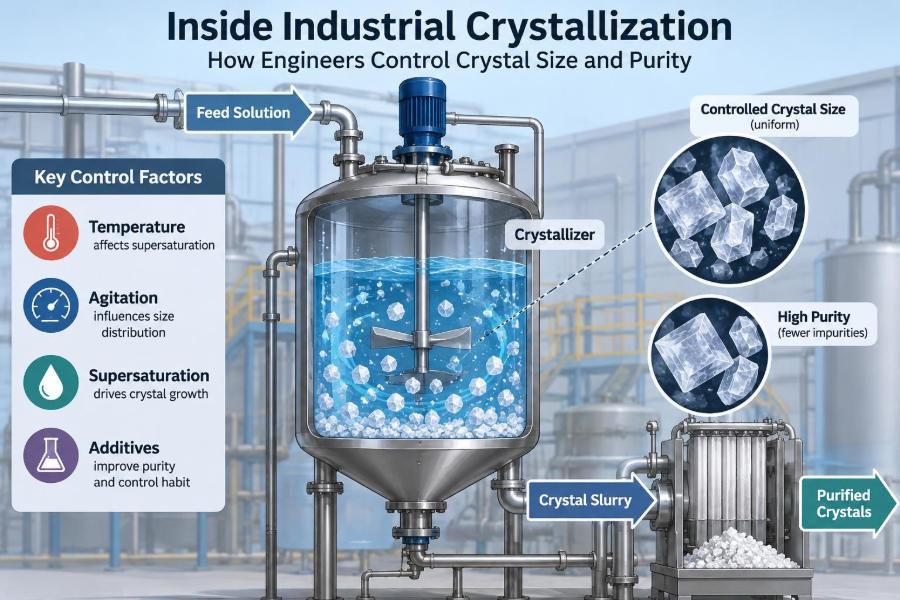

A bag of table salt, a dose of antibiotics, a semiconductor wafer, and a specialty pigment may look unrelated. Yet each can depend on crystallization: the deliberate formation of ordered solid particles from a liquid, vapor, or melt.
When crystallization goes well, the product filters easily, dries predictably, meets purity targets, and behaves consistently in the next manufacturing step. When it goes poorly, a plant may produce fine powder that blinds filters, oversized crystals that will not dissolve as intended, or material that traps unwanted impurities.
The challenge is not simply to “make crystals.” Industrial engineers must decide when crystals first appear, how many form, how fast they grow, and what gets incorporated into their structure.
That turns a familiar phenomenon—like sugar crystals forming in a cooling syrup—into a tightly managed separation process. The physics is elegant, but the operating decisions are highly practical.
🔬 What Industrial Crystallization Does
Crystallization is a separation and particle-engineering operation. A dissolved substance, called the solute, leaves a solution and arranges itself into a repeating solid lattice. The remaining liquid is the mother liquor.
In industry, the aim may be product recovery, purification, particle-size control, or all three. A crystallizer is therefore not just a vessel where solids happen to appear; it is equipment designed to control mass transfer, heat transfer, mixing, residence time, and solid handling.
🧂 Why Crystal Properties Matter Beyond Appearance
Crystal size affects filtration, washing, drying, flow through hoppers, dust formation, dissolution rate, and downstream blending. A narrow size distribution often gives more predictable handling than a mixture of fines and large agglomerates.
Purity is equally consequential. In pharmaceutical processing, a trace impurity can be unacceptable. In bulk chemicals, impurity specifications may be less stringent, but contamination can still affect color, reactivity, corrosion, or product performance.
💧 Solubility: The Starting Point for Every Design
Solubility describes the equilibrium amount of solute that can remain dissolved under specified conditions. For many solids in many solvents, solubility rises with temperature. Cooling then creates the opportunity to crystallize the excess solute.
That pattern is common, not universal. Some materials have relatively flat solubility curves, and others become less soluble as temperature rises. Engineers need measured solubility data for the actual solvent composition, not assumptions based on a chemically similar material.
📈 Supersaturation Is the Driving Force
A solution contains supersaturation when it holds more dissolved solute than is stable at equilibrium. This excess provides the thermodynamic driving force for crystal formation and growth.
Supersaturation can be expressed in several related ways, such as a concentration difference or ratio relative to saturation. The exact definition matters in models, but operationally the key idea is simple: too little supersaturation produces little growth; too much can create an uncontrolled burst of tiny crystals.
🗺️ Reading the Metastable Zone
Between the solubility curve and the point where spontaneous nucleation becomes rapid lies the metastable zone. A solution in this region can remain clear for a time, especially if it is clean and undisturbed, yet existing crystals can grow if introduced.
This zone gives engineers room to operate. A seeded crystallization can be held in a growth-favorable region, while an unseeded batch pushed too far into supersaturation may nucleate unexpectedly and generate excessive fines.
🌱 Nucleation Creates New Crystals
Nucleation is the birth of new crystal particles. Primary nucleation occurs without deliberately added crystals, while secondary nucleation results from the presence, collision, or breakage of existing crystals.
Because each nucleus can become a final particle, nucleation largely determines crystal number. For a fixed amount of recovered solid, many nuclei generally mean smaller crystals; fewer nuclei generally allow larger ones to grow.
⚖️ The Central Balance: Nucleation Versus Growth
Crystallizer control is often a balancing act between nucleation and growth. Growth consumes dissolved solute on surfaces that already exist. Nucleation creates new surface area that competes for that same solute.
A process that favors growth can yield fewer, larger crystals. A process that favors nucleation may recover material quickly but often produces fine particles and a broad, difficult-to-handle crystal-size distribution.
🌡️ Cooling Crystallization and Its Limits
Cooling crystallization lowers solubility by reducing temperature. It is widely used when the solubility-temperature curve is sufficiently steep and cooling can be achieved economically.
The cooling rate is critical. Fast cooling can generate high local supersaturation and nucleation, particularly near cooling surfaces. Controlled cooling, often combined with seeding, gives the system more time to deposit material onto selected crystals.
💨 Evaporative Crystallization for Flat Solubility Curves
If temperature has little effect on solubility, engineers can remove solvent instead. Evaporation concentrates the solute until supersaturation develops, often under vacuum to reduce boiling temperature and protect heat-sensitive materials.
Evaporative crystallization is common for some inorganic salts and high-throughput operations. Its trade-offs include steam demand, scaling risk on heat-transfer surfaces, and the need to manage boiling, entrainment, and slurry circulation.
🧪 Antisolvent Addition Changes the Solvent Environment
In antisolvent crystallization, a second liquid is added to reduce solubility. For example, a compound soluble in one solvent may crystallize when mixed with another liquid in which that compound is much less soluble.
This route can be valuable for temperature-sensitive compounds, but mixing becomes especially important. If antisolvent enters faster than it disperses, small regions experience intense supersaturation and can produce fines, agglomerates, or variable crystal forms.
🧊 Reactive Crystallization Couples Chemistry and Separation
Some crystals form when reactants are combined and a low-solubility product is created. Precipitation of an inorganic salt is a familiar example. Here, reaction rate, feed-point mixing, pH, and local concentration gradients all influence particle formation.
Reactive crystallization can be extremely fast. That makes it useful, but it also makes scale-up challenging: a feed strategy that works in a laboratory beaker may create severe local supersaturation in a large vessel.
🌰 Seeding Gives the Batch a Controlled Beginning
Seeding means adding a known amount of suitable crystals to a supersaturated solution. Those seed crystals provide growth surfaces and reduce reliance on unpredictable primary nucleation.
Seed quality matters. Seeds should have the desired crystal form, a suitable size range, and enough surface area to consume supersaturation at the planned operating rate. Too little seed can lead to fresh nucleation; too much can leave every crystal smaller than intended.
📏 Seed Loading and Size Distribution
Engineers select seed mass and seed-size distribution together. Fine seed has high surface area and can grow quickly, but it may be hard to retain during filtration. Coarser seed is easier to handle but provides less area for solute deposition.
A practical batch design often calculates a supersaturation trajectory and checks whether the available seed surface can support the projected growth rate. This is more reliable than using a seed amount copied from a different scale or solvent system.
🔄 Mixing Must Disperse Without Damaging Crystals
Mixing keeps temperature, concentration, and solids reasonably uniform. It also distributes seed and prevents settled solids from forming dense beds where caking or uncontrolled growth can occur.
More agitation is not always better. High shear can break fragile crystals, increase secondary nucleation, and create fines. The useful question is whether mixing removes harmful gradients without causing unacceptable attrition.
🌀 Feed Location Can Decide Product Quality
In continuous antisolvent or reactive systems, where a feed enters can matter as much as how much is added. Introducing feed into a well-mixed, high-turbulence region usually reduces the time that extreme concentration pockets exist.
Poor feed placement may create a plume of high supersaturation. Crystals born in that plume can differ in size, shape, or impurity content from crystals formed in the bulk liquid, even when the vessel-average composition appears correct.
🔥 Heat Transfer Creates Local Operating Conditions
Jackets, coils, and external heat exchangers do more than set a vessel’s average temperature. Their surfaces can create local cooling, heating, or evaporation conditions that differ from bulk measurements.
For cooling crystallization, a very cold wall can generate crystals on the surface rather than in the intended slurry. For evaporative service, heat-transfer surfaces may scale when concentration near the wall becomes too high. Circulation and modest driving forces help reduce these risks.
🧱 Crystal Growth Is Not Always Uniform
Crystal faces do not necessarily grow at the same speed. Differences in molecular attachment lead to characteristic shapes such as needles, plates, prisms, or more equant particles.
Shape matters operationally. Needle-like crystals may form mats that drain poorly, while compact crystals often filter more easily. Solvent choice, impurities, additives, temperature, and supersaturation can all alter relative face-growth rates.
🧬 Polymorphs Change the Meaning of “Pure”
A polymorph is a different crystal arrangement of the same chemical substance. Polymorphs can have different density, solubility, stability, filtration behavior, and dissolution characteristics.
Purity by chemical assay does not guarantee the intended solid form. A crystallization process may need controls for seed form, temperature history, solvent composition, and drying conditions to avoid unwanted transformation or mixed polymorph populations.
🧹 Impurities Follow Different Pathways
Impurities may remain dissolved in the mother liquor, adsorb onto crystal surfaces, become trapped in liquid pockets, or enter the crystal lattice. The last mechanism, often called inclusion or solid solution behavior, can be particularly difficult to remove by simple washing.
An impurity’s behavior depends on its chemistry, concentration, molecular size, charge, and similarity to the desired solute. A crystallization route must therefore be developed around the actual impurity profile, not only the target compound.
🚿 Washing Removes Mother Liquor, Not Every Defect
After filtration or centrifugation, crystals retain mother liquor between particles and sometimes within agglomerates. A properly selected wash displaces this liquid and can substantially reduce soluble surface contamination.
However, a wash can dissolve product, change polymorph, or cause crystal cracking if its composition and temperature are poorly chosen. The best wash is usually one that balances impurity removal against product loss and solid-form risk.
🪨 Agglomeration and Breakage Reshape the Product
Crystals can collide and stick together, especially when slurry solids are high or small crystals bridge larger particles. Agglomerates may look like large particles in a sieve analysis but can break apart during pumping, drying, or use.
Conversely, pumping through restrictive valves or applying aggressive stirring can fracture crystals. A particle-size specification should therefore be checked at the point that matters—after the relevant handling steps—not only at crystallizer discharge.
🏭 Batch and Continuous Crystallizers Serve Different Needs
Batch crystallizers are flexible and well suited to variable campaigns, complex recipes, and products requiring carefully programmed temperature or solvent profiles. They also allow individual batches to be isolated if something deviates.
Continuous crystallizers can provide steady operation and more uniform average conditions, but they require stable feeds and robust control. Start-up, residence-time distribution, and fines removal are central design concerns.
⚙️ Common Crystallizer Configurations
Equipment selection depends on slurry properties, heat-transfer needs, scale tendency, and desired size distribution. No vessel geometry is universally best.
| Configuration | Typical strength | Common challenge |
|---|---|---|
| Stirred batch vessel | Flexible recipes and easy seeding | Batch-to-batch variation if profiles drift |
| Draft-tube or forced-circulation unit | Good slurry suspension and heat-transfer control | Energy use and potential crystal attrition |
| Vacuum evaporative crystallizer | Solvent removal at lower temperature | Boiling stability and scaling management |
| Fluidized-bed crystallizer | Can promote growth of larger particles | Requires reliable classification and circulation |
📊 Measuring Crystal Size Means Choosing the Right Metric
“Average particle size” can conceal a problematic distribution. A sample with a few large crystals and many fines may have the same average as a narrow, well-controlled population, yet filter and flow very differently.
Sieving, microscopy, laser diffraction, image analysis, and focused-beam techniques can each provide useful information. Results depend on sampling and method assumptions, especially for needles, agglomerates, and irregularly shaped crystals.
👁️ Process Analytical Technology Improves Visibility
Inline or at-line measurements can help operators see concentration, turbidity, particle trends, temperature, and sometimes solid-form changes while a batch is running. This supports earlier intervention than waiting for final laboratory results.
These tools are not automatic truth machines. Optical signals may be affected by bubbles, fouling, particle shape, and high solids content. They need calibration, thoughtful installation, and confirmation against representative samples.
🧮 Population Balances Turn Particle Behavior into Models
A population balance model tracks how a crystal population changes through nucleation, growth, agglomeration, breakage, and removal. Rather than representing all crystals by one average size, it represents a size distribution.
Such models can guide cooling profiles, seed plans, and continuous-crystallizer design. Their quality depends on kinetic inputs and reliable measurements, so they are most useful when treated as engineering tools to test assumptions, not as perfect predictors.
🧯 Common Operating Mistakes and Their Consequences
- Cooling too quickly: creates excess supersaturation and a surge of fines.
- Using inconsistent seed: causes variable nucleation, size, or polymorph outcomes.
- Ignoring slurry viscosity: weakens mixing and creates temperature or concentration gradients.
- Sampling poorly: gives misleading size or purity data because solids settle and segregate.
- Optimizing yield alone: can sacrifice filtration, wash efficiency, and final product quality.
These failures often interact. For example, too many fines raise cake resistance, which leaves more mother liquor after filtration and can then appear as a purity problem.
🛠️ A Practical Development Sequence
Process development usually begins with solubility, metastable-zone, and solid-form information across the intended operating range. Engineers then evaluate impurity behavior, seed response, mixing sensitivity, and achievable filtration and washing performance.
- Define product requirements for assay, crystal form, size, and handling.
- Measure equilibrium behavior in realistic solvent mixtures.
- Select a crystallization route and establish a controlled supersaturation profile.
- Test seed type, loading, and addition point.
- Confirm that isolation, washing, and drying preserve the desired product.
- Evaluate scale-up with attention to mixing and heat-transfer differences.
📐 Scale-Up Is More Than Making the Tank Bigger
A larger vessel has different circulation paths, mixing times, heat-transfer area per unit volume, and hydrostatic pressure. Matching agitator revolutions per minute alone rarely reproduces the small-scale environment.
Scale-up should focus on the phenomena that govern the product: local energy dissipation near feed points, suspension quality, wall cooling, residence-time distribution, and crystal breakage. Pilot trials are useful precisely because they expose interactions that simple geometric scaling misses.
♻️ Solvent Recovery and Mother-Liquor Management
Mother liquor contains residual product, impurities, and often valuable solvent. Recycling it can improve material efficiency, but repeated recycling may allow impurities to accumulate until they alter crystal growth or purity.
A sustainable process considers purge strategy, solvent recovery, energy for cooling or evaporation, and wastewater treatment from the beginning. The lowest-solvent process is not automatically the lowest-impact process if it demands excessive energy or produces difficult waste streams.
🦺 Safety Starts with the Whole Slurry System
Crystallization can involve flammable solvents, vacuum equipment, hot concentrated solutions, corrosive materials, and dust generated during drying or milling. Hazard assessment must cover the full process, not just the crystallizer.
Solid accumulation can block lines, overload agitators, or alter pressure behavior. Procedures should address start-up, shutdown, sampling, cleaning, loss of agitation, and unexpected cooling or evaporation. Site-specific engineering and safety review remain essential.
🎯 The Core Principle: Control Supersaturation in Space and Time
The most useful unifying idea is that crystal quality follows the history of supersaturation. Engineers seek to create it at a controlled rate, distribute it uniformly, and direct it toward growth on the desired crystals rather than accidental nucleation.
That requires coordinated control of solvent composition, temperature, evaporation, feed addition, seeding, mixing, and downstream isolation. There is no single “correct” crystal size: the target depends on what the product must do next.
Industrial crystallization succeeds when thermodynamics, transport phenomena, and solid-particle behavior are managed as one connected system. A clear solubility curve and a good seed are valuable, but consistent crystals ultimately come from controlling the entire journey from solution to dry solid. 🧪⚙️🌱