
A packet of instant coffee that wakes up in seconds, a shelf-stable vial of medicine, and a lightweight meal carried on a long expedition may seem unrelated. Each can depend on the same deceptively careful separation process: removing water without turning the product into a shrunken, overheated, damaged version of itself.
Ordinary drying works well for many materials. Warm air can evaporate water from lumber, grains, or laundry. But for a heat-sensitive drug, a delicate biological sample, or food with a porous structure, liquid water can be part of the problem: as it leaves, surfaces collapse, ingredients migrate, and heat can cause degradation.
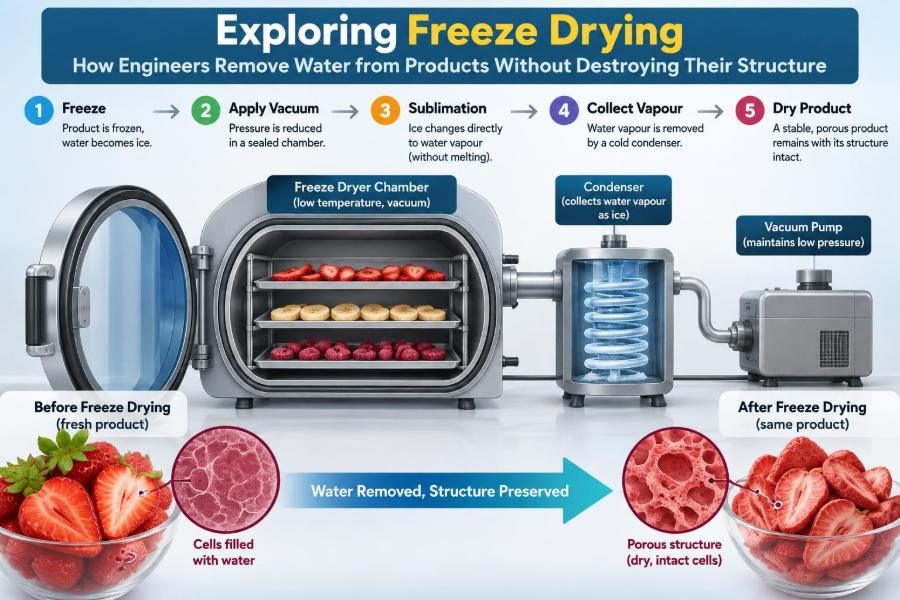
Freeze drying, also called lyophilization, takes a different route. It freezes the water first, then removes it as vapor under low pressure. The process is energy-intensive and technically demanding, but it can preserve shape, enable rapid rehydration, and extend stability for selected products.
For chemical engineers, freeze drying is a rich example of thermodynamics, heat transfer, mass transfer, formulation science, equipment design, and process control meeting in one operation.
🧊 What Freeze Drying Actually Means
Freeze drying removes a solvent, usually water, from a frozen product by sublimation. Sublimation is the direct transition from solid to vapor, without passing through the liquid state under the operating conditions.
A typical cycle has three broad stages: freezing, primary drying, and secondary drying. The first creates ice, the second removes that ice, and the third removes water that remains bound or adsorbed within the product.
The goal is not simply “very dry.” Engineers seek an acceptable combination of residual moisture, product structure, chemical stability, biological activity, reconstitution time, and process cost.
🌡️ Why Ordinary Evaporation Can Damage Products
When liquid water evaporates, dissolved ingredients can become concentrated near a receding liquid surface. Salts may crystallize, proteins may unfold, and a soft matrix may shrink as capillary forces pull pore walls inward.
Heating also creates risk. Many pharmaceuticals, enzymes, vaccines, flavors, and microorganisms are sensitive to temperature exposure, even if they survive brief periods at a higher temperature.
Freeze drying avoids much of the liquid-phase movement during the main moisture-removal step. That does not make it universally gentle: freezing itself can damage a formulation. It does, however, offer a useful route when preserving a dry, open, readily rehydratable structure matters.
🔺 The Phase Diagram Behind the Process
A phase diagram maps the combinations of temperature and pressure at which a substance exists as solid, liquid, or vapor. Water’s diagram is central to freeze-dryer design because it tells engineers when ice can sublime rather than melt.
The key landmark is the triple point, where solid, liquid, and vapor water can coexist. Below the triple-point pressure, liquid water is not stable. If frozen water receives enough heat at sufficiently low pressure, it can leave as vapor.
Real formulations complicate this picture. Solutes lower the freezing point and alter the thermal behavior of the frozen matrix, so engineers work with the product formulation rather than with pure-water values alone.
❄️ Stage One: Freezing Builds the Product Structure
Freezing is not merely preparation for drying. It establishes the ice-crystal pattern that becomes the pore network after sublimation. Those pores determine vapor flow resistance and strongly influence primary-drying time.
As ice forms, it usually excludes most dissolved solutes. The unfrozen regions become increasingly concentrated, producing a freeze-concentrated phase containing ingredients, salts, sugars, buffers, and other excipients.
A controlled freezing profile can improve consistency from vial to vial. Uncontrolled supercooling, variable fill depth, or uneven shelf contact can produce different ice structures across a batch, making the later drying stages harder to predict.
🧬 Ice Crystals Are a Design Variable
Slow cooling often gives ice crystals more time to grow, creating larger pores. Larger pores can reduce resistance to vapor escape and shorten primary drying, but they may create an appearance or texture that is unsuitable for a particular product.
Rapid cooling tends to generate smaller crystals and a finer pore structure. This may be desirable for some products, yet it can make vapor transport slower because the escaping vapor encounters narrower passages.
The best ice morphology depends on the product. A porous food, a protein formulation in a vial, and a bulk intermediate may each favor a different freezing strategy.
🧪 Formulation Controls More Than Ingredients
In pharmaceutical freeze drying, excipients are often included to stabilize the active ingredient during freezing and drying. Sugars, bulking agents, buffers, and surfactants may each affect stability, cake structure, or reconstitution behavior.
A useful formulation must also be processable. A product that is chemically stable but collapses during drying, forms an unattractive cake, or rehydrates poorly may not be commercially viable.
Concentration matters too. Higher solids can reduce the amount of water that must be removed, but they can increase viscosity, affect freezing behavior, and make the dried matrix more resistant to vapor flow.
🧱 Crystalline and Amorphous Solids Behave Differently
Some solutes crystallize during freezing. Others form an amorphous, glass-like solid with no long-range crystal order. This distinction changes the temperatures that define a safe drying path.
Crystalline systems are often discussed using a eutectic melting temperature, below which the frozen structure remains solid. Amorphous systems are commonly limited by a glass-transition-related collapse temperature, above which the concentrated matrix can soften and lose structure.
Products may contain both types of behavior. Thermal analysis is therefore valuable, but it must be interpreted alongside actual drying trials rather than treated as a complete prediction of production behavior.
📉 Why Vacuum Is Necessary
Vacuum lowers the chamber pressure so that ice can sublime. It also helps pull water vapor away from the product surface, maintaining a driving force for mass transfer.
Low pressure alone does not dry a product quickly. Sublimation consumes substantial energy, so heat must be delivered to the frozen product at a controlled rate. Too little heat causes an unnecessarily long cycle; too much can melt or collapse the product.
Vacuum systems must also manage leaks, non-condensable gases, and changing vapor loads. Even small amounts of air can reduce heat-transfer behavior and interfere with pressure measurement.
🔥 Primary Drying Removes the Visible Ice
During primary drying, heat supplied through shelves, radiation, and limited gas conduction provides the energy needed for ice sublimation. A moving boundary separates the dried layer from the still-frozen region below.
Water vapor travels through the growing dry layer, then leaves the product chamber. Because this layer becomes thicker over time, resistance increases as primary drying progresses.
The engineering challenge is to keep product temperature below its critical limit while transferring enough heat to maintain a practical sublimation rate. This balance is the central operating problem of primary drying.
🧭 The Drying Front Moves Through the Product
Imagine a vial containing frozen solution on a temperature-controlled shelf. Drying generally begins at the exposed top surface, and the sublimation interface gradually moves downward toward the vial bottom.
The dry cake above that interface is not inert from a transport perspective. Its pores form the pathway for vapor, and their size, tortuosity, thickness, and occasional blockage determine resistance.
In bulk trays, the geometry is different but the principle remains: as the frozen zone becomes farther from the escaping surface, heat and mass transfer become more difficult. Fill depth can therefore have a large effect on cycle duration.
⚖️ Heat Transfer and Mass Transfer Must Match
Freeze drying is often introduced as a phase-change process, but its performance comes from coupled transport. Heat arrives at the product; ice absorbs that energy to sublime; vapor moves outward; the condenser captures it.
If heat transfer is increased without adequate vapor removal, product temperature can rise. If vapor transport is strong but insufficient heat is supplied, sublimation slows. Equipment, vial geometry, shelf temperature, chamber pressure, and formulation all shape this balance.
Engineers do not optimize one variable in isolation. A setting that speeds one product may damage another product with a lower collapse threshold or denser dried matrix.
🧊 The Condenser Is the Dryer’s Water Trap
Water vapor must be captured before it reaches the vacuum pump in excessive amounts. A cold condenser provides a surface where vapor deposits as ice, keeping chamber pressure low and protecting downstream equipment.
Condenser temperature and capacity must suit the vapor load. If the condenser becomes too warm or overloaded, its ability to collect vapor declines and chamber pressure control can suffer.
Condenser performance also affects cycle planning. A process may be limited not only by the product’s drying rate but by how much ice the system can safely accumulate during a run.
🧯 Collapse Is More Than a Cosmetic Defect
When product temperature exceeds a formulation-specific structural limit during primary drying, the dried matrix can soften and collapse. The result may look shrunken, glossy, or melted rather than porous.
Collapse can reduce surface area and slow rehydration. It may also change moisture distribution and, depending on the product, create stability concerns. Appearance alone is not always a complete quality assessment, but it can be an important diagnostic signal.
A controlled process sometimes operates near the product limit to gain speed. That choice requires evidence that the resulting product still meets quality requirements; it is not a general shortcut.
💧 Secondary Drying Removes Bound Water
At the end of primary drying, most ice is gone, but water remains associated with solids through adsorption, capillary retention in very small pores, or molecular interactions. This water is removed during secondary drying.
Secondary drying usually involves raising product temperature while maintaining low pressure. The mechanism is largely desorption rather than sublimation, so the thermal constraints and moisture-removal rate differ from those in primary drying.
Driving residual moisture as low as possible is not automatically best. Excessive temperature or dwell time can damage sensitive materials, while some formulations require a small amount of moisture to retain desirable physical properties.
🧫 Residual Moisture Is a Quality Attribute
Residual moisture influences chemical degradation, physical aging, powder flow, container interactions, and reconstitution. Its acceptable range is product-specific rather than universal.
Too much moisture can increase molecular mobility in an amorphous material, allowing degradation reactions or structural changes to proceed more readily. Too little moisture can also be problematic for certain biologically derived materials or fragile matrices.
Moisture methods must be appropriate to the sample and target range. Karl Fischer titration is commonly used for low water contents, while process measurements and other analytical tools help build a broader understanding of the drying endpoint.
📦 Containers Change the Process
A vial, stopper, tray, ampoule, and bulk container do not present the same transport conditions. Vial diameter, fill volume, glass properties, stopper design, and placement on the shelf can all influence heat transfer and drying uniformity.
In vial drying, edge vials often receive more radiative heat from chamber walls than center vials. This can make them warmer and faster drying, creating a familiar scale-up and uniformity challenge.
Container closure also matters after drying. A well-designed cake can still lose quality if it absorbs moisture or oxygen during stoppering, handling, storage, or reconstitution.
🏭 What a Freeze Dryer Contains
A production freeze dryer typically includes a product chamber with temperature-controlled shelves, a condenser, a vacuum system, refrigeration equipment, instrumentation, and a control system. Pharmaceutical systems may also include specialized cleaning, sterilization, and containment features.
Stoppering can occur inside the chamber by lowering shelves onto partially inserted stoppers after drying. This allows vials to be sealed under vacuum or after backfilling with a suitable inert gas.
The equipment is therefore more than a cold vacuum oven. It is an integrated system designed to manage temperature, pressure, vapor flow, cleanliness, and container closure.
📏 Sensors Reveal Only Part of the Story
Thermocouples placed in selected vials can show product-temperature trends, but they measure only those locations and may alter local behavior slightly. They should not be mistaken for a complete map of every vial in the batch.
Pressure measurements can provide useful endpoint clues. For example, comparing gauges that respond differently to water vapor versus total gas can indicate whether sublimation is still significant, although interpretation depends on the system.
More advanced approaches may use tunable diode laser absorption spectroscopy, process models, or other process analytical technologies. Their value lies in improving understanding and control, not in eliminating the need for validation and sound engineering judgment.
🧮 Developing a Cycle Step by Step
Cycle development begins with the product, not with a copied shelf-temperature recipe. Engineers first characterize formulation behavior, identify likely thermal limits, and decide what final quality attributes matter most.
- Define formulation composition, fill volume, container, and target product profile.
- Study freezing behavior and relevant thermal transitions.
- Run conservative trials to observe cake appearance, temperature, moisture, and reconstitution.
- Adjust freezing, chamber pressure, shelf-temperature ramps, and hold times.
- Confirm robustness across expected variation in equipment, loading, and materials.
This iterative approach is slower than guessing, but it exposes the interactions that determine whether a cycle will be reliable beyond a single successful run.
🛠️ A Practical Example of the Trade-Off
Consider a hypothetical protein solution filled into vials. Raising shelf temperature may shorten primary drying by delivering more energy, but only until product temperature approaches the formulation’s collapse-related limit.
Lowering chamber pressure may improve some aspects of sublimation driving force, yet it can also reduce gas conduction between shelf and vial. The net result is not always intuitive, especially when radiation and vial contact contribute significantly to heat transfer.
The practical question is not “Which setting is highest or lowest?” It is “Which combination keeps the product within its safe thermal range while producing acceptable drying time and uniformity?”
⚠️ Common Development Mistakes
- Treating every product like water: solutes change freezing behavior, structural limits, and drying resistance.
- Ignoring freezing: a poorly controlled ice structure can make later drying inconsistent even with a carefully designed primary-drying step.
- Using only one monitored vial: edge and center locations may behave differently.
- Chasing the shortest cycle: a small time reduction is not worthwhile if it increases collapse, moisture variability, or failures.
- Assuming a dry-looking cake is acceptable: appearance must be supported by moisture, stability, reconstitution, and other relevant tests.
Most of these errors come from oversimplifying a coupled process. A well-designed experiment changes variables thoughtfully and connects observations to physical mechanisms.
🔄 Scale-Up Is Not a Simple Volume Increase
A laboratory dryer and a production dryer differ in shelf area, chamber geometry, condenser capacity, radiation environment, loading pattern, and control response. A cycle that works in a few vials may shift when hundreds or thousands of vials are loaded.
Equipment-to-equipment transfer adds another challenge. Nominally identical shelf temperatures or chamber pressures do not guarantee identical product conditions because heat-transfer characteristics and instrumentation can differ.
Robust scale-up uses mechanistic understanding, representative loads, and carefully selected operating ranges. It does not rely solely on matching setpoints from a smaller machine.
🥫 Food Applications Favor Lightness and Fast Rehydration
Freeze-dried berries, herbs, coffee, meal components, and starter cultures can retain a porous texture that absorbs water quickly. Low final moisture can also reduce mass substantially, which is valuable where transportation weight matters.
However, freeze drying is usually more expensive than hot-air drying because refrigeration, vacuum generation, and long cycle times consume resources. It is often chosen for products whose quality or rehydration behavior justifies that cost.
Packaging remains essential. A porous dried food can readily take up moisture from humid air, losing crispness and becoming more vulnerable to quality loss.
💉 Pharmaceutical Uses Demand Tight Control
Many injectable drugs are freeze dried because the dry state may offer better stability than an aqueous solution during storage. Before use, the product is reconstituted with a specified diluent.
For these products, the dried cake is not merely visual packaging. It can influence reconstitution time, dose delivery, sterility assurance strategy, and confidence that each vial experienced an appropriate cycle.
Pharmaceutical manufacture requires extensive development, validation, and quality systems. Process choices must be justified for the specific product and facility; broad educational principles cannot replace product-specific regulatory or technical assessment.
🧫 Biological Materials Need Extra Care
Cells, microorganisms, enzymes, antibodies, and other biological materials may be vulnerable to freezing stress, interfaces, concentration effects, and dehydration. Damage can occur before the vacuum stage begins.
Protective excipients can reduce some forms of stress, but their selection is formulation-specific. A material that stabilizes one protein may be unsuitable for another, and biological activity must be tested after rehydration rather than inferred from cake appearance.
For live cultures, post-drying survival is only one requirement. Storage conditions, oxygen exposure, and rehydration procedure can also influence real-world performance.
⚡ Energy and Sustainability Trade-Offs
Freeze drying can create products that are lighter to transport and stable without continuous cold storage in some applications. Those downstream advantages may matter, particularly for high-value or remote-use products.
Yet the process itself requires refrigeration, vacuum pumping, heat input, and often long operating periods. Its energy demand is generally higher than that of simpler drying methods.
Meaningful sustainability assessment considers the whole system: product losses avoided, transportation mass, storage needs, packaging, solvent recovery where relevant, equipment utilization, and electricity source. Freeze drying is neither automatically wasteful nor automatically sustainable.
🧹 Cleaning, Containment, and Operator Safety
Freeze dryers handling potent compounds, allergens, or biological materials require appropriate containment and cleaning strategies. Dried powders can become airborne during unloading, creating exposure and cross-contamination concerns.
Cleaning must address product-contact surfaces, condensers, drains, and areas where residues can accumulate. In regulated manufacturing, cleaning procedures and verification are part of the wider quality system.
Vacuum equipment also brings physical hazards: moving mechanisms, low temperatures, pressure differentials, and occasionally cleaning chemicals. Safe operation depends on equipment-specific procedures, training, and maintenance.
🔍 Diagnosing an Unexpectedly Long Cycle
When primary drying takes longer than expected, engineers should avoid changing every setting at once. First, ask whether the product is receiving less heat, facing higher vapor resistance, or experiencing weaker vapor removal than anticipated.
Possible causes include poor vial-shelf contact, changed fill depth, an altered freezing profile, different stopper resistance, refrigeration limitations, non-condensable gas leakage, pressure-control issues, or an overloaded condenser.
Trend data, representative product-temperature measurements, pressure behavior, and inspection of the finished product can narrow the cause. The best diagnosis ties each observation to a plausible heat- or mass-transfer mechanism.
🚀 New Directions in Freeze-Drying Engineering
Current development efforts include improved process monitoring, mechanistic and data-assisted models, controlled nucleation methods, continuous or semi-continuous concepts, and more efficient equipment designs. The objective is often greater consistency as much as faster drying.
Controlled nucleation, for example, aims to reduce variation in the point at which freezing begins. More uniform ice formation can create more consistent pore structures and improve batch-to-batch predictability.
Innovation should still be evaluated against product needs. A sophisticated technology is useful only if it improves quality, robustness, capacity, safety, or resource use in a meaningful way.
🎓 Skills Chemical Engineers Bring to the Problem
Chemical engineers contribute by translating product behavior into operating conditions. They use phase equilibria to understand allowable pressure-temperature regions, transport phenomena to model drying rates, and control principles to manage variable equipment behavior.
They also connect disciplines that are sometimes treated separately: formulation chemistry, mechanical design, refrigeration, analytical testing, manufacturing operations, and quality assurance.
For students, freeze drying is a practical reminder that a process specification is never just a list of settings. It is a hypothesis about how material properties and equipment will interact over time.
🧠 The Core Principle: Preserve Structure by Controlling the Path
Freeze drying succeeds when engineers control the route water takes out of a product. They first create ice deliberately, then supply enough energy for sublimation while keeping pressure low and product temperature below the limit where structure or activity is lost.
The resulting dry material is valuable because its pores often remain open, its components experience less liquid-phase movement during main drying, and it can often rehydrate rapidly. Those benefits come with costs in time, energy, equipment complexity, and development effort.
The central lesson is simple but demanding: freeze drying is not just removing water at low temperature; it is managing phase change, formulation behavior, and transport resistance so the product survives the journey to dryness.
When the freezing pattern, thermal limits, vapor path, and final moisture target are understood together, freeze drying becomes a controlled engineering operation rather than a mysterious preservation method. 🧊⚙️🧪