
A plant operator sees a reactor conversion begin to drift downward and suggests the most intuitive correction: raise the temperature. A laboratory team needs a faster result before the end of the day, so the hotplate dial moves up. In both situations, more heat seems like the obvious route to better performance.
That instinct is understandable. Temperature changes are visible, fast, and powerful. They can speed up reactions, lower liquid viscosity, improve mixing, and help remove water or solvents. Yet a process is not judged by reaction speed alone.
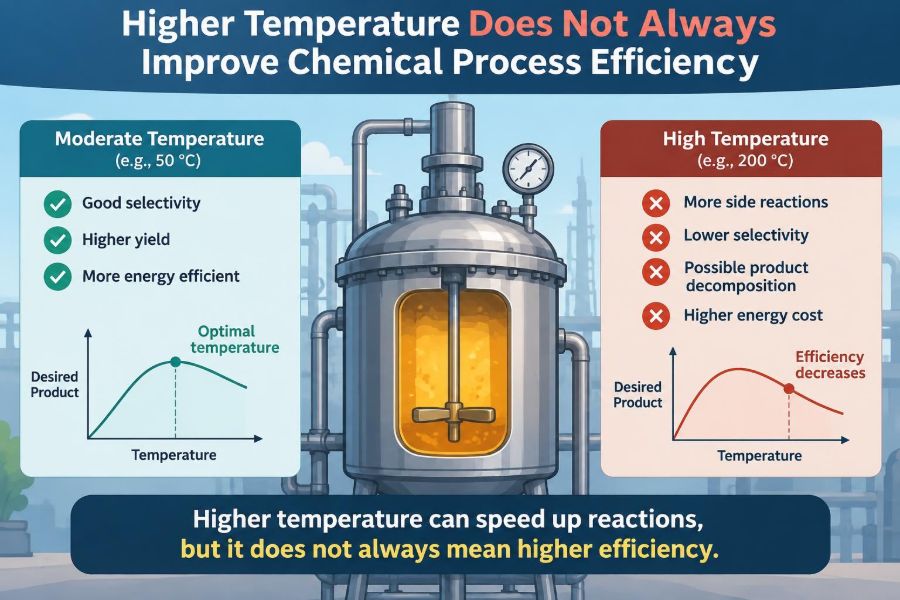
Efficiency includes yield, selectivity, energy use, equipment reliability, safety margin, separation load, and product quality. A hotter process can improve one of those measures while quietly damaging several others.
The useful engineering question is therefore not “Can we run hotter?” It is “What temperature gives the best overall process outcome under real operating constraints?”
🌡️ Temperature Is a Lever, Not a Universal Solution
Temperature is one of the most influential process variables because it affects molecular motion, phase behavior, heat transfer, reaction rates, and material properties. That influence is precisely why it must be handled carefully.
Increasing temperature usually changes several parts of a process at once. A reactor may become kinetically faster, while an equilibrium limitation becomes worse, a catalyst loses activity, and a downstream condenser requires more cooling duty.
Good process efficiency is an optimization problem, not a race toward the highest temperature. The preferred operating point is often a compromise rather than an extreme.
📏 What “Efficiency” Actually Means in Chemical Processing
Before deciding whether a temperature increase helps, define the objective. “Efficient” can mean different things to production, operations, quality, and energy teams.
- Conversion: the fraction of a reactant consumed.
- Yield: the amount of desired product obtained from the reactant supplied.
- Selectivity: the share of converted material that becomes the desired product rather than by-products.
- Energy efficiency: useful production achieved per unit of heating, cooling, compression, or utility use.
- Throughput: product made per unit time.
- Asset efficiency: reliable operation with manageable fouling, corrosion, and maintenance.
A higher temperature can raise conversion but lower selectivity. It can increase hourly output but also increase steam consumption enough that the economic result is unfavorable.
⚗️ Why Reactions Often Speed Up When Heated
For many reactions, molecules need enough energy to pass an activation barrier before they can rearrange into products. Heating raises the fraction of molecules with sufficient energy, so the reaction rate constant often increases.
This relationship is commonly represented by the Arrhenius equation: k = A exp(-Ea/RT), where k is the rate constant, Ea is activation energy, R is the gas constant, and T is absolute temperature.
The equation explains why moderate temperature changes can have a noticeable effect on rate. It does not say that the resulting process will be more efficient, safer, or more profitable.
🧭 Rate and Equilibrium Are Different Questions
Reaction kinetics asks how quickly a system approaches its limit. Thermodynamic equilibrium asks where that limit lies. These ideas are often confused because both affect the measured conversion in a reactor.
Imagine an equilibrium reaction that is slow at low temperature but favorable toward products. Heating may help the system reach equilibrium faster, yet shift that equilibrium so that less product is present once the system settles.
For reversible processes, a temperature increase can therefore improve short-residence-time performance but reduce the best conversion achievable at long residence time. Reactor design and operating target determine which effect dominates.
🔄 Exothermic Equilibria Often Prefer Cooler Conditions
An exothermic reaction releases heat. Under the usual equilibrium interpretation, adding heat favors the side that absorbs it, often the reactant side. As temperature rises, the equilibrium constant for product formation may decrease.
Ammonia synthesis is a familiar conceptual example: higher temperature accelerates the surface chemistry but tends to make equilibrium conversion less favorable. Industrial operation uses a carefully chosen temperature range, pressure, catalyst, recycle loop, and staged heat management rather than simply maximizing temperature.
This is not a contradiction. It is a reminder that a fast route toward an unfavorable equilibrium is not automatically useful.
❄️ Endothermic Systems Have a Different Trade-Off
For an endothermic reaction, heat is effectively a reactant in the thermodynamic picture, so higher temperature may favor products at equilibrium. That can make heating particularly valuable.
Even then, the optimum is not unlimited. Furnaces require fuel or electricity, reactor materials face higher stress, and side reactions can grow faster than the desired pathway. Gas-phase cracking operations, for example, must balance conversion against coke formation, selectivity, and furnace tube life.
A favorable equilibrium trend tells engineers where to look, not where to stop increasing temperature.
🎯 Selectivity Can Fall Even When Conversion Rises
Most real reaction networks contain more than one possible pathway. A desired reaction competes with side reactions that produce unwanted compounds, gases, heavy residues, color bodies, or difficult-to-remove impurities.
If the undesired reaction has a higher activation energy, its rate can be more temperature-sensitive than the desired pathway. Raising temperature may therefore improve overall reactant disappearance while decreasing the fraction turned into saleable product.
This distinction matters in batch manufacturing. A hotter batch may finish sooner but generate an impurity profile that demands extra purification or fails specification altogether.
🧪 Parallel and Consecutive Reactions Change the Answer
In a parallel network, reactant A may form desired B or undesired C. The best temperature depends on the relative kinetics of both routes, not on the rate of A consumption alone.
In a consecutive network, A may form B and B may then degrade into C. Here, high temperature can make the desired intermediate appear rapidly and disappear just as rapidly. Residence time, quench timing, and feed strategy become part of temperature control.
For these systems, laboratory kinetic data collected at several temperatures are far more informative than a single “hot versus cold” comparison.
🧯 Thermal Decomposition Sets a Harder Limit
Many products, reactants, additives, and solvents are not stable indefinitely at elevated temperature. Decomposition can be gradual and initially difficult to see, especially when the main reaction is also accelerating.
Common symptoms include darkening, viscosity increase, gas generation, loss of active ingredient, off-odor, unexpected pressure rise, or a growing burden on purification equipment. Polymers can undergo chain scission or crosslinking; biologically derived materials may denature or degrade.
Operating below a known decomposition threshold is not sufficient by itself. Exposure time, local hot spots, oxygen ingress, and impurities may all change the practical limit.
🧲 Catalysts Do Not Always Benefit from More Heat
A catalyst lowers the activation barrier for a reaction, but it is still a physical material with a finite stability range. High temperature can sinter metal particles, alter crystal phases, destroy supports, leach active components, or accelerate poisoning.
In catalyst sintering, small active particles merge into larger ones, reducing available surface area. Activity may decline slowly enough that an operator compensates by raising temperature again, creating a cycle of higher energy use and faster deactivation.
A rising temperature requirement can be a diagnostic signal, not merely an operating inconvenience. It may indicate catalyst aging, fouling, feed contamination, or poor heat distribution.
🧱 Materials of Construction Have Temperature Windows
Vessels, gaskets, linings, seals, trays, and instrumentation each have temperature-dependent limits. A process temperature that seems chemically reasonable may be unsuitable for an elastomer seal, polymer lining, adhesive, or coating.
Metals also change behavior with temperature. Strength can decline at elevated temperature, thermal expansion can create mechanical stress, and corrosion rates may rise in certain chemical environments.
Engineering review must consider the whole system. The limiting item may be a flange gasket or a level transmitter, not the reactor shell.
🔥 Heat Transfer Does Not Become Simpler at Higher Temperature
A larger temperature difference can increase the driving force for heat transfer, which is useful in many heaters and exchangers. But higher process temperatures may also promote fouling, boiling instability, coking, or degradation at hot surfaces.
Wall temperature deserves special attention. The fluid bulk temperature measured by an instrument may be acceptable while the heater surface is substantially hotter. Heat-sensitive liquids can degrade in this boundary region before the bulk measurement shows a problem.
Good thermal design considers heat flux, circulation pattern, exchanger cleanliness, and control response—not just the target temperature.
🌀 Viscosity and Mixing Can Improve with Heat
Heating often lowers the viscosity of liquids. Lower viscosity can improve pumping, mixing, atomization, and mass transfer, making a temperature increase genuinely helpful.
For a viscous resin, oil, or slurry, better flow can reduce stagnant zones and improve temperature uniformity. That may enhance reaction control even if the intrinsic chemical kinetics were already adequate.
However, a lower viscosity can also change residence-time distribution, agitation power demand, droplet size, or gas holdup. The benefit should be verified at process scale rather than assumed from a beaker observation.
🌬️ Gas Solubility Usually Declines as Temperature Rises
Many gas–liquid processes depend on dissolving a gas into a liquid before reaction can occur. As temperature increases, gases commonly become less soluble in liquids, reducing the concentration available for reaction.
This matters in hydrogenation, oxidation, fermentation-related aeration, carbonation, and absorption operations. A hotter liquid may have faster chemistry but less dissolved gas, so the overall rate can plateau or even decline.
Pressure, agitation, bubble size, and mass-transfer area can partly compensate, but they add cost and operational complexity. The relevant measure is the coupled gas-transfer-and-reaction rate.
💨 Vapor Pressure Creates Hidden Separation Costs
Heating raises vapor pressure. In an open or vented system, that can increase evaporative loss of volatile solvents and reactants. In a closed system, it can raise pressure and require more demanding containment or relief design.
Higher vapor loads also affect condensers, vacuum systems, off-gas treatment, and solvent recovery. A reactor that looks more productive may transfer its difficulty downstream to a distillation column or emissions-control system.
Losses are not only financial. Changing solvent composition through evaporation can alter concentration, viscosity, reaction rate, crystallization behavior, and product consistency.
🧪 Distillation Is Not Automatically Better at a Higher Temperature
Distillation separates components by volatility, but the key comparison is relative volatility, not temperature alone. Raising absolute temperature by operating at higher pressure may change relative volatility in an unfavorable way for some mixtures.
Heat-sensitive materials often benefit from vacuum distillation because lower pressure permits boiling at lower temperature. The equipment may be more complex, but avoiding degradation can outweigh the added utility and vacuum-system demands.
Separation design must therefore examine pressure, reflux, reboiler duty, condenser duty, product stability, and hydraulics together.
💧 Crystallization Depends on Solubility Curves
For crystallization, a higher temperature may dissolve more solute, but that does not automatically produce better crystals. The cooling path, supersaturation rate, impurities, seeding practice, and mixing determine crystal size distribution and filterability.
Overheating can create problems if it dissolves undesired solids, changes solvent composition through evaporation, or damages a temperature-sensitive solute. It may also require more cooling later, shifting energy demand rather than eliminating it.
The desired outcome is controlled supersaturation, not the highest possible dissolution temperature.
⚡ Energy Efficiency Includes Both Heating and Cooling
Every unit of heat added to a process must eventually leave with a product stream, an exhaust stream, cooling water, refrigeration, or heat recovery system. For exothermic reactions, heating less may also mean removing less heat later.
Energy analysis should include utility quality. Low-pressure steam, high-pressure steam, electricity, cooling water, chilled water, and refrigeration do not carry the same economic or environmental burden.
Heat integration can change the answer. A stream that must be heated may be an excellent heat source for another stream, but only if temperature levels, fouling risk, control needs, and safety isolation are compatible.
📈 Throughput Can Increase While Profitability Declines
Suppose a hypothetical reactor produces material 15% faster after a temperature increase. That sounds favorable until the same change reduces yield, raises solvent losses, shortens catalyst life, and overloads a purification step.
The bottleneck may simply move. If the downstream dryer, centrifuge, distillation train, or wastewater system cannot handle the additional load, reactor acceleration does not translate into plant-wide throughput.
Engineers should evaluate marginal output against marginal cost and constraint. Plant optimization is a systems problem.
🛡️ Higher Temperature Can Narrow the Safety Margin
Elevated temperature can increase reaction rate, pressure, vapor generation, decomposition rate, and the sensitivity of a process to disturbances. In an exothermic system, this can contribute to thermal runaway: a feedback loop in which heat generation increases temperature, which further increases heat generation.
Whether this risk is significant depends on reaction chemistry, inventory, heat-removal capacity, mixing, control response, and emergency safeguards. It should be assessed using appropriate hazard studies and calorimetric data where warranted.
Normal operation should leave room for realistic upsets such as cooling loss, delayed feed shutoff, agitator failure, unexpected contamination, or instrumentation error.
📍 Local Hot Spots Matter More Than an Average Reading
A single temperature transmitter reports conditions at one location. It may not reveal a hot catalyst bed, poorly mixed reactor zone, heater outlet spike, or viscous region near a vessel wall.
Fixed-bed reactors can develop hot spots when an exothermic reaction is concentrated near the inlet. These regions can harm selectivity or catalyst life even when the average outlet temperature appears acceptable.
Multiple sensors, validated models, careful sampling, and temperature-profile trends help reveal these conditions. Better distribution of feed, staged addition, dilution, or interbed cooling may outperform a simple change in setpoint.
⏱️ Residence Time Determines Whether Extra Heat Helps
Residence time is the average period material spends in a process unit. A faster reaction at higher temperature may allow a smaller reactor or higher flow rate, but only if mass transfer, mixing, and downstream operations can keep pace.
For unstable products, shorter residence time at an elevated but controlled temperature can sometimes be better than long exposure at a lower temperature. Conversely, a long hot hold can create degradation that a rapid heat-and-quench operation avoids.
The relevant exposure is the full temperature-time history, not just a reactor setpoint.
🧫 Laboratory Results Need Scale-Up Discipline
Small laboratory vessels often heat and cool differently from industrial equipment. Their surface-area-to-volume ratio is higher, mixing may be more uniform, and heat removal may be easier relative to reaction volume.
A temperature that is manageable in a small flask can be difficult to control in a large batch vessel, especially for strongly exothermic chemistry. Probe placement and addition rates also become more consequential at scale.
Scale-up should use sound reaction calorimetry, mixing assessment, heat-transfer estimates, and pilot or demonstration data where appropriate. A laboratory optimum is a starting hypothesis, not a plant operating instruction.
📊 Build a Temperature–Performance Map
Instead of testing only a low and high condition, characterize performance across a practical temperature range. Measure the outputs that actually matter: rate, conversion, selectivity, impurity profile, energy demand, pressure, color, viscosity, and catalyst condition.
A simple comparison framework can prevent one-dimensional decisions.
| Question | Why it changes the decision |
|---|---|
| Does conversion rise? | Shows whether reaction progress is faster or more complete. |
| Does selectivity hold? | Determines whether extra conversion becomes desired product. |
| Does equilibrium shift? | Sets the achievable limit for reversible reactions. |
| What happens downstream? | Reveals added separation, cooling, or off-gas load. |
| Is the equipment still within limits? | Protects catalyst, materials, seals, and safety margin. |
The best region is commonly broad enough to allow controllability, not a single sharp point that is difficult to hold.
🧮 Use Economics Without Reducing Everything to Energy
Utility cost is important, but total process economics also includes raw-material losses, product value, waste treatment, maintenance, downtime, catalyst replacement, quality rejects, and capacity constraints.
A temperature increase that requires expensive refrigeration downstream may be less attractive than one requiring modest additional steam. Likewise, a small yield improvement can be highly valuable when a feedstock is costly or scarce.
Economic comparisons should state their assumptions clearly. Feed composition, energy prices, production rate, and equipment condition can change the preferred operating point.
🎛️ Control Strategy Is Part of Temperature Selection
An excellent target temperature is of limited value if the control system cannot hold it during normal disturbances. Dead time in jackets, variable utility pressure, nonlinear reaction heat release, and sensor lag can cause cycling or overshoot.
For sensitive operations, engineers may use cascade control, feed-forward control, staged reactant addition, ratio control, or automated quenching. The right choice depends on process dynamics and available measurements.
Setpoints should include an operating envelope: normal range, alert limits, intervention actions, and conditions requiring shutdown or escalation. This makes temperature management repeatable across shifts.
🔧 Better Alternatives to “Turn Up the Heat”
When production is slow or conversion is low, temperature is only one possible lever. Often another change addresses the actual limitation more directly.
- Increase catalyst activity or correct catalyst poisoning.
- Improve mixing, gas dispersion, or mass-transfer area.
- Adjust reactant ratio, concentration, pressure, or pH where chemically appropriate.
- Remove a product to shift equilibrium, using separation or recycle.
- Reduce fouling and restore heat-transfer performance.
- Change feed location, staging, or residence-time distribution.
- Recover and reuse heat instead of raising the entire process temperature.
These options require evaluation, but they illustrate a central habit of process engineering: diagnose the limiting mechanism before choosing the intervention.
🚫 Common Temperature-Optimization Mistakes
One common mistake is using conversion as the only success metric. Another is comparing runs at different temperatures without matching residence time, composition, agitation, pressure, or sampling method.
Operators can also be misled by a short trial. Fouling, catalyst deactivation, corrosion, or impurity buildup may emerge only after extended operation. A temporary rate gain is not proof of sustainable improvement.
Finally, treating a design temperature as an operating recommendation is unsafe reasoning. Design limits define what equipment may tolerate under specified conditions; they do not define the best routine process condition.
📝 A Practical Decision Sequence
When considering a temperature change, use a structured sequence rather than an informal trial-and-error approach.
- Define the primary objective and all important constraints.
- Identify whether kinetics, equilibrium, mass transfer, heat transfer, or separation is limiting.
- Review chemical stability, catalyst behavior, equipment limits, and process safety implications.
- Test or model a realistic range while measuring yield and quality, not rate alone.
- Evaluate plant-wide utility and downstream effects.
- Confirm that controls and safeguards can manage the selected range.
- Document the operating window and monitor performance after implementation.
This approach takes more thought than changing a setpoint, but it reduces the chance of solving one problem by creating three others.
🧠 The Core Principle: Optimize the Whole Process
Higher temperature can be exactly the right decision when reaction kinetics are limiting, product stability is adequate, utilities are available, and no larger penalty appears elsewhere. It can also be the wrong decision when equilibrium, selectivity, safety, or downstream load dominates.
The most capable engineers separate cause from intuition. They ask which mechanism limits performance, which metric defines success, and which effects occur beyond the reactor boundary.
Temperature improves chemical process efficiency only when its total benefits exceed its chemical, energy, equipment, safety, and separation costs.
Run a process at the temperature that best serves the entire system—not simply the highest temperature the equipment can reach. That mindset turns heat from a blunt operating response into a precise engineering tool. 🧪🌡️⚙️