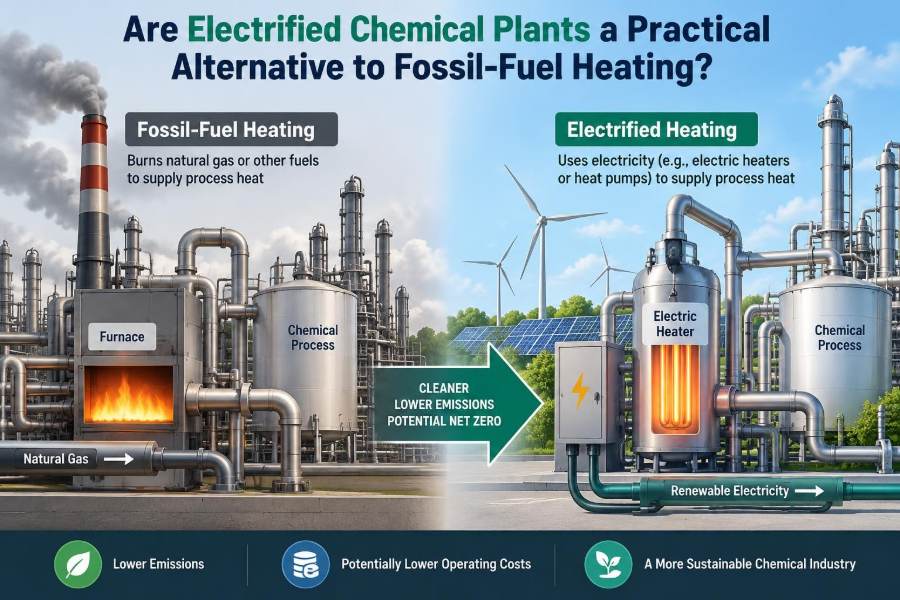

A process operator notices the familiar signs of a furnace start-up: fuel gas pressure checks, combustion air dampers moving, a flame scanner confirming ignition, and a stack beginning to warm. For decades, this sequence has been routine in refineries, chemical plants, and manufacturing sites.
Now imagine the same plant planning a major revamp. Its customers want lower-carbon products, its electricity supplier is offering a cleaner power contract, and managers are asking whether an electric heater could replace a fired unit. The question sounds simple until it reaches the process design office.
Heat is not one uniform service. A jacketed batch reactor at 150°C, a distillation reboiler at 230°C, and a steam-cracking furnace operating at far higher temperatures make very different demands on equipment, utilities, control systems, and economics.
Electrified chemical plants can be practical, but not by treating electricity as a drop-in fuel. The useful question is: which heat duty should be electrified first, with what technology, and under what operating conditions?
⚙️ What “electrified heat” actually means
Electrified process heat is thermal energy delivered using electricity rather than burning coal, fuel oil, natural gas, refinery fuel gas, or another combustible fuel at the point of use. It may involve resistance elements, induction coils, electric boilers, heat pumps, microwave or radio-frequency heating, or electrochemical routes that avoid a conventional heated reactor.
The electricity source matters. An electric heater has no combustion stack at the plant, but its wider emissions depend on how the grid electricity or contracted supply is generated. Electrification moves energy demand from the fuel system to the power system; it does not automatically make every duty low carbon.
🔥 Why fossil-fired heating became standard
Fossil fuels earned their dominant role for practical reasons. They are energy-dense, readily stored on site, and capable of producing very high temperatures directly in a furnace firebox.
Many plants also generate steam by burning fuel in central boilers. That steam is distributed to many users, providing both heat and a convenient way to recover condensate. The result is an integrated utility system that is reliable, familiar, and deeply embedded in plant design.
Replacing one fired heater can therefore affect fuel-gas balancing, steam generation, boiler load, flare operation, electrical substations, and even the economics of combined heat and power.
🌡️ Temperature is the first screening question
Temperature strongly narrows the technology choices. Low- and medium-temperature duties are generally easier to electrify because many commercial electrical technologies can deliver controlled heat in this range.
As required temperature rises, materials limits, electrical equipment design, heat-transfer surfaces, and power density become more challenging. Very high-temperature continuous furnaces may still be candidates, but they need a more specialized assessment than a vessel jacket or a hot-water loop.
| Heat-duty range | Typical examples | Often-considered options |
|---|---|---|
| Low temperature | Hot water, washing, drying, preheating | Heat pumps, electric boilers, resistance heaters |
| Medium temperature | Reboilers, reactors, evaporators | Electric boilers, resistance heating, induction in suitable equipment |
| High temperature | Calcination, furnaces, cracking and reforming duties | Specialized electric furnaces, induction, plasma or redesigned processes |
These categories are only a first pass. A 200°C duty with a small, clean heat exchanger may be easier to electrify than a lower-temperature duty requiring enormous continuous heat flow.
📏 Heat duty matters as much as temperature
A process engineer also needs to know the heat rate, usually expressed as thermal power, and the total annual energy. A small batch reactor may need a high heating rate for an hour, while an evaporation train may require a large steady duty all year.
Electricity infrastructure is sized around peak electrical demand, not only annual consumption. A site with several large heaters switching on together may require a new substation, transformers, switchgear, protection studies, and utility-grid upgrades.
This is why a technically simple heater replacement can become a site-wide power project.
🔌 Direct resistance heating: the straightforward option
In resistance heating, electric current passes through a resistive element and produces heat. The element may heat air, circulating fluid, molten salt, a vessel wall, or another heat-transfer medium.
Its major strengths are rapid response, accurate control, modular construction, and no combustion air or flue-gas handling. It is particularly useful for clean duties where compact equipment and tight temperature control matter.
However, element surface temperature must be managed carefully. If an element is too hot relative to the process fluid, it can cause product degradation, local boiling, coking, or fouling even when the bulk temperature appears acceptable.
🧲 Induction heating and conductive equipment
Induction heating uses an alternating magnetic field to generate heat within a conductive material. It can heat metal equipment directly or heat a susceptible material placed within an induction field.
This can reduce some heat-transfer resistance because heat is created close to where it is needed. Applications may include metal components, certain reactors, and specialized furnace arrangements.
Induction is not universal. Equipment geometry, material magnetic properties, wall thickness, coil placement, and electromagnetic shielding all affect feasibility. A useful pilot test is often more informative than a purely theoretical estimate.
💧 Electric boilers and electrode boilers
Electric boilers convert electricity into steam or hot water. Resistance-boiler designs use heating elements, while electrode boilers pass current through water itself. Both can supply familiar steam users without changing every downstream heat exchanger at once.
That makes electric steam generation attractive for phased projects. Yet steam is not a lossless heat carrier: generating it, distributing it, and condensing it introduce losses. Where a process can use electricity or a heat pump directly, making steam first may not be the most efficient route.
Water treatment, blowdown, pressure safety, and steam-network controls remain necessary. “Electric” does not mean “simpler in every respect.”
♨️ Heat pumps upgrade waste heat
A heat pump transfers heat from a lower-temperature source to a higher-temperature sink using electricity. Instead of creating all heat from scratch, it upgrades energy that would otherwise be rejected through cooling water, air coolers, or low-pressure vapor.
For suitable temperature lifts, this can deliver more useful heat than the electrical energy supplied because it moves existing heat. The key word is suitable: performance falls as the required temperature lift becomes larger, and the source must be available when the process needs heat.
Heat pumps are often most compelling where a plant simultaneously has cooling demand and low- or moderate-temperature heating demand. They turn an energy-integration problem into an electrification opportunity.
🧪 Electrifying the reaction, not just the heater
Some transformations can be redesigned so electrical energy drives the chemistry more directly. Electrochemical synthesis, electrocatalysis, plasma-assisted processes, and electrically heated catalytic reactors are examples of broad development pathways.
These approaches can change selectivity, reactor size, separation needs, and feedstock choices. They should not be judged only as replacements for a burner; they may represent an entirely different process route.
That promise comes with uncertainty. Catalyst durability, scale-up behavior, electrical efficiency, product purification, and intermittent operation may all remain central development questions for a specific application.
🏭 The easiest early targets in a plant
Good first candidates often have moderate temperature requirements, limited peak power, a clear boundary around the equipment, and an operating profile that matches available electricity. Electrically heated package units can be particularly attractive when an aging local fired heater needs replacement anyway.
- Tank and vessel heating for clean liquid services
- Drying, curing, and controlled air heating
- Small or intermittent steam loads
- Heat tracing and freeze protection
- Batch operations where rapid, repeatable temperature control is valuable
These examples are not automatic wins. Hazardous-area classification, product sensitivity, and electrical capacity still need review.
🏗️ Why high-temperature furnaces are harder
High-temperature furnaces combine severe heat duty with demanding heat transfer. A fired heater radiates intensely from flames and hot refractory surfaces, while convection sections recover energy from hot flue gas. An electric replacement must achieve the required process-side heat flux without damaging tubes or creating unacceptable hot spots.
In hydrocarbon services, tube-skin temperature is especially important because excessive surface temperature can accelerate coke formation. Changing the heating method changes the thermal profile, not merely the energy source.
Very large electric loads can also be difficult to supply at a single site. A project may require new high-voltage connections and long lead times for major electrical equipment.
🧱 Materials set practical boundaries
Heating elements, insulation, ceramic supports, electrical feedthroughs, coils, tube alloys, and power cables all have temperature and environment limits. Corrosive vapors, dust, vibration, thermal cycling, and reducing or oxidizing atmospheres can shorten service life.
A heater that works in a clean laboratory environment may not survive years of industrial cycling. Materials selection should consider normal operation, start-up, shutdown, loss of flow, fouling, and credible upset conditions.
Maintenance access matters too. A replaceable element may be practical in a small vessel but disruptive if it requires opening a critical process unit.
📉 Efficiency is more than the heater rating
Electric resistance heating is highly efficient at converting electricity into heat at the device boundary. But plant decisions should compare the full energy chain: electricity generation and delivery, process integration, heat losses, steam distribution, and displaced fuel use.
A combustion heater can lose energy in stack gases, radiation, and excess air. It may also provide useful high-temperature heat directly. An electric route may remove stack loss but create new transformer and distribution losses, or it may permit much better control and less over-heating.
The relevant metric is useful process heat delivered per unit of primary energy, cost, and emissions—not the nameplate efficiency of one component.
🌍 Carbon intensity depends on the power supply
Whether electrification reduces emissions depends heavily on the marginal or contracted electricity supply. When electricity is produced with low-carbon sources, replacing onsite combustion can substantially reduce operational emissions. When electricity is mainly fossil-generated, the result may be smaller, mixed, or potentially unfavorable on a system basis.
Plants may use long-term power agreements, dedicated generation, on-site renewables, or increasingly clean grids. Each arrangement has different implications for reliability, accounting, cost exposure, and the time profile of emissions.
Engineers should distinguish physical electricity flows from contractual emissions claims. Both can be relevant, but they answer different questions.
⚡ Grid capacity is a design constraint
Industrial electrification can create loads measured in many megawatts. A local distribution network that can serve offices and conventional motors may not have spare capacity for large electric boilers or furnaces.
Early discussions with the electricity provider are essential. They should address connection voltage, maximum import, fault levels, harmonic limits, power factor, planned network reinforcement, and outage arrangements.
Waiting until detailed design to check grid capacity is a common and expensive mistake. It can force equipment downsizing, delay a project, or leave a plant dependent on fossil backup longer than intended.
🔋 Flexibility can improve the business case
Some electrical heat loads can be scheduled, modulated, or paired with thermal storage. This can help a plant respond to electricity prices, renewable-power availability, or grid constraints without interrupting production.
Thermal storage may use hot water, pressurized water, molten salts, solid materials, or another appropriate medium. It stores heat rather than electricity, which can be less complex for a process that ultimately needs heat.
Flexibility is not free. Product quality, reaction residence time, equipment turndown, and safety requirements may limit how much a duty can move in time.
🛢️ Thermal storage is not a universal battery
A storage system must match the temperature level and discharge profile of the process. A hot-water tank can support low-temperature loads but cannot replace a high-temperature furnace. Conversely, high-temperature storage uses more demanding materials and insulation.
Storage also adds footprint, capital cost, heat loss, control logic, and operating procedures. Its value is greatest when it solves a defined mismatch between when cheap or low-carbon electricity is available and when heat is required.
Installing storage without a clear operating strategy can create an expensive asset that is seldom used.
🎛️ Process control changes with electric heat
Electric heaters can respond much faster than many fired systems because they do not require fuel-air ratio control, flame stabilization, or furnace draft management. Fast response can improve product consistency, especially in batch operations.
It can also create new control challenges. A high-power heater may overshoot if temperature sensors are poorly located or if mixing is inadequate. Controllers must account for thermal lag between the element, the equipment wall, and the bulk process fluid.
Control design should include ramp-rate limits, independent high-temperature trips, low-flow interlocks, and credible behavior following power restoration.
🛡️ Safety hazards do not disappear
Removing combustion reduces hazards related to fuel leaks, burner flameouts, furnace explosions, and flue-gas exposure. That is valuable, but an electrified plant has its own hazard set.
- Electrical shock and arc-flash exposure
- High fault currents and protection-coordination requirements
- Local overheating following low flow or loss of agitation
- Ignition risks in flammable atmospheres from unsuitable equipment
- Unexpected restart after a power disturbance
Hazard reviews should examine the complete system, including substations, cables, variable power devices, heater controls, process equipment, and operating procedures. Electrical and process safety teams need to work together from the concept stage.
🔧 Reliability shifts from burners to power equipment
Fired systems require maintenance on burners, refractory, stacks, fuel trains, and emissions equipment. Electrical systems reduce some of these needs but add dependence on transformers, switchgear, control electronics, heating elements, cooling arrangements, and grid supply.
Redundancy should be designed around production consequences. A small backup heater may be appropriate for a critical tank, while a major continuous process may need duplicate electrical feeders, standby generation, retained combustion capacity, or planned curtailment procedures.
The best reliability strategy is site-specific. It begins with identifying what happens to process safety and product quality if heat is lost for seconds, minutes, or hours.
💸 Economics require more than a fuel-price comparison
Comparing the price of natural gas with the price of electricity is a useful starting point, but it is not a project evaluation. Electricity tariffs may include demand charges, network charges, time-of-use pricing, and penalties or incentives related to power quality.
Capital costs can include the heater, power electronics, transformers, cabling, civil works, substation expansion, grid connection, heat-transfer modifications, controls, and shutdown work. Savings may include reduced fuel infrastructure, lower stack-emissions equipment needs, less maintenance in some services, and avoided carbon costs where applicable.
A transparent analysis tests plausible operating cases rather than assuming one energy price will remain unchanged for the life of the asset.
📊 A simple decision framework
A practical screening study can organize the decision before detailed engineering begins. It should use real plant data, especially actual heat demand profiles rather than only design-case values.
- Define the duty: temperature, pressure, heat rate, annual energy, heating rate, and operating hours.
- Map existing heat sources, heat sinks, steam systems, and waste-heat opportunities.
- Identify technically suitable electric technologies and their operating limits.
- Check electrical capacity, connection timing, and resilience requirements.
- Compare lifecycle cost, emissions basis, operability, safety, and maintainability.
- Test the preferred option through piloting or staged implementation where uncertainty is high.
This sequence prevents a technology preference from driving the problem definition.
🔄 Heat integration should come before new supply
Before adding an electric heater, engineers should ask whether the duty can be reduced or met by recovered heat. Pinch analysis and other heat-integration methods identify opportunities to exchange heat between hot and cold process streams while respecting minimum temperature differences.
For example, a warm product stream may preheat a feed stream, reducing both heating and cooling utility demand. A heat pump may then raise the remaining low-grade heat to a usable level.
Electrification is often strongest when paired with efficiency improvements. Supplying an avoidable heat load with clean electricity is still avoidable cost and infrastructure.
🧭 Retrofitting is different from building new
A new plant can place substations, cable routes, thermal storage, and electric process units into the initial layout. It can also select process routes that fit an electric energy system from the start.
Retrofits must work around existing pipe racks, plot space, shutdown windows, structural limits, and live operations. A replacement may need to fit into the footprint of a fired heater while avoiding interference with nearby hazardous equipment.
This does not make retrofit electrification impractical. It means constructability and outage planning deserve equal weight with thermal calculations.
🪜 Phased conversion lowers execution risk
A plant does not need to electrify every heat source at once. A phased strategy can begin with a small isolated duty, then expand after the team has experience with equipment performance, controls, electrical maintenance, and utility interfaces.
One hypothetical pathway is to electrify selected batch-vessel heating, install an electric boiler for variable steam demand, recover waste heat with a heat pump, and retain existing fired equipment for duties that lack a credible near-term alternative.
Phasing can protect production, but it should still fit a long-term utility plan. Otherwise, temporary electrical additions can become difficult-to-manage permanent infrastructure.
🧮 Common analysis mistakes
Several shortcuts can produce misleading results. Treating all process heat as interchangeable ignores temperature quality. Using annual average electricity emissions can hide the importance of the actual operating schedule. Ignoring grid connection time can make an apparently quick project impossible to deliver quickly.
Another mistake is assuming that removing a fired heater always simplifies operations. The steam network, fuel balance, export power arrangements, and process heat recovery may all change.
Finally, do not assume a pilot unit proves full-scale feasibility. Scale changes current levels, conductor routing, heat flux, protection systems, maintenance methods, and the consequence of failure.
👷 Skills chemical engineers need for electrification
Chemical engineers remain central because the hardest questions involve process duty, heat transfer, reaction behavior, integration, safety, and operability. But successful projects require closer collaboration with electrical engineers than many traditional thermal projects.
Useful working knowledge includes load profiles, single-line diagrams, power quality, protection concepts, hazardous-area equipment selection, and the limits of electrical isolation. Engineers do not need to become power-system specialists, but they need to ask the right questions early.
Likewise, electrical teams need a clear picture of process consequences. “Loss of heater” is not an adequate description when a reactor can solidify, overpressure, or lose product quality.
🌐 The system view: plant, grid, and supply chain
Electrification connects a chemical plant more tightly to external infrastructure. The project may affect local grid planning, renewable-generation development, water use in power production, and demand for specialized electrical equipment.
It can also change the plant’s role in the energy system. A flexible load may help absorb periods of abundant low-carbon power, while an inflexible round-the-clock furnace may require firm supply and robust network capacity.
Good decisions therefore consider boundaries explicitly: onsite emissions, purchased-energy emissions, upstream supply impacts, and the operational reliability required by customers.
✅ When electrified heat is most practical
Electrification tends to be most practical where heat demand is moderate in temperature, electrical infrastructure is available or achievable, low-carbon power can be secured, and the process benefits from precise control or flexible operation.
It is less straightforward where extremely high temperature, huge continuous heat flux, constrained grid access, or complex furnace heat transfer dominates. In those cases, efficiency measures, heat recovery, alternative fuels, hybrid designs, or process redesign may be more realistic near-term options.
The right answer is often a portfolio, not a single technology. Plants can electrify what works well now while developing credible routes for harder duties.
🎯 The core takeaway for plant decisions
Electrified chemical plants are not a theoretical idea, nor are they a universal replacement for combustion. Mature options already exist for many low- and medium-temperature duties, while high-temperature and reaction-intensive services require more careful engineering or different process designs.
The decisive questions are practical: What temperature and heat flux are required? Can the local power system deliver the load reliably? Is the electricity genuinely lower carbon on the chosen accounting basis? What happens during outages, ramps, and maintenance?
Electrification is practical when it is designed as an integrated process-and-power-system change, not as a simple swap between a fuel pipe and an electrical cable.
The strongest projects begin with reduced heat demand and good heat integration, then match the remaining duty to the right electric technology, power supply, and operating strategy. That disciplined approach makes electrification a useful engineering option rather than an all-or-nothing promise. ⚡🏭🌱