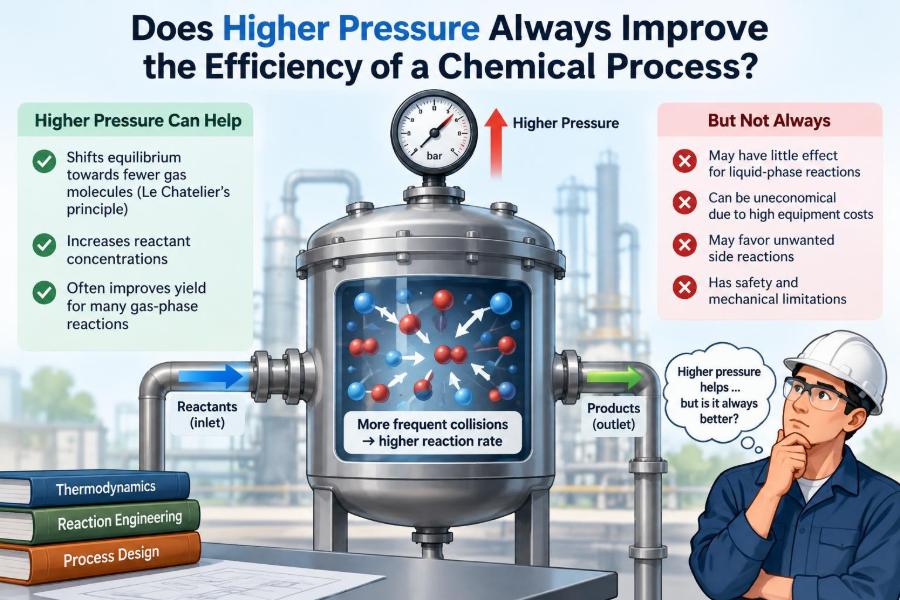

A plant operator sees a compressor with spare capacity and a reactor that is not quite meeting its production target. The tempting question is simple: if pressure pushes molecules closer together, why not raise it?
That instinct is sometimes exactly right. High pressure is central to large-scale processes such as ammonia synthesis, gas separation, and many polymer operations. It can improve reaction rates, shift equilibria, shrink equipment, and make difficult separations practical.
But pressure is not free. It consumes energy, changes phase behavior, affects catalyst life, increases mechanical design demands, and can introduce new safety and control problems. A higher pressure setpoint may improve one part of a process while making the whole plant less efficient.
The useful engineering question is therefore not “Can we operate at higher pressure?” It is “What pressure gives the best overall technical, economic, energy, and safety outcome?”
⚖️ Efficiency Has More Than One Meaning
Before judging the effect of pressure, define efficiency. In chemical engineering, the word can refer to several different measures, which do not always move in the same direction.
- Conversion: the fraction of a reactant consumed.
- Selectivity: the fraction of converted reactant that becomes the desired product rather than by-products.
- Yield: product obtained relative to reactant fed or theoretically available.
- Energy efficiency: useful chemical output relative to energy supplied.
- Economic efficiency: value produced after accounting for utilities, equipment, maintenance, and operating costs.
A pressure increase that raises single-pass conversion can still lower energy efficiency if compression requires substantial power. It may also reduce selectivity, meaning more raw material is diverted to unwanted products.
🔍 Pressure Changes Molecular Crowding
For gases, pressure is closely related to how densely molecules occupy a volume. At a fixed temperature, compression raises the number of molecules per unit volume, increasing their concentrations.
In a gas-phase reaction, more molecules in the same space can make productive collisions more frequent. That is why pressure often has a strong influence on reactions involving gaseous reactants.
The effect is less direct for liquids and solids. Liquids are already relatively dense and not very compressible, so modest pressure changes often produce only small changes in liquid-phase reaction concentration. Pressure may still matter through boiling point, solubility, or phase behavior.
⚗️ Reaction Rate Depends on the Rate Law
Pressure does not automatically increase every reaction rate by the same amount. The response depends on the rate law: the experimentally determined relationship between reaction rate and reactant concentrations.
Consider a hypothetical gas-phase reaction where the rate is proportional to the concentration of A and the concentration of B. If temperature and composition stay fixed, doubling total pressure approximately doubles both concentrations. The rate could then increase by roughly four times.
That simple result does not apply universally. A reaction may be nearly independent of one reactant, limited by catalyst sites, inhibited by a product, or controlled by mass transfer rather than chemical kinetics.
🧭 Equilibrium Favors Fewer Gas Molecules
Reaction kinetics tells us how quickly a system moves. Chemical equilibrium tells us the composition it tends toward after sufficient time. These are related but distinct ideas.
For a reversible gas reaction, increasing pressure tends to favor the side with fewer moles of gas. This follows from the system’s tendency to counter a pressure disturbance by reducing gas volume where possible.
For example, in the simplified synthesis reaction N₂ + 3H₂ ⇌ 2NH₃, four moles of gaseous reactants form two moles of gaseous product. Higher pressure favors ammonia at equilibrium. This is one reason pressure is indispensable in industrial ammonia manufacture.
↔️ Some Equilibria Barely Respond
If a reaction has the same number of gas moles on both sides, changing pressure has little idealized equilibrium effect. For example, A(g) + B(g) ⇌ C(g) + D(g) has two gas moles on each side.
Pressure can still affect the reaction rate by changing concentrations, and real-gas behavior can matter at sufficiently high pressure. But there is no large equilibrium advantage created merely by raising total pressure.
This distinction prevents a common error: applying “higher pressure favors products” to every gas reaction. The relevant question is the change in gas moles, not simply whether gases are present.
🌡️ Temperature and Pressure Cannot Be Separated
Pressure is usually adjusted alongside temperature, because both influence reaction rate, equilibrium, density, and separation performance. Their effects can point in opposite directions.
Many exothermic reversible reactions release heat. Higher temperature may accelerate them but can reduce equilibrium conversion to the desired product. Higher pressure may help equilibrium, while temperature is chosen to keep the reaction fast enough.
The resulting operating point is a compromise. In ammonia synthesis, for instance, pressure promotes equilibrium conversion, while catalyst performance and reaction speed require elevated temperature. Neither variable can be optimized sensibly in isolation.
🚀 Compression Requires Real Work
Raising the pressure of a gas requires a compressor, and compressors consume shaft work. The required work generally rises as the pressure ratio increases, especially when compression is far from ideal.
Compression also heats the gas. That heat may need to be removed between stages, recovered elsewhere, or tolerated in downstream equipment. Multi-stage compression with intercooling is often used to reduce power demand and protect machinery.
A process that gains a little reactor conversion but demands substantially more compressor power can have a worse overall energy balance. This is why pressure decisions belong in a flowsheet-wide analysis, not just a reactor calculation.
🔄 Recycle Can Change the Best Pressure
Many unreacted feed streams are recovered and recycled. Recycling improves overall feed utilization, but it means the compressor may repeatedly handle a large circulating gas flow.
At a higher reactor pressure, the single-pass conversion may increase. Yet the recycle compressor, purge handling, and gas-cleanup equipment can also become more demanding. The optimal pressure depends on the balance between conversion gain and circulation cost.
In some designs, a lower-pressure reactor paired with efficient recycle is preferable to a very high-pressure once-through arrangement. The answer depends on feed value, electricity cost, catalyst activity, separation needs, and capital constraints.
🧱 Higher Pressure Raises Equipment Costs
Pressure-containing equipment must resist internal force safely. As design pressure rises, vessels, piping, valves, flanges, and heat exchangers generally require stronger construction, greater wall thickness, or more specialized designs.
Thicker walls use more material and can complicate welding, inspection, and heat transfer. Large, high-pressure reactors may require expensive alloys or forged components, especially when hydrogen, corrosive chemicals, or elevated temperatures are involved.
There is no universal pressure at which cost suddenly becomes unacceptable. However, capital cost often increases nonlinearly as pressure requirements become more demanding, particularly for large equipment diameters.
🛡️ Pressure Changes the Safety Case
Stored energy increases with pressurized inventory. If containment fails, rapid depressurization can create strong physical forces, cold temperatures, noise, projectiles, and a large release of hazardous or flammable material.
High-pressure service requires robust relief systems, isolation valves, leak detection, inspection plans, operating procedures, and emergency response design. These safeguards are not optional add-ons; they are part of the process design.
A well-designed high-pressure plant can operate safely, but risk management becomes more consequential. Efficiency claims that omit reliability and loss-of-containment consequences are incomplete.
💨 Gas Separation Often Benefits from Pressure
Pressure can be especially valuable in gas separation. In membrane systems, a pressure difference provides the driving force for gas permeation. A larger difference can increase flux through the membrane, within practical material and equipment limits.
Pressure swing adsorption uses changes in pressure to load and release components from an adsorbent. Absorption of many gases into liquids also becomes more favorable at higher gas partial pressure.
Still, compression is a major utility expense in separation trains. Engineers compare the benefit of high-pressure separation with alternatives such as refrigeration, solvent selection, membrane area, vacuum operation, or staged processing.
🫧 Solubility Can Transform a Liquid-Phase Process
When a gas reacts in a liquid, the bottleneck may be getting enough gas into the liquid phase. Increasing the gas partial pressure generally increases its dissolved concentration, consistent with Henry’s-law behavior over an appropriate range.
This can improve processes such as hydrogenation, oxidation, and biological aeration when gas availability limits performance. More dissolved reactant can support a higher reaction rate.
However, a higher dissolved-gas concentration does not guarantee proportional production. Once the catalyst, liquid-phase chemistry, or mixing becomes limiting, additional pressure offers diminishing returns.
🌀 Mass Transfer Can Be the True Bottleneck
In a gas-liquid reactor, molecules must cross the gas-liquid interface before they can react in the liquid. This transfer rate depends on interfacial area, turbulence, bubble size, solubility, and concentration driving force.
Higher pressure can raise the driving force, but better agitation, sparger design, reactor internals, or gas recirculation may solve the same problem more efficiently. A pressure increase should not be used as a substitute for diagnosing poor mixing.
For catalytic slurry systems, the pathway may include transfer from gas to liquid, liquid to catalyst surface, and diffusion inside catalyst pores. Any one of these steps can become controlling.
🧪 Catalysts Have Pressure-Dependent Behavior
Heterogeneous catalysts work at active surface sites. At higher reactant partial pressure, more reactant may adsorb onto those sites, increasing rate until the surface begins to approach saturation.
Past that point, further pressure increases may bring little benefit. In some reactions, strongly adsorbed species can occupy too many sites and inhibit the desired pathway. Products can also adsorb and suppress activity.
Catalyst selection, particle size, pore structure, and reactor temperature influence this behavior. A pilot-scale or kinetic study is often needed before assuming that pressure alone will deliver a predicted rate increase.
🧊 Condensation Can Help—or Create Trouble
Pressure raises the condensation temperature of a vapor. This can be useful when a process needs a component to condense for recovery, recycle, or purification without extremely low refrigeration temperatures.
But unintended condensation may cause operational problems. A two-phase stream can increase pressure drop, disrupt flow measurement, damage compressors, alter reactor feed distribution, or cause liquid accumulation in lines.
Phase envelopes and dew-point calculations are therefore essential in high-pressure gas systems. Composition changes from recycling, purging, or feed variation can shift where condensation begins.
📏 Real Gases Depart from the Ideal Model
The ideal gas law is useful for first estimates, but high-pressure gases often deviate significantly from ideal behavior. Molecules occupy volume and exert attractive or repulsive forces on one another.
Engineers account for this using an equation of state and properties such as fugacity, a corrected measure of chemical tendency used in equilibrium calculations. At high pressure, using partial pressures alone may give misleading predictions.
This does not make hand calculations useless. It means preliminary reasoning should be verified with suitable thermodynamic models before equipment is sized or operating conditions are finalized.
🔬 Pressure Can Alter Selectivity
Suppose a desired reaction and an unwanted side reaction both consume the same feed. Raising pressure may accelerate both pathways, but not equally. The product distribution can shift.
For example, a gas-phase process may form heavier molecules through bimolecular side reactions that become more likely at high reactant concentration. In another system, higher hydrogen pressure may suppress coke formation and improve catalyst stability.
There is no general direction for selectivity. Engineers need reaction-network data, not just the stoichiometry of the main reaction, to determine whether more pressure improves product quality.
🧯 Fouling, Coking, and Deactivation Matter
Long-term operation matters as much as initial conversion. Pressure can influence catalyst deactivation through coke deposition, sintering conditions, contaminant adsorption, condensed-phase formation, or changes in local temperature.
A condition that gives high initial production may cause faster pressure drop across a catalyst bed or require more frequent regeneration. Lost operating time can outweigh a modest improvement in fresh-catalyst performance.
When evaluating a pressure change, examine performance over the intended run length: activity decline, impurity buildup, cleaning intervals, and the ability to return to stable operation after disturbances.
📉 Pressure Drop Can Consume the Benefit
Every flowing system loses pressure through pipes, valves, heat exchangers, distributors, catalyst beds, and separators. At high flow rates, pressure drop can be substantial.
If reactor inlet pressure is raised but most of the added pressure is lost across restrictive equipment, the intended reaction benefit may be small. Pressure drop also raises compression requirements and can create uneven flow distribution.
Good design considers the entire pressure profile, not a single nominal pressure. Larger pipe diameters, improved internals, lower-resistance catalysts, or parallel equipment may sometimes be better investments than more compression.
🎛️ Control Becomes More Demanding at High Pressure
Pressure affects inventories, densities, flow-controller behavior, valve sizing, and the response of compressors. A high-pressure system can have tightly coupled variables: changing a recycle valve may influence reactor pressure, separator conditions, and compressor surge margin.
Compressors must avoid surge, an unstable low-flow condition that can cause vibration and damage. Control strategies may require recycle loops, anti-surge protection, and carefully coordinated pressure controls.
Steady-state simulations are useful, but dynamic behavior matters too. The best operating pressure must remain manageable during startup, shutdown, feed changes, and equipment upsets.
🏭 Ammonia Synthesis Shows the Trade-Off
Ammonia synthesis is the classic example of pressure helping a chemical process. Its stoichiometry favors fewer gas moles on the product side, so high pressure improves equilibrium ammonia concentration.
Yet industrial operation does not simply use the maximum possible pressure. Very high pressure raises compression power and equipment cost, while temperature is needed to obtain practical catalyst rates. Unreacted gases are separated and recycled because complete single-pass conversion is not economically necessary.
The lesson is broader than ammonia: the winning design is commonly an integrated compromise, not the condition that maximizes one reaction variable.
🛢️ Hydroprocessing Offers a Different Lesson
Petroleum and renewable-feed hydroprocessing reactions often use hydrogen under pressure. High hydrogen partial pressure can improve hydrogen availability, support desired reaction pathways, and help limit carbonaceous deposits on catalysts.
At the same time, hydrogen compression, thick-walled reactors, high-temperature hydrogen service, and gas recycle add substantial complexity. Feed contaminants and catalyst behavior can be as influential as pressure.
The relevant target is often hydrogen partial pressure, not total pressure alone. Inert gases, light hydrocarbons, and recycle composition can raise total pressure while contributing little to the chemical driving force.
🌱 Biological Processes Have Narrower Limits
In aerobic fermentation or wastewater treatment, raising oxygen partial pressure can increase dissolved oxygen availability. This can help where oxygen transfer constrains microbial activity.
Microorganisms, however, can be sensitive to changes in gas composition, dissolved carbon dioxide, shear, temperature, and pressure. A condition that improves oxygen transfer may alter metabolism or product formation.
Bioprocess pressure decisions therefore require biological performance data as well as mass-transfer calculations. The “more is better” assumption is particularly risky when living cells are involved.
🧰 Alternatives to Raising Pressure
When pressure is proposed as a remedy, consider whether another change attacks the actual constraint more directly. A process limited by poor heat removal, for instance, may not benefit much from compression.
- Use a more active or selective catalyst.
- Increase reactor volume or residence time.
- Improve mixing, gas dispersion, or heat-transfer area.
- Remove a product continuously to shift equilibrium.
- Improve feed purification to protect catalyst activity.
- Use staging, interstage cooling, or recycle more effectively.
- Reduce pressure drop through redesigned flow paths.
These alternatives can sometimes deliver a better overall result with lower mechanical and utility penalties.
🧮 Use an Energy and Material Balance First
A disciplined evaluation begins with mass and energy balances. Determine how pressure changes conversion, recycle rate, product recovery, heat duties, compressor power, and utility consumption across the process.
Then assess equipment implications: design pressure, metallurgy, relief loads, rotating-equipment capacity, and likely maintenance needs. A simple reactor-only calculation is not enough for a meaningful decision.
Process simulation can support this work, but its assumptions must be checked. The selected thermodynamic package, reaction model, compressor efficiency, and separation model all affect the conclusion.
📊 Compare Marginal Gains, Not Just End Points
Pressure optimization is often best understood by looking at the next increment of pressure. What additional conversion, recovery, or throughput comes from a modest increase? What additional power, capital, and risk does it impose?
Early increases may provide large benefits, while later increases yield only small improvements. This pattern of diminishing returns is common when equilibrium approaches its limit, catalyst sites saturate, or mass transfer stops being controlling.
A practical optimum occurs where the incremental benefit no longer justifies the incremental cost and operational burden. The exact point varies with plant objectives and local utility economics.
📝 Questions to Ask Before Changing Setpoints
Changing operating pressure in an existing plant should be treated as a managed engineering change, not an informal production adjustment. Even a seemingly small increase can affect safety margins and downstream conditions.
- What is limiting performance now: kinetics, equilibrium, heat transfer, mass transfer, or separation?
- Which pressure matters: total pressure or a reactant’s partial pressure?
- Do equipment design limits, relief devices, and controls permit the change?
- How will compressor power, temperature rise, and surge margin change?
- Will phase behavior, pressure drop, or downstream separation change?
- Could selectivity, product specification, catalyst life, or fouling worsen?
Formal review should involve operations, process engineering, mechanical integrity, and process safety personnel as appropriate.
🚫 Common Shortcuts That Lead to Poor Decisions
One shortcut is calculating equilibrium at a higher pressure and treating the result as plant production. Real reactors may be limited by kinetics, catalyst activity, heat removal, or residence time long before equilibrium is reached.
Another is using total pressure when reactant partial pressure is what controls rate or solubility. Adding an inert gas can increase total pressure without increasing the concentration of the reactive component in the same useful way.
A third is ignoring off-design operation. A pressure target that looks attractive at full capacity may be unstable, inefficient, or unsafe during turndown, startup, or variable feed conditions.
🎯 The Core Principle: Optimize the Whole System
Higher pressure can improve chemical-process performance when it increases useful reactant concentration, favors the desired equilibrium, improves gas solubility, or enables a more effective separation. These are powerful advantages, not minor details.
Its penalties are equally real: compressor work, capital cost, mechanical complexity, pressure drop, control challenges, potential phase changes, and greater consequences of leaks or failures. Pressure can also change selectivity and catalyst lifetime in ways a simple equilibrium argument misses.
The best pressure is therefore the one that delivers the best whole-process outcome under realistic operating, economic, and safety constraints—not necessarily the highest pressure the equipment can withstand.
Higher pressure is a tool, not a universal upgrade: use it when its chemical and separation benefits exceed its energy, equipment, and safety costs. That systems perspective is what turns a plausible operating idea into sound chemical engineering. 🧪⚙️🌡️