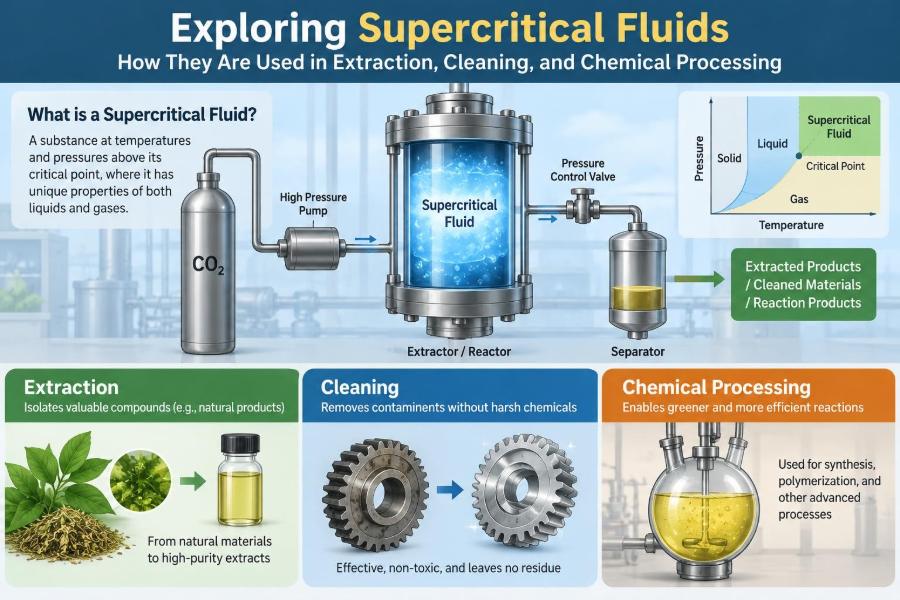

A cup of decaffeinated coffee, a bottle of citrus essential oil, and a precision-cleaned aerospace component may seem unrelated. Yet each can involve a processing fluid that behaves neither quite like an ordinary liquid nor quite like an ordinary gas.
Supercritical fluids give engineers an unusual combination of properties: they can flow into tiny spaces like gases while dissolving selected compounds more like liquids. That flexibility can make separations cleaner, reduce solvent residues, and open process routes that conventional liquids handle poorly.
The technology is not a universal replacement for organic solvents or water. It requires pressure-rated equipment, thoughtful phase-equilibrium design, and a realistic view of economics. But where its strengths match the problem, it can be remarkably effective.
Understanding supercritical-fluid processing starts with a phase diagram, then quickly leads to practical questions about extraction yield, particle cleaning, recycling, safety, and scale-up.
🌡️ What Makes a Fluid Supercritical?
A substance becomes a supercritical fluid when it is held above both its critical temperature and critical pressure. At this condition, the boundary between liquid and vapor disappears: there is only one continuous fluid phase.
Below the critical point, heating a liquid eventually produces vapor separated by a visible interface. Above it, compressing or heating the material changes its density smoothly rather than causing a distinct liquid-to-gas transition.
This is a thermodynamic state, not a separate chemical substance. Carbon dioxide remains CO₂ whether it is a gas, liquid, solid, or supercritical fluid; its physical behavior is what changes.
📈 Reading the Critical Point on a Phase Diagram
A pressure-temperature phase diagram maps where solid, liquid, and vapor states are stable. The vapor-liquid coexistence curve ends at the critical point. Beyond that endpoint, liquid and gas are no longer distinguishable phases.
For carbon dioxide, the critical temperature is about 31 °C and the critical pressure is about 7.4 MPa. Those relatively accessible conditions are a major reason CO₂ is the most widely used supercritical process fluid.
Water also has a supercritical region, but reaching it requires much harsher conditions: its critical point is approximately 374 °C and 22.1 MPa. That difference strongly shapes the equipment and chemistry used in each case.
🔍 Why Supercritical Fluids Behave So Differently
Near the critical point, small changes in pressure or temperature can cause large changes in density. Since density influences solvent power, engineers can adjust how strongly a supercritical fluid dissolves a compound without switching to a different solvent.
Supercritical fluids typically have low viscosity compared with liquids and higher diffusivity, meaning dissolved molecules can move through porous materials relatively quickly. They also have very low surface tension, so they can penetrate fine pores that liquid solvents may not wet effectively.
These properties do not all reach their best values at exactly the same condition. A process must balance density for solvency against viscosity, diffusivity, selectivity, energy use, and separation behavior.
🧊 Carbon Dioxide as the Workhorse Fluid
Supercritical CO₂ is popular because it is nonflammable, inexpensive relative to many specialty solvents, and readily available from existing industrial streams. It also leaves little residual solvent in a product when pressure is released, because it returns to a gas.
Its modest critical temperature helps protect heat-sensitive materials such as flavors, fragrances, and some natural compounds. CO₂ is also chemically less reactive than water under many processing conditions.
However, pure CO₂ is relatively nonpolar. It is therefore naturally better at dissolving oils, waxes, terpenes, and other nonpolar or weakly polar molecules than salts, sugars, or strongly polar compounds.
🧪 Other Supercritical Process Fluids
CO₂ is not the only option. Water is used in supercritical water oxidation and in certain reaction environments. Light hydrocarbons, ammonia, alcohols, and fluorinated fluids have also been considered or used for specialized separations and reactions.
Each fluid brings a different polarity, critical condition, toxicity profile, flammability risk, and environmental burden. A solvent that improves solubility may create new recovery or safety problems.
For that reason, solvent selection is never simply a matter of finding the strongest dissolver. The practical choice includes compatibility with equipment, downstream purification, occupational controls, and the fate of emissions or waste.
🧲 Solubility Depends on Molecular Interactions
A useful first rule is “like dissolves like.” Nonpolar CO₂ tends to dissolve nonpolar solutes more readily than ionic or highly polar ones. Yet real systems are more nuanced because molecular size, vapor pressure, crystal structure, and specific interactions all matter.
Many solid solutes dissolve in supercritical CO₂ more readily as pressure rises, because increased fluid density strengthens solute-fluid interactions. Temperature can have competing effects: it may lower fluid density while increasing a solute’s vapor pressure.
This competition produces solute crossover behavior, where changing temperature reverses its effect on solubility at different pressures. Experimental data or reliable thermodynamic models are essential for important design decisions.
🧴 Using Co-Solvents to Expand Solvent Power
When pure CO₂ cannot dissolve a desired compound effectively, a small amount of a more polar liquid may be added. This modifier, often called a co-solvent or entrainer, can substantially change the mixture’s polarity and intermolecular interactions.
Ethanol is a common choice in food, botanical, and pharmaceutical contexts because it is familiar and comparatively easy to remove. Even then, its amount must be controlled: more co-solvent can improve recovery while reducing selectivity and complicating separation.
Co-solvents can also swell a solid matrix, alter mass transfer, and extract unwanted polar compounds. They should be treated as active process variables, not as minor additives.
🌿 Botanical Extraction and Essential Oils
Supercritical CO₂ extraction is widely associated with plant materials. Ground herbs, spices, seeds, or flowers are loaded into a pressure vessel, contacted with dense CO₂, and stripped of soluble oils and aromatic compounds.
Compared with steam distillation, the lower operating temperature can be attractive for compounds that change or degrade with prolonged heating. Compared with conventional solvent extraction, depressurization can simplify removal of the primary solvent from the extract.
The resulting composition is not automatically “better.” It depends on pressure, temperature, residence time, plant preparation, co-solvent use, and separator settings. Those choices determine which families of molecules reach the product.
☕ Decaffeination as a Selective Separation
Coffee decaffeination illustrates both the promise and the difficulty of supercritical extraction. The target is caffeine, but coffee contains many flavor-active compounds that processors want to retain as much as practical.
Green beans are typically prepared to make caffeine more accessible, then contacted with high-pressure CO₂. Water can play an important role by affecting caffeine transport and the behavior of the bean matrix, rather than serving merely as an incidental moisture source.
Selective removal is the real engineering objective. A high total extraction rate would be undesirable if it also removed excessive flavor precursors or damaged bean quality.
💊 Pharmaceutical Purification and Particle Design
In pharmaceutical processing, supercritical fluids can support purification, crystallization, micronization, and particle formation. A solute may be dissolved and then precipitated by changing pressure, temperature, or composition, producing particles with different size and morphology from conventional methods.
One approach uses supercritical CO₂ as an antisolvent: CO₂ mixes with an organic solution and reduces the solute’s solubility, causing precipitation. The result depends heavily on mixing rate, nozzle design, concentration, and phase behavior.
These methods can reduce exposure to some conventional solvents, but they do not eliminate the need for rigorous control. Particle properties affect downstream blending, dissolution, filtration, and product performance.
🧼 Precision Cleaning Without Surface-Tension Barriers
Conventional liquid cleaning can struggle inside narrow channels, porous parts, and delicate assemblies. Surface tension can prevent liquid from entering tiny features, while drying can leave residues or create capillary forces that damage fragile structures.
Supercritical CO₂ has essentially no liquid-gas interface in the supercritical state, so it can penetrate complex geometries and leave by depressurization without a conventional drying step. It is particularly suited to certain oils, greases, and nonpolar contaminants.
It is not equally effective for every soil. Ionic residues, particles bound by polar films, and inorganic contamination may require co-solvents, different cleaning chemistry, or an entirely different method.
🔬 Semiconductor and Specialty Component Cleaning
High-value components can justify the complexity of supercritical cleaning when contamination is difficult to remove and product failure is expensive. Examples include precision optical parts, microstructured components, and some electronic or aerospace applications.
The key concern is often not visible dirt but trace films, processing oils, or residues in inaccessible features. The cleaning fluid must remove the contaminant without attacking photoresists, adhesives, polymers, metals, or protective coatings.
Compatibility testing is indispensable. A fluid that cleans well may extract plasticizers, cause polymer swelling, redeposit dissolved material during pressure release, or disrupt an assembly in subtle ways.
⚗️ Supercritical Fluids as Reaction Media
A supercritical fluid can be more than a solvent for extraction. It can serve as a reaction medium in which reactants, catalysts, and products have useful transport or separation behavior.
For example, a gaseous reactant may dissolve efficiently in a dense supercritical phase, while a product can be removed by changing pressure. In catalytic systems, diffusivity can help reduce transport limitations around porous catalyst particles.
Reaction advantages are system-specific. Catalysts may lose activity, reactants may have limited mutual solubility, and phase changes during reaction can make control difficult. Kinetics and phase equilibrium must be considered together.
♻️ Supercritical Water Oxidation for Difficult Wastes
Above its critical point, water becomes a very different reaction medium. Organic compounds and oxygen can become mutually miscible, allowing rapid oxidation of some hazardous organic wastes in a single phase.
This process, called supercritical water oxidation, can convert organic material largely to carbon dioxide, water, and inorganic products under suitable conditions. It has been explored for wastes that are difficult to treat by ordinary biological or aqueous methods.
The engineering challenge is formidable. Hot, high-pressure water with oxidants can be highly corrosive, while inorganic salts may precipitate and plug equipment. Reliable reactor design is therefore central to viability.
🧭 The Basic Extraction Process Flow
A typical supercritical CO₂ extraction unit includes a CO₂ supply, compressor or pump, heater, extractor vessel, one or more separators, and a recycle loop. Solid feed enters the extractor while conditioned CO₂ flows through or around it.
The loaded fluid then enters a separator at lower pressure, lower density, or both. Its solvent power falls, so dissolved material precipitates or separates. CO₂ can then be recompressed and reused.
- Prepare the feed to control moisture, particle size, and flow resistance.
- Set pressure, temperature, and CO₂ flow for the desired extraction balance.
- Fractionate extract in separators and recycle the recovered fluid.
📦 Feed Preparation Controls the Outcome
Before extraction begins, the physical condition of the feed can determine whether the process performs smoothly. Grinding exposes more surface area and shortens internal diffusion paths, but excessive fines may compact, channel, or be carried out of the extractor.
Moisture can help or hinder. In plant materials it may change cell structure and influence solute mobility; in other feeds it can compete for interactions or cause operational complications.
For a packed bed, engineers also watch pressure drop. Uneven packing creates preferential channels where solvent bypasses much of the material, reducing recovery even when average operating conditions look correct.
🚶 Mass Transfer Inside a Packed Extractor
Extraction is not controlled by solubility alone. A target compound must first move from within the solid matrix to the particle surface, then cross a boundary layer into the flowing supercritical phase.
Early in a run, readily accessible surface material may be removed quickly. Later, the rate often slows because diffusion from pores or cellular structures becomes limiting. A yield-versus-time curve can therefore contain a fast stage and a long tail.
Increasing flow rate may thin the external boundary layer, but it cannot fully solve slow internal diffusion. Smaller particles help until pressure drop, handling, or damage to the matrix becomes a problem.
🎛️ Pressure, Temperature, and Flow as Design Knobs
Pressure commonly has a strong effect on CO₂ density and therefore on extraction strength. Raising it may increase yield, but it can also co-extract waxes or other undesired components and increase compression duty.
Temperature affects density, solute volatility, viscosity, and thermal stability. The best setting is not necessarily the highest or lowest value; it is the condition that meets the product specification with acceptable time and energy use.
Flow rate sets solvent-to-feed ratio and contact time. Too little flow can leave the fluid near saturation early in the bed, while excessive flow can waste compression energy without proportional gains.
🧪 Fractionation Through Controlled Depressurization
Separator vessels allow processors to exploit changes in solubility as CO₂ loses pressure or temperature changes. Heavier waxes and less soluble fractions may drop out first, while lighter oils remain dissolved until a later stage.
This is one reason supercritical processing can deliver more than a single crude extract. Carefully designed pressure steps can divide a complex mixture into fractions with different composition and physical properties.
Fractionation is not perfectly sharp. Separator performance depends on residence time, mixing, entrainment, and the mixture’s real phase behavior. Product testing remains necessary to verify the cut.
🔄 Solvent Recovery and Closed-Loop Operation
After separation, CO₂ is usually recompressed, cooled or heated as needed, and returned to the extractor. Recirculation reduces consumption and is integral to the economics of most large-scale systems.
A closed loop still needs controls for leaks, impurities, and inventory changes. Water, co-solvent, oxygen, extracted volatiles, or compressor lubricants can accumulate and alter behavior if not managed.
Engineers must also account for startup and shutdown. The inventory held in vessels, piping, and separators is substantial enough that safe depressurization and recovery procedures deserve deliberate design.
⚡ Energy Use Is More Than Heating Duty
Supercritical processes are sometimes described as “green” because CO₂ can be recycled and solvent residues can be low. That description is incomplete without considering electricity for compression, heating and cooling loads, feed preparation, and the source of the CO₂.
Energy demand depends on pressure level, recycle ratio, heat integration, throughput, and how much product is recovered per unit of circulating fluid. A low-temperature extractor may still require substantial mechanical energy.
A fair comparison should examine the entire process: conventional solvent production and recovery, wastewater treatment, emissions control, product purification, and the quality of the final material—not one feature in isolation.
🛡️ High Pressure Changes the Safety Conversation
CO₂ is nonflammable, but high-pressure CO₂ equipment has serious hazards. A failed fitting, damaged seal, or uncontrolled release can create a violent pressure event. Rapid expansion also causes intense cooling that can embrittle materials or cause cold burns.
In enclosed spaces, released CO₂ can displace oxygen and create an asphyxiation hazard. Ventilation, gas monitoring where appropriate, emergency procedures, and clearly designed vent routes are essential safeguards.
Pressure vessels, piping, relief devices, instruments, and operating procedures must be designed and maintained under applicable local requirements. A process safety review should consider normal operation, transients, maintenance, and credible failures.
🔩 Materials, Seals, and Corrosion Compatibility
Material selection is more complicated than choosing a metal that tolerates pressure. CO₂, water, co-solvents, extracted acids, and trace contaminants can interact in ways that affect corrosion, seal swelling, wear, and contamination.
Elastomer seals deserve particular attention because dense CO₂ can permeate and swell some polymers. During rapid decompression, absorbed gas may expand within a seal and cause blistering or mechanical damage.
For supercritical water systems, corrosion resistance becomes even more demanding because temperature, pressure, salts, and oxidizing conditions can combine aggressively. Pilot exposure tests are often more informative than assumptions based on room-temperature compatibility tables.
📏 Scale-Up Is Not Just Building a Bigger Vessel
A laboratory extractor may show excellent yield, yet a commercial unit can behave differently. Bed diameter changes flow distribution, heat transfer, pressure drop, and the consequences of nonuniform packing.
Residence-time distribution also matters. If one part of a large bed receives more flow than another, the reported average solvent-to-feed ratio does not describe what individual zones experience.
Scale-up should combine equilibrium data, mass-transfer measurements, hydrodynamic modeling, and pilot runs. Simply preserving extraction time or solvent ratio can miss the mechanisms that actually limited the smaller system.
📊 Comparing Supercritical Processing with Alternatives
| Approach | Typical strength | Typical limitation |
|---|---|---|
| Supercritical CO₂ | Adjustable selectivity; low residual primary solvent; effective pore penetration | High-pressure capital and limited polarity without modifiers |
| Organic solvent extraction | Broad solvent choices and familiar equipment | Solvent recovery, residues, flammability, or emissions may require extensive control |
| Steam distillation | Useful for volatile, heat-tolerant aromatic compounds | Heat exposure and limited recovery of nonvolatile components |
| Aqueous cleaning | Effective for many polar soils and particulates | Drying, wastewater, and surface-tension limitations in fine structures |
No row is universally superior. The right option follows the contaminant or target chemistry, product requirements, throughput, site utilities, and safety constraints.
💰 Where the Economics Become Favorable
Supercritical equipment is capital-intensive because it must safely contain elevated pressure. Compressors, pumps, thick-walled vessels, controls, and inspection requirements can outweigh savings for simple, high-volume separations.
The case becomes stronger when conventional solvents create expensive recovery, residue, or disposal burdens; when the product has high value; or when selectivity avoids multiple downstream purification steps. Product quality can matter more than extraction yield alone.
Economic assessment should include uptime, cleaning and changeover, labor, maintenance, CO₂ losses, utility demand, and realistic feed variability. A successful pilot campaign is useful evidence, but it is not a complete business case.
⚠️ Common Design Mistakes to Avoid
One frequent mistake is treating pressure as the only meaningful control variable. Without measuring extract composition, a higher yield can hide a loss of selectivity or the extraction of unwanted material.
- Using solubility data without considering mass transfer through the feed matrix.
- Ignoring water and co-solvent accumulation in a recycle loop.
- Assuming nonflammability removes all major safety concerns.
- Scaling directly from a small, well-packed laboratory vessel.
- Skipping material and seal compatibility testing under actual pressure cycles.
Good design turns these unknowns into measured variables early, when changes are far cheaper than after installation.
🧠 A Practical Workflow for Process Development
Start by defining the job precisely: which compound must be removed or retained, what purity is needed, and which impurities are unacceptable? That specification guides solvent choice more effectively than beginning with a preferred technology.
Next, screen phase behavior and solubility, then run small experiments that separately probe equilibrium, extraction rate, and product composition. A well-designed test matrix varies pressure, temperature, flow, feed preparation, and co-solvent level rather than changing everything at once.
Finally, connect technical results to safety and economics. The preferred operating point is often a robust region with tolerable variability, not the single condition that produced the maximum yield in one experiment.
🔮 Emerging Directions in Supercritical Processing
Current development continues to focus on better process modeling, intensified fractionation, continuous processing, and hybrid systems that combine supercritical steps with membranes, adsorption, or conventional separations.
There is also interest in using supercritical methods to recover valuable compounds from complex biomass and industrial side streams. Such applications must be evaluated carefully because feed inconsistency, contaminants, and pretreatment can dominate the real challenge.
Digital monitoring can improve control of pressure, temperature, flow, and composition, but it does not replace sound thermodynamics. Better sensors are most useful when paired with an understanding of what process change they actually represent.
🧩 The Core Principle: Tunable Properties Create Options
The central value of a supercritical fluid is its tunable balance of solvent power and transport behavior. By adjusting pressure, temperature, and composition, engineers can influence dissolution, penetration, precipitation, and recovery within one connected process.
That flexibility explains its role in extraction, cleaning, particle engineering, and reaction systems. It also explains why successful applications require careful design: changing conditions changes more than one property at a time.
Supercritical technology works best when the target chemistry, equipment limits, safety plan, and downstream separation strategy are considered as one system rather than as isolated decisions.
Supercritical fluids are powerful engineering tools not because they are inherently “better” solvents, but because their properties can be deliberately matched to a difficult separation, cleaning, or processing problem. Used with sound thermodynamics and high-pressure discipline, they turn an unusual physical state into practical industrial control. 🧪⚙️🌿