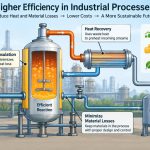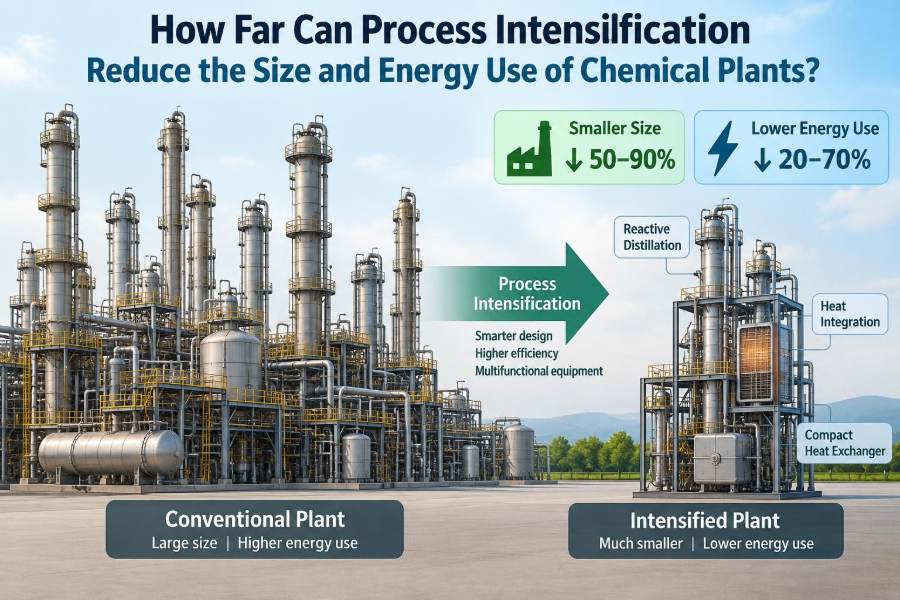

A plant engineer walks through a conventional separation area and sees the familiar signs of scale: tall distillation columns, large heat exchangers, long pipe racks, utility headers, pumps, compressors, and control rooms keeping everything coordinated. Each item has a purpose, but together they occupy land, consume energy, and create many opportunities for heat loss, pressure drop, and operational complexity.
Now imagine producing the same product with a skid-sized unit that combines reaction and separation, recovers heat locally, and reaches steady operation quickly. That is the promise behind process intensification: performing a chemical process more effectively in less equipment volume, with less energy or fewer supporting operations.
The idea matters because chemical plants must reduce emissions and resource use while still meeting demanding requirements for safety, reliability, purity, and throughput. Smaller equipment is attractive, but it is not automatically better. A compact device can introduce new fouling, control, maintenance, and scale-up problems.
The useful question is therefore not whether process intensification can make every plant tiny. It is which process limitations can be removed, and what new limitations appear when they are.
🔍 What Process Intensification Actually Means
Process intensification (PI) is the redesign of a process so that transport, reaction, separation, heat transfer, or control happens more efficiently. It may replace several unit operations with one device, improve contact between phases, or recover energy at the point where it is released.
It is broader than simply buying a smaller reactor. A smaller vessel with unchanged mixing, heat removal, and separation duties is not necessarily intensified. True PI changes the underlying process function or the rate at which that function can occur.
📏 Size Is More Than a Plant Footprint
When engineers say a plant becomes smaller, they may mean less equipment volume, less plot area, less installed pipework, or fewer utility systems. These are related but not identical outcomes.
A microreactor may have very low internal volume, for example, yet production still needs feed tanks, filters, dryers, packaging, maintenance access, and safety equipment. Intensification can shrink the process core dramatically without making the entire facility equally small.
⚡ Why Energy Use Is Often the Bigger Prize
Chemical manufacturing frequently spends large amounts of energy moving heat and separating mixtures. Distillation, evaporation, drying, compression, refrigeration, and pumping can dominate a plant’s utility demand.
PI targets these duties by improving heat and mass transfer, reducing temperature differences, avoiding repeated heating and cooling, or replacing a thermal separation with a different mechanism. The greatest gains occur when an intensified design removes a genuine thermodynamic or transport bottleneck rather than merely rearranging equipment.
🚧 The Bottlenecks That Make Plants Large
Most large process equipment exists because something is slow. Heat must cross a wall, molecules must diffuse to an interface, droplets must settle, reactants must mix, or vapour and liquid must contact each other repeatedly.
Increasing the available surface area, shortening diffusion distances, and improving mixing can make these steps much faster. This is why many PI technologies use narrow channels, structured surfaces, rotating elements, or finely dispersed phases.
🧪 Reaction Engineering: Faster Chemistry in Less Volume
A reactor must provide enough residence time for reactants to reach the desired conversion and selectivity. If mixing is poor or temperature gradients are large, engineers often compensate with a bigger vessel and conservative operating conditions.
Intensified reactors can improve mixing and heat removal so that reactions proceed closer to their preferred conditions. This can reduce reactor volume, suppress unwanted side reactions, and make highly exothermic chemistry easier to manage—provided the flow distribution remains reliable at production scale.
🌡️ Heat Transfer Is a Central Lever
Heat transfer rate rises with heat-transfer area and temperature driving force. Conventional jacketed vessels have limited surface area relative to their contents, especially at large scale. Their centres may heat or cool more slowly than fluid near the wall.
Compact heat exchangers and microstructured reactors create much more surface area per unit volume. They can remove heat rapidly from a reaction or add heat precisely where it is needed, reducing batch time and potentially avoiding oversized utility systems.
🌀 Mixing Can Change Product Quality
Mixing is not just about making a tank look uniform. In fast reactions, local pockets of high reactant concentration or incorrect pH can form unwanted products before bulk mixing catches up.
Static mixers, rotor-stator devices, oscillatory flow reactors, and small channels can shorten mixing times. The result may be a higher-quality product or a narrower particle-size distribution, which can reduce downstream purification work as well as reactor volume.
💧 Mass Transfer Drives Many Separations
Mass transfer describes molecules moving from one phase to another, such as a gas dissolving into liquid or a solute moving across a membrane. Slow transfer often leads to tall columns, large contactors, or long residence times.
PI improves the contact area and renews the boundary layer at phase interfaces. Fine dispersions, thin films, spinning surfaces, and structured packing all aim to make molecules travel shorter distances before crossing from one phase to another.
🧱 Compact Heat Exchangers Reduce Utility Burden
Plate-and-frame, printed-circuit, spiral, and other compact heat exchangers pack large transfer area into a small footprint. They can support tighter temperature approaches, meaning hot and cold streams can exchange more heat before external utilities are needed.
The trade-off is often higher sensitivity to fouling and plugging. A design with very narrow passages is excellent for clean fluids but may be impractical for slurries, polymerizing streams, crystallizing solutions, or feeds with suspended solids.
🔄 Reactive Distillation Combines Two Jobs
Reactive distillation places chemical reaction and distillation in the same column. As products are removed by evaporation or condensation, equilibrium can shift toward further conversion. The integration may eliminate a separate reactor and reduce recycle flow.
It is especially attractive when reaction and volatility cooperate. It is less suitable when catalysts deactivate quickly, reactants have incompatible temperature requirements, or the separation needs conditions that harm selectivity. Integration is powerful only when the combined duties are physically compatible.
🧫 Membrane Reactors and Membrane Separations
A membrane selectively allows some molecules to pass while retaining others. In a membrane reactor, selective removal of a product can shift reaction equilibrium. In a separation service, a membrane may avoid some of the heating associated with distillation.
However, membranes are not universal replacements for columns. Permeability, selectivity, pressure requirements, chemical resistance, and fouling determine whether they are practical. Many membrane systems still need pretreatment and a final polishing step.
🧩 Dividing-Wall Columns Save More Than Space
A dividing-wall column uses an internal partition to carry out what might otherwise require multiple distillation columns. It can reduce repeated remixing of intermediate components and use heat more efficiently.
The concept illustrates an important PI principle: energy savings often come from avoiding an unnecessary reversal of separation. Rather than separating a mixture, remixing it in another column, and separating it again, the column performs the required splits in a more coordinated arrangement.
🧊 Heat-Integrated Distillation Has Practical Limits
Distillation remains essential because it is robust and handles very large throughputs. Intensification can lower its energy use through thermal coupling, vapour recompression, heat pumps, improved internals, and better integration with nearby process streams.
Yet the energy required for a difficult separation cannot be designed away completely. Mixtures with close boiling points, azeotropes, or low relative volatility still demand substantial work or an alternative separation route. Thermodynamics sets the floor; hardware determines how close a plant gets to it.
🧷 Microreactors Explain the PI Mindset
Microreactors contain channels with very small characteristic dimensions. Their high surface-area-to-volume ratio enables rapid heat transfer and short diffusion paths. They are valuable for hazardous, highly exothermic, or very fast reactions.
The key lesson is not that all production belongs in microscopic channels. Rather, it is that controlling transport at the same timescale as chemistry can improve safety and selectivity. Industrial capacity may then be created by numbering up many parallel channels or modules.
🏗️ Numbering Up Is Not the Same as Scaling Up
Traditional scale-up makes one vessel or column larger. Its geometry changes, and mixing, heat transfer, and flow patterns may change with it. Numbering up instead replicates a proven module in parallel.
This can preserve local performance and support modular deployment. But flow must be distributed evenly among modules, controls must coordinate many units, and maintenance plans must account for isolation of individual channels. Parallel hardware does not remove engineering discipline.
📦 Modular Plants Can Shorten Deployment
PI frequently aligns with modular construction: equipment is assembled, tested, and instrumented in a fabrication shop before delivery. Smaller standardized modules can reduce site congestion and allow staged capacity additions.
That does not mean every compact plant is easy to install. Transport limits, foundations, electrical systems, utility connections, hazardous-area requirements, and local permits still matter. Modularization changes where work occurs; it does not eliminate the work.
🔗 Integration Removes Intermediate Handling
Every intermediate tank, transfer pump, filter, and storage step can add cost, residence time, contamination risk, and heat loss. Combining operations can avoid these burdens.
For example, a continuous reaction followed directly by crystallization and filtration may reduce inventory and shorten production time compared with a sequence of disconnected batch vessels. The benefit depends on whether each downstream step can tolerate the upstream process variations.
🛢️ Smaller Inventory Can Improve Safety
Holding less flammable, toxic, or reactive material at any moment can reduce the potential source term in an accidental release. Rapid heat removal and short residence times can also help manage some runaway-reaction scenarios.
But small equipment is not inherently safe. A compact process may operate at higher pressure, use concentrated streams, or have channels that block unexpectedly. Safety assessment must examine credible deviations, relief design, containment, detectability, and shutdown response—not just inventory volume.
🎛️ Control Becomes More Demanding
Intensified equipment often has less internal hold-up, meaning less material is present to buffer a disturbance. This gives fast response, but it can also make temperature, pressure, composition, or flow changes propagate quickly.
Good sensors, appropriate control architecture, and well-tested operating procedures become central to performance. A process that is stable in a large batch tank may need tighter feed control and automated safeguards when converted to continuous compact equipment.
🧼 Fouling Is a Frequent Reality Check
Many PI devices achieve high performance with narrow passages, thin films, or finely structured surfaces. Those same features can be vulnerable to deposits from solids, salts, biological growth, polymer formation, corrosion products, or viscous residues.
Designers should ask early how equipment will be cleaned, inspected, drained, and returned to service. A modestly larger device that can be cleaned reliably may outperform a highly compact design that requires frequent shutdowns.
🔧 Maintainability Must Be Designed In
Access matters. Can operators replace a membrane, remove a catalyst cartridge, inspect a gasket, isolate a module, or verify cleaning? Can a failed component be bypassed without stopping all production?
These questions influence the real footprint because maintenance clearance, lifting paths, spares storage, and access platforms take space. A plant layout should evaluate installed maintainable size, not only process-equipment dimensions shown on a flowsheet.
📈 Capacity Changes the Best Choice
At modest throughputs, compact equipment can be particularly attractive because conventional columns and vessels may be physically oversized relative to production needs. At very large commodity scale, conventional equipment benefits from decades of operating experience and economies of scale.
The optimal choice depends on throughput, feed variability, product value, utility cost, product life cycle, and how often capacity may change. PI is often most compelling where improved selectivity, safety, flexibility, or deployment speed has value beyond simple equipment volume.
🧪 Batch, Continuous, and Hybrid Operation
Process intensification is often associated with continuous processing, but the two are not identical. An intensified batch reactor can use improved heat transfer or mixing; a continuous process can still use conventional equipment.
Continuous systems can reduce inventory and maintain consistent conditions, while batch systems remain useful for multiproduct plants, low-volume products, and processes requiring flexible recipes. Hybrid designs may use continuous reaction with batch finishing, blending, or packaging.
💰 Capital Cost Does Not Always Fall
Reducing equipment count and footprint can lower civil work, piping, insulation, and building needs. Yet specialized materials, precision fabrication, advanced instrumentation, custom modules, and development testing can raise purchase cost.
A fair economic comparison includes installation, utilities, yield, solvent recovery, cleaning, downtime, labour, waste treatment, and product quality. Comparing only the price of a compact device with a conventional vessel misses the system-level economics.
🌍 Energy and Carbon Must Be Evaluated as a System
Lower steam demand can reduce emissions where steam is generated from carbon-intensive fuel. Electrified heat pumps, mechanical vapour recompression, and efficient compression may be attractive where low-carbon electricity is available.
But shifting a duty from steam to electricity is not automatically a climate improvement. Engineers need to examine the local energy supply, seasonal operation, equipment efficiency, refrigerant choices where relevant, and the life-cycle impact of materials and replacement parts.
🧭 A Practical Screening Method
Start with the process constraint rather than a favourite technology. Identify where energy, volume, capital, yield loss, waste, safety risk, or delay originates. Then ask whether the constraint is kinetic, thermal, mass-transfer-related, equilibrium-limited, or operational.
- Map material and energy flows, including recycles and utility loads.
- Find the unit operation causing the largest penalty or bottleneck.
- Define performance targets and unacceptable operating risks.
- Compare conventional improvements with integrated or intensified alternatives.
- Test representative feeds, fouling behaviour, controllability, and cleaning before committing to full scale.
🧮 Use the Right Performance Metrics
Useful metrics include production rate per unit volume, heat-transfer area per unit volume, energy per unit product, solvent use, yield, selectivity, inventory, uptime, and waste generation. No single metric captures the full result.
A device with an impressive volumetric productivity may be a poor choice if it demands frequent cleaning or produces a difficult-to-treat waste stream. The best metric set follows the real business and sustainability constraints of the process.
⚠️ Common Mistake: Treating PI as Miniaturization
Miniaturization is a possible outcome, not the definition. A process may be intensified by integrating heat, removing an equilibrium barrier, improving a catalyst arrangement, or eliminating a separation—even if some equipment remains physically large.
Conversely, shrinking channels without considering pressure drop, maldistribution, plugging, and maintenance can turn a promising concept into an unreliable operation. The objective is better process performance, not small dimensions for their own sake.
🧱 Common Mistake: Ignoring the Whole Flowsheet
Improving one reactor or separator can shift the bottleneck elsewhere. A faster reaction may overload purification. A membrane may create a permeate stream requiring treatment. A heat-integrated system may become less flexible during start-up and shutdown.
Evaluate upstream preparation, downstream finishing, utilities, off-spec handling, and abnormal operation. PI delivers its strongest results when the flowsheet is redesigned around the new capability rather than when one compact device is inserted into an unchanged plant.
🔬 Pilot Work Must Reproduce Real Conditions
Clean laboratory feeds often behave differently from real feeds containing trace contaminants, changing composition, entrained gas, or solids. Long-term catalyst ageing and fouling may not appear in short demonstrations.
Well-planned pilots test the conditions that are most likely to challenge the process: start-up, turndown, feed changes, cleaning cycles, expected impurities, and loss of utilities. This evidence is more useful than a brief test at ideal conditions.
🤝 Technology Selection Needs Several Disciplines
Successful PI projects involve reaction engineers, separation specialists, process control engineers, mechanical designers, operators, maintenance teams, safety professionals, and commercial decision-makers. Each sees a different failure mode or opportunity.
Operators may identify cleaning difficulties; maintenance teams may flag inaccessible components; control engineers may reveal an unmanageable response time. Bringing these perspectives in early prevents a technically elegant design from becoming an operational burden.
🚀 Where Intensification Is Most Credible
Strong candidates usually have a clear pain point: hazardous reaction inventory, poor heat removal, expensive solvent or steam use, complex recycle loops, multiple low-throughput batch steps, or a separation that repeatedly mixes and re-separates material.
Fine chemicals, pharmaceuticals, specialty materials, and distributed production can value compactness and flexibility highly. Large-volume processes can also benefit, particularly from improved heat integration and separation design, but the case must compete with robust established infrastructure.
🗺️ How Far Can Plants Really Shrink?
There is no universal reduction factor. A reaction system may shrink substantially while purification, storage, utilities, and product handling remain similar. A separation-intensive process may save more energy than footprint. Another process may gain mainly in safety and product consistency.
Claims should therefore state the boundary clearly: reactor volume, battery-limits process area, total site area, utility demand, or life-cycle energy. Without that boundary, “smaller” and “more efficient” can conceal important trade-offs.
🎯 The Core Principle: Remove the Limiting Step
Process intensification works best when it directly attacks what makes a process slow, energy-intensive, unsafe, or cumbersome. Faster heat transfer helps when heat transfer limits operation; reactive separation helps when reaction and phase equilibrium cooperate; modular replication helps when conventional scale-up is risky.
The lasting lesson is that PI is a method of matching equipment structure to the physics and chemistry of the process. It can radically reduce size and energy in the right application, but it cannot repeal thermodynamics, eliminate maintenance, or substitute for careful systems engineering.
Process intensification delivers its greatest value not by making every chemical plant small, but by removing the specific bottlenecks that force plants to be large and energy-hungry in the first place. 🧪⚙️🌍