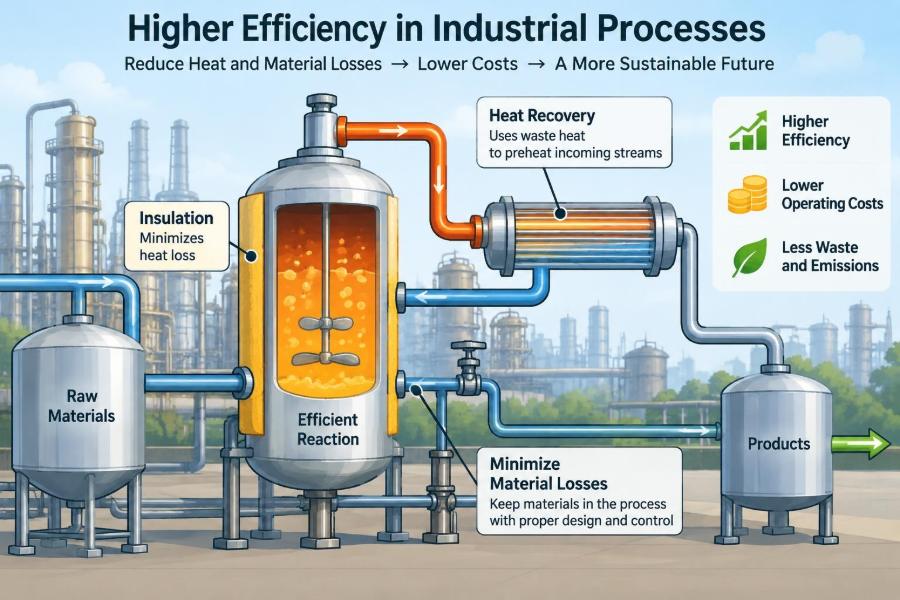

A production line can appear to be running well while quietly losing money and resources at every stage. Steam drifts from an uninsulated valve, hot product leaves a cooler than necessary, powder collects in ductwork, and off-spec material is sent for rework.
None of these losses may stop the plant. Together, however, they increase fuel use, utility demand, waste handling, maintenance effort, and the cost of every tonne or batch produced.
For a student, this is where mass and energy balances become more than classroom equations. For a working engineer, it is often where a process-improvement project begins: identify what enters, what leaves, and what disappears without creating value.
Reducing heat and material losses is not simply about installing more insulation or recovering every possible stream. It means understanding the process, protecting quality and safety, then choosing changes whose benefits exceed their complexity and risk.
🔍 Start with the Meaning of “Loss”
A loss is an input that does not become useful product, useful energy, or an intentionally managed by-product. Material losses include leaks, spills, evaporation, dust emissions, purge streams, contaminated product, and reject material.
Heat losses include energy escaping through equipment surfaces, hot exhaust gases, cooling water, vents, and hot streams discharged before their energy is reused. Some heat rejection is necessary; a condenser, for example, must remove heat to perform separation.
The central question is therefore not “Can this loss be eliminated?” but “Is this energy or material leaving at a condition where it could be avoided, reduced, or used?”
🧭 Define the Process Boundary Before Diagnosing It
Every balance depends on a clearly stated boundary. It may surround a single heat exchanger, a distillation unit, an entire utility system, or the whole site.
A boundary that is too narrow can hide opportunities. For instance, heat leaving a reactor jacket may look like a loss locally, yet it could be a useful heat source for feed preheating elsewhere. A boundary that is too broad can make the source of a problem difficult to locate.
Draw a simple process flow diagram and mark feeds, products, utilities, vents, drains, recycles, and waste streams. This first sketch frequently reveals streams that are measured poorly or not measured at all.
⚖️ Use Mass Balances to Find Missing Material
At steady state, the basic mass-balance idea is straightforward: mass entering a system equals mass leaving it plus accumulation. If accumulation is negligible, unexplained differences point to measurement error, inventory changes, leaks, losses, or unrecorded streams.
For a process unit, engineers commonly compare measured feed, product, waste, and recycle quantities over a representative operating period. A batch process needs extra care because vessel holdup and cleaning losses can be significant.
A mass balance is not automatically proof of a leak. Flowmeters may drift, tank level readings may be unreliable, and moisture content may change. Still, the mismatch provides a disciplined starting point for investigation.
🌡️ Apply Energy Balances with Real Operating Data
An energy balance accounts for fuel, steam, electricity, hot feeds, cooling duties, products, exhaust, and heat transferred to surroundings. In many practical reviews, enthalpy—the heat-related energy carried by a stream—is the most useful quantity.
For a liquid with no phase change, a rough estimate of sensible heat is Q = m × Cp × ΔT, where m is mass, Cp is heat capacity, and ΔT is temperature change. Phase changes, chemical reactions, pressure changes, and mixed compositions require more complete treatment.
Use actual temperatures, flow rates, and compositions where possible. Design values can be useful references, but they may no longer describe fouled equipment, altered feedstocks, or changed production rates.
📊 Build a Loss Register Instead of Chasing Everything
A loss register turns scattered observations into an improvement plan. List each loss, its likely cause, how it is measured, its safety or environmental consequence, and its probable cost or operational impact.
| Loss type | Typical evidence | Useful first check |
|---|---|---|
| Heat to surroundings | Hot equipment surface or thermal image | Inspect insulation condition and surface temperature |
| Steam loss | Visible plume, hissing, poor pressure control | Survey traps, valves, flanges, and condensate return |
| Product loss | Yield gap or unexplained inventory difference | Reconcile batch records and tank inventories |
| Solvent loss | High makeup use or vent loading | Check seals, condensers, recovery equipment, and vents |
| Waste generation | High disposal volume or rework rate | Classify waste by origin and contamination mechanism |
Prioritize losses that are large, frequent, hazardous, expensive, or easy to correct. A small leak of a hazardous solvent may deserve attention before a larger but benign low-temperature heat loss.
🧱 Insulate Hot and Cold Equipment Properly
Insulation reduces heat transfer between equipment and its surroundings. Hot pipes, vessels, valves, furnace ducting, and steam headers are obvious candidates, but cold surfaces also need insulation to prevent heat gain, condensation, and refrigeration losses.
Good insulation work includes more than wrapping straight pipe. Flanges, valves, instrument connections, vessel heads, and removable covers are often omitted because access is needed. These exposed areas can become disproportionately large losses.
Insulation must remain dry and intact. Water trapped beneath damaged cladding can promote corrosion under insulation, creating an integrity risk. Insulation upgrades should therefore be coordinated with inspection and maintenance planning.
🛠️ Repair Steam Leaks and Manage Steam Traps
Steam is valuable because it carries substantial energy and is easy to distribute. It is also easy to waste through leaking valves, failed joints, open bypasses, and poorly operating steam traps.
A steam trap removes condensate and non-condensable gases while limiting live-steam loss. A trap stuck open may pass steam directly to the condensate system; a trap stuck closed can cause waterlogging, poor heat transfer, corrosion, or water hammer.
A planned trap survey combines visual inspection with suitable testing methods and records each trap’s condition. Replacing a failed trap without finding why it failed—dirt, incorrect sizing, poor installation, or pressure conditions—often repeats the problem.
💧 Return Condensate Wherever Quality Allows
Condensate returning from steam users is hot, treated water. Returning it to the boiler system can reduce the demand for makeup water, water-treatment chemicals, pumping energy, and boiler fuel.
The phrase “where quality allows” matters. Condensate exposed to process contamination may be unsuitable for direct boiler return. In these cases, segregation, monitoring, treatment, or alternate beneficial use may be safer than mixing it into a clean return header.
Flash steam from high-pressure condensate can also be recovered for lower-pressure users when the site has a suitable demand. The system must be designed to handle pressure, drainage, and control safely.
🔥 Recover Heat from Hot Process Streams
Heat recovery transfers energy from a hot stream that needs cooling to a colder stream that needs heating. Common examples include using reactor effluent to preheat feed, using hot product to warm incoming raw material, or recovering heat from flue gas.
The best opportunity is often a near-neighbor match: streams are close together, operate at compatible times, and require only a modest temperature difference to exchange heat. This avoids long piping runs and complicated controls.
Recovered heat may not always be valuable. Heat at a low temperature has limited usefulness if no process needs it. Evaluate the quality of heat, the timing of demand, fouling risk, and the energy source being displaced.
🔄 Think in Terms of Heat Integration
Heat integration considers the entire network of heating and cooling duties rather than optimizing exchangers one at a time. The goal is to reduce unnecessary utility use by matching hot and cold process streams efficiently.
Pinch analysis is a structured method for identifying theoretical energy targets and practical heat-recovery opportunities. It is particularly useful for complex continuous plants with many exchangers, but its results depend on sensible assumptions about minimum temperature approach and operability.
A network that minimizes utility demand on paper can be difficult to clean, control, start up, or isolate. Practical designs balance energy targets with reliability, maintenance access, contamination control, and production flexibility.
🧼 Control Heat Exchanger Fouling
Fouling is the buildup of deposits, biological material, corrosion products, polymers, or scale on heat-transfer surfaces. It adds thermal resistance, so more area, higher utility flow, or greater temperature driving force is needed for the same duty.
Symptoms include rising steam consumption, reduced outlet-temperature control, increasing pressure drop, or a gradual decline in heat-transfer performance. Fouling can also create uneven temperatures that affect product quality.
Solutions may include filtration, better water treatment, adjusted velocities, chemical cleaning, mechanical cleaning, or changes in exchanger selection. Cleaning too late wastes energy; cleaning too often causes downtime and can damage equipment.
🎛️ Match Heating and Cooling Utilities to the Duty
Using high-pressure steam for a low-temperature heating job can work, but it may consume a high-quality utility where lower-pressure steam, hot water, or recovered heat would be sufficient.
Likewise, using chilled water to remove heat that cooling water could handle increases refrigeration demand. The appropriate utility depends on required temperatures, control response, contamination constraints, and availability across the plant.
Utility cascading uses the highest-temperature energy first where it is needed most, then directs lower-grade heat to lower-temperature duties. This is a practical expression of energy quality, not merely energy quantity.
⚙️ Improve Furnace and Boiler Combustion
Combustion systems lose energy through hot flue gas, incomplete combustion, radiation from hot surfaces, poor air control, and cycling. Their efficiency depends on fuel properties, burner condition, excess-air levels, firing pattern, and heat-transfer surfaces.
Too little air can produce incomplete combustion and unsafe emissions. Too much air increases the volume of flue gas that must be heated and exhausted. The aim is stable, complete combustion with no more excess air than the equipment and safety requirements need.
Combustion adjustments should be performed by qualified personnel using appropriate flue-gas measurement and operating procedures. A change that lowers stack temperature is not automatically an improvement if it risks condensation, corrosion, unstable flames, or emissions noncompliance.
🌬️ Capture Useful Energy from Exhaust Streams
Hot exhaust from furnaces, dryers, oxidizers, and compressors can contain recoverable energy. Economizers, air preheaters, waste-heat boilers, and process-gas heat exchangers are common approaches.
The challenge is that exhaust streams may contain dust, corrosive compounds, condensable vapors, or variable flow. These can foul or damage recovery equipment and complicate cleaning.
Before selecting equipment, characterize temperature profiles, composition, particulate loading, dew-point behavior, and operating variability. A robust but slightly lower-recovery system may outperform a high-recovery design that is frequently bypassed.
🌀 Reduce Losses from Pumps, Fans, and Compressors
Electrical energy is also part of the heat-and-material-loss picture. Pumps, fans, and compressors can consume excess power when they throttle flow, operate far from their efficient range, leak, or overcome avoidable pressure drop.
Variable-speed drives can reduce energy use when flow demand genuinely varies, because slowing a centrifugal machine often requires much less power than throttling. They are not automatically suitable for every motor, duty cycle, or process-control requirement.
Look for oversized equipment, partially closed valves, dirty filters, restricted piping, air leaks, and excessive system pressure. Reducing demand at the system level is usually better than installing a larger machine to overcome a restriction.
💨 Stop Compressed-Air Waste
Compressed air is convenient but energy-intensive to produce. Leaks, inappropriate uses, excessive pressure, artificial demand from pressure drops, and unattended equipment can turn it into a persistent utility loss.
A leak survey should include audible checks, ultrasonic detection where available, tagging, repair, and verification. Repairs often fail to hold when hoses, fittings, vibration, or poor installation practices are not addressed.
Replace air-driven cooling, cleaning, agitation, or conveying only after evaluating safety and process needs. In some cases, an electric blower, mechanical actuator, or redesigned nozzle can provide the same function with lower energy demand.
🧪 Prevent Evaporation and Volatile Material Loss
Volatile liquids can escape from storage tanks, reactors, dryers, loading operations, and open handling steps. Lost vapors may represent valuable solvent, product contamination, worker exposure, emissions, or flammability hazards.
Controls include sealed transfer systems, suitable tank venting, condenser systems, vapor recovery, properly maintained seals, and operating conditions that avoid unnecessary heating or agitation. The right choice depends on vapor pressure, chemistry, throughput, and safety requirements.
Do not assume that tighter containment is always harmless. Pressure relief, inerting, thermal expansion, and maintenance access must be designed correctly. A closed system still needs safe pathways for credible abnormal conditions.
🧯 Find and Eliminate Liquid Leaks Early
Liquid leaks can be obvious spills or slow losses from pump seals, valve packing, flanges, sampling points, drains, and corroded lines. A small leak may contaminate insulation, create slip hazards, accelerate corrosion, or enter drains unnoticed.
Routine field rounds remain valuable because people can spot staining, odors, drips, vibration, unusual temperatures, and damaged supports that instruments may miss. Digital condition monitoring can strengthen, not replace, careful observation.
Repairs should address root cause. Repeated seal failures may indicate dry running, cavitation, misalignment, incompatible materials, excessive vibration, or incorrect operating pressure rather than a defective seal alone.
🧹 Reduce Powder, Pellet, and Dust Losses
Solids handling creates losses through transfer-point spills, dust collection, poor enclosure, pneumatic-conveying wear, segregation, and product left in hoppers or filters. Fine material can become a safety issue when combustible dust is present.
Improved chute geometry, enclosed transfers, correctly designed dust collection, controlled conveying velocity, and preventive cleaning can reduce loss. The aim is not simply to collect dust after release but to prevent its generation and escape.
Collected dust is not automatically reusable. Its particle-size distribution, moisture, contamination, and degradation must be evaluated before returning it to product. Improper recycle can create quality drift or upset downstream equipment.
♻️ Use Recycle Streams Carefully
Recycling off-spec material, solvent, purge components, or by-products can improve yield, but it also returns impurities. Without a route for non-reactive species or contaminants to leave, they can accumulate until quality or operability declines.
A recycle design needs a defined composition, flow limit, destination, and monitoring plan. For example, a recovered solvent may require drying or purification before reuse, even when it looks clear.
Material recovery is most effective when it avoids creating a larger downstream burden. Evaluate separation energy, quality risk, storage needs, waste reduction, and the effect on reaction or separation performance.
🧫 Improve Yield at the Source
The cheapest kilogram of waste is often the kilogram never formed. Yield losses may begin with variable raw materials, incorrect ratios, poor mixing, incomplete reaction, overreaction, degradation, poor temperature control, or separation inefficiency.
Trend process variables alongside yield and quality data. A recurring loss may correlate with a particular feed lot, shift condition, temperature excursion, hold time, or equipment configuration.
Process chemistry and product specifications set real limits. Pushing conversion or recovery harder can sometimes increase impurities, energy use, fouling, or safety risk. Optimize the whole process, not one laboratory metric.
🧊 Minimize Cooling and Refrigeration Losses
Cooling systems lose performance through warm-air infiltration, damaged insulation, poor condenser heat rejection, fouled evaporators, excessive setpoints, and unnecessary circulation. Refrigeration is especially sensitive because removing heat at low temperature requires significant work.
Maintain doors, seals, vapor barriers, defrost systems, and airflow paths in chilled spaces. For process refrigeration, verify that temperature targets match actual quality, reaction, or safety needs rather than inherited operating habits.
Lowering a setpoint “for safety” without analysis can raise energy consumption and sometimes cause freezing, viscosity problems, or control instability. A documented operating envelope is more reliable than an informal margin.
📏 Measure What You Intend to Improve
Useful measurements include fuel flow, steam flow, condensate return, electricity, cooling-water temperature rise, product yield, waste mass, vent concentration, and key pressure and temperature differences. Metering should support decisions, not create dashboards nobody uses.
Data quality matters. Verify instrument range, calibration, installation, sampling frequency, and whether values are averaged in a meaningful way. A flowmeter cannot correct for a bypass line that avoids it.
Establish a baseline under defined operating conditions. Comparing energy per unit product without accounting for throughput, feed quality, ambient conditions, and product mix can produce misleading conclusions.
📈 Choose Metrics That Expose Real Performance
Specific energy consumption, such as energy per tonne of acceptable product, is often more revealing than total energy use. Material yield, solvent makeup per batch, water use per unit product, and waste per unit product provide similar insight.
Use several metrics when necessary. A plant can improve energy per tonne by producing more material while still increasing total emissions or creating more off-spec waste. Conversely, a temporary energy increase may be justified by a large quality improvement.
Control charts and simple trends help distinguish normal variation from a sustained shift. Metrics should trigger questions and investigation, not encourage operators to manipulate numbers at the expense of safe operation.
🧑🔧 Involve Operators and Maintenance Teams
Operators see how equipment behaves during startups, grade changes, cleaning, and upsets—the periods where losses often spike. Maintenance teams understand recurring failures, difficult access points, and repairs that do not last.
Invite both groups into walkdowns and root-cause discussions. Their observations can identify a leaking manual valve, a heat exchanger that fouls after a certain campaign, or a procedure that routinely leaves product in a line.
Improvement projects work better when the new practice is easy to operate, clearly documented, and supported by training. A technically elegant modification that makes routine work harder may be bypassed.
🧠 Use Root-Cause Analysis for Persistent Losses
When a loss returns after an apparent fix, move beyond the immediate symptom. A structured review can ask why the condition occurred, why it was not detected, and why the system allowed it to persist.
For example, repeated product spills may not be solved by a larger drip tray if the underlying causes are poorly sequenced valve operations, an unclear line-up checklist, and level instrumentation that is hard to trust.
Root-cause analysis should lead to actions that are specific, owned, and verifiable. “Improve awareness” is rarely enough on its own; redesign, maintenance, measurement, or procedural changes may be needed.
⚠️ Protect Safety, Quality, and Compliance
Energy and material efficiency projects can alter pressure, temperature, flow, chemical composition, and equipment interactions. These changes can affect relief requirements, flammability risk, thermal stability, contamination control, emissions, and worker exposure.
Apply the site’s management-of-change process before implementing modifications. Review operating procedures, safeguards, alarms, control logic, materials compatibility, and required approvals.
A heat-recovery exchanger that allows cross-contamination between streams, or a recycle stream that changes reaction behavior, can cost more than the energy it saves. Efficiency is only an improvement when the process remains safe, compliant, reliable, and within specification.
💼 Rank Projects by Value and Practicality
Start with low-cost actions such as leak repair, insulation repair, setpoint review, trap maintenance, cleaning schedules, and better shutdown discipline. These often provide valuable learning before capital-intensive projects are considered.
For larger investments, estimate savings conservatively and include installation, downtime, controls, maintenance, cleaning, reliability, and operator workload. Sensitivity analysis is useful when utility prices, production rates, or operating hours are uncertain.
A project with a modest energy benefit may still rank highly if it also reduces emissions, improves capacity, prevents quality losses, or removes a recurring maintenance problem.
🗺️ Create a Practical Improvement Roadmap
A workable roadmap converts observations into a sequence of actions. It should identify a baseline, target, owner, deadline, measurement method, safety review needs, and a plan for checking whether the change held.
- Map major material and energy flows.
- Verify the largest suspected losses in the field and with data.
- Fix obvious defects and standardize the repair.
- Study process-integration and yield opportunities.
- Measure results, update operating practices, and repeat.
Do not wait for a perfect site-wide model before correcting a clearly leaking steam valve or broken insulation cover. At the same time, avoid making isolated changes that block a larger heat-integration opportunity.
🚫 Avoid Common Efficiency Mistakes
One common mistake is focusing only on visible losses. A clean-looking process may waste far more energy through an oversized compressor or an exchanger fouled internally than through a visible plume.
Another is treating all heat as equally useful. A large quantity of low-temperature heat may have little recovery value, whereas a smaller high-temperature stream can displace significant fuel. Timing matters too: heat available overnight cannot help a daytime batch unless it can be stored or the schedule changes.
Finally, do not declare success immediately after installation. Verify performance across normal operating conditions and watch for maintenance, quality, and control problems that emerge later.
🌱 Connect Loss Reduction to Sustainable Operations
Lower fuel use generally reduces the emissions associated with generating that energy, while lower material loss reduces resource extraction, treatment, transport, and disposal burdens. These benefits are meaningful, but they should be evaluated alongside the full process impact.
For example, a recovery system may reduce solvent loss while consuming electricity and requiring periodic cleaning chemicals. The net result can still be favorable, but responsible engineering makes those trade-offs visible.
Sustainable operation is therefore closely linked to good process engineering: use resources deliberately, reduce avoidable waste, and preserve the performance of the equipment and people that keep the plant running.
🎯 The Core Principle: Keep Value Inside the Process
Heat and materials leave industrial processes for physical reasons: temperature differences drive heat transfer, pressure differences drive leaks and flow, and imperfect separations leave material in unwanted places. Engineers cannot remove every driving force, nor should they try to eliminate every discharge.
The practical goal is to identify where valuable inputs cross a boundary without serving a useful purpose, then reduce that loss at its source or recover value safely. Sound balances, reliable measurements, field observation, and cross-functional knowledge make this possible.
Whether the action is repairing a steam trap, tightening a transfer system, recovering hot condensate, or redesigning a recycle loop, the same discipline applies: understand the mechanism, verify the result, and protect the wider process.
An efficient industrial process is one that turns more of every purchased material and unit of energy into safe, on-spec value—and treats unavoidable losses as engineering problems to understand rather than background noise. 🧪🌡️♻️