
A baker knows that a warm kitchen can make dough rise faster. A process operator knows that raising a reactor temperature may increase production. These experiences make temperature seem like a simple control knob: turn it up, and chemistry moves faster.
That rule is often useful, but it is not a complete rule. A reaction can slow when a catalyst loses activity, when a reactant escapes as a gas, or when high temperature shifts the chemical equilibrium away from the desired product.
For chemical engineers, the distinction matters well beyond the classroom. Temperature affects conversion, selectivity, pressure, energy consumption, product quality, and safety at the same time.
The better question is not simply, “Will a higher temperature speed up the reaction?” It is: which step is controlling the observed rate, and what else changes when temperature rises?
🌡️ The Short Answer: Usually, but Not Always
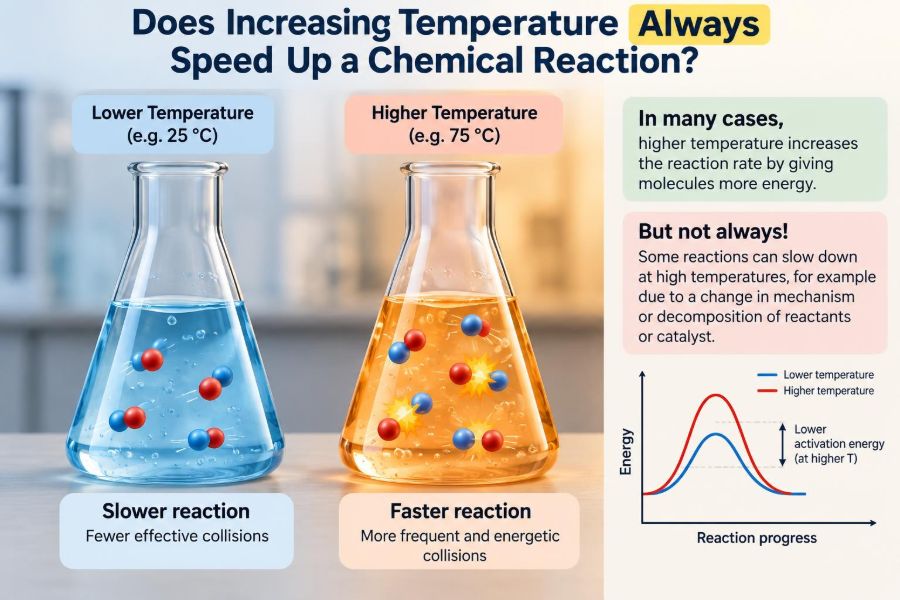
For a single elementary reaction under otherwise unchanged conditions, increasing temperature generally increases the rate constant. Molecules have more thermal energy, and a greater fraction can cross the activation-energy barrier.
Real reactions are rarely that isolated. Industrial and laboratory systems may involve reversible chemistry, catalysts, multiphase transport, competing reactions, changing concentrations, and heat-transfer limits. Any of these can weaken, cancel, or reverse the expected rate increase.
It helps to separate intrinsic kinetics—the chemistry occurring at a reaction site—from the observed rate of the complete system.
⚛️ What Chemists Mean by Reaction Rate
Reaction rate describes how quickly reactants are consumed or products are formed. It can be expressed as a change in concentration with time, such as mol per litre per second, or as a molar production rate in a reactor.
A rate law connects rate to variables such as concentration and temperature. A simplified form is rate = k[A]^m[B]^n, where k is the rate constant and the exponents reflect how the chemistry responds to reactant concentrations.
Temperature often changes k most directly. But it can also change the concentrations, phases, physical properties, and even the identity of the species present.
🏔️ Activation Energy Is the Main Barrier
Many reactions require reacting molecules to reach a high-energy arrangement before bonds can break and form. This energy threshold is called the activation energy.
Imagine hikers crossing a mountain pass. A warmer molecular population does not literally raise hikers, but it does give more molecules enough energy to reach the pass. More successful crossings per unit time usually means a faster reaction.
Activation energy is not the energy released or absorbed by the overall reaction. A reaction can be strongly exothermic and still be slow if its activation barrier is high.
📈 The Arrhenius Equation Explains the Usual Trend
The common temperature dependence of a rate constant is described by the Arrhenius equation: k = A exp(-Ea/RT). Here, Ea is activation energy, R is the gas constant, T is absolute temperature, and A is the pre-exponential factor.
Because temperature appears in the denominator of the negative exponent, increasing T generally increases k. The effect can be substantial, especially for a reaction with a relatively high activation energy.
However, the equation assumes that the reaction mechanism and relevant physical conditions remain comparable over the temperature range being considered. That assumption can fail.
📊 Why a Few Degrees Can Matter
Temperature effects are nonlinear. A rise from 300 K to 320 K does not produce a fixed universal percentage change in rate; the result depends on activation energy and mechanism.
That is why a modest reactor temperature adjustment can noticeably change throughput, while a similar adjustment has little effect on another process. The temperature sensitivity belongs to the particular reaction system, not to temperature alone.
A useful engineering practice is to measure or estimate kinetics over the operating range rather than relying on a rule of thumb such as “the rate doubles every 10 degrees.” Such shortcuts may be reasonable for rough intuition but are not reliable design data.
🔬 Elementary Steps and Overall Reactions Differ
An elementary step is a single molecular event with a defined mechanism. For such a step, its rate expression may follow directly from molecular encounters.
An overall reaction equation can combine many elementary steps. One slow intermediate-forming step, a surface adsorption event, or a product-desorption step may determine the overall rate.
As temperature changes, the rate-controlling step can change too. A simple Arrhenius plot may then curve or show different slopes in different temperature regions.
🔄 Reversible Reactions Have Two Directions
A reversible reaction has both forward and reverse rates. Heating commonly speeds both directions because both have activation barriers.
What matters for net production is the difference between them. Near equilibrium, the forward and reverse reactions can each be rapid while the net rate is small.
This is a key reason that “faster molecular reactions” does not automatically mean “more desired product per hour.”
⚖️ Equilibrium Can Move Against the Product
Temperature also changes the equilibrium constant. For an exothermic reaction, heat behaves like a product in the thermodynamic sense, so higher temperature often favors reactants at equilibrium. For an endothermic reaction, it often favors products.
Consider ammonia synthesis conceptually: higher temperature improves reaction kinetics, but the equilibrium yield of ammonia is less favorable because ammonia formation is exothermic. Industrial operation therefore uses a compromise, along with pressure, catalyst selection, recycle, and product removal.
Kinetics tells how fast equilibrium is approached; thermodynamics tells where equilibrium lies. They answer different questions.
🎯 Faster Conversion Can Still Mean Worse Selectivity
Many feedstocks can follow several reaction pathways. Heating may accelerate the desired reaction and an undesired side reaction by different amounts.
If the undesired path has a larger effective activation energy, it may become disproportionately faster as temperature rises. The reactor can show high total conversion but lower selectivity to the target product.
For example, a temperature increase in an organic reaction may promote decomposition, overreaction, or polymerization alongside the intended transformation. The best operating temperature is therefore often below the temperature that gives the largest raw reaction rate.
🧩 Side Reactions Change the Meaning of “Faster”
Production targets are usually based on yield, not merely disappearance of feed. Yield combines conversion with selectivity, so it captures whether consumed reactant actually became the intended product.
When side reactions matter, engineers examine a product distribution over temperature rather than one rate curve. Analytical tools such as chromatography or spectroscopy can reveal products that a simple conversion measurement misses.
Heating without checking selectivity can create the misleading appearance of an improved process while increasing waste separation and reducing usable output.
🧯 Thermal Decomposition Can Reduce Reactant Availability
At sufficiently high temperature, a reactant, product, solvent, initiator, or catalyst ligand may decompose. The desired reaction may still be intrinsically fast, but there is less active material left to react.
Decomposition may be gradual, or it may begin sharply across a narrow operating range. A material-safety review and thermal screening are especially important when heating unfamiliar mixtures.
In batch work, an initial burst of product formation followed by a slowdown can indicate reactant depletion, catalyst loss, or formation of an inhibiting by-product. Temperature alone does not diagnose which cause is responsible.
🧪 Catalysts Can Lose Their Advantage When Heated
A catalyst lowers the activation barrier by providing a different reaction pathway. It is not consumed by the ideal catalytic cycle, but real catalysts can deactivate.
Common high-temperature deactivation routes include sintering of metal particles, poisoning by impurities, loss of active surface area, coking, phase changes, and leaching from supports. Enzymes can also unfold and lose their functional shape.
The observed result may be a rate that rises at first with temperature and then falls after the catalyst deactivates. This behavior is particularly relevant during long runs, where short laboratory tests can look better than sustained plant operation.
🧬 Enzymes Often Have a Temperature Optimum
Enzyme-catalyzed reactions illustrate the limit clearly. Increasing temperature often accelerates enzyme activity up to a useful range because molecular motion and catalytic turnover increase.
Beyond that range, the enzyme’s protein structure can become unstable or denature. Activity falls, sometimes irreversibly, even though ordinary chemical reaction rates would be expected to increase.
The exact optimum depends on the enzyme, solution composition, residence time, and process conditions. It should be measured rather than assumed from another enzyme system.
🫧 Dissolved Gases Become Less Available
Gas solubility in many liquids decreases as temperature rises. In a gas–liquid reaction, less dissolved gas can be available at the reaction site even if the intrinsic chemical step is faster.
This matters in hydrogenations, oxidations, fermentation aeration, and wastewater treatment. A warmer liquid may have faster kinetics but lower dissolved oxygen or another limiting gas concentration.
If gas transfer is limiting, increasing agitation, pressure, interfacial area, or gas flow may matter more than further heating.
🚰 Mass Transfer May Be the Real Bottleneck
Mass transfer is the movement of a species from one location or phase to another. Examples include diffusion through a liquid film to a catalyst particle and transport of a gas into a liquid.
Temperature can reduce viscosity and increase diffusivity, which often improves mass transfer. But this does not guarantee a proportional production increase, particularly if another resistance becomes dominant.
A useful diagnostic is to change mixing speed, particle size, or flow rate. If the observed reaction rate changes strongly, transport limitations may be masking the intrinsic temperature dependence.
🧱 Diffusion Inside Porous Catalysts Has Limits
Many solid catalysts contain pores. Reactants must diffuse from the bulk fluid into those pores before reaching active sites, and products must diffuse back out.
At high intrinsic reaction rates, reactants may be consumed near the outer surface faster than they can penetrate inward. Much of the catalyst interior then contributes less than expected.
Engineers use concepts such as the effectiveness factor to compare the observed pellet rate with the rate that would occur if every active site saw the bulk concentration. A hotter reactor may increase intrinsic kinetics while making internal diffusion limitations more severe.
🔥 Heat Transfer Can Create Temperature Gradients
Temperature setpoint and actual reaction temperature are not always the same. In an exothermic reactor, heat generated within the mixture can create hot zones, especially near catalyst beds or where mixing is poor.
Those hot zones may accelerate reactions locally, promote side products, and change catalyst aging. In an endothermic system, insufficient heat supply can leave parts of the reactor cooler and slower than indicated by one sensor.
Good temperature control requires thoughtful sensor placement, mixing, heat-exchanger design, and sometimes multiple measurement points—not just a controller display.
💥 Exothermic Reactions Carry Runaway Risk
An exothermic reaction releases heat. If a temperature rise increases its rate, the reaction releases heat faster, which can raise temperature again. This feedback loop is called thermal runaway.
A runaway is not inevitable in every exothermic system, but the possibility must be assessed. Heat removal, reaction kinetics, inventory, mixing, emergency quench capability, and relief design all influence the risk.
Scale matters. A small vessel loses heat relatively easily through its surface, while a larger vessel has less heat-transfer area relative to volume. A procedure that appears calm in a flask may behave very differently at larger scale.
🧊 Cooling Can Sometimes Improve Overall Output
Cooling may sound counterproductive when a reaction is slow, yet it can improve the overall process. Lower temperature may preserve catalyst activity, suppress a side reaction, retain dissolved gas, or improve equilibrium yield for an exothermic synthesis.
In a strongly exothermic reactor, controlled cooling can also keep operation within a stable region where heat removal exceeds heat generation. The result can be steadier production and more consistent product quality.
The goal is rarely the highest possible temperature. It is the temperature profile that best satisfies rate, yield, energy, safety, and equipment constraints.
🌬️ Phase Changes Can Interrupt the Expected Trend
Heating can evaporate a volatile solvent or reactant, alter liquid composition, change pressure, or create two phases where one previously existed. These changes affect concentration and contact between reactants.
For instance, if a volatile reactant boils away from an open or poorly contained system, its liquid-phase concentration decreases. The desired liquid reaction can slow despite the higher temperature.
Conversely, melting a solid reactant may improve mixing and contact dramatically. Phase behavior should be part of any explanation of temperature effects.
🧂 Solvents and Ionic Media Are Not Passive
Temperature changes solvent viscosity, dielectric behavior, solubility, and hydrogen bonding. These properties influence how ions separate, how molecules collide, and whether intermediates are stabilized.
Some reactions in solution show non-Arrhenius behavior because the solvent environment changes significantly with temperature. A rate constant measured in one solvent cannot automatically be transferred to another.
In electrolyte systems, conductivity and mass transport can improve with warming, while evaporation, corrosion, or material compatibility may become more challenging.
🧱 Material Limits Set Practical Temperature Windows
Even if chemistry benefits from heating, seals, gaskets, linings, instruments, and vessels have allowable service ranges. Higher temperature can accelerate corrosion, embrittlement, fouling, or degradation of polymer components.
Pressure is also often coupled to temperature, especially when volatile materials are present. Raising temperature in a closed system can increase pressure substantially and alter both mechanical and process hazards.
Process decisions should therefore use the operating envelope of the whole system, not only reaction data from a small test vessel.
🔍 How to Tell What Is Actually Limiting
A measured slowdown or plateau needs evidence before it receives an explanation. Start by distinguishing a chemical limitation from a transport, equilibrium, or equipment limitation.
- Measure actual temperature at relevant locations, not only jacket or heater temperature.
- Track reactants, desired products, and likely by-products over time.
- Vary mixing, gas flow, pressure, or catalyst particle size to test for transport effects.
- Compare fresh and used catalyst to investigate deactivation.
- Check material balances for evaporation, leaks, precipitation, or unmeasured products.
Changing one variable at a time is especially useful during diagnosis. Otherwise, a temperature change combined with a mixing or feed change can produce ambiguous results.
📉 Arrhenius Plots Are Useful, Not Automatic Proof
An Arrhenius plot graphs ln(k) against 1/T. If the reaction follows simple Arrhenius behavior over the tested range, the result is approximately a straight line, and its slope relates to activation energy.
A curved plot or a change in slope is informative. It may signal a mechanism change, catalyst deactivation, equilibrium effects, phase changes, or mass-transfer control.
However, the plot is only as good as the rate constants supplied to it. Using initial-rate data, maintaining comparable composition, and avoiding temperature-measurement error are essential.
🧾 A Compact Guide to Temperature Effects
| Situation | What higher temperature often does | What can complicate the result |
|---|---|---|
| Single kinetic step | Increases rate constant | Mechanism changes at a new temperature |
| Reversible exothermic reaction | Speeds approach to equilibrium | May reduce equilibrium product fraction |
| Parallel reactions | Raises conversion | May favor unwanted products |
| Heterogeneous catalysis | Increases intrinsic surface rate | Diffusion limits or catalyst deactivation |
| Gas–liquid reaction | Can accelerate chemical reaction | Reduced gas solubility and transfer |
| Biocatalysis | Raises activity within a range | Enzyme denaturation |
🏭 Industrial Temperature Selection Is an Optimization Problem
In a plant, temperature is selected alongside pressure, residence time, catalyst loading, feed ratio, recycle strategy, and separation design. A faster reactor can burden downstream purification if it produces more impurities.
Energy also matters. Heating costs utilities, while excessive cooling requires heat removal capacity. Heat integration may make one operating condition more attractive than another even when reaction performance is similar.
The practical optimum is therefore a system-level decision. It is often a range rather than one perfect number, allowing stable operation despite feed and ambient variation.
🧪 Laboratory Experiments Need Careful Comparisons
When students compare rates at different temperatures, they should keep volumes, concentrations, stirring, sampling times, and measurement methods consistent. A change in temperature can change density and volume slightly, so concentration calculations should be handled thoughtfully.
Use a controlled bath, jacket, or heating system and allow the reaction mixture to reach the intended temperature before timing a kinetic run, where appropriate. Record the uncertainty of temperature measurement rather than treating a setpoint as exact.
For volatile, flammable, toxic, pressurized, or strongly exothermic systems, follow the relevant laboratory procedures and supervision requirements. Heating is a chemical and mechanical hazard as well as an experimental variable.
🚫 Common Misconceptions to Avoid
- “Higher temperature always gives more product.” It may give faster reaction but lower equilibrium yield or selectivity.
- “A catalyst makes temperature unimportant.” Catalysts alter pathways but still have activity, transport, and stability limits.
- “The setpoint is the reaction temperature.” Gradients and heat-release effects can make this false.
- “A flat rate means the chemistry has stopped responding to temperature.” Transport limits, depletion, or deactivation may be controlling instead.
- “One successful hot run defines a safe operating condition.” Repeatability, scale, heat removal, and duration all matter.
🛠️ A Practical Workflow for Raising Temperature
Before increasing temperature, define what improvement is needed: shorter batch time, greater conversion, higher yield, less impurity, or more stable operation. These targets can point toward different temperature choices.
- Establish a safe operating range from material, pressure, and reaction-hazard information.
- Test several temperatures within that range using comparable feed and mixing conditions.
- Measure rate, conversion, selectivity, and signs of catalyst or material degradation.
- Check whether transport or heat transfer changes are influencing the result.
- Choose a condition using whole-process performance, then confirm it over realistic operating time.
This workflow replaces a one-variable intuition with evidence that is more useful for design and troubleshooting.
🧠 The Core Principle: Rate Is Part of a Larger System
Increasing temperature often speeds an elementary chemical step because more molecules can overcome its activation barrier. That foundational idea remains one of the most useful tools in kinetics.
But a chemical process is not only an elementary step. Equilibrium may shift, side reactions may compete, catalysts may deactivate, gases may dissolve less readily, and heat or mass transfer may take control.
The strongest engineering question is therefore not whether heat makes chemistry faster in theory. It is whether a temperature change improves the safe, sustained, selective, and economically useful observed performance of the real system.
Increasing temperature usually accelerates intrinsic reaction kinetics, but it does not always increase the rate or yield that matters in practice; the full reaction system determines the outcome. Treat temperature as a powerful design variable, then test it with kinetics, transport, thermodynamics, and safety in view. 🧪🌡️⚙️