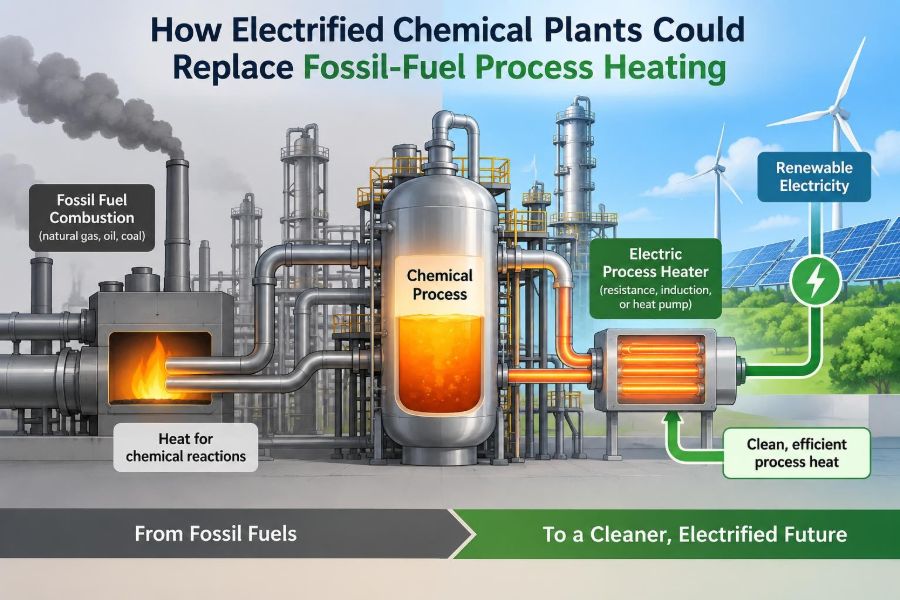

A chemical plant can make products that appear far removed from combustion: medicines, coatings, fertilizers, polymers, detergents, and materials for batteries. Yet behind many of those products is a familiar sight—fuel being burned to make steam, heat furnaces, or keep reactors at temperature.
For a process engineer, the heat source may feel like settled infrastructure. Natural-gas boilers, fired heaters, steam headers, and flue-gas stacks have been integrated into plant layouts and operating habits for decades. But as electricity systems add lower-carbon generation, that assumption is being re-examined.
Electrifying process heat does not mean plugging an entire refinery or chemical complex into a larger socket. It means selecting the right duties, supplying heat through electrically driven equipment, and redesigning utilities, controls, and sometimes chemistry around a different energy source.
The opportunity is substantial, but so are the engineering constraints. Temperature, heat-transfer rate, reliability, electricity availability, product quality, and local grid capacity all determine whether an electric option is sensible.
🔥 Why process heating is central to chemical production
Process heat is thermal energy delivered to a material or piece of equipment to drive a physical or chemical change. It heats feedstocks before separation, provides latent heat for evaporation, maintains reactor temperature, dries solids, and supplies high-temperature energy for reactions.
Unlike building heating, industrial heat often has tight requirements. A distillation reboiler may need stable heat at a specified temperature, while a cracking furnace needs intense heat flux over a particular coil geometry. A replacement must meet the duty, not merely provide “heat” in a general sense.
🏭 Where fossil fuels enter the heat balance
Fossil fuels commonly provide heat in three routes: direct firing, steam generation, and combined heat and power. In direct firing, combustion gases or radiant flames transfer energy to process coils, kilns, ovens, or furnaces.
In indirect systems, a boiler produces steam that travels through headers to exchangers and equipment. This approach is flexible, but every conversion and distribution step creates losses. Combined heat and power can use fuel efficiently at a site, yet it still relies on combustion unless the fuel itself changes.
⚡ What electrified process heat actually means
Electrified process heat uses electricity as the immediate energy input for a thermal duty. The electricity may run a heat pump, create resistance heat, power an induction coil, generate microwave energy, or feed an electric boiler.
It is not automatically zero-carbon. Its climate impact depends on the electricity used over the relevant operating period, as well as equipment manufacture and any displaced fuel. Its key advantage is flexibility: an electrical load can become cleaner as the power system becomes cleaner without rebuilding the process heater.
🧭 Start with a plant heat map
A credible electrification plan begins with a heat map, not a technology catalog. Engineers should identify each thermal duty, its supply and return temperatures, required heat-transfer rate, operating hours, control tolerance, current fuel use, and process consequence of interruption.
Plotting duties by temperature and load duration often reveals priorities. Low-temperature, continuous duties with nearby waste heat may suit heat pumps. Small high-temperature batch duties may suit resistance heating. A large, critical fired furnace may require a longer development path.
🌡️ Temperature determines the available options
Temperature is a useful first screen because it constrains both equipment and efficiency. Heat pumps are strongest where they can upgrade low-grade heat to useful moderate temperatures. Resistance and induction systems can reach much higher temperatures, but their electrical demand can be large.
| Temperature range | Typical duties | Often-considered electric routes |
|---|---|---|
| Low to moderate | Washing, low-pressure steam, evaporation, drying | Industrial heat pumps, electric boilers, resistance heaters |
| Moderate to high | Reboilers, thermal fluid heating, curing, some dryers | Resistance, electrode boilers, induction, advanced heat pumps |
| Very high | Furnaces, kilns, cracking and high-temperature reactors | Resistance, induction, plasma, radiative electric heating, redesigned reactors |
These categories overlap. Feasibility depends on the process fluid, pressure, equipment geometry, materials, and required heat flux—not temperature alone.
💨 Electric boilers can replace some steam production
Electric boilers turn electrical energy into steam through resistance elements or electrodes. They can be compact, responsive, and useful where a plant needs clean steam generation without on-site combustion.
They are often easiest to justify for peak steam demand, smaller distributed loads, or sites with constrained emissions permits. Replacing a very large baseload fuel boiler is harder because it may require a major new grid connection and high-cost electricity during many operating hours.
♨️ Heat pumps move heat rather than create it
A heat pump uses work—usually electricity—to move heat from a colder source to a hotter sink. Because it transfers existing thermal energy, it can deliver multiple units of heat for each unit of electricity under favorable conditions. This relationship is described by the coefficient of performance, or COP.
A useful source might be warm cooling water, condenser heat, compressor aftercoolers, wastewater, or a low-temperature process stream. The smaller the temperature lift between source and sink, the easier the job generally becomes.
🔁 Pinch analysis reveals the best heat-pump targets
Pinch analysis is a method for identifying how a process can recover heat internally while minimizing external heating and cooling. It compares hot streams that must be cooled with cold streams that need heating.
Before adding an electric heat source, a plant should reduce avoidable heating demand through heat integration. A heat pump then becomes especially valuable where recovered heat is available at a temperature just below a useful process duty. Electrification and heat recovery are complements, not competing projects.
🧲 Induction heating puts energy into conductive materials
Induction heating creates an alternating magnetic field that induces currents in electrically conductive material. The resulting resistive losses heat the material, often rapidly and with localized control.
It can be attractive for metal vessels, pipes, reactor components, and certain solids-processing tasks. Its limitations are equally practical: nonconductive materials do not heat directly, coil design matters, and scaling a laboratory geometry to industrial dimensions can change uniformity and control behavior.
🧱 Resistance heating is simple, but heat transfer still matters
Resistance heaters convert electricity to heat in an element, which then transfers energy by conduction, convection, or radiation. The basic conversion is straightforward, but installing a resistance heater does not remove classic thermal engineering problems.
Engineers still need to manage surface temperature, fouling, hot spots, fluid velocity, temperature gradients, and material compatibility. In viscous or heat-sensitive products, excessive wall temperature can cause degradation even when the bulk outlet temperature appears acceptable.
🌊 Dielectric and microwave heating have specialized roles
Dielectric heating uses an alternating electric field to heat materials with suitable dielectric properties. Microwave systems are one form of electromagnetic heating. They may heat more volumetrically than a jacket or coil, which can help in selected drying, curing, and materials-processing applications.
Industrial scale-up can be challenging. Field distribution, penetration depth, changing moisture content, and reflections within the equipment affect uniformity. These technologies should be evaluated through representative trials rather than assumed to behave like domestic microwave ovens.
⚙️ Plasma and electric arcs address extreme temperatures
For very high-temperature applications, plasma torches and electric arcs can supply intense energy without fuel combustion at the point of use. They are being considered for some metallurgical and chemical transformations that are difficult to serve with conventional electric heaters.
However, high temperature alone does not make a process suitable. Electrode wear, product contamination, reactor materials, power quality, and the chemistry of gas-phase reactions can become central design questions.
☀️ The electricity source changes the carbon result
Electrification shifts emissions from a plant stack to the electricity supply chain. If power is generated largely from fossil sources at the time of operation, an electric heater may offer limited emissions benefit and can, in some settings, increase total emissions relative to efficient direct combustion.
Plants should evaluate the relevant grid mix, contracted clean-power supply, and expected future power-system changes. They should also distinguish annual accounting from hourly operation: a yearly renewable-energy purchase does not necessarily mean low-emission power is physically available during every hour of production.
📈 Energy efficiency is not the same as carbon efficiency
An electric resistance heater is highly efficient at converting electricity into heat at the equipment boundary. That does not settle the wider question, because generating and delivering electricity also uses energy. A heat pump often has a stronger system-level efficiency case because it moves heat rather than producing all of it electrically.
Carbon performance is a separate calculation. It depends on the emissions intensity of electricity, the fuel displaced, upstream emissions, and operating patterns. Good decisions assess both energy use and emissions rather than treating either metric as a shortcut for the other.
🔌 Grid capacity can be the real bottleneck
A large thermal duty converted to electricity can create a major new electrical load. The local substation, transmission connection, transformers, switchgear, cables, and utility supply may all require upgrades. These items often have longer lead times than the heater itself.
Early discussions with the electricity provider are essential. Ask about firm capacity, connection timing, fault level, voltage requirements, curtailment arrangements, and whether the plant’s demand profile creates significant peaks.
📊 Demand charges and load shape affect operating cost
Electricity bills may include energy charges, capacity-related charges, and demand charges based on a facility’s highest measured power draw. A short period of simultaneous electric-boiler operation and large motor starts can therefore influence costs well beyond that hour.
Load management can reduce this exposure. Options include staggering batch operations, preheating storage media, operating flexible equipment during favorable periods, and using controls that prevent unnecessary coincidence of peak loads.
🔋 Thermal storage separates heat production from heat use
Thermal energy storage holds heat in media such as water, molten salts, ceramic solids, phase-change materials, or heated process-compatible fluids. It can charge when electricity is available or economical and discharge when the process needs heat.
Storage is not a universal answer; it adds equipment, heat loss, controls, and safety considerations. But it can be valuable when the thermal process needs steady heat while power availability or price varies over the day.
🧪 Product quality must remain the first constraint
Heat source changes can alter temperature profiles, ramp rates, local heat flux, humidity, and gas composition. Those changes may affect crystal form, molecular weight, color, solvent removal, catalyst performance, or the distribution of reaction products.
For example, replacing direct combustion with electric heating may eliminate flue-gas contact or change radiant heating behavior. That can be beneficial for purity, but it may also require new validation work. The correct question is not “Can this equipment reach the temperature?” but “Can it produce the same product consistently?”
🛡️ Electrical safety introduces different hazards
Removing a flame reduces some combustion hazards, but electrical systems bring their own risks: arc flash, shock, high fault currents, energized maintenance areas, and failure modes associated with power electronics and insulation.
Hazard reviews must also cover process effects. A sudden loss of electrical supply can stop heat, agitation, refrigeration, and controls simultaneously unless systems are segregated or backed up. Protection philosophy, emergency shutdown design, and safe restart procedures need revision.
🧯 Combustion hazards do not disappear overnight
Many retrofit projects are hybrid for years. Fuel piping, boilers, fired heaters, flare systems, and combustible inventories may remain on site while electric equipment is added. Teams should avoid assuming that an electrification project automatically simplifies every safety case.
During transition, interfaces can increase complexity: bypass lines, temporary utilities, mixed control systems, and changed startup sequences deserve careful management of change.
🧰 Retrofitting is different from designing a new plant
New facilities can position substations, heat pumps, utility corridors, and thermal storage as part of the initial layout. Existing plants must work around congested pipe racks, limited plot space, operating constraints, and equipment that may not be easy to isolate.
A practical retrofit may electrify a side stream, one production line, or a steam peak first. Modular execution can lower outage risk and generate operating data before a site-wide conversion is attempted.
🧮 Compare options using a full system boundary
A screening study should compare alternatives on more than the heater purchase price. Include utility upgrades, heat-recovery equipment, civil work, downtime, maintenance, replacement intervals, controls, backup capacity, expected utilization, and changes in emissions exposure.
Define the boundary clearly. Comparing an electric heater at its terminals with a gas boiler at its fuel inlet can produce misleading conclusions. A fair comparison tracks energy and costs consistently from supply to delivered process duty.
📏 Measure the duty before sizing the replacement
Historic fuel bills are useful, but they are not a direct heater specification. They include startup losses, standby losses, combustion inefficiency, heat losses, and sometimes unrelated users. Instrumentation can reveal the true hourly demand and process-side temperature approach.
Temporary flow meters, steam measurements, electrical logging, and process historian data can expose oversized utilities or highly variable loads. Better measurement may reduce the required size of an electric replacement before procurement begins.
🧑🔧 Operations and maintenance practices will change
Operators accustomed to adjusting burner firing rates will need procedures for electric load limits, power-quality alarms, heat-pump performance, and demand-response events. Maintenance teams may need stronger capabilities in high-voltage systems, drives, refrigeration circuits, and digital controls.
Training should focus on normal operation as well as abnormal conditions. An efficient heat pump with a fouled heat exchanger, refrigerant issue, or poorly controlled source stream will not deliver its expected benefit.
🧠 Control systems must coordinate heat and power
Electrified heat creates opportunities for tighter control because electrical equipment can respond quickly. But quick response can also create instability if utility controls and process controls act independently.
Consider a heat pump, electric boiler, thermal store, and legacy steam system serving one header. The control strategy needs clear priorities for pressure, temperature, equipment limits, electricity constraints, and backup activation. Model-based or supervisory controls can help, provided the basic instrumentation is reliable.
🪜 A sensible implementation sequence
Projects generally succeed when they progress from understanding to demonstration rather than jumping directly to a fleet-wide equipment order.
- Build an accurate heat and utility balance.
- Reduce avoidable demand through insulation, condensate recovery, and heat integration.
- Rank duties by temperature, criticality, controllability, and electrification potential.
- Assess grid connection, power price structure, and electricity-emissions scenarios.
- Pilot or model technically uncertain duties with representative materials.
- Design the utility, control, safety, and maintenance changes as one system.
- Scale in phases while monitoring product quality and actual performance.
🚧 Common mistakes in electrification studies
- Choosing technology before defining the duty: a fashionable heater cannot compensate for an unclear heat balance.
- Ignoring heat recovery: using expensive electricity to supply heat that could have been internally recovered wastes the strongest opportunities.
- Using annual average power data alone: hourly constraints can matter for emissions, reliability, and cost.
- Underestimating infrastructure: transformers, substations, protection systems, and utility interconnection are core project scope.
- Treating backup as an afterthought: critical processes need a deliberate plan for power interruptions and maintenance.
🌍 Electrification is one route, not the only route
Some sites may combine electrification with biomass, renewable fuels, hydrogen, solar thermal energy, improved heat recovery, or changes to the process chemistry itself. The best pathway depends on local resources, feedstock constraints, safety requirements, and the temperature of the duty.
Direct electrification is particularly compelling where it avoids combustion cleanly and efficiently. Elsewhere, a hybrid design may be more realistic while electrical infrastructure and low-carbon power supplies develop.
🔭 What a future electrified plant may look like
A future chemical site may have fewer central combustion assets and more distributed thermal equipment: heat pumps recovering low-grade energy, electric boilers supporting flexible steam loads, thermal stores smoothing demand, and high-temperature electric reactors where technically suitable.
It may also operate more interactively with the power system. That does not mean production must become unpredictable; it means flexibility can be designed into selected noncritical loads while critical duties retain firm supply and backup.
✅ The core principle: match heat quality to the right technology
The central engineering task is to supply the required heat quality—temperature, flux, cleanliness, control, and reliability—with the least waste and acceptable risk. Low-grade heat should not be discarded if a heat pump can upgrade it, and a high-temperature reactor should not be forced into a low-temperature solution simply because it is electric.
Electrified chemical plants will be built duty by duty, using rigorous heat integration, reliable electrical design, and evidence that the process still performs. Replacing fossil-fuel heating is therefore not a single equipment swap; it is a system redesign that connects chemistry, utilities, power infrastructure, and operations.
For students and practitioners, the practical lesson is clear: understand the heat balance first, then choose the technology and energy supply that fit the duty. That disciplined approach can turn electrification from a broad ambition into a workable plant project. ⚡🏭🌿