
A chemical reaction that works perfectly in a laboratory flask may behave very differently when it is moved into a reactor holding hundreds or thousands of liters of material. 🏭⚗️
This is one of the biggest challenges in chemical engineering: scale-up.
Scale-up is the process of transforming a small laboratory procedure into a reliable, safe, economical, and repeatable industrial manufacturing process. It is not as simple as multiplying every ingredient by 1,000. As the equipment becomes larger, heat flows differently, mixing changes, gases behave differently, reaction times may shift, and safety risks can increase dramatically.
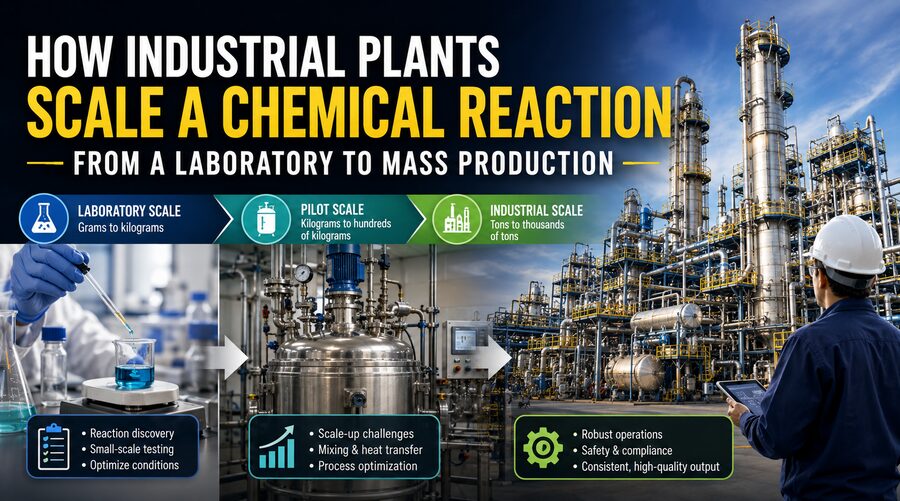
That is why industrial scale-up usually proceeds through several carefully controlled stages, including laboratory development, bench-scale testing, pilot plants, demonstration systems, and finally full commercial production.
🔬 Stage 1: Understanding the Laboratory Reaction
Everything begins with a laboratory experiment.
Chemists may first test a reaction using small quantities of raw materials in glassware such as:
- Flasks
- Beakers
- Small stirred reactors
- Condensers
- Temperature-controlled vessels
- Laboratory pressure equipment
At this stage, the objective is usually to determine whether the desired chemical reaction is possible and whether it produces the intended product.
Researchers study important factors such as:
- Reaction temperature 🌡️
- Pressure
- Reaction time ⏱️
- Raw-material concentration
- Catalyst requirements
- Solvent selection
- Product yield
- Impurity formation
- Reaction speed
- Energy release or absorption
Once the chemistry appears promising, engineers begin asking a different question:
Can this reaction be operated safely and economically on a much larger scale?
That question marks the beginning of process development.
📏 Why Chemical Reactions Cannot Simply Be Multiplied
Suppose a chemist successfully produces 100 grams of a chemical in the laboratory.
It may seem logical to assume that producing 10,000 kilograms requires simply multiplying every ingredient by 100,000.
Unfortunately, industrial processes do not scale linearly.
The reason is geometry.
When a vessel becomes larger, its volume increases faster than its surface area.
This matters because heat usually enters or leaves the reactor through its walls.
A small laboratory flask has a relatively large surface area compared with the amount of material inside it. A massive industrial reactor contains much more material relative to its surface area.
As a result, a large reactor may have much more difficulty removing heat generated by a chemical reaction.
That can completely change how the process behaves.
🔥 Heat Transfer Becomes a Major Challenge
Many chemical reactions release heat. These are called exothermic reactions.
In a small laboratory vessel, that heat may escape quickly through the glass walls or a cooling bath.
In a large reactor, however, the same reaction can generate enormous amounts of heat.
If the cooling system cannot remove that heat fast enough, the temperature may increase.
A higher temperature can make some reactions proceed even faster, which can generate even more heat.
This is one reason engineers perform detailed thermal analysis before scaling up a reaction.
Industrial reactors may use:
- Cooling jackets
- Internal cooling coils
- External heat exchangers
- Temperature sensors
- Automated shutdown systems
- Emergency cooling systems
Engineers calculate how quickly heat is produced and how quickly it can be safely removed.
🔥 Heat management is often one of the most important parts of chemical scale-up.
🌀 Mixing Changes as Reactors Become Larger
Mixing is another major challenge.
In a laboratory, a magnetic stirrer or small impeller may mix a solution almost instantly.
In a large industrial reactor, however, the distance between different parts of the vessel can be several meters.
Poor mixing can create zones with different:
- Temperatures
- Concentrations
- pH levels
- Reaction rates
Imagine adding a concentrated reactant into a large vessel.
If mixing is too slow, the material near the feed point may temporarily reach a much higher concentration than expected.
That local concentration could produce unwanted side reactions or excessive heat.
Chemical engineers therefore carefully design industrial mixing systems.
They consider variables such as:
- Impeller diameter
- Rotation speed
- Blade shape
- Vessel geometry
- Fluid viscosity
- Mixing time
- Power consumption
Powerful industrial agitators may consume significant amounts of electricity, so engineers must balance mixing effectiveness with energy efficiency. ⚙️
💨 Gas-Liquid Reactions Become More Complicated
Some industrial reactions involve gases reacting with liquids.
Examples include oxidation, hydrogenation, fermentation, and gas absorption processes.
In these systems, the gas must move from bubbles into the liquid before the chemical reaction can occur.
At laboratory scale, gas transfer may be relatively easy because the vessel is small.
At industrial scale, engineers must consider mass transfer.
Important factors include:
- Bubble size
- Gas flow rate
- Mixing intensity
- Pressure
- Liquid viscosity
- Gas solubility
Reactors may use devices called spargers to distribute gas through the liquid as many small bubbles.
Smaller bubbles provide more surface area, which can improve gas transfer.
However, the entire system must be designed carefully to maintain safe pressure and effective mixing.
⚗️ Engineers Select the Appropriate Reactor Type
Not every chemical reaction uses the same type of industrial reactor.
The reactor design depends on the chemistry and production requirements.
🛢️ Batch Reactors
In a batch reactor, raw materials are loaded into the vessel, the reaction takes place, and the finished mixture is removed.
Batch reactors are common when manufacturers produce:
- Pharmaceuticals
- Specialty chemicals
- Paints
- Adhesives
- Fine chemicals
They provide flexibility because the same reactor can sometimes manufacture several different products.
🔄 Continuous Reactors
In a continuous process, raw materials continuously enter the reactor while product continuously leaves.
These systems are common when very large quantities of the same product are manufactured.
Continuous processes can offer advantages such as:
- High production rates
- Stable operating conditions
- Efficient energy use
- Reduced labor requirements
However, they may require more complex control systems.
🌊 Plug-Flow and Tubular Reactors
Some reactions occur as chemicals flow through long pipes or tubes.
Engineers control the flow rate, temperature, pressure, and residence time so the desired reaction takes place before the material exits the reactor.
Choosing the correct reactor architecture is one of the most important decisions in process scale-up.
🧪 Stage 2: Bench-Scale Process Development
After early laboratory experiments, engineers often build somewhat larger systems known as bench-scale equipment.
Instead of tiny glassware, these systems may contain small metal reactors with industrial-style components.
Bench-scale testing helps engineers investigate:
- Mixing behavior
- Heat transfer
- Reaction kinetics
- Material compatibility
- Sensors
- Pumps
- Valves
- Automated controls
At this stage, researchers begin creating a process that resembles industrial manufacturing more closely.
They also start evaluating how raw-material variations affect product quality.
🏗️ Stage 3: The Pilot Plant
Before constructing a full-size factory, companies often test the process in a pilot plant.
A pilot plant is a smaller version of the proposed industrial process.
It may include scaled-down versions of:
- Reactors
- Pumps
- Heat exchangers
- Distillation columns
- Filtration systems
- Dryers
- Storage tanks
- Process-control systems
The pilot plant allows engineers to discover problems that are difficult to predict using laboratory experiments or computer models alone.
For example, engineers might discover that:
- A mixture becomes difficult to pump.
- A solid unexpectedly forms in a pipeline.
- Foam builds up inside the reactor.
- A filter becomes blocked.
- Heat transfer is slower than predicted.
- A product behaves differently during drying.
Discovering these problems at pilot scale is much less expensive than discovering them after a full production plant has already been built.
💻 Computer Modeling Helps Predict Industrial Behavior
Modern chemical engineers increasingly use computer simulations before building large equipment.
These models can predict:
- Temperature profiles
- Fluid flow
- Pressure changes
- Heat-transfer rates
- Mixing patterns
- Reaction conversion
- Energy consumption
One important technique is Computational Fluid Dynamics, or CFD.
CFD simulations can show how liquids and gases move through reactors and pipelines.
Engineers may use these simulations to identify poorly mixed regions or areas where excessive temperatures could develop.
Process simulation software can also model entire factories, including reactors, separators, compressors, heat exchangers, and recycling systems.
Computer modeling cannot replace physical testing entirely, but it can greatly reduce development time and cost. 💻🏭
📊 Reaction Kinetics Must Be Understood
Chemical engineers also study reaction kinetics, which describes how quickly chemical reactions occur.
Reaction speed may depend on:
- Temperature
- Concentration
- Pressure
- Catalyst concentration
- Mixing
- Surface area
Engineers develop mathematical models that predict how the reaction progresses under different operating conditions.
This information helps determine important parameters such as residence time—the amount of time material must remain inside the reactor.
If residence time is too short, the reaction may remain incomplete.
If it is unnecessarily long, production capacity may decrease and unwanted by-products may form.
🧯 Process Safety Is Central to Scale-Up
Safety becomes increasingly important as the quantity of chemicals increases.
A small laboratory experiment might contain only a few grams of reactive material.
An industrial reactor could contain many tons.
The amount of stored chemical and thermal energy therefore becomes much larger.
Before full-scale production, engineers conduct formal safety studies.
These may examine hazards such as:
- Excessive temperature
- Excessive pressure
- Loss of cooling
- Pump failure
- Incorrect raw-material addition
- Valve malfunction
- Power failure
- Flammable vapor accumulation
- Unexpected side reactions
Industrial plants may use multiple protective layers, including:
Sensors → Alarms → Automatic controls → Interlocks → Pressure-relief systems → Emergency shutdown systems
This layered approach means that safety does not depend on only one device or one operator.
🚨 What Is a Runaway Reaction?
One important risk during scale-up is a runaway chemical reaction.
This can happen when a reaction generates heat faster than the equipment can remove it.
The rising temperature may increase the reaction rate, which creates even more heat.
If uncontrolled, temperature and pressure can rise dangerously.
Engineers prevent this by studying reaction behavior before commercial operation and designing appropriate cooling, pressure control, shutdown, and emergency systems.
This is another reason industrial scale-up must be gradual and carefully engineered.
🧱 Materials of Construction Matter
Laboratory experiments often use glass because it resists many chemicals and allows researchers to see what is happening.
Industrial reactors, however, usually require much stronger materials.
Depending on the process, equipment may be constructed from:
- Stainless steel
- Carbon steel
- Special alloys
- Glass-lined steel
- Certain engineered plastics
Engineers must consider corrosion carefully.
A chemical that slowly damages a laboratory container might cause serious problems if it continuously attacks a large industrial reactor or pipeline.
Material compatibility testing therefore becomes part of process development.
🔬 Separating the Product Can Be Harder Than Making It
The chemical reaction itself is only one part of industrial manufacturing.
After the reaction finishes, the desired product usually needs to be separated from solvents, unreacted materials, catalysts, or impurities.
Industrial separation methods can include:
- Distillation
- Filtration
- Crystallization
- Centrifugation
- Extraction
- Evaporation
- Drying
- Membrane separation
In many chemical plants, separation equipment actually consumes more energy and occupies more space than the reactor itself.
For example, producing a liquid mixture may be relatively easy, but separating two liquids with similar boiling points could require a large distillation system.
♻️ Recycling Raw Materials Improves Efficiency
Industrial processes often recycle materials that were not consumed during the reaction.
Instead of discarding them, engineers may separate and return them to the reactor.
Recycling can:
- Reduce raw-material costs
- Reduce waste
- Improve overall yield
- Lower environmental impact
However, recycling must be carefully controlled because impurities can gradually accumulate in the system.
Engineers therefore determine when materials should be recycled and when part of the stream must be removed or purified.
✅ Quality Control Must Remain Consistent
A laboratory chemist may carefully control every step manually.
A factory, however, may operate continuously for months.
The product must remain consistent regardless of changes in:
- Raw-material batches
- Ambient temperature
- Production rate
- Equipment condition
- Operator shifts
Industrial plants therefore use extensive quality-control systems.
Samples may be analyzed for:
- Purity
- Concentration
- Moisture
- Color
- Particle size
- Density
- Chemical composition
Automated instruments may also monitor the process continuously.
🤖 Automation Keeps the Process Stable
Modern chemical plants rely heavily on automated control systems.
Sensors continuously measure conditions such as:
- Temperature 🌡️
- Pressure
- Flow rate
- Tank level
- Chemical composition
Computerized controllers compare these measurements with desired operating values.
If the reactor temperature begins increasing, for example, the control system might automatically increase cooling.
If pressure becomes abnormal, alarms or protective shutdown systems may activate.
Automation helps keep large industrial processes stable and repeatable.
💰 Engineers Must Also Make the Process Economical
A reaction can be scientifically successful but commercially impractical.
Industrial engineers therefore evaluate the economics of production.
They consider:
- Raw-material costs
- Energy consumption
- Equipment costs
- Labor
- Waste treatment
- Maintenance
- Product yield
- Production capacity
Sometimes a chemical route that provides the highest laboratory yield is not the cheapest industrial option.
A slightly lower-yield process might be preferred if it operates faster, requires less energy, uses safer materials, or generates less waste.
🌱 Environmental Impact Is Part of Modern Scale-Up
Industrial chemical production must also consider environmental performance.
Engineers aim to reduce:
- Waste
- Water consumption
- Energy consumption
- Air emissions
- Hazardous by-products
Modern process development increasingly follows principles of green chemistry and process intensification.
For example, engineers may redesign a process to use:
- Safer solvents
- More selective catalysts
- Lower temperatures
- Recycled heat
- Continuous processing
- Reduced quantities of hazardous intermediates
Improving efficiency can benefit both the environment and manufacturing economics. 🌍♻️
🏭 Stage 4: Full Commercial Production
After successful laboratory, bench, and pilot testing, engineers can design the full industrial plant.
The final system may include:
Raw-material storage → Feed preparation → Reactor → Separation → Purification → Recycling → Product storage → Packaging
During startup, the plant is usually operated cautiously while engineers compare real performance with design predictions.
Operating conditions may then be optimized.
Even after commercial production begins, process engineers continue analyzing data and looking for improvements.
📈 Scale-Up Is Usually an Iterative Process
Industrial scale-up rarely follows a perfectly straight path.
Instead, engineers repeatedly test, measure, redesign, and improve the process.
A typical development path may look like:
Laboratory experiment → Bench-scale reactor → Pilot plant → Demonstration unit → Commercial plant
At each stage, new information becomes available.
Engineers then use that information to reduce uncertainty before moving to the next scale.
This gradual approach dramatically reduces technical and safety risks.
🧠 Why Chemical Engineers Are Essential
Chemical scale-up requires expertise from many different fields.
Teams may include:
- Chemists
- Chemical engineers
- Mechanical engineers
- Process-control engineers
- Safety specialists
- Materials engineers
- Environmental engineers
- Quality-control scientists
- Plant operators
Chemists understand the molecular reaction.
Chemical engineers determine how to make that chemistry work reliably inside industrial equipment.
The collaboration between these disciplines is what turns a laboratory discovery into a manufactured product.
✅ Final Thoughts
Scaling a chemical reaction from a laboratory flask to an industrial plant is one of the most complex tasks in manufacturing. 🧪➡️🏭
The challenge is not simply producing more material.
Engineers must understand how heat transfer, mixing, mass transfer, reaction kinetics, pressure, materials, separation, automation, safety, economics, and environmental performance all change as equipment becomes larger.
A reaction that behaves gently in a small flask can behave very differently when thousands of kilograms of material are involved.
That is why industrial plants scale processes gradually.
Researchers first understand the chemistry. Engineers then test increasingly realistic equipment, operate pilot plants, build mathematical models, analyze safety risks, and verify product quality.
Only after those steps are successful does the process move into full commercial production.
The result is a carefully engineered system capable of producing enormous quantities of chemicals safely, efficiently, and consistently—turning a small laboratory experiment into the products used throughout modern life. ⚗️🏭🌍