
Modern industry depends on chemical reactions to manufacture fuels, fertilizers, plastics, medicines, detergents, food ingredients, electronics materials, and thousands of other products. 🏭🧪 Yet many useful chemical reactions would be far too slow, energy-intensive, or expensive to perform on an industrial scale without a special class of substances known as catalysts.
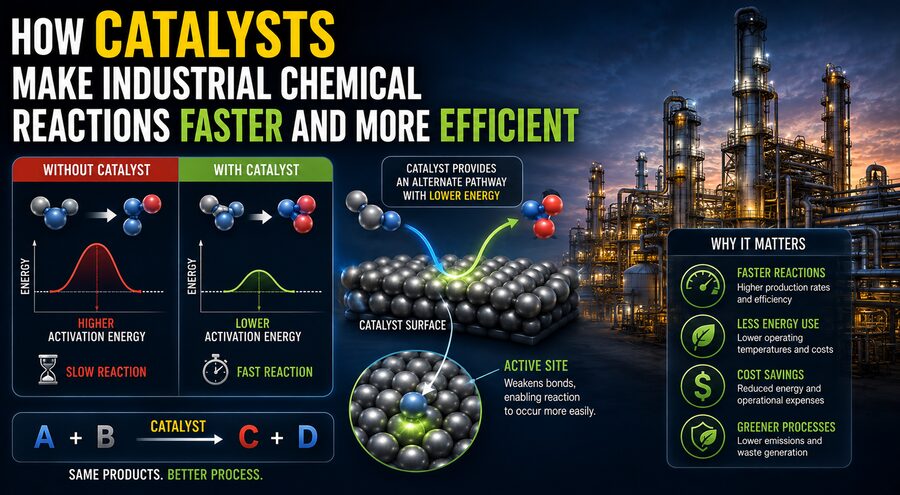
A catalyst increases the rate of a chemical reaction without being permanently consumed by the overall reaction. Instead of forcing molecules to react through a difficult, high-energy pathway, the catalyst provides an alternative route that requires less energy.
In simple terms:
Reactants + catalyst ➡️ easier reaction pathway ➡️ faster production
Catalysts are enormously important because making a reaction faster often allows factories to operate at lower temperatures or pressures, reduce energy consumption, improve product yield, and generate less waste. 🌱⚙️
From ammonia fertilizers and petroleum refining to plastics and pollution-control systems, catalysis is one of the foundations of modern chemical engineering.
🧪 What Is a Catalyst?
A catalyst is a substance that speeds up a chemical reaction by lowering the amount of energy needed for the reaction to proceed.
During a chemical reaction, atoms in the reactant molecules must rearrange. Existing chemical bonds may need to break before new ones can form.
That rearrangement often requires molecules to pass through a temporary, unstable, high-energy condition called a transition state.
The minimum energy required to reach this state is known as the activation energy. ⚡
If the activation-energy barrier is very high, relatively few molecules have enough energy to react at any given moment. As a result, the reaction may proceed extremely slowly.
A catalyst provides another reaction pathway with a lower activation-energy barrier.
More molecules can therefore react successfully in the same amount of time.
🏔️ Understanding Activation Energy
Imagine trying to move from one valley to another by crossing a mountain.
Without a catalyst, the only route may involve climbing over a very tall peak. 🏔️
With a catalyst, it is as though someone has constructed a tunnel through the mountain.
The starting point and destination remain the same, but the journey becomes easier.
Chemically, the comparison can be written as:
Uncatalyzed reaction:
Reactants ➡️ high energy barrier ➡️ products
Catalyzed reaction:
Reactants ➡️ lower energy barrier ➡️ products
The catalyst does not provide energy to the reaction. Instead, it changes the pathway by which the reaction occurs.
This distinction is fundamental to understanding catalysis.
⚡ Why Lower Activation Energy Makes Reactions Faster
Molecules are constantly moving and colliding.
However, not every collision produces a reaction.
For a collision to be successful, molecules generally need sufficient energy and an appropriate orientation.
At a particular temperature, molecules have a distribution of kinetic energies. Only a fraction possesses enough energy to overcome the reaction’s activation barrier.
When a catalyst lowers this barrier, a much larger fraction of molecular collisions can lead to successful reactions. 🧠
Consequently, the reaction rate increases—sometimes dramatically.
A reaction that might otherwise take days, months, or even years can potentially occur within seconds or minutes under suitable catalytic conditions.
🔄 Is a Catalyst Used Up?
One of the defining features of a catalyst is that it is regenerated during the catalytic reaction cycle.
A catalyst may temporarily interact with reactant molecules and even form intermediate chemical species.
For example, a simplified mechanism could look like:
Reactant + Catalyst ➡️ Intermediate
Then:
Intermediate ➡️ Product + Catalyst
The catalyst participates in individual reaction steps but reappears at the end.
That means a relatively small quantity of catalyst can help convert a much larger quantity of reactants.
However, real industrial catalysts do not necessarily last forever. They can become contaminated, damaged, poisoned, or structurally altered and may eventually require regeneration or replacement.
🏭 Why Catalysts Are So Important in Industry
Industrial chemical plants often produce enormous quantities of material.
Even a modest improvement in reaction rate or efficiency can have a major economic effect when millions of kilograms of product are involved.
Catalysts can help industrial plants:
- Increase production rates 📈
- Reduce operating temperatures 🌡️
- Reduce required pressures
- Lower energy consumption ⚡
- Increase product selectivity 🎯
- Reduce unwanted byproducts
- Decrease waste generation ♻️
- Reduce manufacturing costs 💰
- Make previously impractical reactions commercially viable
For these reasons, choosing the correct catalyst is often one of the most important decisions in chemical-process design.
🎯 Catalysts Can Improve Selectivity
Speed is not the only advantage of catalysts.
Chemical reactants can sometimes follow several possible pathways and produce several different products.
Suppose a manufacturer wants product A, but the same starting materials could also produce unwanted products B and C.
A well-designed catalyst can favor the pathway leading toward product A.
This characteristic is called selectivity.
High selectivity is extremely valuable because it means more raw material becomes the desired product and less becomes waste.
For example:
Poor selectivity:
100 kg raw material ➡️ 60 kg desired product + 40 kg unwanted products
Improved selectivity:
100 kg raw material ➡️ 90 kg desired product + 10 kg unwanted products
In a large chemical plant, such improvements can save enormous quantities of raw materials and energy. 💰🌍
🧱 Heterogeneous Catalysis
One of the most common forms of industrial catalysis is heterogeneous catalysis.
In heterogeneous catalysis, the catalyst and reactants exist in different physical phases.
For example, the catalyst may be a solid while the reactants are gases.
Gas molecules flow over the surface of the solid catalyst, where the reaction takes place.
Common catalyst materials include metals such as:
- Platinum
- Palladium
- Nickel
- Iron
- Rhodium
- Copper
Metal oxides, zeolites, and many other materials can also serve as catalysts.
Because reactions occur primarily at the catalyst’s surface, engineers often design catalysts to have extremely large surface areas.
🔬 Why Surface Area Matters
Imagine two blocks of catalytic material containing the same amount of substance.
One is a single solid cube.
The other has been divided into millions of tiny porous particles.
The porous material exposes much more surface area to the reactants. 🧽
Since heterogeneous catalytic reactions take place at active surface sites, greater surface area can create more locations where molecules can react.
Industrial catalysts are therefore often highly porous.
A surprisingly small amount of material can contain an internal surface area equivalent to many square meters—or considerably more—because of microscopic pores.
This is why catalyst design involves not only chemistry but also material science, nanotechnology, and surface engineering.
🧲 Adsorption: Molecules Attach to the Catalyst
Many heterogeneous catalytic reactions begin with adsorption.
Adsorption occurs when reactant molecules attach to the surface of the catalyst.
This is different from absorption, where a substance enters the bulk of another material.
Once molecules are adsorbed onto a catalytic surface, their chemical bonds may weaken or their orientation may change.
This can make them more likely to react.
A simplified catalytic cycle might involve:
- Reactant molecules reach the catalyst surface.
- Molecules adsorb onto active sites.
- Chemical bonds weaken or rearrange.
- New bonds form.
- Product molecules detach from the surface.
- Active sites become available again.
This cycle can repeat continuously while the plant operates. 🔄⚗️
🧪 Homogeneous Catalysis
Not all industrial catalysts are solids.
In homogeneous catalysis, the catalyst and reactants exist in the same phase—often dissolved together in a liquid.
Because catalyst molecules can mix intimately with the reactants, homogeneous catalysts can provide excellent reaction control and high selectivity.
They are widely used in chemical manufacturing, including processes involving:
- Pharmaceuticals 💊
- Specialty chemicals
- Polymer production
- Organic synthesis
- Fine chemicals
One disadvantage is that separating a dissolved catalyst from the finished product can sometimes be difficult.
Industrial chemists therefore balance catalytic performance against recovery and recycling costs.
🧬 Enzymes Are Biological Catalysts
Nature also uses catalysts.
Enzymes are biological molecules—usually proteins—that accelerate reactions inside living organisms.
Industrial biotechnology takes advantage of enzymes in many applications.
They are used in:
- Food processing 🍞
- Brewing and fermentation 🍺
- Detergents
- Pharmaceutical manufacturing 💊
- Biofuel production
- Textile processing
Enzymes can be extremely selective and often operate under relatively mild conditions.
This can make enzyme-based processes attractive when manufacturers want to reduce energy consumption or avoid harsh chemicals.
🌾 The Haber-Bosch Process: Catalysis and Fertilizer
One of history’s most important industrial catalytic processes is the Haber-Bosch process.
It produces ammonia from nitrogen and hydrogen:
N₂ + 3H₂ ⇌ 2NH₃
Nitrogen gas is extremely stable because its two nitrogen atoms are connected by a strong triple bond.
Breaking that bond requires considerable energy.
Industrial ammonia production uses an iron-based catalyst to increase the reaction rate.
The process also operates at elevated temperature and pressure.
Ammonia is essential for producing nitrogen fertilizers, which support agricultural production around the world. 🌾
Without effective catalysis, large-scale ammonia production would be much more difficult and energy-intensive.
🛢️ Catalysts in Petroleum Refining
Oil refineries rely extensively on catalysts to convert crude oil into useful fuels and chemicals.
One major process is fluid catalytic cracking, commonly abbreviated as FCC.
Large hydrocarbon molecules are broken into smaller, more valuable molecules used in products such as gasoline.
Special porous materials called zeolites are commonly used as catalysts.
Other refinery processes use catalysts to:
- Remove sulfur
- Rearrange hydrocarbon structures
- Produce higher-quality fuels
- Generate hydrogen
- Convert heavy petroleum fractions
Without catalysis, modern fuel refining would be significantly less efficient.
🧴 Catalysts and Plastic Production
Many plastics are produced through catalytic polymerization.
Small molecules called monomers are connected into long chains known as polymers.
Catalysts can influence not only how quickly the polymer forms but also its microscopic structure.
That structure can strongly affect the finished plastic’s:
- Strength
- Flexibility
- Density
- Heat resistance
- Transparency
Catalyst technology has therefore played a major role in producing specialized plastics for packaging, vehicles, medical equipment, electronics, construction, and countless other applications. 🧴🚗
🚗 Catalytic Converters Use the Same Principle
Catalysis is not restricted to giant chemical factories.
Automobiles contain catalytic converters that use metals such as platinum, palladium, and rhodium to accelerate reactions that convert harmful exhaust gases into less harmful substances.
Depending on the system, catalytic reactions can reduce pollutants such as:
Carbon monoxide ➡️ carbon dioxide
Unburned hydrocarbons ➡️ carbon dioxide + water
Nitrogen oxides ➡️ nitrogen
The catalyst makes these reactions occur rapidly enough to treat exhaust gases while they pass through the vehicle’s exhaust system. 🚘🌱
🌡️ Why Catalysts Can Save Energy
Many chemical reactions become faster when temperature increases.
Without a catalyst, an industrial plant might therefore need to heat reactants to extremely high temperatures to achieve an acceptable production rate.
Heating huge quantities of chemicals requires enormous amounts of energy.
If a catalyst allows the reaction to proceed rapidly at a lower temperature, fuel or electricity consumption can decrease.
For example:
Without catalyst: very high temperature ➡️ high energy cost
With catalyst: lower temperature possible ➡️ reduced energy requirement
The exact savings depend on the reaction and process design, but across large industries, catalytic efficiency can translate into substantial economic and environmental benefits. ⚡🌍
⚖️ Catalysts Do Not Change Chemical Equilibrium
A catalyst can make a reaction reach equilibrium faster, but it does not fundamentally move the equilibrium position.
For a reversible reaction:
A ⇌ B
the catalyst accelerates both the forward and reverse reactions.
Therefore, it helps the system reach equilibrium more quickly but does not change the equilibrium ratio dictated by thermodynamics under the same conditions.
This point is important because a catalyst cannot make an energetically impossible reaction suddenly become favorable.
Catalysts affect kinetics—how quickly reactions occur—not the fundamental thermodynamic balance between reactants and products.
🧯 What Is Catalyst Poisoning?
Although catalysts are regenerated during reactions, their effectiveness can decline.
One major problem is catalyst poisoning.
Certain impurities can attach strongly to active sites and block reactants from reaching them.
Imagine a parking lot where every parking space represents an active catalytic site. 🚗
If unwanted substances occupy the spaces, the intended molecules have nowhere to attach.
Common catalyst poisons can include sulfur compounds, lead, carbon-containing deposits, or other impurities, depending on the catalyst.
Industrial plants often purify feedstocks carefully to protect expensive catalysts.
🕸️ Sintering and Catalyst Deactivation
Catalysts can also lose effectiveness through sintering.
At high temperatures, tiny catalyst particles may begin to merge into larger particles.
When this happens, total surface area decreases.
Fewer active sites become available, reducing catalytic performance.
Other forms of catalyst deactivation can result from:
- Carbon deposits
- Chemical contamination
- Structural changes
- Mechanical damage
- Pore blockage
- Loss of active material
Engineers therefore monitor catalyst performance and may periodically regenerate or replace catalyst beds.
♻️ Catalyst Regeneration
Some catalysts can be restored rather than discarded.
For example, deposits that block active sites may sometimes be removed through controlled heating, oxidation, washing, or other treatments.
This process is called catalyst regeneration.
Regeneration can reduce costs because industrial catalysts—especially those containing precious metals—may be expensive.
Precious catalyst materials can also be recovered and recycled.
Efficient catalyst management therefore plays an important role in both economics and sustainability. ♻️
🧠 Designing Better Catalysts
Catalyst development is a major field of scientific research.
Researchers investigate how individual atoms and molecules behave on catalytic surfaces using advanced tools including spectroscopy, microscopy, computer simulation, and quantum-mechanical modeling.
Scientists may attempt to optimize:
- Surface structure
- Particle size
- Pore dimensions
- Chemical composition
- Active-site distribution
- Thermal stability
- Resistance to poisoning
- Selectivity
At the nanoscale, even small changes in catalyst structure can significantly alter reaction behavior. 🔬
Modern catalyst design increasingly aims to position active atoms precisely where they will provide the greatest effect while minimizing the use of expensive materials.
🌱 Catalysts and Greener Manufacturing
Catalysis plays a major role in green chemistry, which seeks to reduce the environmental impact of chemical manufacturing.
An efficient catalyst can make a process more sustainable by:
🌱 Lowering energy demand
♻️ Producing fewer waste products
🎯 Increasing selectivity
💧 Reducing solvent requirements
⚡ Allowing milder operating conditions
🏭 Increasing raw-material efficiency
Researchers are also developing catalysts for emerging technologies such as hydrogen production, carbon-dioxide conversion, renewable fuels, battery materials, and sustainable chemical manufacturing.
For example, converting captured carbon dioxide into useful chemicals requires catalysts capable of activating an extremely stable molecule efficiently.
🔋 Catalysts in Hydrogen and Fuel Cells
Hydrogen-energy technologies also rely heavily on catalysis.
Electrolyzers use catalysts to help split water into hydrogen and oxygen.
Fuel cells perform the reverse type of energy conversion by combining hydrogen and oxygen electrochemically to produce electricity and water.
Catalysts accelerate the electrode reactions that make these technologies practical.
Researchers are particularly interested in reducing dependence on expensive precious metals such as platinum by finding cheaper and more abundant catalytic materials. 🔋⚗️
💰 Why Small Improvements Can Be Worth Millions
Industrial chemical plants may operate continuously for years while processing enormous quantities of raw materials.
Suppose a catalyst improvement increases the yield of desired product from 95% to 97%.
A two-percentage-point improvement may sound small.
But if a facility processes one million tonnes of material annually, the economic and environmental impact can be substantial.
Higher catalyst efficiency can mean:
More product from the same raw material
Less waste requiring treatment
Lower energy per tonne produced
Greater plant production capacity
This is why companies invest heavily in catalyst research and optimization.
🏁 Conclusion
Catalysts make industrial chemistry faster and more efficient by providing alternative reaction pathways with lower activation-energy barriers. ⚗️⚡
They do not simply “add energy” to reactions, nor do they permanently disappear after performing their role. Instead, catalysts repeatedly interact with reactant molecules, help chemical bonds break and form more easily, and then become available for another reaction cycle.
Their benefits extend well beyond faster reactions.
Catalysts can improve selectivity, reduce energy consumption, decrease waste, enable lower operating temperatures, make raw materials more productive, and allow chemical processes that would otherwise be commercially impractical.
From the iron catalysts used to manufacture ammonia to the zeolites inside oil refineries, the metal catalysts used to manufacture chemicals and plastics, the enzymes used in biotechnology, and the catalytic converters fitted to vehicles, catalysis is everywhere. 🏭🚗🌾🧬
As industries work toward cleaner manufacturing, renewable fuels, hydrogen energy, carbon recycling, and more sustainable chemical processes, advanced catalysts will become even more important.
A tiny amount of carefully designed material can transform the economics and environmental impact of an enormous chemical plant—making catalysis one of the most powerful tools in modern industrial chemistry. 🌍🔬⚙️