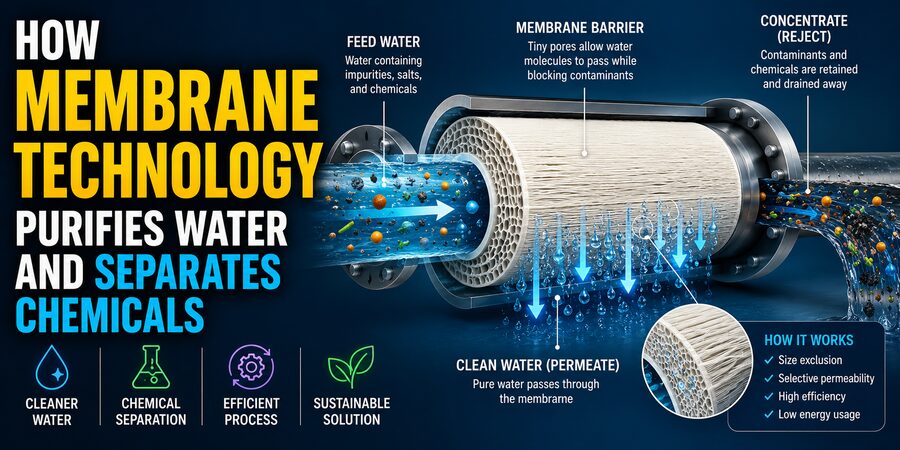

Membrane technology plays a major role in modern water treatment, chemical processing, food production, biotechnology, medicine, and environmental protection. At its core, the idea is remarkably simple: a membrane acts as a selective barrier that allows some substances to pass through while blocking others.
What makes membranes powerful is their ability to separate materials without necessarily requiring boiling, evaporation, or complicated chemical reactions. Depending on the membrane and process, they can remove suspended particles, bacteria, salts, organic molecules, gases, and even individual ions from a mixture.
This makes membrane systems especially important for applications such as drinking-water purification, seawater desalination, wastewater treatment, pharmaceutical manufacturing, dairy processing, hydrogen purification, and industrial chemical separation.
Although the basic principle is simple, the science behind membrane separation involves chemistry, physics, materials science, fluid mechanics, and engineering. 💧🔬
🧱 What Is a Membrane?
A membrane is a thin material that separates two regions while controlling which substances can move from one side to the other.
Some membranes contain microscopic pores. Others are so dense that molecules must dissolve into the membrane material and then diffuse through it.
The substances being separated may include:
- 💧 Water molecules
- 🧂 Dissolved salts
- 🦠 Bacteria and microorganisms
- 🧪 Organic chemicals
- ⚛️ Ions
- 🌬️ Gases
- 🧬 Proteins and biological molecules
The exact separation depends on factors such as membrane pore size, surface chemistry, electrical charge, pressure, concentration, and molecular properties.
🔍 How Does Membrane Separation Work?
A membrane does not simply behave like an ordinary kitchen sieve.
Some membranes do physically block particles based mainly on size, but advanced membranes can separate substances through several mechanisms.
These include:
- Size exclusion — larger particles cannot pass through small pores.
- Diffusion — some molecules move through a dense membrane faster than others.
- Solubility differences — certain chemicals dissolve more easily into the membrane material.
- Electrical charge — charged membranes can repel or attract specific ions.
- Pressure differences — pressure can force water or chemicals through a membrane.
- Concentration differences — molecules naturally move from regions of higher concentration toward lower concentration.
- Electrical potential — an applied voltage can drive ions through ion-selective membranes.
Different membrane technologies take advantage of different combinations of these effects.
🚰 Membranes in Water Purification
One of the most important uses of membrane technology is water purification.
Untreated water can contain a mixture of unwanted materials, including:
- Sand and sediment
- Clay particles
- Bacteria
- Viruses
- Dissolved salts
- Organic chemicals
- Heavy-metal ions
- Industrial pollutants
No single membrane is ideal for every contaminant.
Instead, engineers select different membrane processes depending on what must be removed.
Four of the most important pressure-driven membrane technologies are microfiltration, ultrafiltration, nanofiltration, and reverse osmosis.
🦠 Microfiltration
Microfiltration, often abbreviated MF, uses membranes with relatively large microscopic pores compared with other membrane processes.
It is useful for removing:
- Suspended solids
- Sediment
- Some microorganisms
- Many bacteria
- Larger particles
Microfiltration is often used as a pretreatment stage before more advanced purification.
For example, water may pass through microfiltration before entering a reverse-osmosis system. Removing larger particles first helps protect the more sensitive downstream membrane.
Microfiltration generally does not remove most dissolved salts because salt ions are far smaller than its pores.
🔬 Ultrafiltration
Ultrafiltration, or UF, uses smaller pores than microfiltration.
It can remove very small suspended particles, many microorganisms, colloids, and large organic molecules.
Ultrafiltration is widely used in municipal water treatment, wastewater recycling, biotechnology, and food processing.
Because UF membranes can provide an effective physical barrier against many microorganisms, they are valuable for improving the microbiological quality of water.
However, dissolved salts usually remain in the treated water.
⚗️ Nanofiltration
Nanofiltration, or NF, lies between ultrafiltration and reverse osmosis in separation ability.
Nanofiltration membranes can remove many larger dissolved molecules and multivalent ions such as calcium and magnesium.
This makes nanofiltration useful for water softening, because calcium and magnesium are responsible for much of the hardness in water.
NF can also remove certain organic contaminants and some dissolved salts while operating at lower pressures than typical reverse-osmosis systems.
Its selectivity often depends not only on molecular size but also on electrical interactions between dissolved ions and the charged membrane surface.
🌊 Reverse Osmosis
Reverse osmosis, commonly abbreviated RO, is one of the best-known membrane purification technologies.
It is widely used for:
- Seawater desalination
- Brackish-water treatment
- Drinking-water purification
- Industrial process water
- Wastewater recycling
- High-purity water production
To understand reverse osmosis, it helps to first understand natural osmosis.
💧 What Is Osmosis?
Imagine two water solutions separated by a membrane that allows water to pass but blocks most dissolved salts.
One side has a low salt concentration, while the other has a high salt concentration.
Water naturally tends to move through the membrane toward the side with the higher dissolved-solute concentration.
This movement is called osmosis.
The process continues until the chemical driving force is balanced by a pressure difference called osmotic pressure.
🔄 How Reverse Osmosis Reverses the Process
In reverse osmosis, engineers apply pressure to the more concentrated side.
If the applied pressure exceeds the osmotic pressure, water is forced through the membrane in the opposite direction from natural osmosis.
Most dissolved salts and many other contaminants remain behind.
The stream that passes through the membrane is called the permeate, while the concentrated stream that remains is often called the concentrate, retentate, or brine.
For seawater desalination, RO membranes can reject the overwhelming majority of dissolved salts, producing water suitable for further treatment and eventual human use.
🌀 Why Reverse Osmosis Needs High Pressure
RO membranes are extremely selective.
Water molecules must pass through a thin membrane layer while most salt ions are prevented from crossing.
This requires significant pressure.
Seawater requires particularly high pressure because its salt concentration creates substantial osmotic pressure.
Modern desalination plants therefore use powerful pumps and specialized pressure vessels.
Energy-recovery devices can capture energy from the high-pressure brine stream and reuse it, dramatically improving efficiency compared with older systems. ⚡
🧂 What Happens to the Salt?
Reverse osmosis does not destroy salt.
It separates the incoming water into two streams.
One stream contains relatively purified water.
The other contains a higher concentration of dissolved salts.
In desalination plants, this concentrated brine must be managed responsibly.
Depending on the facility, it may be returned to the ocean through carefully designed discharge systems, treated further, or processed for resource recovery.
Brine management is one of the important environmental considerations associated with desalination.
🧪 Membranes Can Separate Chemicals Too
Membrane technology is not limited to water.
Chemical industries use membranes to separate molecules based on factors such as size, solubility, charge, and diffusivity.
In many cases, membranes can replace or supplement conventional processes such as distillation.
This is important because distillation requires heating and vaporizing liquids, which can consume large amounts of energy.
Membrane separations may operate without a phase change, potentially reducing energy consumption.
🌬️ Gas Separation Membranes
Special membranes can separate gases.
Suppose a gas mixture contains carbon dioxide, hydrogen, methane, nitrogen, and other gases.
Different gas molecules may dissolve into and diffuse through a membrane at different rates.
A membrane that allows carbon dioxide to pass more readily than methane, for example, can help upgrade natural gas or biogas.
Gas-separation membranes can be used for:
- Hydrogen recovery
- Carbon dioxide removal
- Oxygen enrichment
- Nitrogen production
- Natural-gas processing
- Biogas purification
The membrane material must be selected carefully because gas selectivity and permeability can vary dramatically.
⚡ Electrodialysis
Not all membrane processes are driven by pressure.
Electrodialysis uses electrically charged membranes and an electric field to move ions.
The system contains alternating cation-selective and anion-selective membranes.
Cation-exchange membranes primarily allow positively charged ions to pass, while anion-exchange membranes primarily allow negatively charged ions to pass.
When voltage is applied, ions move through the appropriate membranes.
This creates alternating channels where salt becomes more concentrated and others where salt concentration decreases.
Electrodialysis is particularly useful for treating some brackish waters and industrial process streams.
🧪 Pervaporation
Pervaporation is another specialized membrane process.
A liquid mixture contacts one side of a dense membrane.
Certain components preferentially pass through the membrane and emerge on the other side as vapor.
Pervaporation can be useful for separating liquid mixtures that are difficult to separate by ordinary distillation.
Examples include removing small amounts of water from organic solvents or separating certain alcohol-water mixtures.
🥛 Membranes in Food and Beverage Processing
Membrane technology is widely used in the food industry.
Dairy processors, for example, use membranes to separate milk components.
Ultrafiltration can concentrate proteins while allowing water, minerals, and smaller molecules to pass.
Membrane processes can be used in:
- 🥛 Milk concentration
- 🧀 Cheese production
- 🍺 Beverage clarification
- 🍎 Juice processing
- 🧬 Protein isolation
- 💧 Process-water recycling
Because membrane systems can operate at relatively moderate temperatures, they may help preserve heat-sensitive flavors and nutrients.
💊 Membranes in Biotechnology and Medicine
Membranes are also essential in biotechnology.
Pharmaceutical manufacturers use ultrafiltration and related processes to concentrate and purify proteins, enzymes, antibodies, and other biological molecules.
One familiar medical example is dialysis.
In hemodialysis, a semipermeable membrane helps remove metabolic waste products and excess water from a patient’s blood.
The membrane allows certain small substances to cross while retaining blood cells and larger biological components.
This demonstrates how membrane selectivity can be used in life-supporting medical treatment. 🩺
🏭 Membrane Bioreactors for Wastewater
A membrane bioreactor, or MBR, combines biological wastewater treatment with membrane filtration.
Microorganisms first break down organic pollutants.
Membranes then separate treated water from suspended biological solids.
Compared with conventional settling tanks, membrane separation can provide very high-quality treated water and allow facilities to operate with high concentrations of microorganisms.
MBRs are increasingly used where wastewater must be treated for reuse or discharged under strict water-quality requirements.
🧱 What Are Membranes Made From?
Membranes can be manufactured from many materials.
Common polymeric membrane materials include:
- Polyamide
- Polyethersulfone
- Polysulfone
- Polyvinylidene fluoride
- Cellulose-based materials
There are also ceramic membranes made from materials such as alumina, zirconia, or titania.
Ceramic membranes can tolerate high temperatures and harsh chemicals better than many polymer membranes, but they may be more expensive.
Researchers are also investigating advanced membrane materials involving:
- Graphene-based structures
- Nanocomposites
- Metal-organic frameworks
- Advanced polymers
- Biomimetic channels
The goal is often to produce membranes that are simultaneously more permeable, selective, durable, and resistant to contamination.
⚠️ Membrane Fouling: A Major Challenge
One of the biggest practical problems in membrane systems is fouling.
Fouling occurs when unwanted material accumulates on the membrane surface or inside its pores.
Possible foulants include:
- 🦠 Microorganisms
- 🪨 Mineral scale
- 🧪 Organic compounds
- 🧱 Suspended particles
- 🧬 Biological materials
As fouling increases, water or chemicals have more difficulty passing through the membrane.
The system may require higher pressure, consume more energy, and produce less permeate.
Eventually, the membrane must be cleaned or replaced.
🧼 How Are Membranes Cleaned?
Membrane systems use several strategies to control fouling.
These can include:
- Pretreating the feed stream
- Flushing the membrane
- Reversing flow temporarily
- Using chemical cleaning solutions
- Controlling pH
- Preventing mineral scaling
- Disinfecting biological growth
In microfiltration and ultrafiltration systems, backwashing may be used.
During backwashing, clean water is forced in the opposite direction through the membrane to remove accumulated material.
Good pretreatment is often crucial for keeping expensive membrane systems operating efficiently.
📈 Permeability and Selectivity
Two important concepts in membrane science are permeability and selectivity.
Permeability describes how readily a substance passes through a membrane.
Selectivity describes how effectively the membrane allows one substance to pass relative to another.
Ideally, engineers would like membranes with extremely high permeability and extremely high selectivity.
However, improving one property can sometimes reduce the other.
Researchers therefore work to overcome this trade-off by designing new materials and membrane structures.
⚡ Energy Efficiency of Membrane Processes
One major advantage of many membrane systems is their potential energy efficiency.
Traditional chemical separations often rely on distillation.
Distillation works by boiling and condensing substances, which can require enormous amounts of heat.
Membranes can sometimes separate chemicals without vaporizing the entire mixture.
This does not mean membrane processes require no energy.
Reverse osmosis, for example, still requires substantial pumping pressure.
However, eliminating phase changes can make membrane-based separation attractive in many industrial applications.
🌎 Environmental Benefits
Membrane technology can provide important environmental benefits.
It can help:
- ♻️ Recycle wastewater
- 🌊 Produce freshwater from seawater
- 🏭 Reduce industrial waste
- 💧 Recover valuable chemicals
- 🌱 Reduce freshwater consumption
- ⚡ Lower energy use in some separations
- 🧪 Remove hazardous contaminants
Water reuse is particularly important in regions facing water scarcity.
Highly treated municipal wastewater can be purified using combinations of ultrafiltration, reverse osmosis, advanced oxidation, and disinfection.
The purified water can then be reused for industrial, agricultural, groundwater-recharge, or even potable-water applications when appropriate treatment and regulation are in place.
🔬 The Future of Membrane Technology
Scientists are developing increasingly sophisticated membranes.
One major research area involves biomimetic membranes, which attempt to imitate the remarkable selectivity found in biological cell membranes.
For example, natural proteins called aquaporins transport water molecules rapidly through biological membranes.
Researchers have explored incorporating similar structures into artificial membranes.
Other scientists are developing atomically thin materials containing precisely controlled nanoscale pores.
If these technologies become durable and economical, they could potentially enable faster filtration while reducing energy consumption.
Another growing field is resource recovery.
Instead of viewing wastewater or industrial brine entirely as waste, engineers are investigating membrane systems that could recover valuable salts, nutrients, metals, and chemicals.
This approach supports the idea of a more circular economy. ♻️
🌟 Final Thoughts
Membrane technology is one of the most versatile separation tools available to modern engineering.
A membrane can appear deceptively simple—a thin barrier separating two streams—but its structure and chemistry can determine whether particles, ions, molecules, gases, or liquids are allowed to pass.
In water treatment, microfiltration and ultrafiltration remove particles and microorganisms, nanofiltration can remove hardness and selected dissolved contaminants, and reverse osmosis can reject most dissolved salts and produce highly purified water.
In industry, membranes can separate gases, concentrate proteins, purify pharmaceuticals, process foods, recycle wastewater, and recover valuable chemicals. 💧🧪
Their greatest strength is selectivity: instead of treating every component of a mixture in the same way, a carefully designed membrane distinguishes between substances at microscopic and even molecular scales.
Challenges remain, including fouling, membrane degradation, energy consumption, and concentrate disposal. But continued improvements in materials science, nanotechnology, manufacturing, and process engineering are making membrane systems increasingly efficient and durable.
As demand grows for clean water, lower-energy industrial processes, and more sustainable resource use, membranes are likely to become even more important.
Whether turning seawater into drinking water, cleaning industrial wastewater, separating gases, or purifying medicines, membrane technology demonstrates how a carefully engineered microscopic barrier can solve some of the world’s largest environmental and industrial challenges. 🌍💧🔬