
A reusable water bottle seems simple until you consider what it must do: remain safe after repeated washing, resist cracking, use reasonable amounts of energy to make, and avoid creating a larger waste problem at the end of its life. The same kind of hidden complexity sits behind batteries, medicines, clean water, fuels, fertilizers, and food.
Most people encounter the finished product, not the process that made it possible. Chemical engineers work in that middle space: between a promising molecule or laboratory result and a dependable system that can serve millions of people.
That work now carries a sharper responsibility. A process that makes a useful product but consumes excessive water, releases hazardous material, or cannot be controlled safely is not a complete solution.
Cleaner and smarter engineering means asking better questions from the start. What should be made? What resources will it require? What happens to emissions, by-products, workers, communities, and materials after use?
🧭 Chemical Engineering Is the Art of Making at Scale
Chemical engineering applies chemistry, physics, biology, mathematics, and economics to transform raw materials into useful products safely and reliably. It is less about discovering a molecule than designing the process that can make, separate, purify, transport, and use it.
A chemist may show that a reaction can produce a desired compound in a flask. A chemical engineer asks whether the reaction can run continuously, handle variations in feed quality, recover valuable material, and remain stable during equipment upsets.
🔬 From a Good Idea to a Working Process
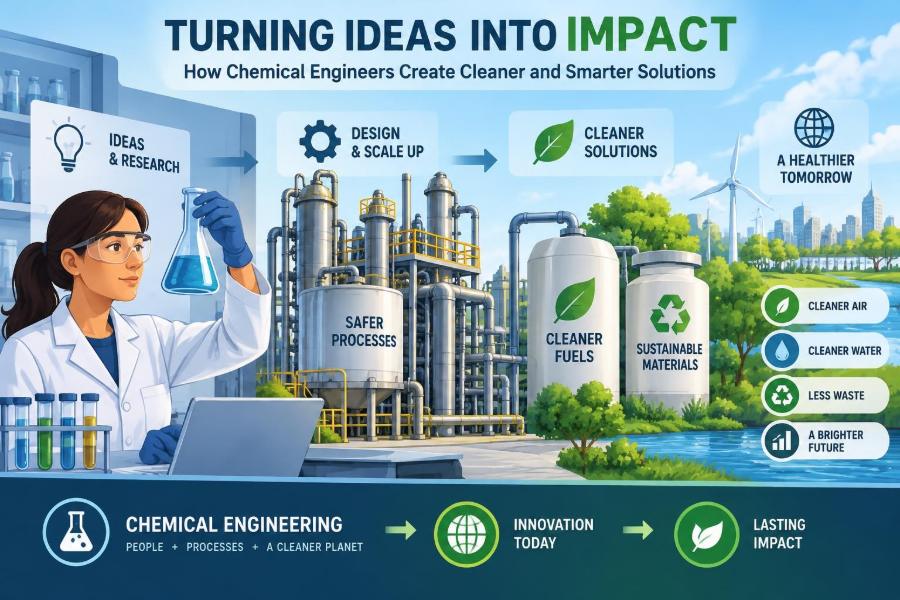
Ideas rarely move directly from lab bench to factory. They pass through stages in which assumptions are tested and redesigned. A catalyst that performs well for a few hours, for example, may slowly lose activity when exposed to real impurities.
- Laboratory work establishes feasibility and identifies key chemistry.
- Pilot-scale work tests equipment, operating conditions, and control approaches under more realistic flow rates.
- Scale-up and deployment integrate utilities, safety systems, supply chains, maintenance, and product specifications.
Each stage can reveal a different failure mode. Scaling is not merely building a larger version of the same apparatus.
⚙️ Mass Balances Reveal Where Materials Go
A mass balance is an accounting framework: material entering a system must leave it, accumulate within it, or be converted into something else. It helps engineers find where losses, waste streams, and recovery opportunities occur.
Consider a plant using a solvent to extract a valuable product. If most of the solvent exits with wastewater or vapor, the issue is not only cost. It may affect worker exposure, emissions control, and the treatment load downstream.
Closing that loop with recovery equipment can reduce fresh solvent demand, but the recovery unit itself needs energy and maintenance. A balance makes such trade-offs visible.
🔥 Energy Balances Expose Hidden Costs
Many industrial transformations require heating, cooling, compression, evaporation, or refrigeration. An energy balance tracks where energy enters, leaves, is stored, or is released by a process.
Heat integration is a classic smarter-systems strategy. Rather than discard a hot stream and separately heat a cold one, engineers may exchange heat between them through a heat exchanger. The approach can lower utility demand, though it must account for fouling, temperature limits, and safe separation between streams.
🌡️ Thermodynamics Sets the Boundaries
Thermodynamics describes what transformations are possible and how energy and equilibrium constrain them. It does not tell engineers how fast a reaction will occur, but it can show why complete conversion may be impractical under certain conditions.
Separation is often governed by these limits. Distillation works because components distribute differently between liquid and vapor, yet components with very similar volatility can demand substantial energy or alternative methods.
⏱️ Kinetics Determines How Fast Change Happens
Kinetics concerns reaction rate. Temperature, concentration, mixing, catalyst condition, and residence time can all affect how quickly reactants become products.
A reaction that is thermodynamically favorable may still be too slow for an economical process. Catalysts provide an alternative reaction pathway, often enabling lower temperatures or pressures. They can improve efficiency, but may be poisoned by contaminants or require careful regeneration.
🧪 Reaction Engineering Turns Chemistry into Throughput
Reaction engineering connects molecular behavior with reactor design. Engineers choose among batch reactors, continuous stirred tanks, plug-flow reactors, and other configurations based on mixing, heat release, selectivity, and production needs.
Selective production matters because unwanted reactions create by-products that consume raw materials and complicate purification. Sometimes a modest change in temperature profile or reactant addition strategy improves selectivity more effectively than adding a large separation train afterward.
🧹 Separation Often Dominates the Process
Making a product is only part of the task; isolating it at the required purity is frequently the more demanding step. Chemical engineers use distillation, filtration, membranes, adsorption, crystallization, extraction, and centrifugation.
| Method | Useful when | Key limitation |
|---|---|---|
| Distillation | Components differ in volatility | Can require substantial heat |
| Membranes | Selective transport is possible | Fouling and replacement can matter |
| Crystallization | A solid product has suitable solubility behavior | Particle size and purity need control |
| Adsorption | Trace contaminants must be captured | Adsorbent requires regeneration or disposal |
The cleanest-looking option is not automatically the best. Its full material and energy requirements must be evaluated in context.
💧 Water Is a Process Resource, Not an Infinite Utility
Water can act as a solvent, reactant, coolant, cleaning medium, or steam source. Its quality matters: dissolved salts, microbes, particles, and organic compounds can damage equipment or interfere with sensitive products.
Smarter water management begins by matching water quality to the task. Using highly purified water for a duty that tolerates lower-quality reclaimed water wastes treatment effort. Reuse is valuable only when contaminants are understood and managed rather than simply transferred elsewhere.
🌬️ Emissions Must Be Designed Out Where Possible
End-of-pipe controls such as scrubbers, filters, and thermal oxidizers can reduce releases, but prevention is usually preferable. Process changes may eliminate a hazardous solvent, reduce leaks through better containment, or avoid generating a pollutant in the first place.
That does not mean control equipment is unnecessary. Some emissions are unavoidable, and well-designed capture and treatment systems remain essential safeguards. The strongest strategy combines prevention, containment, monitoring, and treatment.
♻️ Waste Is Often a Design Signal
A waste stream may contain unreacted feedstock, recoverable solvent, usable heat, or a by-product with another application. Treating it as a design signal encourages engineers to examine why it exists before deciding how to dispose of it.
Not every by-product should be repurposed. Quality, safety, transport, market demand, and regulatory requirements all matter. A circular pathway is meaningful only when it avoids creating a new burden elsewhere.
🌱 Green Chemistry Influences Early Choices
Green chemistry emphasizes reducing hazardous substances and waste at the molecular and reaction-design level. Chemical engineering translates those principles into equipment and operations that can work beyond the laboratory.
Useful questions include whether a safer feedstock is available, whether a reaction can avoid protective groups or unnecessary steps, and whether a catalyst can replace a stoichiometric reagent. A safer chemistry may still face scale-up challenges, so environmental intent and process practicality must develop together.
📊 Life-Cycle Thinking Prevents Burden Shifting
Life-cycle thinking examines impacts across raw material extraction, manufacturing, transport, use, and end-of-life handling. It prevents a narrow improvement from being mistaken for an overall one.
For example, making a package lighter can reduce material use and transport demand, but a multilayer design may be harder to recycle. There is no universal winner; the comparison depends on function, collection systems, product protection, and actual disposal routes.
🔋 Electrification Changes the Energy Question
Electrically driven heaters, boilers, heat pumps, and electrochemical processes can reduce reliance on direct fuel combustion when the electricity supply has lower associated emissions. They also create new design questions about power availability, load flexibility, and capital cost.
Electrification is especially attractive where temperature requirements fit available equipment. For very high-temperature duties or continuous operations with limited grid capacity, other routes may remain necessary. Engineers assess the full operating context rather than treating electricity as automatically clean.
⚡ Hydrogen Is a Tool, Not a Universal Answer
Hydrogen can serve as a chemical feedstock, reducing agent, fuel, or energy carrier. Its value depends strongly on how it is produced, compressed, stored, and used.
It is difficult to handle because it has low volumetric energy density and can create material and safety challenges. A sensible project begins with a specific use case—such as replacing a feedstock already requiring hydrogen—not with an assumption that hydrogen suits every energy need.
🧫 Biotechnology Expands the Engineering Toolkit
Bioprocessing uses cells, enzymes, or biological systems to make products such as medicines, food ingredients, and specialty chemicals. Chemical engineers design bioreactors, manage oxygen transfer, separate delicate products, and maintain sanitary operations.
Biological routes can operate under relatively mild conditions, but they may require carefully controlled nutrients, sterile equipment, and complex downstream purification. Their sustainability profile depends on feedstocks, yields, utilities, and the fate of residual biomass.
🧠 Sensors Turn Operations into Information
Processes are easier to improve when engineers can see what is happening. Sensors track variables such as pressure, temperature, flow, composition, pH, and vibration; laboratory analysis fills gaps where online measurements are difficult.
Data quality is crucial. A poorly calibrated instrument can drive the wrong decision with impressive-looking precision. Measurement design should consider accuracy, response time, maintenance, and whether the variable actually predicts the outcome of interest.
🤖 Automation Supports People and Consistency
Control systems can hold operating conditions near a target, respond to disturbances, and reduce repetitive manual tasks. Advanced methods may use process models to anticipate changes rather than merely reacting after a deviation occurs.
Automation does not remove the need for engineering judgment. Operators understand practical behavior, alarms can be poorly configured, and models have limits. Good systems make abnormal conditions clearer and give people the information and authority to act safely.
🛡️ Safety Is a Design Requirement
Process safety focuses on preventing major releases, fires, explosions, and toxic exposures. It differs from personal safety, though both are essential. Gloves and hard hats matter, but they cannot compensate for a process designed without adequate containment or relief protection.
Engineers identify hazards, examine credible deviations, and build layers of protection. These may include inherently safer chemistry, pressure-relief systems, interlocks, ventilation, emergency procedures, and training.
🚧 Inherently Safer Design Comes First
Inherently safer design aims to remove or reduce hazards instead of relying only on controls. Common strategies are minimizing hazardous inventory, substituting less hazardous materials, moderating temperature or pressure, and simplifying equipment.
A smaller inventory of a dangerous chemical generally creates a smaller potential release than a larger one. Yet substitutions need careful review: a replacement may reduce one hazard while introducing incompatibility, persistence, or new waste-treatment concerns.
📈 Scale-Up Is Where Surprises Appear
At larger scale, surface area does not increase as quickly as volume. This simple geometric fact can make heat removal, mixing, and gas transfer much harder than in a small vessel.
A strongly exothermic reaction that is manageable in a lab can become difficult to cool at production scale. Pilot testing, conservative design margins, and rigorous hazard analysis help reveal such issues before full deployment.
🏭 Equipment Choices Shape Environmental Performance
Equipment is not neutral. A pump selection affects energy use and leak risk; a reactor material affects corrosion resistance and product contamination; a heat exchanger layout affects cleaning frequency and recoverable heat.
Reliability also has environmental value. Frequent failures can cause off-specification product, unplanned flaring, extra cleaning, and emergency maintenance. Designing for inspection and maintainability supports both steady production and lower waste.
💼 Economics Clarifies Feasibility, Not Values Alone
Economic analysis helps compare capital investment, operating cost, material use, energy demand, maintenance, and uncertainty. It is necessary because resources are finite and a solution that cannot operate reliably will not deliver its intended benefit.
But the cheapest option under a narrow accounting boundary may impose costs through pollution, resource depletion, or community risk. Sound decisions make assumptions visible and include safety, resilience, and environmental obligations rather than treating them as afterthoughts.
🤝 Collaboration Connects the Whole System
Cleaner solutions require collaboration among chemists, mechanical and electrical engineers, environmental specialists, operators, maintenance teams, supply-chain professionals, and affected communities. Each group sees constraints that others may miss.
For example, an elegant process flow diagram can fail in practice if equipment cannot be cleaned safely or spare parts are unavailable. Listening early avoids costly redesign and produces solutions people can actually operate.
🗣️ Clear Communication Is an Engineering Skill
Engineers must explain technical choices to people with different priorities. A plant operator may need a clear response procedure, a manager may need a trade-off summary, and a community audience may need an honest explanation of safeguards and remaining uncertainties.
Good communication does not mean oversimplifying. It means separating evidence from assumptions, naming limitations, and using plain language where possible. A well-drawn process diagram or a simple mass-balance sketch can often prevent misunderstanding.
🧩 Common Mistakes in “Sustainable” Process Design
Some mistakes recur because sustainability is treated as a final label rather than a design discipline.
- Optimizing one metric, such as energy use, while ignoring water, toxicity, or product lifetime.
- Assuming a recyclable material will actually be collected and processed locally.
- Adding treatment equipment without first investigating waste prevention.
- Trusting model outputs without checking data quality and operating assumptions.
- Ignoring startup, shutdown, cleaning, and maintenance, where performance can differ from normal operation.
These are not arguments against ambitious goals. They are reminders to evaluate the real system, including its messy boundaries.
🧰 A Practical Framework for Better Decisions
When evaluating a new process or improvement project, work from purpose to evidence. Define the function first: what must the product or system accomplish, and what quality is non-negotiable?
- Map material, energy, and information flows.
- Identify hazards and constraints before selecting equipment.
- Generate alternatives, including prevention and reuse options.
- Compare trade-offs over an appropriate life-cycle boundary.
- Test critical assumptions at pilot scale or through validated models.
- Monitor performance after implementation and revise when reality differs.
This iterative approach turns sustainability from a slogan into an engineering practice.
🎓 Building the Skills to Contribute
Students can strengthen their foundation in material and energy balances, thermodynamics, transport phenomena, reaction engineering, separations, process control, and safety. These subjects are connected tools, not isolated courses.
Working professionals can deepen impact by learning life-cycle assessment concepts, data analysis, hazard review methods, and communication across disciplines. Curiosity about plant realities—maintenance, operator workload, procurement, and waste handling—is as valuable as a sophisticated simulation.
🔭 The Future Is Systems Thinking
Future chemical engineering solutions will likely combine lower-carbon energy, improved catalysts, circular material flows, digital monitoring, and carefully designed biological or electrochemical routes. No single technology will solve every industrial challenge.
The strongest innovations will be those that fit their context: available resources, local infrastructure, safety needs, product requirements, and end-of-life pathways. Progress comes from connecting these pieces, not from chasing novelty alone.
✨ Turning Ideas into Responsible Impact
The central task of chemical engineering is to convert scientific possibility into dependable reality. That means balancing performance with safety, cost with resilience, and near-term output with long-term consequences.
Cleaner and smarter solutions emerge when engineers trace every major flow, question every avoidable loss, and design for people as carefully as they design for molecules. The goal is not perfection in a single metric; it is a process that provides real value while reducing preventable harm.
When chemical engineers treat the whole system as part of the design, ideas can become solutions that are useful, safer, and more responsible. That is how technical creativity earns lasting impact. 🧪♻️🌍