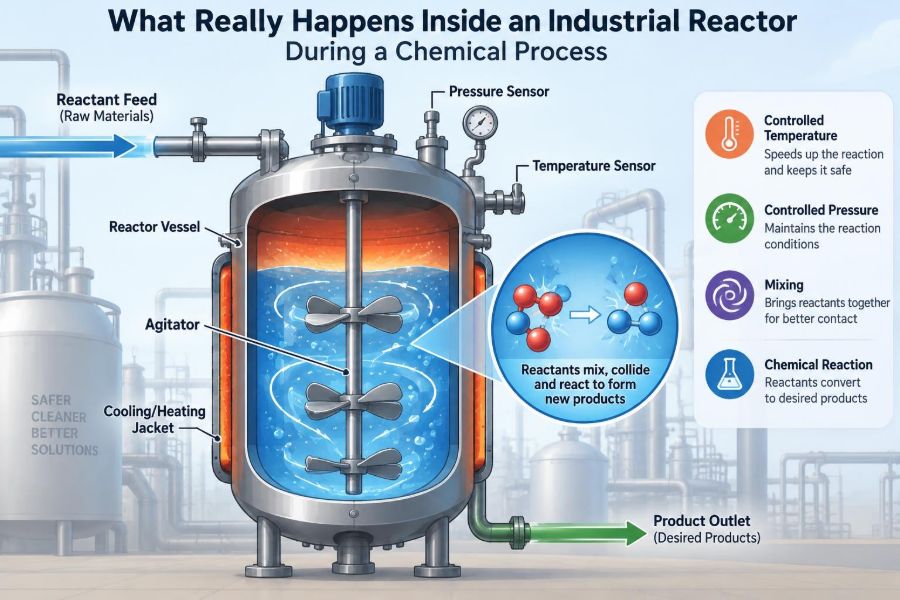

A bottle of detergent, a polymer pipe, a pharmaceutical tablet, and a tank of cleaner fuel can look unrelated on a store shelf. Yet each may have passed through an industrial reactor: a carefully designed vessel where raw materials are converted into products under controlled conditions.
It is tempting to picture a reactor as a large metal tank in which chemicals simply “cook.” The reality is more interesting. Inside, molecules collide, react, release or absorb heat, mix unevenly, travel through pipes and catalyst beds, and sometimes form unwanted by-products at the same time.
For an operator, the reactor is not an abstract diagram. Its temperature, pressure, level, composition, and flow behavior determine whether the plant makes on-specification product safely and efficiently.
Understanding what happens inside a reactor connects reaction chemistry to heat transfer, fluid mechanics, control systems, materials selection, and process safety. That connection is at the heart of chemical engineering.
🧭 A Reactor Is a Controlled Conversion Zone
An industrial reactor is equipment designed to create conditions in which a desired chemical reaction proceeds at a useful rate and selectivity. Conversion describes how much of a reactant has been consumed; selectivity describes how much of that consumed material becomes the desired product rather than unwanted compounds.
Those goals can conflict. Raising temperature may speed a reaction, for example, while also accelerating side reactions or damaging a catalyst. A reactor therefore manages several variables together rather than maximizing one in isolation.
🧪 Molecules Must First Meet
A chemical reaction begins when reactant molecules reach each other in a suitable orientation and with sufficient energy. In a liquid reactor, stirring and circulation help renew contact between reactants. In gas-phase systems, turbulence and distribution devices influence how well gases mix.
If one reactant enters as droplets, bubbles, or solid particles, the reaction may be limited by how quickly material crosses the phase boundary. The chemistry might be fast, but the overall process can still be slow because molecules cannot reach the reaction zone quickly enough.
⚗️ Reaction Rate Is the Starting Point
Reaction kinetics describes the relationship between reaction rate and conditions such as concentration, temperature, and catalyst activity. Engineers use kinetic models, often developed from experiments, to estimate what reactor volume and residence time are needed.
Real feedstocks can complicate these models. Small amounts of water, sulfur compounds, inhibitors, or trace metals may change the rate substantially. For that reason, laboratory kinetics must be tested against realistic feed composition before being treated as a reliable plant design basis.
🌡️ Temperature Changes More Than Speed
Many reactions accelerate as temperature rises because more molecular collisions can overcome the activation-energy barrier. But temperature also shifts phase behavior, affects viscosity, changes equilibrium limits, and can alter the distribution of products.
In polymer production, temperature can influence molecular weight and product properties. In a selective oxidation, excess temperature may form more unwanted oxidation products. The practical question is rarely “what is the hottest safe temperature?” but “what temperature best balances rate, yield, quality, and controllability?”
🔥 Heat Release Can Become the Central Challenge
An exothermic reaction releases heat. If the heat is generated faster than the reactor can remove it, temperature rises; a higher temperature can then increase reaction rate and generate still more heat. This feedback is the basis of thermal runaway risk.
Cooling jackets, internal coils, recirculating heat exchangers, and staged reactant addition are common ways to manage heat. Their adequacy depends not only on installed area but also on heat-transfer performance, coolant availability, fouling, and the reaction’s behavior under upset conditions.
❄️ Some Reactions Need Heat Supplied
Endothermic reactions absorb heat. Here, insufficient heating can lower conversion or cool the reactor until the reaction becomes impractically slow. Steam coils, furnaces, electric heating, molten-salt systems, or heat transfer from another process stream may supply the required energy.
Heating has its own limits. Hot wall surfaces may cause local decomposition, coking, or product degradation even when the measured bulk temperature looks acceptable. Good design considers the temperature at the wall and within the reacting fluid, not just one instrument reading.
🌀 Mixing Is Not the Same as Stirring
An agitator turning in a vessel does not guarantee uniform conditions. Mixing includes blending concentrations, dispersing gas bubbles, suspending solids, distributing heat, and preventing stagnant regions. Each task can require a different impeller, speed, baffle arrangement, or vessel geometry.
A useful analogy is stirring sugar into tea. A spoon can create visible motion while leaving a concentrated sweet layer near the bottom for a time. In reactors, comparable concentration pockets can cause side reactions, localized heat release, or inconsistent product quality.
🫧 Gas–Liquid Reactions Depend on Mass Transfer
When a gas reacts with a liquid, as in hydrogenation or oxidation, the gas must dissolve before it can react in the liquid phase. The rate of this step is governed by mass transfer: movement of a species from one location or phase to another.
Smaller bubbles provide more interfacial area, while agitation renews liquid around the bubbles. However, adding more agitation increases power demand and can create foaming or mechanical concerns. Gas dispersion must be designed with both reaction needs and operability in mind.
🧱 Solid Catalysts Create Active Surfaces
A catalyst increases reaction rate without being consumed in the overall reaction. Industrial catalysts are often solids shaped as pellets, extrudates, beads, or coated structures. Reactants diffuse from the bulk fluid to the surface, into pores, and finally to active sites.
The useful chemistry occurs on a very small scale, but the consequences are plant-scale. Pore blockage, loss of active material, poisoning by impurities, or pellet breakage can reduce production long before the reactor vessel itself appears to have a problem.
🪨 A Catalyst Bed Is Not Uniform by Default
In a fixed-bed reactor, fluid should spread evenly across the catalyst. Maldistribution can create channels where flow bypasses much of the bed, alongside poorly fed zones where catalyst contributes little. In exothermic service, uneven flow can also create local hot spots.
Inlet distributors, support grids, graded packing, and careful loading practices matter because they shape the flow before it reaches the catalyst. A catalyst specification alone cannot guarantee performance; installation and distribution are part of the reactor system.
⏱️ Residence Time Sets the Opportunity to React
Residence time is the average time material spends in a reactor. It is often estimated by dividing working volume by volumetric flow rate, but actual molecules do not all spend exactly that average time inside.
A short residence time may leave reactant unconverted. An excessively long one can promote degradation, side reactions, or unnecessary energy use. The desirable residence time depends on kinetics, mixing pattern, and whether intermediates must be protected from further reaction.
🚶 Flow Pattern Changes Product Distribution
Two idealized flow patterns help engineers reason about reactors. In a plug-flow reactor, fluid moves forward with little back-mixing, so concentration changes along the reactor length. In a continuous stirred-tank reactor, contents are ideally uniform and the outlet resembles the bulk liquid.
| Reactor behavior | Useful feature | Common limitation |
|---|---|---|
| Plug flow | Can achieve high conversion efficiently for many reactions | Temperature and composition vary along the path |
| Well-mixed tank | Uniform bulk conditions and flexible operation | Back-mixing may reduce conversion for some kinetics |
| Batch vessel | Flexible recipes and strong traceability | Downtime for filling, emptying, and cleaning |
Actual reactors lie between these ideals. Dead zones, bypassing, recirculation, and channeling change the residence-time distribution and therefore the achievable performance.
🏭 Batch Reactors Work in Discrete Campaigns
A batch reactor is charged with ingredients, processed for a defined time, then discharged. It is common where production volumes are moderate, product recipes change, cleaning is essential, or strict batch records are needed, including many specialty and pharmaceutical operations.
Batch operation allows controlled additions during the run. That can moderate an exothermic reaction by keeping the reactive inventory low. Its trade-off is that each cycle includes nonproductive steps such as charging, sampling, cleaning, and preparation.
🔁 Continuous Reactors Prioritize Steady Operation
In continuous processing, feed enters and product leaves while the reactor operates near a target condition. This can provide consistent output and avoid the repeated heating and cooling associated with batches. Large-scale commodity chemical plants often use continuous reactors for this reason.
Steady operation is a goal, not a guarantee. Feed changes, catalyst aging, fouling, and utility disturbances continuously push the process away from its target. Control systems and operating discipline are what keep continuous production stable.
📈 Pressure Can Shift the Chemistry
Pressure is especially influential for gas-phase reactions and reactions involving gases dissolving in liquids. Higher pressure can increase gas concentration in a liquid and may favor equilibrium conversion when the number of gas molecules decreases during reaction.
But compression costs energy, and high-pressure equipment demands robust mechanical design, inspection, and pressure relief protection. The right pressure is determined by reaction performance, separation needs, equipment cost, and safe operating limits—not simply by the highest attainable conversion.
⚖️ Equilibrium Draws a Boundary
Some reversible reactions approach chemical equilibrium, where forward and reverse reactions continue but at equal rates. At that point, more residence time alone will not produce more net conversion under the same conditions.
Engineers can alter equilibrium by changing temperature or pressure where appropriate, using excess reactant, or removing a product as it forms. These choices have consequences downstream: excess material must often be recovered and recycled, while separation may add complexity and energy demand.
🧬 Selectivity Determines What “Good” Means
High conversion is not automatically high yield. Suppose reactant A can form desired B or unwanted C. Driving A almost completely to disappearance may also consume B in a later reaction, producing even more undesired material.
For this reason, plants may intentionally operate below maximum conversion per pass and recycle unreacted feed. The target is usually overall yield of specification product, considered alongside energy use, separation load, catalyst life, and waste generation.
🧹 Side Reactions Create Hidden Work
Side reactions produce impurities, gases, heavy compounds, color bodies, salts, or deposits that were not in the intended reaction pathway. Even a small by-product stream can become significant when it complicates purification or prevents a product from meeting quality requirements.
Common causes include excessive temperature, poor mixing, incorrect reactant ratio, contaminated feed, and too much residence time. Diagnosing side reactions often requires combining laboratory analysis with operating trends rather than blaming a single variable immediately.
🧯 Fouling and Coking Slowly Change the Reactor
Fouling is the buildup of unwanted material on heat-transfer surfaces, internals, or catalyst. Coking is a carbon-rich deposit that can form during some high-temperature hydrocarbon processes. Both can restrict flow and reduce heat transfer.
The effect may appear gradual: a larger temperature difference is needed to achieve the same duty, pressure drop rises, or product quality drifts. Cleaning, regeneration, feed pretreatment, and adjusted operating conditions can help, but the best response depends on the deposit’s chemistry and location.
📏 Sensors See Only Part of the Story
Temperature, pressure, flow, level, pH, and composition instruments give operators a window into the reactor. Yet every measurement has a location, response time, calibration history, and possible failure mode. One temperature probe cannot necessarily reveal the hottest point in a large vessel or catalyst bed.
Engineers interpret trends together. A rising bed temperature combined with changing pressure drop and declining conversion suggests a different problem than a temperature rise with stable flow and altered feed composition. Process understanding gives meaning to data.
🎛️ Control Loops Hold the Operating Window
A control loop compares a measured value with a setpoint and adjusts a manipulated variable, such as coolant flow, steam flow, feed rate, or agitator speed. The familiar temperature controller is only one part of a coordinated operating strategy.
Fast reactions can respond faster than a conventional feedback loop. In those cases, feedforward control, cascade control, interlocks, or conservative reactant addition procedures may be needed. A controller cannot overcome inadequate heat removal or an inherently unstable process design.
🚨 Safety Layers Address Credible Upsets
Reactor safety starts with knowing what could go wrong: loss of cooling, wrong feed addition, blocked outlet, utility failure, contamination, external fire exposure, or unexpected reaction behavior. Hazards must be evaluated for the actual chemistry, scale, equipment, and operating procedure.
Protection may include alarms, automatic trips, emergency cooling or quench systems, containment, pressure relief devices, and operating procedures. These layers should not be viewed as substitutes for sound process design. Preventing an upset is generally preferable to relying on mitigation after it starts.
🧰 Pressure Relief Is a Last Line, Not a Control Method
When pressure rises beyond the vessel’s allowable limit, relief devices provide a path to protect equipment from overpressure. Their design requires credible scenarios, such as blocked discharge, gas generation, thermal expansion, or runaway reaction.
Relief sizing and discharge handling are specialized safety tasks. A relief valve that opens into an unsuitable destination can transfer a problem elsewhere. Reactor teams must consider the full path—from vessel to flare, scrubber, vent system, or collection equipment.
🔩 Materials Must Survive the Environment
Reactor construction material must tolerate temperature, pressure, corrosion, erosion, solvent exposure, and cleaning chemicals. Stainless steel is widely used, but it is not universally resistant. Chloride-containing streams, strong acids, caustic solutions, and high temperatures can each introduce specific concerns.
Lining, glass, special alloys, and nonmetallic components may be appropriate in particular services. Material selection also includes gaskets, seals, instrument wetted parts, and internals, because a small incompatible component can limit the whole unit’s reliability.
🔬 Sampling Connects the Vessel to the Lab
Online analyzers can provide rapid information, but laboratory samples remain valuable for detailed composition and quality testing. A sample must represent the process safely; poorly flushed lines, phase separation, flashing, or contamination can produce misleading results.
Sampling frequency should reflect how quickly the process can change and what decision the result supports. In a batch, an early sample may guide a feed adjustment. In a continuous unit, trends over several samples may reveal slow catalyst deactivation.
♻️ Unreacted Material Often Comes Back Around
Many plants separate unreacted feed from products and recycle it to the reactor. Recycling can improve overall yield and reduce raw-material losses, but it also changes the reactor feed composition and may allow inert compounds or impurities to accumulate.
A purge stream is sometimes needed to prevent that buildup. The resulting design problem spans reaction, separation, and waste management: recycle improves resource use, while purge protects the system from becoming progressively contaminated.
🧩 The Reactor Cannot Be Designed Alone
A reactor sits within a process system. Upstream equipment determines feed purity, temperature, phase, and flow stability. Downstream separators influence the pressure at which the reactor can operate and determine whether unreacted material can be recovered economically.
For example, a reaction might perform well at low temperature but produce an outlet that is difficult to separate. Another condition might sacrifice some selectivity while making recovery much easier. Good process design evaluates the whole flowsheet rather than optimizing the vessel in isolation.
🛠️ Troubleshooting Starts With a Material and Energy Picture
When performance drifts, a disciplined first step is to compare what enters and leaves. Material balances check whether flows and compositions are plausible; energy balances ask whether the observed temperature changes match heating, cooling, and reaction effects.
- Verify instrument health and recent calibration before drawing conclusions.
- Check feed composition, utility conditions, and operating changes around the time the trend began.
- Compare conversion, selectivity, pressure drop, and heat-transfer behavior together.
- Use controlled, authorized changes rather than several simultaneous adjustments.
This approach reduces the risk of treating a symptom while the underlying cause remains.
👷 Human Decisions Remain Part of Reactor Performance
Procedures, shift handovers, training, alarm response, and maintenance planning strongly influence how a reactor behaves in practice. A technically sound design can still be vulnerable if its operating limits are unclear or if unusual conditions are not communicated between teams.
Clear operating envelopes help: acceptable feed ranges, maximum addition rates, required utilities, action limits, and defined responses to deviations. These limits should be based on process knowledge and reviewed as equipment, feedstocks, or production objectives change.
🧠 Digital Models Help, but They Need Reality Checks
Process simulators, computational fluid dynamics, and plant data models can help predict reactor behavior, explore alternatives, and detect deviations. They are especially useful for linking reaction kinetics with heat transfer, hydraulics, and recycle loops.
However, a model is only as credible as its assumptions and data. Unknown impurities, fouling, imperfect mixing, and changing catalyst condition may not be fully represented. Measurements, pilot work, and operating experience remain essential checks on calculated results.
🌍 Better Reactor Operation Can Reduce Waste and Energy Use
Improving selectivity reduces the raw material and separation effort associated with by-products. Better heat integration can recover useful energy from hot reactor effluent, while stable control can reduce off-specification production and the need for reprocessing.
These improvements are not automatically compatible. Lower energy use may reduce available driving force for separation; a more active catalyst may require tighter temperature control. Sustainable operation comes from evaluating trade-offs across the process, not attaching a single “green” label to one change.
🎓 The Core Principle: Manage Interactions, Not Isolated Variables
What happens inside an industrial reactor is a coupled physical and chemical system. Kinetics determines how reactions can proceed; mixing and mass transfer determine whether reactants reach each other; heat transfer controls temperature; flow pattern sets contact time; controls and safety systems keep the operation within defensible limits.
The central engineering task is to make these interactions predictable enough to produce the intended material reliably. A reactor succeeds not because one variable is perfect, but because the entire system remains balanced as feeds, equipment condition, and operating demands change.
An industrial reactor is where chemistry becomes a managed process: molecules, energy, flow, equipment, and human decisions must all work together. That is why understanding the vessel means looking far beyond its metal walls. 🧪⚙️🌡️