
Separating chemicals is one of the most important tasks in chemistry and chemical engineering. Many familiar separation methods rely on differences in physical properties such as boiling point, particle size, solubility, or density. Among these methods, distillation is one of the most widely used because it can efficiently separate liquids whose components have sufficiently different volatilities. 🌡️
But distillation has limitations.
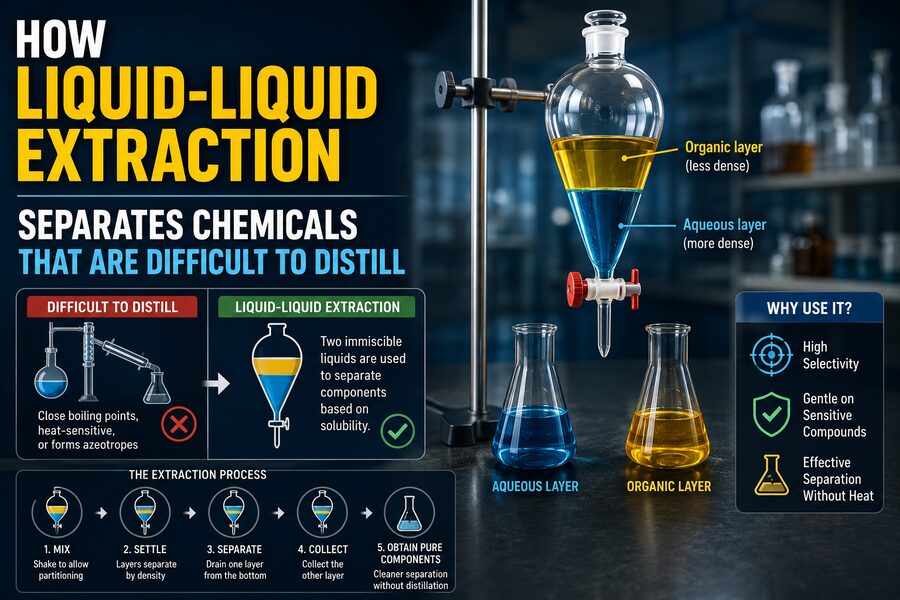
Some chemicals have boiling points that are extremely close together. Others may decompose when heated, react at elevated temperatures, or form mixtures that are difficult to separate by ordinary distillation. In these situations, chemists and engineers often turn to a powerful alternative called liquid-liquid extraction.
Liquid-liquid extraction, sometimes called solvent extraction, separates substances by allowing them to distribute themselves between two liquids that do not readily mix with each other. Instead of relying mainly on differences in boiling point, the method relies on differences in solubility and chemical affinity.
This makes liquid-liquid extraction especially useful for compounds that would be inefficient, expensive, or even impossible to separate by conventional distillation.
🧩 What Is Liquid-Liquid Extraction?
Liquid-liquid extraction is a separation process in which a dissolved chemical moves from one liquid phase into another liquid phase.
The two liquids are usually immiscible, meaning they form separate layers rather than mixing completely.
A familiar example is oil and water. 🛢️💧
When oil and water are placed together, they separate into distinct phases because their molecular properties are very different.
In a chemical extraction, one liquid contains the compound that needs to be separated. A second liquid—called the extracting solvent—is added.
If the target chemical is more soluble in the extracting solvent than in the original liquid, some of it transfers into the new phase.
The two liquids can then be separated physically.
In simple laboratory experiments, this is often done using a separatory funnel. In industrial plants, large extraction columns, mixer-settlers, centrifugal extractors, and other specialized equipment may perform the same fundamental task.
⚗️ The Basic Principle: A Chemical Chooses Between Two Liquids
The key idea behind liquid-liquid extraction is partitioning.
Suppose substance A is dissolved in water.
Now imagine adding an organic solvent that does not mix significantly with water.
Substance A may be soluble in both liquids, but not equally soluble.
After mixing and allowing the phases to separate, some molecules of A remain in the water while others move into the organic solvent.
Eventually, an equilibrium is established.
The preference of the chemical for one phase over the other can be described by a partition coefficient.
In simplified form:
K = concentration of A in solvent phase ÷ concentration of A in original phase
If K is large, the compound strongly prefers the extracting solvent.
If K is small, most of the compound remains in the original phase.
This simple relationship is at the heart of liquid-liquid extraction. 🔄
🌡️ Why Distillation Sometimes Struggles
Distillation works by heating a mixture and taking advantage of differences in volatility.
If one component vaporizes much more readily than another, the vapor becomes enriched in the more volatile substance. Repeated evaporation and condensation can then create a highly purified product.
But problems arise when two chemicals have similar boiling points.
Imagine compounds A and B boiling at:
118°C and 120°C
Their volatilities may be so similar that many distillation stages would be required to separate them effectively.
That means:
🔥 More energy consumption
🏭 Larger equipment
💰 Higher operating costs
⏱️ Longer processing time
Some mixtures present an even greater challenge because they form azeotropes.
An azeotrope is a mixture that boils in such a way that the vapor and liquid can have the same composition at a particular concentration.
Ordinary distillation cannot move past that composition easily.
Liquid-liquid extraction offers another route because it does not depend primarily on volatility.
🧪 Separating Heat-Sensitive Chemicals
Another major advantage of liquid-liquid extraction is that it can often operate at moderate temperatures.
Some molecules are thermally sensitive.
When heated strongly, they may:
- 🔥 Decompose
- 🧬 Change molecular structure
- ⚗️ React with other chemicals
- 🎨 Lose desired properties
- 💊 Lose biological activity
This is especially important in industries dealing with pharmaceuticals, natural products, flavors, fragrances, and specialty chemicals.
Distilling a heat-sensitive molecule might destroy part of the product before separation is complete.
Liquid-liquid extraction can sometimes move the desired compound into another solvent without requiring the substance itself to boil.
That allows engineers to perform separations under gentler conditions. 🌿
💧 Why the Two Liquids Must Form Separate Phases
A successful liquid-liquid extraction generally requires two liquid phases that can be separated after mixing.
If the liquids completely dissolve into one another, the mixture will not divide into separate layers.
For example, water and ethanol mix readily in almost all proportions, so they are not usually useful as the two phases of a conventional liquid-liquid extraction.
Instead, chemists choose solvents with limited mutual solubility.
The precise choice depends on several factors:
🧪 Solubility of the desired compound
🚫 Solubility of unwanted compounds
💧 Ability to form a separate phase
⚖️ Density
🌡️ Temperature behavior
♻️ Ease of solvent recovery
🛡️ Safety and environmental considerations
💰 Cost
Selecting the correct solvent is one of the most important parts of designing an extraction process.
🎯 Selectivity Is More Important Than Solubility Alone
A solvent should not simply dissolve a large amount of material.
It should preferentially dissolve the right material.
Suppose a mixture contains compounds A and B.
If the extracting solvent dissolves both equally well, little separation is achieved.
Instead, engineers want a solvent that strongly prefers A while leaving most of B behind.
This property is known as selectivity.
High selectivity makes extraction more efficient because fewer stages may be needed to achieve the desired purity.
This explains why solvent selection is often based on molecular interactions rather than simply asking, “Which liquid dissolves the most material?” 🧠
🧲 Molecular Polarity and Chemical Attraction
Why does one molecule prefer one liquid over another?
Much of the answer comes from intermolecular forces.
Molecules interact through effects including:
⚡ Dipole forces
🧲 Hydrogen bonding
🌫️ Dispersion forces
🔋 Ionic interactions
A common chemistry principle is:
“Like dissolves like.”
Polar compounds tend to interact favorably with polar solvents.
Nonpolar compounds often dissolve more readily in relatively nonpolar solvents.
However, real extraction systems can be much more complex. Molecular size, functional groups, acidity, basicity, complex formation, and solvent structure can all influence how strongly a compound prefers one phase.
Chemical engineers use experimental data and thermodynamic models to predict these interactions.
⚖️ Density Creates the Layers
After two immiscible liquids are mixed and allowed to settle, gravity causes them to form separate layers.
The denser liquid forms the lower phase, while the less-dense liquid forms the upper phase.
It is important not to assume automatically that the organic phase will always be on top.
Some organic solvents are denser than water and therefore form the lower layer.
In industrial extraction equipment, density differences are extremely important because the liquids must eventually separate after being contacted.
If the densities are too similar, settling may become slow and difficult.
🔄 Why Multiple Extractions Work Better Than One
One of the most useful ideas in liquid-liquid extraction is that several smaller extraction stages can be more effective than one single extraction using the same total amount of solvent.
Suppose a chemical is distributed between water and an organic solvent.
A single extraction removes part of the target substance.
If the remaining original phase is then contacted with fresh solvent, another portion transfers.
Repeating the process progressively removes more of the compound.
This works because each fresh portion of solvent creates a new equilibrium opportunity.
The same principle is used at industrial scale, where multiple extraction stages are arranged so the fluids contact one another repeatedly.
🔄 Fresh solvent continuously creates additional separation potential.
🏭 Countercurrent Extraction
Industrial liquid-liquid extraction often uses a highly efficient arrangement called countercurrent flow.
In a countercurrent system, the feed solution flows in one direction while the extracting solvent flows in the opposite direction.
This means relatively fresh solvent contacts material that has already been partly extracted, while solvent containing more extracted material contacts incoming feed.
The arrangement maintains favorable concentration differences across the equipment.
This can greatly improve separation efficiency.
Countercurrent extraction is widely used because it can achieve a high degree of separation while reducing the amount of solvent required.
🏗️ Mixer-Settlers
One common industrial extraction device is the mixer-settler.
As the name suggests, it has two main operations.
🔄 Mixing
The two liquid phases are mixed thoroughly.
Mixing breaks one liquid into small droplets dispersed throughout the other.
This creates a large contact area between the phases, allowing molecules to transfer rapidly.
💧 Settling
The mixture then enters a quieter region.
The droplets merge, and the liquids separate into two layers according to density.
The phases are removed separately.
Multiple mixer-settler stages can be connected together to perform increasingly complete extraction.
🗼 Extraction Columns
Another major class of equipment is the liquid-liquid extraction column.
These towers allow two immiscible liquids to flow past each other while creating extensive contact between them.
Depending on the design, columns may contain:
🔘 Trays
🧱 Packing materials
🔄 Agitators
📳 Pulsing mechanisms
One liquid may flow upward as droplets while the other moves downward continuously.
As droplets travel through the column, the target molecules transfer between phases.
Extraction columns can process large amounts of liquid continuously, making them useful in chemical manufacturing and refining.
🌀 Centrifugal Extraction
Gravity is not always fast enough to separate liquid phases.
In such cases, centrifugal extractors can use rapid rotation to generate forces much greater than gravity.
These systems can mix liquids, transfer solutes, and separate phases very rapidly.
Centrifugal extraction can be valuable when:
⏱️ Rapid processing is needed
📦 Equipment must remain compact
🧪 The chemicals are unstable during long contact times
💧 Phase separation by gravity is slow
These devices demonstrate how the same underlying chemistry can be implemented using very different mechanical designs.
⚗️ Acid-Base Extraction
Chemists can make extraction even more selective by changing a molecule’s chemical form.
One important example is acid-base extraction.
Many organic acids and bases can exist either as:
- A neutral molecule
- A charged ion
Neutral organic molecules may strongly prefer an organic solvent.
Charged ions may strongly prefer an aqueous phase.
By changing the pH, chemists can shift a compound between these two forms.
For example, an organic acid may be converted into a water-soluble ionic form.
That allows it to move from an organic layer into water.
Later, changing the pH again may convert it back into its neutral form.
This technique uses chemistry itself to control where the molecule prefers to reside. 🧪🔄
🔗 Reactive Extraction
Some industrial processes go further by using reactive extraction.
Here, the extracting solvent contains a substance that interacts chemically with the target compound.
The reaction may create a new complex that strongly prefers the solvent phase.
This can significantly improve separation when ordinary physical solubility differences are too small.
Reactive extraction has applications in recovering organic acids, metals, and specialized chemicals.
However, engineers must ensure that the reaction is reversible if the target compound eventually needs to be recovered from the solvent.
⛏️ Extracting Metals
Liquid-liquid extraction has major applications in metallurgy and mineral processing.
After valuable metals are dissolved from ores, the resulting liquid may contain many different metal ions.
Specialized extracting chemicals can selectively bind certain ions and transfer them into an organic phase.
The metals can later be removed from that solvent and recovered in purified form.
This approach is used in processing materials containing metals such as:
🔋 Copper
⚙️ Nickel
🔌 Cobalt
☢️ Uranium
🧲 Rare-earth elements
As technologies such as batteries, renewable energy systems, and electronics increase demand for high-purity materials, sophisticated extraction methods remain extremely important.
💊 Pharmaceutical Applications
Pharmaceutical manufacturing often requires separating valuable compounds from complicated mixtures.
These mixtures may contain:
🧬 Desired active molecules
🧪 Reaction byproducts
🌿 Natural compounds
💧 Water
⚗️ Residual reactants
Because many pharmaceutical molecules are large or thermally sensitive, distillation may not be appropriate for separating the molecule itself.
Liquid-liquid extraction can selectively move desired compounds into another phase while leaving impurities behind.
It is also commonly used during chemical synthesis to separate organic products from water-soluble salts and other unwanted species.
🌿 Food, Flavor, and Natural Product Processing
Natural materials often contain hundreds of different chemical compounds.
Plants, for example, contain oils, pigments, acids, sugars, aroma compounds, and numerous other substances.
Selective extraction allows manufacturers and researchers to isolate particular groups of molecules.
Applications can include:
☕ Food processing
🌸 Fragrance production
🍊 Flavor compounds
🌿 Botanical extracts
🎨 Natural pigments
Gentle extraction conditions can be especially important for protecting compounds whose aroma, flavor, or activity could be damaged by excessive heat.
🛢️ Petroleum and Petrochemical Processing
Liquid-liquid extraction is also used in petroleum and petrochemical operations.
Petroleum fractions can contain complex mixtures of hydrocarbons and other substances whose boiling points overlap.
Certain solvents can preferentially dissolve specific chemical families.
This allows engineers to separate substances according to chemical character rather than relying exclusively on volatility.
Such processes can be useful for refining lubricating oils, removing unwanted aromatic compounds, and purifying chemical feedstocks.
🌎 Environmental Applications
Liquid-liquid extraction is widely used in environmental analysis.
Scientists may need to detect very small quantities of pollutants in water.
Instead of attempting to analyze an extremely dilute sample directly, they can transfer the target compounds into a smaller volume of another liquid.
This process can effectively concentrate the analytes.
Extraction can therefore help laboratories detect:
🔬 Pesticides
🏭 Industrial contaminants
🛢️ Hydrocarbons
🧪 Organic pollutants
Similar principles can also be used in treatment processes designed to remove contaminants from industrial wastewater.
🔁 Recovering the Product From the Solvent
Extraction alone does not necessarily produce the final purified chemical.
After extraction, the target compound is often dissolved in the new solvent.
Engineers must then recover it.
Depending on the system, recovery might involve:
🌡️ Distillation of the solvent
🧪 Changing pH
⚗️ Chemical stripping
❄️ Crystallization
💨 Evaporation
🔄 Back-extraction into another liquid
Interestingly, distillation and liquid-liquid extraction are therefore not always competitors.
They are often used together.
Extraction performs the difficult selective separation, while distillation later recovers and recycles the solvent.
This hybrid strategy can be much more energy-efficient than attempting the original separation entirely by distillation.
♻️ Why Solvent Recycling Matters
Industrial extraction can require substantial quantities of solvent.
Throwing the solvent away after every use would be economically expensive and environmentally undesirable.
Most large-scale systems therefore try to recover and recycle it.
A well-designed process may circulate the solvent repeatedly through:
Extraction → product recovery → solvent purification → extraction again
This reduces raw-material consumption and waste.
Modern process design increasingly emphasizes solvents that combine strong separation performance with lower toxicity, lower environmental impact, and easier recycling. 🌱
⚠️ Challenges of Liquid-Liquid Extraction
Despite its advantages, liquid-liquid extraction is not perfect.
One challenge is the formation of emulsions.
An emulsion occurs when tiny droplets of one liquid remain suspended in another instead of separating quickly.
This can make phase separation difficult.
Other potential challenges include:
🧪 Solvent losses
💰 Solvent cost
🔥 Flammability of some solvents
🌎 Environmental concerns
🏭 Additional processing equipment
💧 Slow phase separation
🧱 Fouling or contamination
Engineers must balance these factors when determining whether extraction is preferable to another separation method.
📊 Extraction vs. Distillation
The two techniques exploit fundamentally different properties.
Distillation primarily uses differences in volatility.
Liquid-liquid extraction primarily uses differences in solubility and chemical affinity.
Distillation is often excellent when:
🌡️ Boiling points differ significantly
🔥 Components tolerate heating
⚡ Energy costs are manageable
Liquid-liquid extraction can be attractive when:
🧪 Boiling points are close
⚠️ Compounds are heat-sensitive
🔄 Azeotropes complicate distillation
🎯 A selective solvent is available
🏭 Distillation would require excessive energy
The best industrial separation train may combine both methods.
⚡ Energy Advantages
Separating liquids by distillation can require huge amounts of energy because large quantities of material must be vaporized.
Vaporization consumes substantial heat.
Liquid-liquid extraction normally does not require vaporizing the entire feed mixture.
The energy needed to mix and separate liquid phases can therefore be much lower.
However, engineers must consider the full system.
If recovering the extracting solvent requires energy-intensive distillation, some of the advantage may be reduced.
The important quantity is the total energy requirement of the complete process, not simply the extraction step itself.
🧠 How Engineers Design an Extraction Process
Designing an efficient extraction system requires answering several questions.
Engineers must determine:
- Which solvent provides the highest selectivity?
- How much solvent is required?
- How quickly does mass transfer occur?
- How easily do the phases separate?
- How many extraction stages are required?
- How will the product be recovered?
- How will the solvent be recycled?
- What are the safety and environmental impacts?
Laboratory experiments are often performed first to measure equilibrium behavior.
Engineers can then use thermodynamic models, mass balances, and computer simulations to design the full-scale process. 💻🏭
🔬 Mass Transfer: How Molecules Actually Move
Liquid-liquid extraction depends on mass transfer.
When two phases are contacted, molecules move from regions of higher chemical potential toward equilibrium.
Creating many tiny droplets increases the contact area between the phases.
More interfacial area generally means faster mass transfer.
However, extremely small droplets may take longer to settle afterward.
This creates an important engineering tradeoff:
Intense mixing improves transfer but may make phase separation more difficult.
Extraction equipment must therefore balance mixing efficiency against settling performance.
🚀 The Future of Liquid-Liquid Extraction
Separation processes consume a significant portion of the energy used in the chemical industry, so improving them is an important engineering priority.
Researchers are investigating new extraction systems involving:
🌱 Greener solvents
🧂 Ionic liquids
🧪 Deep eutectic solvents
🔬 Highly selective molecular extractants
🌀 Advanced centrifugal equipment
🤖 Automated process control
The goal is to create separations that use less energy, generate less waste, and recover valuable materials more efficiently.
Liquid-liquid extraction may become increasingly important in areas such as battery recycling, critical mineral recovery, pharmaceuticals, biotechnology, and sustainable chemical manufacturing.
🌟 Conclusion
Liquid-liquid extraction solves difficult chemical separation problems by using differences in solubility rather than differences in boiling point.
When two liquids form separate phases, a dissolved chemical can distribute itself between them. By choosing a solvent that strongly prefers the desired compound, chemists and engineers can selectively transfer that compound from one phase into another. 🧪🔄
This makes extraction particularly useful when distillation is problematic because chemicals have similar boiling points, form azeotropes, require excessive energy to separate, or cannot tolerate high temperatures.
The technique can be strengthened further through multiple extraction stages, countercurrent flow, pH adjustment, selective complex formation, and sophisticated industrial equipment.
From pharmaceuticals and metal recovery to petroleum refining, environmental analysis, food processing, and battery-material production, liquid-liquid extraction is one of the most versatile tools available for chemical separation.
Its underlying principle is elegantly simple:
Instead of forcing difficult chemicals apart with heat, give them two different liquids—and let their molecular preferences do the separating. 🧠⚗️