
A discarded phone, a copper ore concentrate, and a container of used motor oil may seem unrelated. Yet each can contain materials worth recovering—if engineers can separate them from a chemically crowded mixture.
Many industrial separations are difficult because the desired component is dissolved, finely dispersed, or present alongside substances with similar physical properties. Filtration cannot capture dissolved ions, and distillation may demand excessive heat or fail when compounds have similar volatilities.
Solvent extraction offers another route. It uses two liquids that do not substantially mix, then gives a target material a chemical reason to move from one liquid phase into the other.
This deceptively simple idea supports metal refining, nuclear-fuel processing, pharmaceutical manufacturing, hydrometallurgy, wastewater treatment, and analytical chemistry. Understanding it means looking beyond the equipment to the molecular preferences that make the separation possible.
🔍 What Industrial Solvent Extraction Means
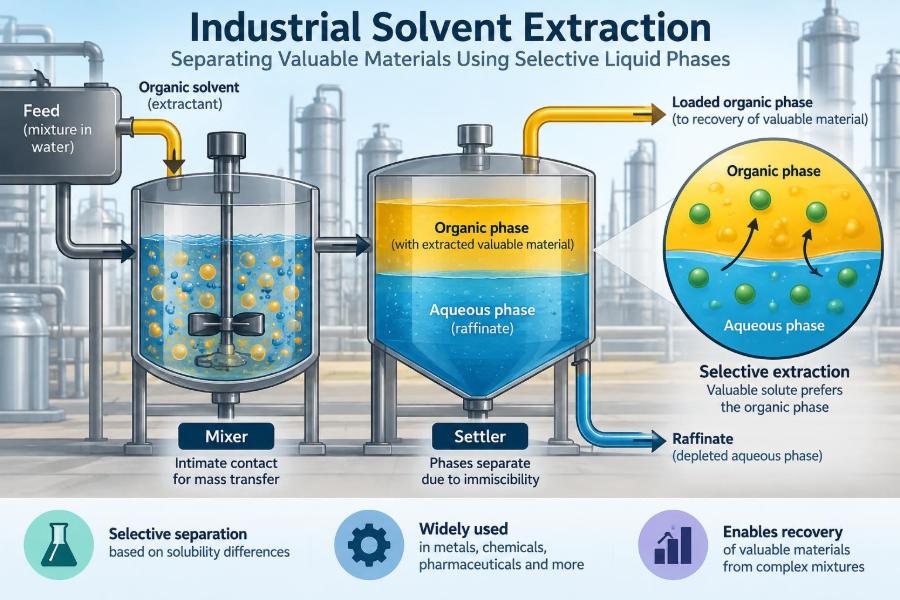
Solvent extraction, also called liquid-liquid extraction, is a separation process in which a solute distributes itself between two largely immiscible liquid phases. One phase is commonly water-based, while the other is an organic liquid containing an extracting chemical.
The target does not disappear or transform merely because extraction occurs. It moves preferentially into the phase where it is more stable. Engineers then separate the two liquid layers and recover the target from the enriched phase.
The term can also describe solid-liquid extraction, such as leaching oil from plant material. In industrial chemical engineering, however, “solvent extraction” often refers specifically to the liquid-liquid process discussed here.
🌊 Why Two Immiscible Liquids Are Essential
Water and many hydrocarbon-based organic liquids form separate layers because their molecular interactions are unfavorable for complete mixing. Water is strongly polar, whereas many organic diluents are much less polar.
That phase split creates the physical basis for extraction. A dissolved species can transfer at the liquid interface, but the liquids remain separable afterward by settling, centrifugation, or coalescence.
A familiar analogy is salad dressing: oil and vinegar can be shaken into droplets, but eventually form layers again. Industrial systems use the same broad behavior, although their chemistry and hydrodynamics are much more carefully controlled.
⚖️ The Distribution Ratio Explains Preference
The central equilibrium measure is the distribution ratio, often written as D. It compares the total concentration of a solute in the organic phase with its total concentration in the aqueous phase at equilibrium.
A large D means the target strongly favors the organic phase under those conditions. A small D means it remains mostly in water. “Total” matters because a metal can exist as several aqueous species or extracted complexes simultaneously.
For a simple neutral solute, engineers may use a partition coefficient. Real metal extraction is usually more complex because acidity, ligand concentration, and chemical speciation all change what form of the metal is present.
🧲 Selectivity Is More Valuable Than Simple Extraction
Recovering a target is not enough when impurities follow it. Selectivity describes how much more readily one solute is extracted than another under the same conditions.
For example, an extractant might transfer copper efficiently while leaving iron in the aqueous solution. That difference enables purification, not just phase transfer.
Engineers often express selectivity through a separation factor: the ratio of distribution ratios for two components. A useful process needs a sufficiently favorable factor over a practical operating range, not just a promising result from one laboratory sample.
🧪 The Chemistry Behind an Extractant
An extractant is the active molecule dissolved in the organic phase. It binds, pairs with, or solvates the target species so that the resulting entity becomes soluble in the organic liquid.
Extractants are chosen for functional groups, acidity, molecular size, solubility, selectivity, stability, and ease of stripping. The surrounding organic liquid, called the diluent, affects viscosity, phase disengagement, safety, and sometimes extraction chemistry.
Industrial formulations may also include modifiers. These additives can prevent unwanted third phases, reduce emulsions, improve solubility, or adjust the physical behavior of the organic phase.
🔗 Major Mechanisms of Solvent Extraction
Different solutes require different chemical routes into the organic phase. The mechanism determines the sensitivity to pH, salt concentration, and competing ions.
| Mechanism | Basic idea | Typical process consequence |
|---|---|---|
| Solvation | A neutral complex is surrounded by an organic-soluble extractant. | Often depends on forming the right anionic ligand complex first. |
| Ion exchange | The extractant exchanges its own ion, commonly H+, for a metal ion. | Extraction commonly rises as acidity is reduced. |
| Ion pairing | An ionic target forms a neutral or hydrophobic ion pair. | Counterion choice can strongly affect selectivity. |
| Neutral complex extraction | A neutral molecular species partitions into the organic phase. | Common for suitable organic molecules and complexes. |
These labels are useful models, but real systems can involve several equilibria at once. A process engineer must test the full feed chemistry rather than relying on a simplified reaction alone.
🧫 Acidity Controls Metal Speciation
pH is often one of the strongest process levers. It changes whether a dissolved metal exists as a free cation, a hydrolyzed species, a ligand complex, or a precipitate-forming compound.
Acidic extractants commonly release hydrogen ions as they bind metal cations. In that case, high acidity can suppress extraction because abundant hydrogen ions compete with the metal for the extractant.
Adjusting pH must be done cautiously. Raising it may improve extraction, but it can also precipitate metal hydroxides, consume reagents, or extract unwanted species.
🧂 Ligands and Counterions Shape the Separation
Ligands are ions or molecules that coordinate to a metal. Chloride, sulfate, nitrate, ammonia, and cyanide are examples used in various chemical systems, each producing different metal complexes.
Changing ligand concentration can alter charge, geometry, and solubility of a metal species. A metal that remains in water under one condition may form an extractable complex under another.
This is why feed preparation is part of separation design. The extractant alone does not decide performance; the aqueous chemistry determines whether the extractant encounters a compatible target.
📈 Single Contacts Rarely Deliver Full Recovery
One equilibrium contact often leaves substantial material behind. Industrial systems therefore use repeated contacts between fresh or partially regenerated solvent and aqueous feed.
Countercurrent flow is especially efficient. Fresh organic phase meets aqueous solution that has already had much of its target removed, while fresh aqueous feed contacts organic phase that is already enriched.
This arrangement uses the driving force more effectively than a sequence of identical one-stage contacts. The same principle appears in absorption and distillation: staged countercurrent operation can achieve demanding separations with manageable material flow.
📊 Reading a McCabe–Thiele Extraction Diagram
A McCabe–Thiele diagram is a graphical tool for estimating the number of ideal extraction stages. It combines an equilibrium curve with an operating line based on phase flow rates and desired outlet concentrations.
Stepping between those lines represents successive ideal contacts. The construction gives process intuition: a shallow equilibrium relationship or an unfavorable flow ratio may require many stages.
Actual equipment is not ideal. Mixing, incomplete settling, entrainment, changing temperature, and mass-transfer resistance reduce performance, so designers apply stage efficiencies or use more detailed models.
🏭 Mixer-Settlers: The Classic Industrial Arrangement
A mixer-settler has two functional zones. In the mixer, aqueous and organic streams are agitated to create droplets and interfacial area. In the settler, agitation stops and the droplets coalesce into separate layers.
They are popular because individual stages are easy to inspect, sample, and adjust. Multiple units can be linked in series for extraction, washing, and stripping.
The tradeoff is footprint. Large settlers may be required when phases separate slowly, and poor interface control can lead to solvent carryover or lost aqueous solution.
🌀 Columns and Centrifugal Contactors Save Space
Extraction columns contact the phases continuously rather than stage by stage in separate tanks. Depending on design, one phase disperses as droplets through the other, allowing mass transfer along the column height.
Centrifugal contactors mix and separate liquids using rotational force. Their short residence time and compact size can be valuable where inventories must be minimized or rapid disengagement is needed.
No contactor is automatically best. Selection depends on throughput, viscosity, density difference, solids content, phase-separation behavior, controllability, maintenance needs, and consequences of solvent inventory.
🔄 Extraction Is Followed by Scrubbing
The loaded organic phase usually contains some co-extracted impurities. Scrubbing contacts that organic stream with a carefully selected aqueous solution to remove those impurities while retaining most of the valuable target.
Scrubbing is not simply rinsing. Its solution chemistry is designed to reverse extraction for selected contaminants more readily than for the desired component.
A weak scrub may leave unacceptable contamination downstream. An overly aggressive scrub can sacrifice product, disturb phase behavior, or create a more complicated recycle stream.
🚿 Stripping Recovers the Valuable Material
Stripping, also called back-extraction, transfers the target from the loaded organic phase into a new aqueous stream. This produces a concentrated aqueous product and regenerates the organic phase for reuse.
The strip solution changes the equilibrium in the opposite direction. Depending on the chemistry, it may use stronger acid, altered pH, a complexing agent, or a different salt composition.
The stripped solution can then go to crystallization, electrowinning, precipitation, refining, or another recovery step. Thus solvent extraction is commonly a concentration and purification operation within a larger flowsheet.
♻️ Solvent Regeneration Keeps the Circuit Viable
After stripping, the organic phase is returned to extraction, but it may need conditioning. It can accumulate degradation products, entrained water, dissolved impurities, or fine solids over time.
Operations may use washing, filtration, treatment with selected reagents, or partial solvent replacement. These practices protect extraction performance and reduce losses of expensive extractant.
A healthy recycle loop requires material balance discipline. Small losses repeated continuously can become significant, especially when solvent is carried out in aqueous streams.
⛏️ Copper Recovery Shows the Process in Context
A well-known application is copper recovery from acidic leach solutions. Ore is leached so that copper enters an aqueous solution, often alongside other dissolved species.
An organic phase containing a copper-selective extractant contacts the leach liquor. Copper transfers into the organic phase, which is then separated and stripped using a strong acidic solution to make a more concentrated copper-bearing electrolyte.
That electrolyte can feed electrowinning, where electric current deposits copper metal at a cathode. The extraction circuit links low-concentration leach liquor to a solution suitable for electrochemical metal recovery.
🔋 Battery Metals Need Carefully Tuned Selectivity
Hydrometallurgical routes for nickel, cobalt, manganese, lithium, and rare-earth elements often involve solvent extraction because these metals can have related chemical behavior in aqueous solutions.
The challenge is rarely “can this metal be extracted?” More often, it is whether one metal can be separated from several others across variable feed compositions without unacceptable reagent consumption.
Small differences in pH response or complex formation can be exploited through staged extraction and stripping. However, feed impurities, organic degradation, and precipitation risk can make scale-up more demanding than bench tests suggest.
☢️ Nuclear Applications Demand Containment and Control
Solvent extraction has long been used in nuclear-fuel-related chemical processing to separate uranium, plutonium, and fission-product species in carefully engineered systems. The underlying chemistry is selective complexation and phase transfer.
These applications require much more than ordinary separation performance. Radiation effects, criticality safety, remote operation, contamination control, safeguards, and waste management shape every equipment and chemistry decision.
This example illustrates a broader lesson: the same unit operation can have very different design constraints depending on the hazards and consequences associated with the material.
💊 Pharmaceutical and Fine-Chemical Purification
In pharmaceutical and specialty-chemical production, liquid-liquid extraction can isolate an intermediate, remove a catalyst residue, neutralize an acid or base, or separate a product from reaction by-products.
Acid-base extraction is a common laboratory and production concept. A basic organic compound can be protonated so it moves into water as a salt, then converted back to its neutral form for recovery into an organic phase.
Process choices must account for product stability and residual solvents. A chemically effective extraction is not automatically acceptable if it complicates solvent removal, impurity control, or compliance with product-quality requirements.
🧼 Wastewater Treatment Has Useful but Limited Roles
Solvent extraction can remove selected organics, phenols, acids, or metals from industrial wastewater, especially when a target has value or when conventional treatment is ineffective.
It is less attractive when the pollutant concentration is extremely low, when the mixture creates stable emulsions, or when solvent loss would create a new environmental burden. Adsorption, membrane separation, biological treatment, precipitation, or oxidation may be better choices in those cases.
The best solution depends on the whole treatment train. Extraction may serve as a recovery step before polishing, rather than as the only treatment method.
🧯 Flammability, Toxicity, and Exposure Must Drive Design
Many organic diluents are flammable, volatile, or hazardous if inhaled or released. Some extractants and modifiers can also irritate skin, damage aquatic environments, or create persistent contamination concerns.
Practical safeguards include closed transfer systems, compatible seals, secondary containment, vapor management, grounding and bonding where relevant, fire protection, leak detection, and clear procedures for sampling and maintenance.
Safety cannot be inferred from a solvent’s familiar name. Site-specific safety data, operating conditions, mixture behavior, and regulatory requirements must guide the design and operating plan.
🌫️ Emulsions and Crud Can Disrupt a Circuit
An emulsion forms when droplets remain suspended instead of separating cleanly. Fine solids, surfactant-like impurities, excessive mixing energy, degradation products, and unfavorable chemistry can all contribute.
Crud is a troublesome interfacial layer containing solids, aqueous droplets, organic material, and sometimes precipitates. It can trap valuable extractant and cause poor phase separation.
Operators respond by identifying the root cause rather than merely waiting longer for settling. Feed clarification, mixing adjustments, temperature control, filtration, chemistry changes, and targeted cleaning may all be necessary.
🧱 Entrainment Causes Product Loss and Contamination
Entrainment is the unwanted carryover of small droplets of one phase into the other. Organic droplets in aqueous raffinate cause solvent loss; aqueous droplets in loaded organic can transport impurities into later stages.
Density difference, droplet size, viscosity, interfacial tension, and residence time all affect entrainment. High flow rates can worsen it by reducing settling time and increasing turbulence.
Coalescers, calmer flow distribution, adequate settler volume, and properly managed interfaces can reduce carryover. Measuring entrainment is valuable because it often explains contamination that equilibrium calculations cannot.
🌡️ Temperature Changes Both Chemistry and Hydraulics
Temperature can alter extraction equilibria, reaction rates, viscosity, density difference, and phase disengagement. A warmer organic phase may flow and separate more readily, yet its selectivity or stability may shift.
Seasonal feed changes can therefore matter in large plants, particularly when equipment is outdoors or cooling capacity varies. Temperature control is sometimes a quality requirement, not just an energy consideration.
Bench data collected at one temperature should not be assumed to represent all operating conditions. Testing across a realistic range helps expose sensitive behavior before design decisions are fixed.
🧭 Designing from a Real Feed, Not an Ideal Solution
Early experiments often use clean synthetic solutions. They are useful for identifying basic equilibria, but real feeds may contain suspended solids, dissolved organics, surfactants, oxidation products, and fluctuating impurity levels.
A sound development program examines extraction isotherms, kinetics, phase separation, impurity transfer, stripping, solvent loss, and solvent aging. Pilot work is particularly valuable when emulsions or changing feed chemistry are likely.
Mass balance closure is a practical test of understanding. If metal, acid, water, or organic inventory does not reconcile, hidden entrainment, sampling errors, reactions, or unmeasured streams may be present.
📏 Key Measurements for Operations
Operators and engineers monitor more than target concentration. The interface level, phase flow rates, pH or acidity, oxidation state where relevant, temperature, density, and organic quality provide clues about circuit health.
Routine sampling should distinguish free aqueous solution from entrained aqueous droplets and free organic from dissolved or dispersed organic. Poor sampling practices can produce misleading assay results and incorrect process adjustments.
Trend data is especially useful. A gradual change in phase separation time or distribution behavior may reveal extractant degradation or a feed change before production quality is affected.
⚙️ Common Design Mistakes to Avoid
- Choosing a solvent only for high extraction: selectivity, stripping, safety, and phase separation are equally consequential.
- Ignoring impurities: a trace component can poison a downstream operation or form persistent crud.
- Using excessive mixing: more agitation can increase interfacial area but also create hard-to-settle droplets.
- Underestimating solvent loss: dissolved, entrained, and evaporated losses require different controls.
- Assuming equilibrium is instantaneous: some systems need sufficient contact time for complexation and mass transfer.
The recurring lesson is that chemical equilibrium, fluid behavior, and plant operability must be designed together.
🧠 When Solvent Extraction Is the Right Choice
Solvent extraction is attractive when a target can be made selectively extractable, when concentration or purification is needed, and when a regenerable solvent circuit is practical. It is particularly useful for dilute metal-bearing solutions where direct precipitation would consume excessive reagent or produce mixed solids.
It may be a poor choice if the feed makes stable emulsions, the target has little chemical selectivity, the solvent poses unacceptable hazards, or a simpler operation can meet the requirement. Ion exchange, membranes, precipitation, adsorption, crystallization, and distillation all remain important alternatives.
Good process selection begins with the separation objective: recovery, purity, concentration, waste reduction, or a combination of these. The “best” technology is the one that meets that objective reliably within safety, cost, and environmental constraints.
🌱 Greener Solvents and Better Process Integration
Current development efforts often seek lower-volatility diluents, more biodegradable extractants, reduced solvent inventory, and improved recovery of solvent from aqueous discharges. These goals must be balanced against extraction performance and long-term stability.
Some alternative solvent systems, including ionic liquids and bio-derived diluents, have promising characteristics in particular applications. They are not automatically greener simply because of their origin or low volatility; synthesis impacts, toxicity, recyclability, and end-of-life behavior still matter.
Integration can also improve sustainability. Recovering metals from residues, recycling strip solutions, reducing acid demand, and minimizing water entrainment can lower the total burden of a process without changing the core extraction chemistry.
✅ The Core Principle: Control Chemical Preference and Phase Flow
Industrial solvent extraction works because chemistry gives a target component a controlled preference for one liquid phase, while equipment repeatedly brings that phase into contact with another and then separates them again.
Successful systems combine four elements: an extractable chemical form, a selective and stable organic formulation, efficient staged contacting, and clean phase disengagement. If any one fails, high theoretical distribution ratios may not translate into reliable plant performance.
For students and practitioners, the most useful mental model is to see solvent extraction as both a molecular and process-level separation. Molecules decide where the target wants to be; engineering decides how efficiently, safely, and cleanly that preference becomes a product stream.
Solvent extraction turns selective molecular interactions into practical industrial separations, provided chemistry, hydraulics, recovery, and safety are designed as one connected system. 🧪⚙️🌍