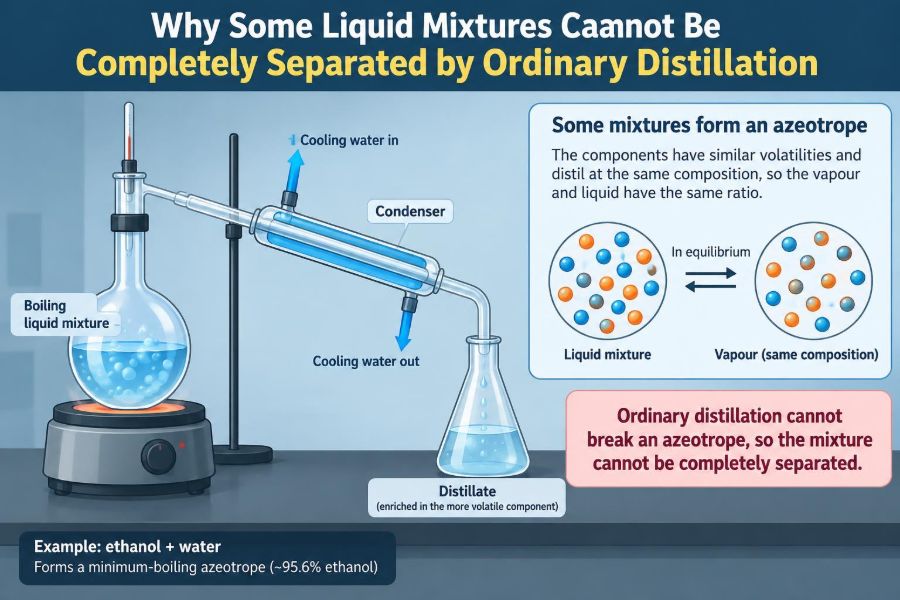

A bottle of ethanol and water seems like a straightforward separation problem. Heat it, collect the vapor, and the more volatile ethanol should come over first. This works remarkably well—until the distillate reaches a composition that stubbornly refuses to become purer.
The same surprise appears in laboratories, fuel production, solvent recovery, and pharmaceutical manufacturing. A distillation column can be made taller, supplied with more reflux, and operated with greater energy input, yet a particular mixture may still approach a hard limit rather than yielding pure components.
That limit is not usually caused by poor equipment or careless operation. It arises from the thermodynamics of the liquid mixture itself: at certain compositions, the vapor has exactly the same composition as the boiling liquid.
These mixtures are called azeotropes. Understanding why they form explains both a fundamental limit of ordinary distillation and the specialized methods engineers use when that limit matters.
🌡️ Distillation Starts with Unequal Volatility
Ordinary distillation separates liquids because their molecules do not enter the vapor phase equally easily. A component with a lower tendency to remain in the liquid, often associated with a lower boiling point when pure, is described as more volatile.
When a mixture boils, its vapor is generally richer in the more volatile component than the liquid left behind. Condensing that vapor creates a liquid with a new, more favorable composition. Repeating this enrichment is the basis of fractional distillation.
🫧 Boiling Is a Vapor-Pressure Balance
A liquid boils when its total vapor pressure equals the pressure surrounding it. At atmospheric pressure, this condition corresponds to the familiar normal boiling point, but the principle applies at any operating pressure.
For a binary mixture of A and B, each component contributes a partial vapor pressure. The sum determines whether the mixture boils. Distillation depends not only on pure-component boiling points, but also on how each component’s vapor pressure changes when it is mixed with the other.
⚖️ Vapor-Liquid Equilibrium Defines the Limit
Vapor-liquid equilibrium, usually abbreviated VLE, describes the condition in which evaporation and condensation occur at equal rates. The liquid and vapor can have different compositions, even though they are in equilibrium.
Engineers commonly represent a binary VLE relationship with liquid composition, x, on one axis and vapor composition, y, on the other. If the vapor composition is richer in component A than the liquid, successive distillation stages can enrich A.
An azeotrope occurs at the unusual point where x = y. There is then no composition difference for a conventional distillation stage to exploit.
🧭 Relative Volatility Is the Separation Compass
Relative volatility compares how strongly two components prefer the vapor phase. For components A and B, it is often expressed as the ratio of their vapor-liquid partitioning tendencies.
If the relative volatility is greater than one, A is easier to enrich in vapor than B. The further it is from one, the more readily a distillation column can separate the pair. When relative volatility approaches one, separation becomes difficult and demands many stages or high reflux.
At an azeotrope, the relative volatility is effectively one at that composition. The usual directional advantage disappears.
🧪 Ideal Mixtures Follow a Simple Rule
An ideal liquid mixture is one in which unlike molecular interactions are similar in strength to like-with-like interactions. In practical terms, A-B attractions resemble A-A and B-B attractions closely enough that mixing does not greatly alter each component’s escaping tendency.
Such mixtures can often be approximated by Raoult’s law: each component’s partial vapor pressure equals its pure-component vapor pressure multiplied by its liquid mole fraction. Many real mixtures behave approximately ideally only over limited composition ranges.
Ideal behavior provides a useful baseline, but azeotropes are usually consequences of meaningful departures from it.
🔗 Molecular Attractions Create Nonideal Behavior
Molecules in a liquid are not isolated. They attract, repel, orient, hydrogen-bond, and sometimes form temporary molecular associations. Changing neighbors changes the energy required for a molecule to escape into vapor.
If A and B attract each other much more strongly than their own molecules, both can be held in the liquid more firmly than an ideal model predicts. If A-B interactions are unusually weak, molecules can escape more readily.
This is why boiling behavior cannot reliably be inferred from pure boiling points alone. Mixture behavior is a property of the combined molecular environment.
📉 Negative Deviations Can Produce Maximum-Boiling Azeotropes
A negative deviation from Raoult’s law occurs when the total vapor pressure is lower than ideal behavior would predict. Strong attractions between unlike molecules reduce their willingness to leave the liquid.
At sufficiently strong negative deviation, the total vapor-pressure curve develops a minimum. At a fixed external pressure, that minimum corresponds to a maximum-boiling azeotrope.
Near this composition, the liquid is especially stable relative to vapor. Distillation drives material toward the azeotropic composition from either side, but cannot pass through it by ordinary rectification.
📈 Positive Deviations Can Produce Minimum-Boiling Azeotropes
A positive deviation from Raoult’s law occurs when unlike molecules interact less favorably than expected from the pure liquids. Molecules escape more easily, increasing total vapor pressure above the ideal prediction.
A sufficiently large positive deviation creates a vapor-pressure maximum, which appears as a minimum-boiling azeotrope at fixed pressure. This azeotrope is more volatile than either pure component.
The ethanol-water system at atmospheric pressure is the familiar teaching example. Distillation can produce ethanol-rich distillate, but it approaches an ethanol-water azeotrope rather than anhydrous ethanol.
🗺️ A Boiling-Point Diagram Shows the Trap
A temperature-composition diagram at constant pressure contains a bubble-point curve and a dew-point curve. The bubble point is where a liquid of known composition first produces vapor; the dew point is where a vapor first produces liquid on cooling.
Between these curves, liquid and vapor coexist. At ordinary compositions, their horizontal tie line connects phases with different compositions. At an azeotrope, the two curves meet, so the liquid and vapor compositions become identical.
This graphical pinch is a direct visual warning: no sequence of equilibrium stages can create a composition change at the meeting point.
🪜 Why More Trays Eventually Stop Helping
A tray column, packed column, or laboratory fractionating column creates repeated vapor-liquid contacts. Each effective contact is an equilibrium stage, and each stage normally shifts composition toward the more volatile material.
As the azeotrope is approached, however, the composition change per stage becomes smaller. In an idealized calculation, reaching the exact azeotropic composition requires an infinite number of stages and, typically, an impractically high reflux ratio.
Adding height may improve product purity while the column remains away from the pinch. It cannot make ordinary distillation cross the azeotropic barrier.
🔄 Reflux Improves Purity but Cannot Change Equilibrium
Reflux is condensed overhead liquid returned to the top of a distillation column. It contacts rising vapor and strengthens internal separation, often producing a much purer overhead product.
High reflux can be valuable for mixtures with moderate relative volatility. Yet reflux only creates more repeated equilibrium contacts; it does not alter the equilibrium relationship itself.
This distinction matters in troubleshooting. If a column reaches a stable composition below the target purity, increasing reflux may consume more energy without overcoming an azeotrope.
🥃 Ethanol and Water: The Classic Practical Example
Ethanol and water mix completely and form a minimum-boiling azeotrope near the ethanol-rich end at atmospheric pressure. The exact composition and boiling temperature depend on pressure and measurement basis, but the engineering result is clear: conventional distillation does not produce completely dry ethanol from this pair.
This matters for products requiring low water content, including some fuels, solvents, and chemical feedstocks. The final dehydration step must use a method beyond simple rectification.
It also illustrates an important nuance: a mixture can be easily separable across much of its composition range and still have a decisive limit near one endpoint.
🧴 Other Mixtures Can Behave Very Differently
Azeotropy is not limited to alcohol-water systems. It can occur in mixtures containing hydrocarbons, chlorinated solvents, ketones, acids, and many other chemical families. Whether an azeotrope forms depends on the full thermodynamic interaction pattern, not on a single functional group.
Some binary pairs have no azeotrope at the operating pressure and can be fractionated to very high purities. Others have one azeotrope, while multicomponent mixtures can have more complicated equilibrium behavior.
Reliable design therefore starts with measured VLE data or a thermodynamic model that has been checked against relevant data.
🧩 Binary Azeotropes Are Only the Beginning
Industrial feeds often contain more than two components. In a ternary or more complex mixture, an azeotrope may involve all components or may arise from a binary subsystem within the larger blend.
The resulting composition maps can contain boundaries that constrain where distillation trajectories go. A column sequence that appears sensible from pairwise boiling points can fail when the complete multicomponent equilibrium is considered.
Process simulators are helpful, but they require appropriate property methods and trustworthy interaction parameters. A polished flowsheet cannot compensate for unsuitable thermodynamics.
🧮 Activity Coefficients Capture Liquid-Phase Effects
For nonideal mixtures, engineers often modify Raoult’s law using an activity coefficient, represented by the Greek letter gamma. It accounts for how the real liquid environment changes a component’s effective escaping tendency.
An activity coefficient above one generally signals positive deviation; below one generally signals negative deviation. The values vary with composition and temperature, which is why a mixture may be nearly ideal in one region and strongly nonideal in another.
Models such as NRTL, UNIQUAC, and Wilson-type equations are commonly used for liquid-phase nonideality. Their usefulness depends on having suitable parameters and recognizing their range of validity.
📊 Read VLE Data Before Choosing Equipment
Before selecting a separation method, examine the operating-pressure VLE data. Key questions include whether an azeotrope exists, where it lies, how close the feed or desired product is to it, and whether liquid-liquid splitting occurs.
The following quick reference helps distinguish common situations:
| Observed equilibrium behavior | What ordinary distillation can usually do | Typical implication |
|---|---|---|
| Relative volatility comfortably different from one | Enrich products toward high purity | Conventional column design may be suitable |
| Relative volatility near one | Separate slowly and with high energy demand | Many stages or an alternative method may be needed |
| Azeotrope between desired pure products | Approach, but not cross, the azeotropic composition | Change pressure or add another separation mechanism |
| Two liquid phases after condensation | Potentially use phase splitting with distillation | Decanter-assisted designs may be possible |
Data quality matters especially near azeotropes, where small thermodynamic errors can change predicted feasibility.
🎚️ Pressure Can Move an Azeotrope
VLE depends on pressure. Changing pressure changes boiling temperatures and can also change the azeotropic composition. In some systems, that shift is large enough to make separation feasible using two columns at different pressures.
This is the principle of pressure-swing distillation. One column operates at a pressure where the azeotrope has one composition; another operates where it has another. Material can be routed between them to bypass the single-pressure limitation.
Pressure swing is not universal. It works only when the azeotrope shifts sufficiently and when compression, vacuum operation, and heat duties are economically and safely manageable.
➕ Entrainer-Based Distillation Changes the System
An entrainer is a deliberately added component that changes phase equilibrium. Instead of trying to force the original binary mixture apart, the process creates a new separation landscape.
In extractive distillation, a relatively high-boiling solvent changes liquid-phase activity coefficients and alters relative volatility. The solvent is usually recovered in a separate column and recycled.
In azeotropic distillation, an added component can form a new azeotrope or promote phase splitting after condensation. Both approaches can be effective, but they add solvent circulation, recovery duties, contamination concerns, and control complexity.
🚰 Liquid-Liquid Splitting Can Be an Advantage
Some condensed overhead vapors separate into two immiscible liquid layers. A decanter can then divide those layers before part of one stream is returned as reflux or sent to additional processing.
This behavior is especially useful in certain heteroazeotropic systems, where phase splitting supplies a separation mechanism that distillation alone lacks. The design must account for the compositions of both liquid phases, not merely the vapor composition.
Phase splitting is not automatically helpful. It depends on temperature, composition, and the presence of contaminants, all of which can change liquid-liquid equilibrium.
🧱 Molecular Sieves Remove Water Selectively
For ethanol dehydration, molecular sieves are widely used after conventional distillation has concentrated ethanol close to its azeotropic limit. These porous solids preferentially adsorb water molecules while allowing ethanol-rich product to pass.
Adsorbent beds eventually become saturated and must be regenerated, often by heating or pressure reduction. Multiple beds are commonly arranged so one can dry feed while another regenerates.
Molecular sieves avoid introducing a liquid entrainer into the product, but they require attention to bed protection, regeneration energy, and adsorbent aging.
🧫 Membranes Offer a Different Driving Force
Membrane processes separate components through selective transport rather than repeated vapor-liquid equilibrium stages. In pervaporation, a liquid feed contacts a membrane and selected components permeate, usually evaporating into a low-pressure or sweep-gas side.
Water-selective membranes can dehydrate alcohols beyond an azeotropic composition. Vapor permeation applies a related principle to vapor feeds and is often considered alongside distillation in hybrid systems.
Membranes can reduce some thermal duties, but performance depends on flux, selectivity, feed contaminants, pressure conditions, and the cost of maintaining the required driving force.
🧊 Extraction May Be Better Than Another Column
Liquid-liquid extraction uses a solvent that preferentially dissolves one component from a mixture. It is valuable when a suitable solvent provides strong selectivity and when distillation would be energy-intensive or azeotrope-limited.
The extracted solute and solvent still need downstream separation, so extraction relocates rather than eliminates part of the separation challenge. However, it can create a much more favorable path than attempting a direct binary split.
Solvent choice must consider selectivity, mutual solubility, recovery difficulty, toxicity, stability, and compatibility with the process.
⚡ Energy Use Rises Near Difficult Separations
Distillation consumes energy mainly in the reboiler, where vapor is generated, and often requires cooling duty in the condenser. Low relative volatility raises internal vapor and liquid circulation, increasing these utility demands.
Near an azeotrope, pursuing marginal purity improvements through conventional distillation can produce diminishing returns. The design question is not only whether a column can reach a target, but what energy, capital, and operational burden it requires.
Heat integration, heat pumps, divided-wall arrangements, and hybrid processes may improve overall efficiency, but none cancels the fundamental equilibrium constraint of the original mixture.
🛠️ A Practical Selection Sequence
A disciplined workflow prevents engineers from treating an azeotrope as a late-stage surprise. Start by defining product specifications, feed variability, impurities, throughput, and allowable utility conditions.
- Screen phase-equilibrium behavior at plausible pressures.
- Determine whether ordinary distillation can meet each product specification.
- Compare pressure swing, entrainer methods, adsorption, membranes, and extraction where needed.
- Evaluate solvent recovery, recycle buildup, energy use, controllability, safety, and waste handling.
- Confirm the selected concept with representative experimental data or validated models.
There is rarely a universally best method. The appropriate design depends on the separation target and the complete process context.
🚫 Mistake: Trusting Pure Boiling Points Alone
A common early mistake is to list pure-component boiling points and assume the lower-boiling liquid will always be obtainable as a pure overhead product. That shortcut ignores nonideality and possible azeotropy.
Pure boiling points describe isolated substances. Separation happens in mixtures, where composition-dependent interactions can reverse expected trends or create a limiting composition.
Use boiling points for initial intuition, not as final evidence of distillation feasibility.
🚫 Mistake: Calling Every Plateau an Azeotrope
A constant or slowly changing overhead composition does not automatically prove an azeotrope. Instrument bias, poor sampling, insufficient column efficiency, feed disturbances, heat losses, flooding, weeping, or contamination can also create disappointing results.
Conversely, a real azeotropic limit may be mistaken for an operational defect. Diagnosis should compare measured temperatures and compositions with reliable equilibrium expectations while checking hydraulic and control performance.
Good sampling practice matters because an observed composition is only as trustworthy as the sample location, handling, and analytical method.
🧯 Safety and Environmental Constraints Shape the Choice
Many azeotrope-breaking options introduce additional hazards. Entrainer solvents may be flammable, toxic, persistent, corrosive, or difficult to contain. Vacuum systems can admit air; pressure swing adds mechanical and relief-design considerations.
Solvent recovery is not merely an economic detail. Losses can affect emissions, worker exposure, product quality, and wastewater treatment. A technically feasible process may be unsuitable if its solvent management is impractical.
Separation design should therefore integrate process safety, materials compatibility, emissions control, and operability from the beginning.
🔬 Laboratory Demonstrations Need Careful Interpretation
In a teaching laboratory, ethanol-water distillation vividly demonstrates progressive enrichment and an eventual purity limit. But a small apparatus is not a scaled-down industrial column in every respect.
Heat loss, variable reflux, pressure fluctuations, limited packing efficiency, and analytical uncertainty can all blur the observed behavior. The demonstration is most useful when students connect measured data to VLE diagrams rather than expecting one exact textbook number.
This habit carries directly into industrial work: use experiments to test thermodynamic reasoning, not to replace it.
📐 Simulation Is Powerful, Not a Substitute for Validation
Process simulation can estimate stage counts, reflux needs, heat duties, azeotrope locations, and alternative flowsheets. It is indispensable for comparing concepts before construction.
But predictions depend strongly on the property package, binary interaction parameters, pressure range, and whether liquid-liquid equilibrium is included. A model calibrated for a related mixture may still be unreliable for a new solvent blend.
When a design depends on operating close to an azeotrope, targeted equilibrium measurements and pilot-scale confirmation can be more valuable than increasingly elaborate simulations built on uncertain inputs.
🧠 The Core Principle: Distillation Needs a Composition Difference
Ordinary distillation works because vapor and liquid have different compositions at equilibrium. Each contact stage uses that difference to make one stream richer in a component than the other.
At an azeotrope, liquid and vapor compositions coincide. The mixture boils and condenses without the compositional leverage that a conventional column needs. More stages and more reflux can approach the point, but they cannot pass it under unchanged conditions.
The solution is to change the equilibrium or introduce another separation mechanism: alter pressure, add an entrainer, exploit phase splitting, use adsorption, apply membranes, or choose extraction when appropriate.
Some liquid mixtures resist complete ordinary distillation not because distillation is weak, but because the vapor and liquid become thermodynamically indistinguishable at a particular composition. Recognizing that boundary early leads to safer experiments, better process choices, and more realistic purity targets. 🧪🌡️⚙️